
Most home remedies for dog ear infection do not treat a real infection, and some cause harm. A true infection needs a vet because yeast, bacteria, and mites each need different medication. Diluted apple cider vinegar or coconut oil may soothe a mild, healthy ear with your vet’s approval, but never a red, painful, or discharging ear. Never use hydrogen peroxide or alcohol.
Home remedies for dog ear infections are everywhere online, and most of them promise more than they deliver. Some are harmless. A few are genuinely dangerous. Almost none will cure a real infection.
Here is the honest starting point, and it comes straight from veterinary guidance. A true ear infection, with yeast, bacteria, or mites, needs a vet and prescription medication. Home remedies do not reliably clear one, and reaching for the wrong one can let a surface infection spread deeper into the ear.
That does not mean everything in your kitchen is useless or harmful. It means you need to know the difference between soothing a mild, healthy ear and treating an infection.
This guide sorts the safe from the dangerous, explains why, and shows where home care ends and the vet begins. For how this breed’s ears become inflamed in the first place, start with how the breed’s ears are put together.
Before any home remedy: is it even safe to try?
This is the most important section on the page, so read it before anything else. Home care is only ever appropriate for a mild, healthy-looking ear, never for a true infection. The same caution runs through the full breed health insights and all our Golden Retriever insights.
The red flags that mean stop
Do not put any liquid or oil into your dog’s ear if you see any of these signs. Call your vet instead.
- Pus, heavy discharge, or bleeding
- Swelling or redness inside the canal
- A strong or foul smell
- Any sign of pain, flinching, or crying when you touch the ear
- A head tilt or loss of balance
Any one of these means a real problem that home remedies cannot fix. Putting liquid into a painful or infected ear can push material against the eardrum and make things far worse. To tell a mild issue from a real infection, what the discharge is telling you helps you read the signs.
Why a real infection needs a vet
Yeast, bacteria, and mites all look similar but need different treatment. A vet confirms this with a simple swab under a microscope, often called cytology. Treating the wrong one with a home remedy does not just fail. It delays the right treatment and can let a surface infection reach the middle ear. What proper treatment involves is covered in how a single infection is treated.
The cost argument matters here too, because it usually runs the opposite way to what owners expect. A swab test is inexpensive and takes minutes. Two weeks of home remedies that fail, followed by a deep infection that needs a longer course of medication, costs far more in the end, in both money and your dog’s comfort. Going to the vet first is usually the cheaper path, not the more expensive one.
The remedies to never use
Some popular online recipes are actively harmful. Avoid these completely, no matter what a blog or video claims.
| Never use | Why it harms |
| Hydrogen peroxide | Damages delicate ear tissue and can inflame the canal, making infection worse |
| Rubbing alcohol | Stings and dries the lining, and burns raw or broken skin |
| Tea tree oil | Toxic to dogs and can cause serious irritation, even in small amounts |
| Undiluted vinegar | Burns inflamed or broken skin |
| Cotton swabs | Push debris and moisture deeper and can rupture the eardrum |
The pattern is simple. Anything that stings, burns, or is toxic does not belong in a dog’s ear. Hydrogen peroxide deserves special mention because so many owners reach for it. Veterinarians advise against it, since it can make the infection worse and inflame the canal. Build safe routine care from the safe cleaning routine instead.

Apple cider vinegar for dog ear: the honest verdict
Apple cider vinegar for dog ear remedies is the most common suggestion online, so here is the careful truth about them. It has a narrow, limited role and a lot of ways to go wrong.
When it might help
Diluted apple cider vinegar is mildly acidic, which can discourage yeast on a healthy ear. Used as a wipe on the outer ear flap of a non-inflamed ear, one part vinegar to one part cooled distilled water, it may support prevention in a dog prone to mild yeast. Some vets suggest it for prevention or very early issues, but only with their approval and only on an intact eardrum.
When it does harm
Here is the critical part. Apple cider vinegar for dog ear treatments can burn badly if the ear is red, raw, inflamed, or painful. The acid stings broken skin. It also adds moisture to the canal, which can feed the very bacteria and yeast you are trying to fight, especially if the problem is not yeast at all.
So the rule is strict. Never use vinegar on an inflamed, painful, or discharging ear, never deep in the canal, and never without your vet’s go-ahead. On the outer flap of a healthy ear, with vet approval, it is a prevention aid at best, not a treatment.
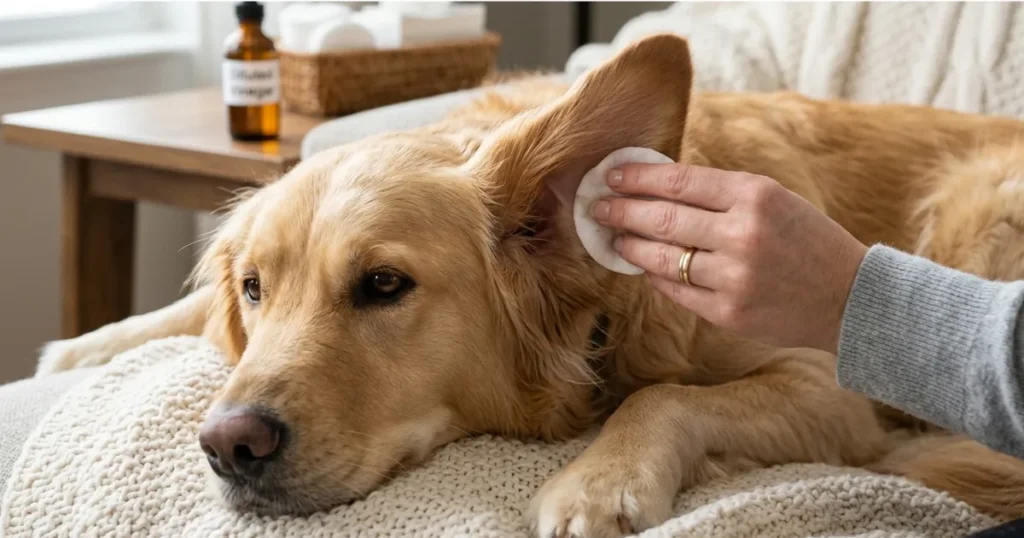
Coconut oil for dog ear: soothing, not curing
Coconut oil for dog ear remedies is gentler than vinegar, but they are widely misunderstood. Coconut oil can soothe. It does not cure an infection.
What it can do
Warm coconut oil, applied to the visible outer ear, can soften wax and soothe mild, dry irritation. It is gentle and unlikely to harm a healthy ear, which is why it is popular.
What it cannot do
Coconut oil for dog ear treatments does not clear a bacterial, yeast, or mite infection. Worse, oil poured into the canal can trap moisture and debris, which can make an infection worse rather than better. Use it only on the outer, visible ear, never deep in the canal, and never as a substitute for treating a real infection. If mites are the problem, they need real treatment, as dark debris and what it means explain.
There is also a simple practical problem with oil. Once it is in the canal, it is hard to get back out, and it coats everything, including any debris already sitting there. That coating can hide the early signs of a worsening infection, so you may not notice the problem growing until it is well advanced. For a dog prone to ear trouble, that delay is exactly what you want to avoid.
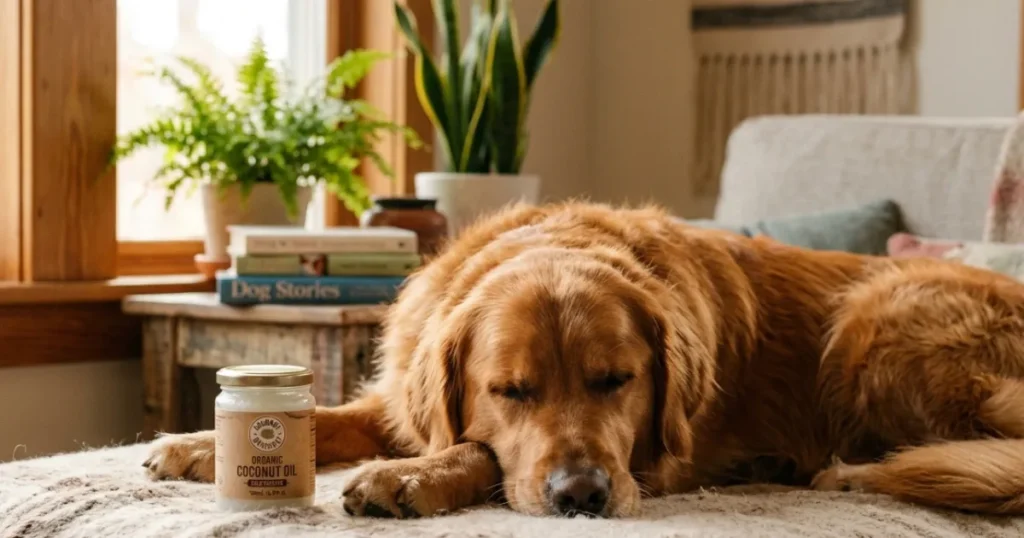
What is actually safe, and what it is for
Here is the full picture in one place. Note that “safe” means safe for a mild, healthy ear, with vet approval, not a cure for infection.
| Remedy | Safe use | Not for |
| Diluted apple cider vinegar wipe | Outer flap of a healthy ear, prevention, vet-approved | Inflamed, painful, or discharging ears |
| Warm coconut oil | Softening wax and soothing the outer ear | Treating any active infection |
| Cooled green tea rinse | Gently soothing mild outer irritation | Deep canal use or real infections |
| Vet-approved ear cleaner | Routine cleaning and drying | Replacing prescribed medication |
| A soft cloth or cotton ball | Wiping the visible outer ear | Pushing into the canal |
Two rules tie this together. Always use cooled distilled or boiled water in any mixture, since tap water can add bacteria. And treat every one of these as outer-ear care for a healthy dog, not as medicine for a sick one. A dog with recurring infections needs the root cause found, which is covered in the root cause of recurring infections.
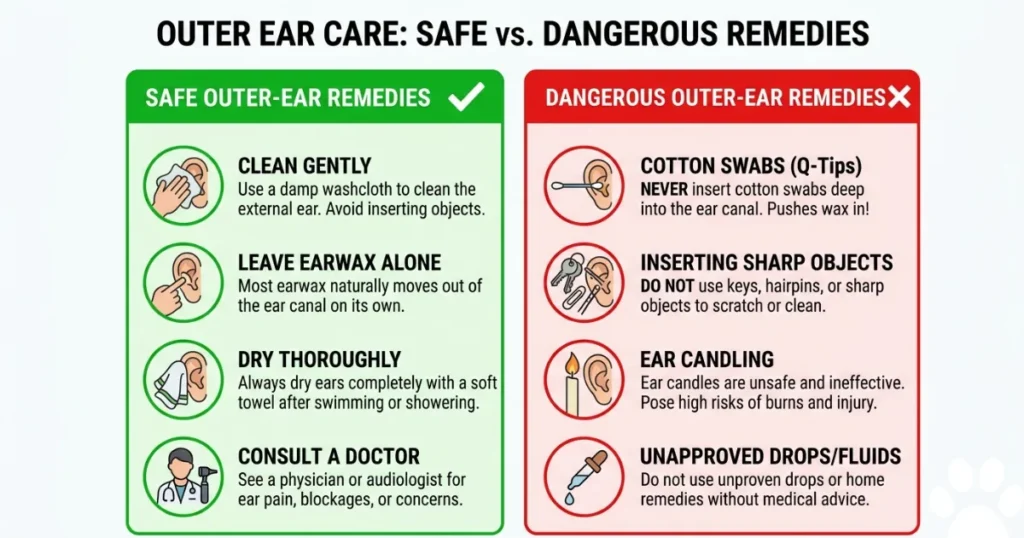
Better than any remedy: prevention
The best home care is the kind that stops infections before they start. This is where your effort actually pays off.
Keep the ears clean and dry, especially after swimming and baths, since trapped moisture is a leading cause of infection in this breed. Drying after water is the single most useful habit, as preventing swimmer’s ear explains. Check the ears weekly, catch changes early, and see your vet at the first real sign rather than reaching for a kitchen remedy. Prevention is safe, free, and far more effective than any remedy you can mix at home.
There is one more prevention step worth mentioning, and it is one many owners overlook. If your dog gets infections again and again despite good ear care, the answer is rarely a better remedy. It is finding the underlying cause, which is usually an allergy. No home treatment addresses that, and chasing it with vinegar or oil only delays the real fix. Working with your vet on the root cause does more to prevent future infections than anything in your kitchen ever could.
Safety First: Read This Before You Try Anything
- A true ear infection needs a vet, not a home remedy. No home treatment reliably clears an active infection, and using the wrong one delays the treatment that works.
- Never put anything in the ear if you see: Pus, swelling, bleeding, a strong odor, or any sign of pain.
- Never use at all: hydrogen peroxide, rubbing alcohol, or tea tree oil. These damage ear tissue or are toxic.
- When in doubt, call your vet. A simple swab test identifies the problem in minutes.
Expert Insight
The home remedy cases I regret are the ones that arrive late. An owner spends two weeks pouring vinegar or peroxide into a painful ear; the infection reaches the middle ear, and what would have been a simple fix becomes a hard one. A cheap swab test on day one would have told us exactly what to use.
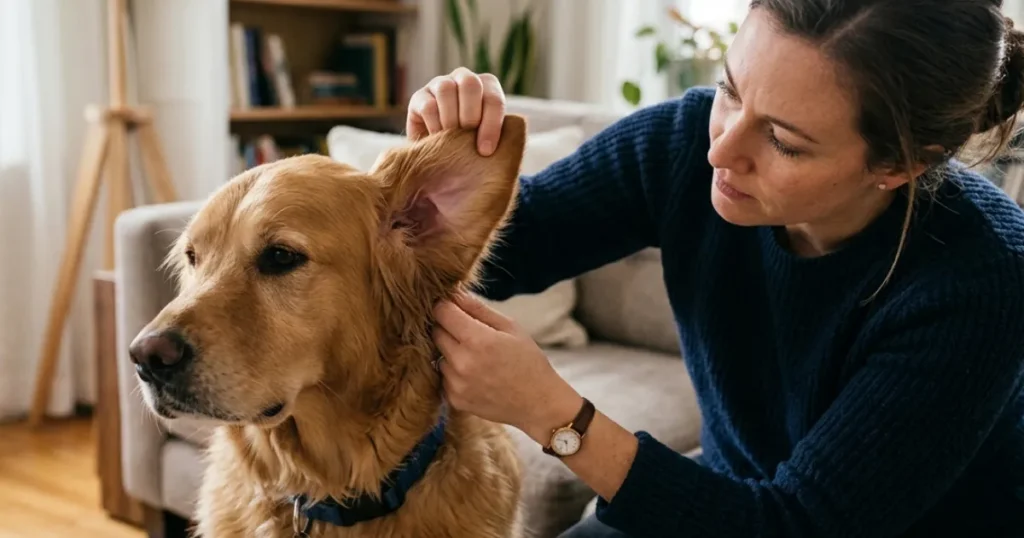
Do home remedies for dog ear infection actually work?
Most of these remedies do not clear a true infection, which needs a vet and prescription medication. Some, like diluted vinegar or coconut oil, may soothe a mild, healthy ear with vet approval, but they are not a cure.
What can I safely put in my dog’s ear at home?
For a mild, healthy ear only, a vet-approved ear cleaner, warm coconut oil on the outer flap, or a diluted vinegar wipe with vet approval. Never put anything in a red, painful, or discharging ear. When in doubt, call your vet.
Is apple cider vinegar safe for a dog’s ear?
Only when diluted, applied to the outer flap of a healthy, non-inflamed ear, and approved by your vet. It burns raw or painful ears and adds moisture that can worsen infection. Never use it deep or on a sore ear.
Can I use coconut oil in my dog’s ear?
Coconut oil is safe on the visible outer ear to soften wax and soothe mild irritation. It does not cure infections, and oil in the canal can trap moisture and worsen them. Use it only on the outer ear, never as treatment.
Can I use hydrogen peroxide in my dog’s ear?
No. Hydrogen peroxide damages delicate ear tissue and can inflame the canal, making an infection worse. Veterinarians advise against it. Use a vet-approved ear cleaner instead, and see your vet if you suspect a real infection.
Is rubbing alcohol safe for dog ears?
No. Rubbing alcohol stings and dries the ear lining and burns raw or broken skin. It can make irritation and infection worse. Never use it in your dog’s ears, and choose a vet-approved cleaning solution for routine care.
Can I use tea tree oil on my dog’s ear infection?
No. Tea tree oil is toxic to dogs and can cause serious irritation, even in small amounts. Avoid it completely, along with other essential oils, which are usually too strong for a dog’s sensitive ear tissue.
When should I stop home treatment and see a vet?
Stop and see a vet at once if you see pus, swelling, bleeding, a strong smell, pain, or a head tilt. These mean a real infection that home remedies cannot fix. In fact, any suspected infection is a reason to call your vet first.
How do I know if my dog has a real infection or mild irritation?
Mild irritation may be occasional head shaking, slight redness, or minor wax with no odor or pain. A real infection brings discharge, a strong smell, swelling, and pain. Only a vet’s swab confirms it, so when unsure, get it checked.
Can home remedies make my dog’s ear infection worse?
Yes. The wrong remedy can delay proper treatment and let a surface infection spread to the middle ear. Oils and watery mixtures can trap moisture, and harsh liquids burn tissue. This is why a real infection needs a vet, not a kitchen fix.
What is the safest home remedy for a Golden Retriever’s ears?
The safest home care for a Golden Retriever is prevention, meaning regular gentle cleaning with a vet-approved product and thorough drying after every swim. For any active infection, the safest choice is always a prompt vet visit, not a home remedy.
Can I mix vinegar and coconut oil to clean my dog’s ear?
It is not recommended. Pouring a homemade vinegar and oil mix into the canal can trap moisture and worsen irritation. If you use either, stick to the outer flap of a healthy ear, and only with your vet’s approval.
Are essential oils safe for dog ear infections?
No. Most essential oils are too strong for a dog’s sensitive ear tissue and can cause irritation or toxicity. Tea tree oil in particular is toxic to dogs. Stick to vet-approved solutions and skip essential oils entirely.
Will a home remedy cure my dog’s ear mites?
No. Ear mites need a proper parasite treatment from your vet, and every pet in the home must be treated. Home remedies will not clear a mite infestation, and delaying real treatment lets the mites spread and the irritation worsen.
Can I prevent ear infections without any remedies?
Yes, and prevention is the best approach. Keep the ears clean and dry, dry them after every swim, check them weekly, and see your vet at the first real sign. This prevents more infections than any home remedy can treat.
Is it ever safe to treat a dog ear infection at home without a vet?
A true infection should always be confirmed and treated by a vet. Only very mild irritation on a healthy, pain-free ear may respond to gentle outer-ear care. If there is any discharge, smell, swelling, or pain, home treatment is not safe.
The bottom line
Home remedies for dog ear infection are mostly a myth when it comes to curing a real infection. Yeast, bacteria, and mites each need specific medication, and only a vet’s swab can tell them apart. Reaching for the wrong remedy wastes time and can let the infection spread.
Some kitchen items have a small, safe role. Diluted apple cider vinegar on a healthy outer ear may aid prevention, and coconut oil can soothe mild irritation, both only with your vet’s approval and never on a sore, red, or discharging ear. Hydrogen peroxide, rubbing alcohol, and tea tree oil should never go near a dog’s ear.
The real takeaway is simple. Prevention beats every remedy, and a true infection beats every remedy too, which is why it belongs at the vet. When in doubt, skip the kitchen and make the call.
Home remedies are tempting, especially late at night when the vet is closed and your dog is uncomfortable. Many owners have tried one before learning what actually helps.
We would like to hear your experience. Did you try a home remedy on your Golden’s ears before seeing the vet, and how did it turn out? If a vet ever warned you off something you found online, share what it was. Your story might stop another owner from reaching for the peroxide.