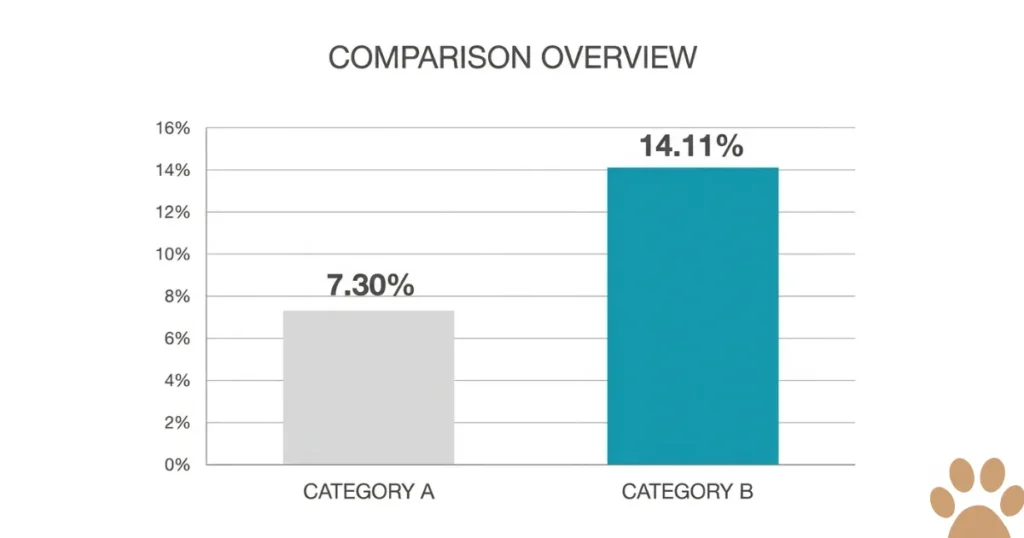
Golden Retriever ears get infected easily because the canal is shaped like the letter L, the ear flap covers the opening like a lid, and the breed loves water. UK veterinary records put the one-year rate of ear canal inflammation at 14.11% in Goldens, against 7.30% in dogs overall. Weekly checks catch most problems early.
Golden Retriever ears worry owners more than almost any other part of the breed. The reason is the way the ear is built, and the floppy flap is only one part of it.
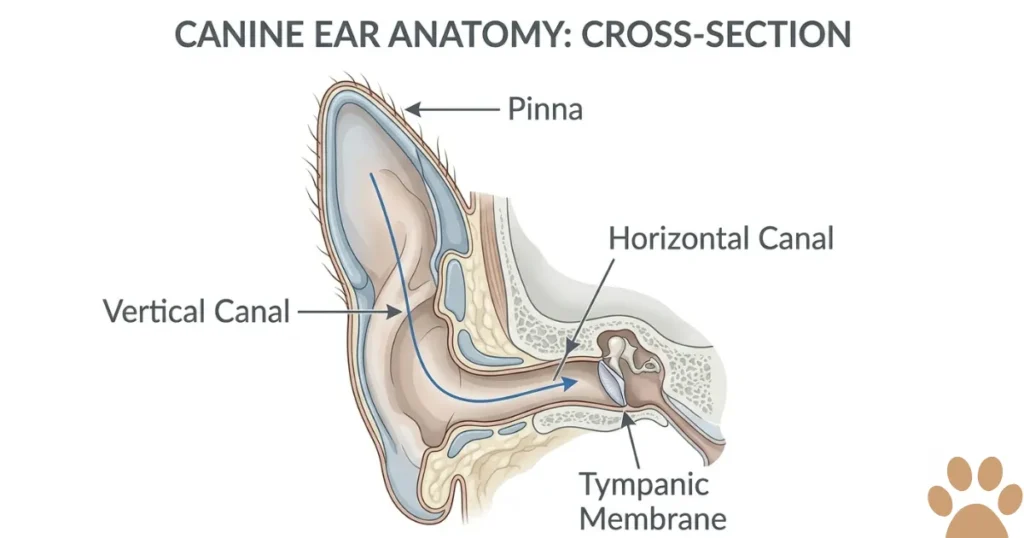
A dog’s ear canal bends like the letter L. Anything that gets into the lower part has to travel upward to get out. Now lay a heavy flap across the opening, add hair growing inside the canal, and add a dog who swims every chance he gets. What you have is a warm, closed tube that rarely dries through.
The numbers follow the shape of the ear. Goldens are diagnosed with ear inflammation about twice as often as mixed-breed dogs.
This guide explains how the ear is built, what the real risk is, which signs matter, and the routine that prevents most trouble. You can find more like it in our Golden Retriever health section.
Why Golden Retriever ears are built for trouble
Three features stack on top of each other, and each one is harmless by itself. Together they create the problem. It is the kind of breed trait we explain across everything we publish on the breed.
The canal bends
A human ear canal runs more or less straight inside the head. A dog’s canal does not. It drops straight down from the opening, then turns and runs sideways toward the eardrum. Veterinary surgeons describe this as an L-shaped canal.
That bend explains almost everything. Water and dirt fall in easily and then settle at the turn. Gravity drains a human ear, but in a dog it works the other way.
This is why a good head shake clears the top of the canal and leaves the bottom of it wet.
The flap works like a lid
A Golden’s ear flap, called the pinna, hangs flat across the opening of the canal. It keeps warmth in and keeps air out.
We can measure how much this matters. In UK veterinary records, breeds whose ears hang down had 1.76 times the odds of ear inflammation compared with breeds whose ears stand up. Breeds with a folded, V-shaped ear came out slightly higher again at 1.84.
A dog with upright ears has an open chimney. A Golden has a closed one.
Hair grows inside the canal
Coarse hair lines the upper canal in this breed. It slows the airflow even further, and it gives dirt something to cling to.
Whether that hair should be removed is genuinely debated among veterinarians, and the answer is not the obvious one. We cover that question separately in whether to pluck or trim the ear hair.
How common are Golden Retriever ear problems, really?
Almost every article on this subject says that Goldens are prone to ear trouble. Very few say how prone it is. The honest answer starts with numbers, and two studies provide them.
The first number is how many dogs are affected
Researchers at the Royal Veterinary College reviewed the records of 22,333 dogs. Across all of those dogs, 7.30% were diagnosed in a single year with otitis externa, which is the medical name for inflammation of the outer ear canal.
For golden retrievers, the figure was 14.11%. That is roughly one golden retriever in every seven in one year.
Once the researchers adjusted for age, sex, weight, and other factors, Goldens still carried 2.23 times the odds of a mixed-breed dog.
The second number matters more
The first figure tells you how many dogs get an ear infection. It does not tell you what happens afterward.
The Golden Retriever Lifetime Study, run by Morris Animal Foundation, has followed a large group of Goldens since puppyhood. Among the 1,755 dogs diagnosed with otitis externa at least once in the first eight years, 57% were diagnosed with it again in a later year.
That figure is worth reading twice. For most affected Goldens, one ear infection is the first of several.
Two common assumptions are wrong
This is not a puppy problem.
In the UK data, every age group above one year old showed higher odds than dogs under one. The risk climbs after the first birthday and then stays high.
The risk is not spread evenly.
Male dogs carried 1.21 times the odds of females. Dogs at or above the average weight for their breed and sex carried 1.45 times the odds of dogs below it.
That last finding is the one almost nobody passes on to owners, and it is also the one they can act on.
The four layers behind every ear problem
This is where most advice goes wrong. Cleaning gets treated as the answer, so owners who clean carefully and still see the problem return decide they must be doing it badly.
Usually they are not. They are treating one layer of a four-layer problem.
Veterinary skin specialists sort ear disease into four groups of factors. The Merck Veterinary Manual and current clinical guidance both use this system.
| Layer | What it means | Typical in a Golden |
| Primary | The thing that starts the inflammation | Allergies to food or the environment, ear mites, an underactive thyroid |
| Secondary | What grows once the ear is already inflamed | Malassezia pachydermatis yeast, staph bacteria |
| Predisposing | Makes the ear vulnerable, but starts nothing on its own | The hanging flap, canal hair, swimming, extra weight |
| Perpetuating | Damage caused by the disease that stops it from clearing | Thickening of the canal, narrowing, middle ear involvement |
Ear mites belong in the top row, and they are a common starting cause in puppies. You can read more about them in ear mites and how they spread between pets.
Cleaning only reaches the third row. If an allergy is driving the inflammation, no cleaning schedule will fix it, because nothing in the routine touches the cause.
That is the mechanism behind the 57% figure above. It is also why a dog on his third ear infection needs a different conversation, which we cover in why infections keep coming back.

Warning signs in Golden Retriever Ears, and what each means
Owners are good at spotting a bad ear. They are less sure how urgent it is. Use the tiers below.
| Sign | What it suggests | Action |
| Head shaking that repeats through the day | Discomfort deep in the canal | Book within the week |
| Scratching one ear, or rubbing it along the furniture | Irritation in one spot | Book within the week |
| Any smell coming from the ear | Something is already growing | Book within the week |
| Visible discharge of any color | An active problem | Book within the week |
| Redness inside the flap | Early inflammation | Watch for 48 hours, then book |
| Flinching when you touch the base of the ear | Pain | Call your vet immediately |
| Head tilt, stumbling, or walking in circles | The middle or inner ear may be involved | Call your vet immediately |
| A sudden soft swelling of the ear flap | Probably a blood blister caused by shaking | Call your vet immediately |
Two of these deserve a note.
Smell is the earliest reliable sign.
A healthy ear has almost no smell at all. If you can smell it from arm’s length, something has been growing in there for a while. To work out what you are looking at, use what the color of the discharge tells you.
Pain changes the plan.
A dog who flinches when you handle the base of his ear should not have anything poured into that ear until a veterinarian has looked inside. Cleaning a painful ear can push material against the eardrum. If the ear is already infected, the signs of an ear infection in Goldens cover diagnosis and treatment.
What good Golden Retriever ear care looks like
There are four levers. They are listed here in order of how much they change the outcome.
Dry the ears after water
Moisture is the factor you control most easily. A head shake clears the upper canal and leaves the lower part wet.
The lower canal stays damp far longer than owners assume, because the flap closes the moment shaking stops. For a water breed, this is the habit that pays back most, and it takes thirty seconds. Dry the flap and the visible opening after every swim and every bath. Our full routine, including timing, is in drying the ears after a swim.
Clean less than you think
This one surprises people. The researchers who analyzed the UK records specifically warned against cleaning too often, and cotton swabs are recognized as a cause of ear inflammation rather than a treatment for it.
Cleaning too often strips the canal, irritates the lining, and can push dirt toward the eardrum. How often your dog needs it is a question for your veterinarian, not a blog. The method itself is covered in how to clean a Golden Retriever’s ears safely.
If you are thinking about vinegar, coconut oil, or hydrogen peroxide, please read which home remedies are safe and which are not before you try any of them. Some are harmless and some will burn the lining of the ear.
Keep the weight down
Dogs at or above the average weight for their breed and sex carried 1.45 times the odds of ear inflammation. Goldens put weight on easily.
Weight control is almost never presented as ear care. On this evidence, it belongs on the list.
Check once a week and learn what normal looks like
Most owners only look inside the ear once something is clearly wrong. By then the canal has often been inflamed for two weeks.
Lift the flap and look inside. Then bring your nose close and smell. A healthy canal is pale pink and has almost no odor, with a trace of light-colored wax at most.
Learn your own dog’s normal, because it varies. One dog may carry more wax than another and still be healthy. What matters is a change from his usual state.
Checking every week means you notice a change on day two instead of day twenty.
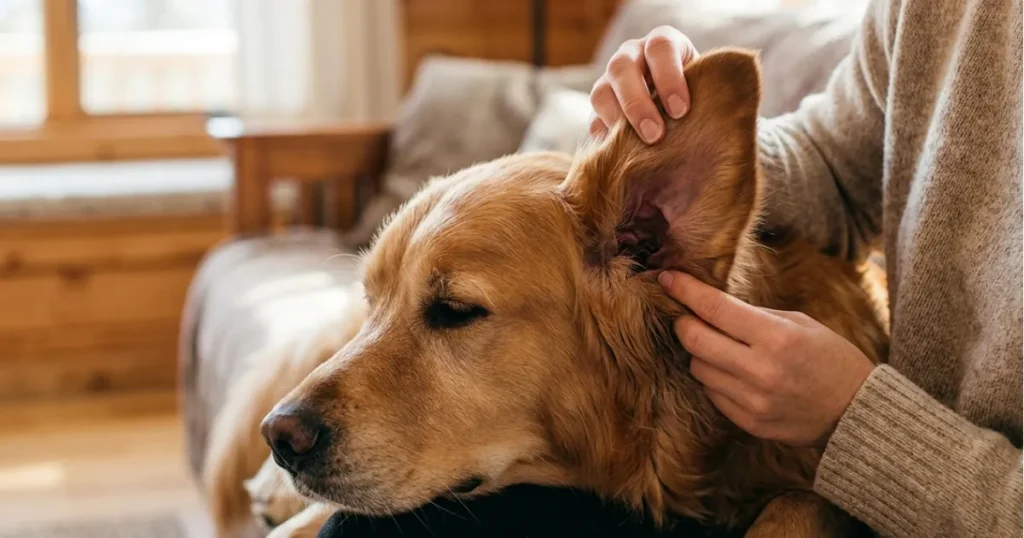
The Golden Ear Risk Stack
Here is every confirmed risk factor for this breed, what the evidence shows, and whether you can do anything about it.
| Factor | What the evidence shows | Can you change it? |
| Being a Golden Retriever | 2.23 times the odds of a mixed-breed dog | No |
| Ears that hang over the canal | 1.76 times the odds of upright-eared breeds | No |
| Hair inside the canal | Slows airflow and traps dirt | Partly, and it is debated |
| Age above one year | Every adult age group beats the under-one group | No |
| Being male | 1.21 times the odds of females | No |
| Weight at or above the breed average | 1.45 times the odds of lighter dogs | Yes |
| Moisture from swimming and bathing | A confirmed contributing factor | Yes |
| Cleaning too often, and cotton swabs | A recognized cause of inflammation | Yes |
| Untreated allergic skin disease | The most common cause of repeat infections | Yes, with veterinary help |
Five of these nine are fixed, and four are not. Owners who focus on the bottom four get results. Owners who focus only on cleaning are working one row of a nine-row table.
Breed Panel
- Ear type: Hanging flat over the canal opening
- Canal shape: Shaped like the letter L, with a vertical part and a horizontal part
- Canal hair: Present, moderate to dense
- Water behavior: High. The breed was developed to retrieve from water
- One-year risk of ear inflammation: 14.11% in Goldens, against 7.30% in dogs overall
- Check frequency: Once a week, and after every swim
Expert Insight
When an owner tells me that their Golden’s ears keep coming back, my first question is whether the dog also licks his paws. The answer usually tells me more than the ear does, because allergic skin disease shows up in both places, and the ear is simply where it becomes obvious.
Why are Golden Retriever ears more prone to problems than other breeds?
Three features stack up. The canal is shaped like an L and drains poorly; the hanging flap seals the opening, and canal hair blocks airflow. UK records show a one-year rate of 14.11% in Goldens against 7.30% overall.
How often should I check Golden Retriever ears?
Once a week, and after every swim or bath. Lift the flap, look for redness or discharge, and smell the ear. Weekly checks catch changes early, which is when problems are cheapest and easiest to fix.
What does good Golden Retriever ear care actually involve?
Four things. Dry the ears after water, avoid cleaning too often, keep your dog’s weight at or below the breed average, and check weekly. How often to clean should come from your veterinarian, not a fixed schedule.
Are Golden Retriever ear problems inherited?
Partly. The ear shape that puts the breed at risk is inherited, and allergic skin disease, which is the most common cause of repeat ear trouble, has a strong genetic component in Goldens. The infection itself is not inherited.
Do Golden Retrievers need their ears cleaned every week?
Not automatically. Checking weekly is not the same as cleaning weekly. The researchers who studied UK veterinary records warned against cleaning too often, because it irritates the lining and can worsen the problem it aims to prevent.
Can Golden Retrievers grow out of ear problems?
The evidence points the other way. In the UK data, every age group above one year carried higher odds than dogs under one year old. The risk rises after the first birthday instead of settling down.
What is the inside of a healthy dog’s ear supposed to look like?
Pale pink, smooth, and almost free of odor, with a trace of light-colored wax at most. You should see no redness, no discharge, and no swelling. The opening should look clear, not narrowed.
Do floppy ears really cause more ear infections?
They contribute rather than cause. Breeds with hanging ears showed 1.76 times the odds of ear inflammation compared with upright-eared breeds and folded V-shaped ears 1.84 times. Ear shape makes a dog vulnerable, but something else starts it.
At what age do Golden Retriever ear problems usually start?
Most often after the first year. Ear trouble in puppies is frequently caused by mites, while trouble in adults is more often driven by allergies. In the Lifetime Study group, first diagnoses were spread across the early adult years.
Does swimming cause ear infections in dogs?
Swimming contributes to the risk rather than causing infection directly. Water settles in the lower canal, where a head shake cannot reach it. Drying the ears after every swim removes most of the added risk.
Can Golden Retrievers hear normally with floppy ears?
Yes. A hanging ear flap does not affect normal hearing. Long-running untreated ear disease can, though, because lasting inflammation changes the shape and lining of the canal over time.
Is it safe to look inside a Golden Retriever’s ear at home?
Yes, as long as you only look. Lift the flap and check the opening. Never insert a cotton swab or any other object into the canal, because cotton swabs are recognized as a cause of ear inflammation rather than a remedy.
Why do Golden Retrievers have hair inside the ear canal?
It is part of the breed’s coat, and coarse hair lines the upper canal. That hair reduces airflow and holds onto dirt. Whether removing it helps or harms is genuinely debated among veterinary skin specialists.
When should I start checking a Golden Retriever puppy’s ears?
From the day your puppy comes home. Handle the ears daily without cleaning them so that checks feel normal long before they are ever needed. A puppy who accepts ear handling is far easier to treat later.
What happens if a Golden Retriever ear infection goes untreated?
The inflammation thickens and narrows the canal, and the infection can reach the middle ear. Warning signs include a head tilt, stumbling, or walking in circles. If you see any of those, call your veterinarian immediately rather than waiting.
The bottom line
Golden Retriever ears are not fragile. They are poorly ventilated, and that single fact explains most of what goes wrong with them.
The breed carries roughly twice the odds of ear inflammation that a mixed-breed dog does, and more than half who get one infection are diagnosed with another later. Those numbers are not an argument for cleaning harder. They are an argument for understanding which risks you can actually move on.
Five of the nine risk factors in this breed are fixed at birth. Four are not. Weight, moisture, cleaning habits, and untreated allergies are all in your hands, and that is where the results come from.
Start here. Lift the flap once a week, look inside, and smell. Two minutes a week catches nearly everything early.
Every golden owner has an ear story. Some catch the first head shake and have it sorted within a week. Others spend months clearing it up and watching it return before anyone mentions allergies. We would like to hear yours. How old was your Golden when the first ear problem appeared, and what finally made the difference? If your veterinarian found an underlying cause, tell us what it turned out to be. That is the detail other owners need most and hear least often.