
Ear mites in dogs are tiny parasites, called Otodectes cynotis, that live in the ear canal and cause intense itching. The classic sign is dark, dry, crumbly debris that looks like coffee grounds. They spread easily between pets, so every dog and cat in the home needs treatment. A vet confirms them under a microscope and prescribes a parasite treatment.
Ear mites in dogs are among the most misdiagnosed ear problems. They itch, they smell, and they fill the ear with dark debris, which makes them look almost exactly like a yeast infection.
The difference matters, because the treatments are completely different. A yeast infection needs antifungal medicine. Mites need a parasite treatment, and they need every pet in the house treated at once, or they simply move back in.
Here is the fact that catches most owners out. Mites are contagious. Your dog did not do anything wrong. He caught them from another animal, often a cat.
This guide covers what mites are, the six signs to look for, how they differ from an infection, how vets treat them, and how to clear them from the whole household. For how the breed’s ear shape makes any ear problem more likely, start with the breed ear care hub.
What are ear mites in dogs?
Ear mites are tiny surface parasites. The species is called Otodectes cynotis, and it lives on the skin of the ear canal, feeding on wax and skin oils. This is one of the parasites we cover across our health library for the breed, alongside the golden retriever insights.
They are too small to see clearly with the naked eye. Under a microscope, or sometimes through an otoscope, they show up as tiny white dots that move. A single adult mite is smaller than the head of a pin, which is why owners never spot the parasite itself. They only ever see the mess it leaves behind.
Mites are also the most common parasitic cause of outer ear inflammation in dogs. That makes them a genuine suspect any time a dog develops sudden, intense ear trouble, even though they are less common overall than infections.
The life cycle explains the treatment
The whole life of a mite happens inside your dog’s ear. From egg to adult takes about three weeks, according to veterinary parasitology from the University of Saskatchewan. Adult mites then live for several more weeks, laying eggs the whole time.
That three-week cycle is the reason treatment is not a one-day job. A treatment that kills adult mites may leave eggs behind. Those eggs hatch, and the problem returns. This is why vets either use a long-acting product or repeat treatment after about three weeks.
Understanding the cycle also explains why treated dogs sometimes seem to get worse before they get better. As mites die and eggs continue to hatch, the debris can briefly increase. Sticking with the full course is what carries the dog through to a clear ear.
Why the itch is so intense
The misery mites cause is not just physical. Much of it is an allergic reaction to the mites themselves.
Your dog’s body reacts to the mites as it would to any allergen, with intense itching and inflammation. That is why even a small number of mites can drive a dog to scratch raw. A dog can carry only a handful of mites and still be frantic with itching, because the reaction is out of proportion to the numbers.
This is also why the itching can be so sudden. One week the ears look fine; the next the dog is scratching constantly as the allergic response builds.
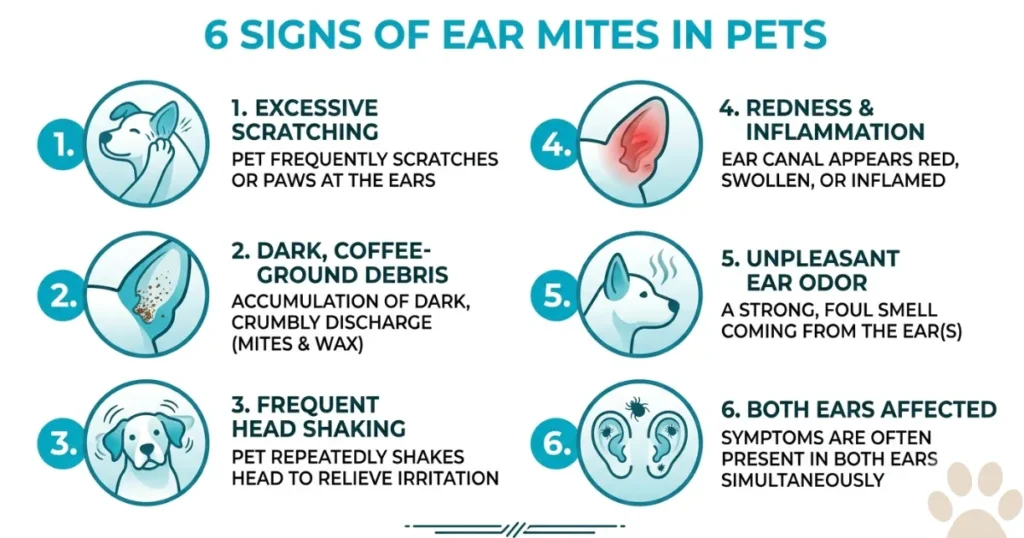
The 6 signs of ear mites in dogs
Most dogs with mites show several of these at once. The debris and the itching are the two that point most strongly to mites rather than an infection.
- Intense scratching at the ears. Often hard enough to break the skin.
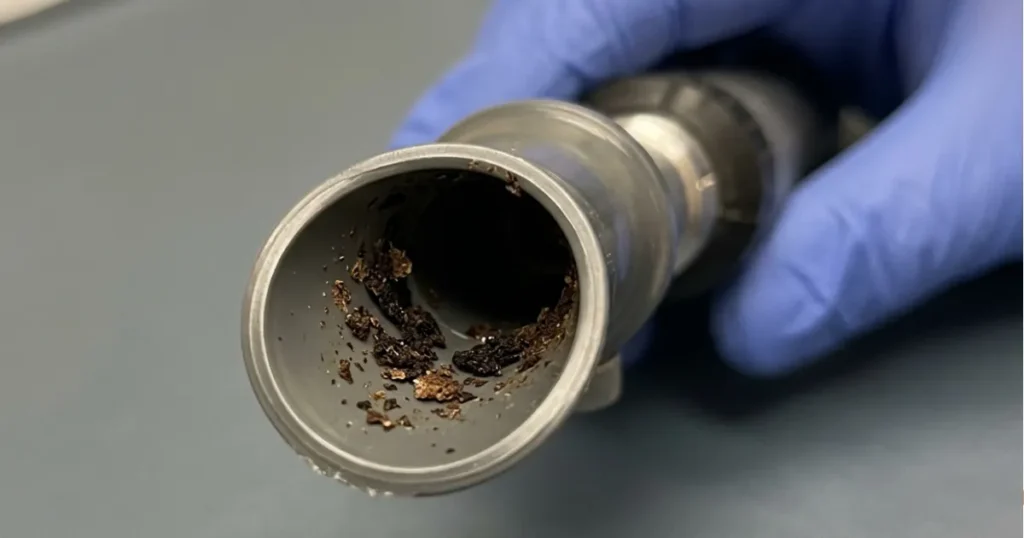
- Dark, dry, crumbly debris. The classic coffee-ground look, usually in both ears.
- Frequent head shaking. The body is trying to dislodge the irritation.
- Redness and inflammation at the ear opening and canal.
- A smell from the ear, though usually less foul than a bacterial infection.
- Both ears affected. Mites usually set up in both ears, while an infection often starts in one.
That last point is a useful clue. A problem in both ears at once, with dry debris, leans toward mites. A problem in one ear, with waxy or pus-like discharge, leans toward infection. To tell the two apart by what you see, a guide to what ear discharge means walks through it in detail.
Dog ear mites symptoms versus a yeast infection
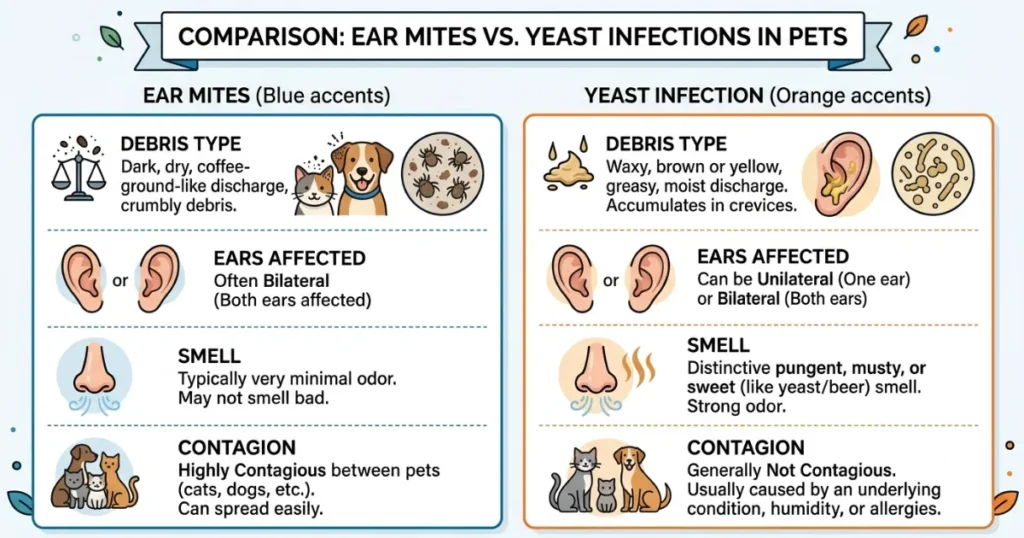
The dog ear mites symptoms above overlap heavily with infection symptoms. This is the single most common point of confusion in dog ear care, so it is worth pinning down.
| Feature | Ear mites | Yeast infection |
| Debris | Dry, dark, crumbly, like coffee grounds | Waxy, dark brown, greasy |
| Ears affected | Usually both | Often one |
| Smell | Mild to moderate | Musty, stronger |
| Itch | Intense, sudden | Present, often milder |
| Most common in | Puppies and young dogs | Dogs of any age, often with allergies |
| Contagious | Yes, to other pets | No |
Two warnings about this table. First, you cannot be certain from appearance alone, and mites and infection often occur together, since the irritation from mites invites secondary yeast and bacteria. Second, a dog with a genuine infection on top of mites needs both treated. That combined picture is covered in how to spot an ear infection early.
Are ear mites in dogs contagious?
Yes, and this is the part owners most need to understand. Ear mites are highly contagious between animals.
Your dog most likely caught them from direct contact with another infected dog or cat. They also spread through shared bedding, grooming tools, and close quarters like daycare, boarding, or a shelter. Interestingly, mites are more common in cats than dogs, so a household cat is a frequent source.
Puppies are especially vulnerable, and they often pick up mites from their mother or littermates before they ever come home. A puppy that arrives from a breeder, a shelter, or a pet shop with dark ear debris and constant scratching should be checked for mites early. Catching it at that stage is far simpler than clearing it from a full household later.
The rule that decides success or failure
Here is the rule that matters most. If one pet has mites, every dog and cat in the home must be treated at the same time, even the ones with no symptoms.
Skip this and the mites simply shuffle between animals. One dog gets treated, passes it back from the untreated cat, and you are back where you started. Treating the whole household at once is the only way to break the cycle.
The reason cats matter so much is that they can carry mites with barely any visible signs. A cat that seems perfectly healthy can still be the reservoir that keeps re-infecting the dog. This is why vets insist on treating every animal, symptoms or not.
Mites can survive a short time off the host, so washing bedding and cleaning shared spaces helps too. A gentle ear clean during treatment also removes debris, and the right way to clean the ears shows the safe method.

Ear mite treatment for dogs
Effective ear mite treatment for dogs starts with a correct diagnosis. That means a vet, not a guess, because the wrong treatment wastes weeks.
Diagnosis first
Your vet examines the ear with an otoscope and looks at a swab of the debris under a microscope. Mites are easy to identify this way, which makes diagnosis quick and reliable. Guessing from the debris alone risks treating for mites when the real problem is an infection, or the reverse.
This step matters more than it sounds. Mite debris and infection debris can look similar to the naked eye, but under the microscope a mite is unmistakable. A five-minute swab saves weeks of treating the wrong problem, which is the single most common reason a dog’s ears fail to improve.
The treatment options
Modern mite treatments are effective and usually well tolerated. Vets most often reach for spot-on or systemic parasite products, and some products treat mites alongside fleas and other parasites. This is convenient, because a single monthly parasite preventive can cover mites and several other threats at once.
The specific product and the dose are your vet’s decision, matched to your dog’s weight and health. Some products clear mites in a single long-acting dose. Others need a repeat after about three weeks to catch newly hatched mites. Follow the plan your vet sets rather than stopping early when the itching eases. The itch usually fades days before the last mites are gone, so an ear that feels better is not proof the job is done.
If a secondary infection has taken hold, your vet treats that at the same time. Never use leftover ear medication for a suspected mite problem, and be cautious with online home remedies, many of which are useless or harmful. What is safe and what is not is covered in which home treatments are safe.
What happens if you leave them
Mites are not an emergency, but they are not something to ignore either. Left untreated, the constant scratching and head-shaking can cause real damage. The longer a dog scratches, the more that damage compounds, so early treatment is always the easier path.
That damage includes secondary bacterial or yeast infections and an aural hematoma, which is a blood-filled swelling of the ear flap caused by violent head shaking. Prevention starts with good routine ear care, and drying the ears properly after water helps, as covered in keeping the ears dry after water.
The Ear Mite Household Checklist
Clearing mites is as much about the household as the dog. Use this list to do it properly.
| Step | Why it matters |
| Get a vet diagnosis first | Confirms mites rather than infection, so you treat the right thing |
| Treat every dog and cat in the home | Untreated pets re-infect the treated ones |
| Treat at the same time | Staggered treatment lets mites move between animals |
| Finish the full course | Eggs hatch after treatment starts, so early stopping fails |
| Wash bedding and clean shared spaces | Mites survive a short time off the host |
| Recheck with the vet if signs return | Rules out a resistant secondary infection |
The theme is simple. One dog treated in isolation almost always fails. The whole household treated almost always works. Recurring problems that outlast proper treatment usually point to something else, which is where why ear infections keep returning helps.
Quick Facts
- What they are: Tiny parasites called Otodectes cynotis, living in the ear canal
- Main sign: Intense itching and dark, dry, coffee-ground debris
- Contagious: Yes, very. They spread between dogs and cats by contact
- Emergency? No, but treat quickly to prevent damage from scratching
- Golden note: Less common in adult Goldens than infections, but easily confused with them
Expert Insight
The ear mite cases that come back are rarely treatment failures. They are household failures. There is a cat in the home that never got treated, and it hands the mites straight back to the dog. When I treat every animal at once, the problem clears and stays gone.

What are ear mites in dogs?
Ear mites in dogs are tiny parasites called Otodectes cynotis that live in the ear canal and feed on wax and skin oils. They cause intense itching and dark, crumbly debris, and they spread easily between pets.
How do I know if my dog has mites or an infection?
You often cannot tell for sure at home. Mites usually cause dry, coffee-ground debris in both ears, while infections cause waxy or pus-like discharge, often in one ear. A vet confirms mites under a microscope.
What are the main dog ear mites symptoms?
The main dog ear mites symptoms are intense ear scratching, dark crumbly debris like coffee grounds, frequent head shaking, redness, and both ears being affected. The itching is often sudden and severe.
What does ear mite treatment for dogs involve?
Ear mite treatment for dogs starts with a vet’s diagnosis and then a prescribed parasite product, either a single long-acting dose or a repeat dose about 3 weeks later. Every pet in the household is treated at the same time.
Are ear mites contagious to other pets?
Yes, very. Ear mites spread easily between dogs and cats through direct contact and shared bedding. If one pet has them, every dog and cat in the home must be treated together, even those without symptoms.
Can ear mites go away on their own?
No. Ear mites do not clear without treatment, and the itching and scratching worsen over time. Untreated mites can cause secondary infections and ear flap swelling. A quick vet visit resolves them reliably.
What do ear mites look like in a dog’s ear?
Ear mites themselves are barely visible, showing as tiny white moving dots under an otoscope or microscope. What owners usually see is the debris they cause, which is dark, dry, and crumbly, like coffee grounds.
Can humans catch ear mites from dogs?
The risk is low but not zero. Ear mites can occasionally cause a temporary skin rash in people, though they do not typically set up in human ears. Treating your pets and their bedding removes the source.
Do Golden Retrievers get ear mites often?
Ear mites are more common in puppies and in cats than in adult Golden Retrievers. In adult Goldens, infections driven by allergies and moisture are far more common. Mites remain worth ruling out, especially in young dogs.
How long do ear mites take to clear in a Golden Retriever?
With correct treatment, most Golden Retrievers improve within days, but the full life cycle takes about three weeks. Finishing the complete course and treating all household pets prevents the mites from returning.
Can I use over-the-counter ear mite drops on my Golden Retriever?
It is better to see your vet first. Over-the-counter drops can miss a coexisting infection and may not match the mite life cycle. A vet confirms the diagnosis and prescribes a product proven to work for your Golden Retriever.
What happens if ear mites are left untreated?
Untreated mites lead to constant scratching, secondary bacterial or yeast infections, and sometimes an aural hematoma from violent head shaking. Prompt treatment prevents these complications and ends the discomfort quickly.
The bottom line
Ear mites in dogs are common, treatable, and easy to confuse with an infection. The giveaway is dark, dry, coffee-ground debris in both ears, along with sudden and intense itching.
Two things clear them for good. First, get a proper diagnosis, because mites and infections look alike but need different treatment. Second, treat every dog and cat in the home at once, or the mites simply move back in from an untreated pet.
Mites are not an emergency, but the scratching they cause can lead to real damage, so do not wait them out. A quick vet visit, the right parasite treatment, and a whole-household approach will clear ear mites reliably and keep them gone.
Ear mites in dogs have a way of moving through a household, especially one with both dogs and cats. Some owners treat one pet, think they are done, and find the problem back within weeks. We would like to hear how it went for you. Did your Golden’s mites turn out to have come from another pet in the home, and how did you finally clear them for good? If a vet spotted a secondary infection hiding behind the mites, tell us how that changed the treatment. Your experience could save another owner a second round.