The best dog ear cleaning solution for most dogs is a pH-balanced, alcohol-free formula with a gentle drying agent, such as salicylic or lactic acid. For a water-loving breed prone to moisture, the drying action matters most. There is no single winner for every dog, so match the formula to your dog’s needs and confirm the choice with your vet before buying.
Searching for the best dog ear cleaning solution turns up hundreds of products and a lot of confident claims. The truth is quieter. There is no single best cleaner for every dog, because the right choice depends on your dog’s ears and needs.
What does not change is what makes a cleaner good or bad. The ingredients, the pH, and the format decide whether a solution helps or irritates. Learn those, and you can judge any product on the shelf, not just the ones a list happens to feature.
The stakes are higher for this breed than for most. Goldens combine floppy ears, hairy canals, and a love of water, which is the exact recipe for trapped moisture and repeat infections. The right cleaner will not fix that on its own, but the wrong one, or the right one used badly, can make a vulnerable ear worse. That is why it is worth a few minutes to choose well.
This page is a buying guide, not a ranking. It teaches you the criteria, names a few common formulas as examples, and hands the final call to you and your vet. To understand why this breed needs attention in the first place, start with what makes its ears vulnerable.
What makes a good dog ear cleaner?
A good cleaner does three jobs. It loosens wax, it flushes debris, and it leaves the canal clean and dry without irritation. The ingredients decide how well it manages all three.
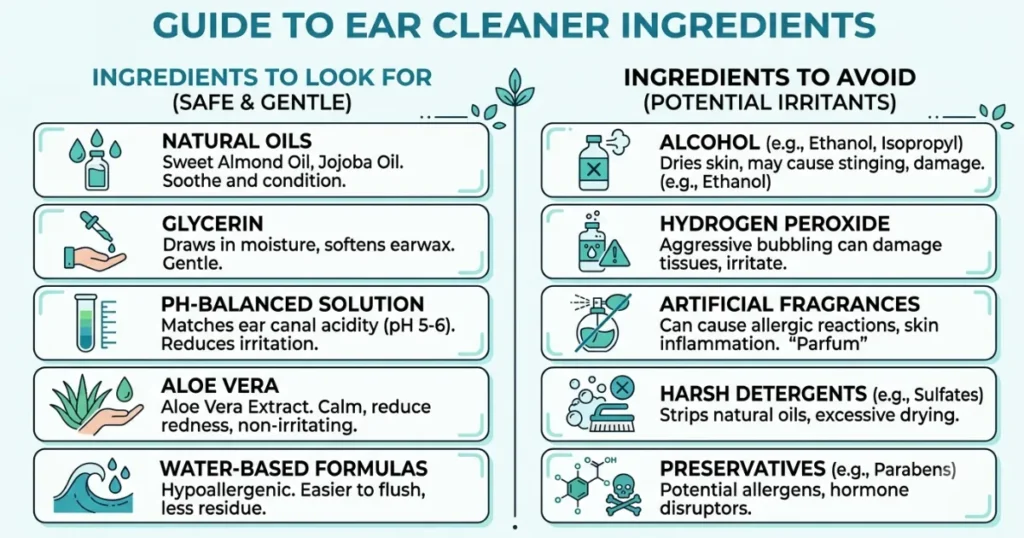
Look for these ingredients.
- Cerumenolytics break down wax so it can travel out. Squalene and docusate sodium are common examples.
- Drying agents remove moisture after cleaning. Salicylic acid and lactic acid are the usual ones, and they matter most for a water dog.
- A pH balanced base matches the natural acidity of the ear, which discourages yeast and bacteria.
- Soothing agents like aloe can calm mild irritation, though they are a bonus, not a must.
Avoid these.
- Alcohol as a main base, which stings and dries the lining, especially on a sore ear.
- Added fragrance on sensitive or allergy-prone dogs, which can irritate.
- Harsh antiseptics meant for infected ears, unless your vet directs it.
The single most useful feature for a Golden is a drying agent, because moisture is this breed’s core problem. Build your routine using the rest of our health content and the rest of our breed coverage.
Why does the drying agent matter so much for this breed specifically? A Golden’s ear canal is L-shaped and sealed under a heavy flap, so water that gets in during a swim sits at the bend and cannot drain out. A cleaner that lifts wax but leaves the canal damp solves half the problem and worsens the other half. A drying agent finishes the job by pulling that moisture out, which is why it belongs at the top of the list for any water dog. That connects directly to ear care for a water dog.
How to read a dog ear cleaner label
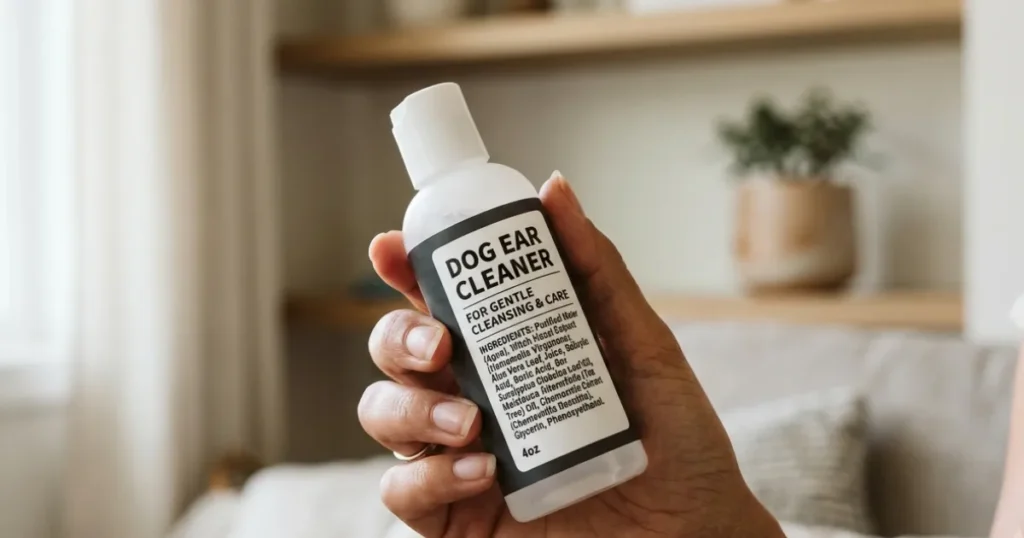
The front of the bottle is marketing. The ingredient list is the truth. Here is how to read it in ten seconds.
| On the label | What it means for you |
| pH balanced or low pH | Gentle on the canal, it discourages microbes. A good sign |
| Alcohol-free | Will not sting or over-dry. A good sign for most dogs |
| Salicylic or lactic acid | Includes a drying agent. Ideal for water dogs |
| Squalene, docusate sodium | Breaks down wax well. Good for waxy ears |
| Alcohol listed first | Likely to sting and dry. Approach with caution |
| Added fragrance or dye | Possible irritant for sensitive dogs |
Two quick rules make this easier. First, match the cleaner to the ear. A waxy ear wants a strong wax-breaker, while a damp, swim-prone ear wants a drying agent. Second, when the label lists something you do not recognize as an active ingredient, look it up or ask your vet before buying.
A word on marketing terms, since they fill these labels. Phrases like natural, gentle, and veterinary strength are not regulated the way ingredient lists are. A product can call itself gentle and still contain alcohol high in the list. Trust the ingredient panel over the front-of-bottle claims every time, because the panel is the part that has to be accurate.
Liquids, wipes, and flushes: which format to choose
Ear cleaners come in a few formats, and the right one depends on your dog and the job.
Liquid solutions
They are the workhorse. You fill the canal, massage, and let your dog shake the debris up and out. This is the most thorough option and the best choice for a proper clean, especially for a waxy or swim-prone ear.
Wipes
They are convenient for a quick wipe of the outer ear and the folds of the flap. They are handy for maintenance between proper cleans, but they cannot reach into the canal, so they do not replace a liquid for a real clean.
Veterinary flushes
They are stronger, often medicated or antimicrobial, and are meant for vet-directed use alongside treatment. They are not routine cleaners, and using one by default on a healthy ear can do more harm than good.
For most Goldens, a good liquid solution is the core product, with wipes as an optional convenience. Match the format to the task rather than buying on habit.
Choosing by your dog’s needs
The right cleaner for your dog depends on what its ears actually do. Use this to narrow the field.
| Your dog’s situation | What to prioritize |
| Swims and bathes often | A drying agent like salicylic or lactic acid |
| Builds up heavy wax | A strong cerumenolytic for wax removal |
| Has sensitive or allergy-prone skin | A gentle, fragrance-free, pH balanced formula |
| Prone to yeast | A low pH, drying formula, confirmed with your vet |
| Prepping for medication | A vet-directed cleaner used before drops |
| Healthy ears, routine care | A mild, general-purpose, alcohol-free cleaner |
Notice that a cleaner is for maintenance and prevention, not for treating an infection. If the ear is already red, smelly, or painful, cleaning is not the answer, and what actually treats an infection explains what is. To tell a dirty ear from an infected one first, use identifying the problem first. Once you have the right cleaner, the gentle way to clean an ear shows how to use it safely.
There is one more point worth making about matching the product to the dog. A young, healthy Golden with clean ears and no swimming habit needs very little, and a mild general-purpose cleaner used occasionally is plenty. A dog that swims daily all summer, or one with a history of waxy, itchy ears, is a completely different case and benefits from a more targeted formula. The same shelf holds the right product for both dogs. The difference is knowing which features your own dog actually needs, rather than buying the one with the loudest label.
Dog ear cleaner comparison: the common formula types
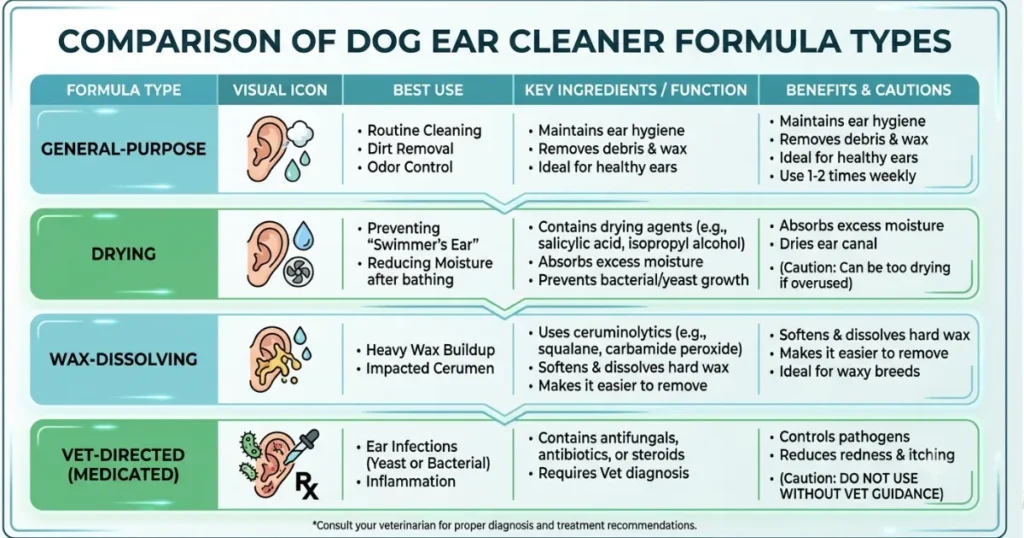
For a genuine dog ear cleaner comparison, it helps to group products by what they do rather than by brand. Most fall into these types. The named products are market examples only, not recommendations, and your vet’s choice for your dog outranks any of them.
| Formula type | What it is best at | Market examples |
| General-purpose, pH balanced, alcohol-free | Routine cleaning and mild maintenance | Virbac Epi-Otic Advanced, Vetoquinol Vet Solutions |
| Drying-focused | Water dogs and swimmer’s ear prevention | Dechra EpiKlean, a formula high in salicylic or lactic acid |
| Wax-dissolving | Heavy, waxy buildup | Cerumenolytic-rich veterinary flushes |
| Vet-directed, antimicrobial | Use alongside treatment, on vet advice only | MalAcetic and similar, prescribed or vet-guided |
These names appear because they come up repeatedly in veterinary and owner discussions, not as an endorsement. Availability and formulas change, and the right pick is the one your vet recommends for your individual dog. A cleaner that suits one Golden may not suit the next.
It is worth understanding why the general-purpose, pH balanced type is the one vets reach for most often in routine discussions. These formulas are designed to match the natural acidity of the ear and to clean without stripping or stinging, which makes them safe for regular use on a healthy ear. The drying-focused type earns its place specifically for water dogs, where clearing moisture matters as much as clearing wax. The wax-dissolving type is a targeted choice for a dog that genuinely builds heavy wax, and the vet-directed antimicrobial type sits apart from all of them because it belongs to treatment, not routine care. Knowing which group a product falls into tells you far more than any star rating.
Common mistakes when buying an ear cleaner
A few buying errors show up again and again. Avoid them and you will choose well.
6 Mistales
Buying for the scent.
A pleasant smell is marketing. The ingredients and pH are what matter.
Choosing an antiseptic cleaner for a healthy ear.
Strong medicated flushes are for vet-directed use, not routine cleaning. Using them by default can irritate a healthy canal.
Ignoring the drying question.
For a water breed, a cleaner with no drying agent misses the whole point. Moisture is the enemy here.
Treating the cleaner as medicine.
No cleaner clears an infection. If the ear is inflamed, that needs a vet, and using more cleaner only delays help. The same is true of home mixtures, as the reason why kitchen remedies fall short explains.
Cleaning too often.
Even the best cleaner harms a healthy ear if overused. Match the frequency to your dog, and when infections keep returning, look deeper into why cleaning alone is not enough.
Buying the biggest bottle first.
It is tempting to buy in bulk to save money, but a cleaner that turns out to irritate your dog is wasted no matter the size. Buy a small bottle first, see how your dog’s ears respond over a couple of weeks, and only size up once you know the formula suits them. This is especially worth doing for a dog with sensitive or allergy-prone skin, where a reaction is more likely.
Check These Three Things First
Before you buy any ear cleaner, look for:
- A drying agent like salicylic or lactic acid, especially for a water-loving breed
- A pH balanced, alcohol-free formula that will not sting or dry the canal
- No harsh ingredients such as alcohol as a main base or added fragrance on sensitive ears
And one rule above all: your own vet’s recommendation for your dog beats any list, including this one.
Expert Insight
Owners often ask me which cleaner is best, expecting a brand name. My answer is usually about the formula, not the label. For my water-loving patients, I look for a pH balanced cleaner with a drying agent, and I match the exact product to the dog in front of me. The best cleaner is the one that fits your dog, used correctly and not too often.
What is the best dog ear cleaning solution?
The best dog ear cleaning solution is a pH balanced, alcohol-free formula with a gentle drying agent like salicylic or lactic acid. There is no single winner for every dog, so match the formula to your dog’s needs and confirm the choice with your vet.
How to choose a dog ear cleaner in a dog ear cleaner comparison?
In a dog ear cleaner comparison, compare formula types rather than brands. Look for pH balance, an alcohol-free base, and a drying agent for water dogs. Match the cleaner to your dog’s ears, then confirm your pick with your vet.
What ingredients should a good dog ear cleaner have?
Look for cerumenolytics like squalene to break down wax, drying agents like salicylic or lactic acid, and a pH balanced base. Avoid alcohol as a main ingredient and added fragrance on sensitive dogs, which can sting or irritate.
Should a dog ear cleaner contain alcohol?
Generally no. Alcohol as a main base stings and dries the ear lining, especially on a sore or sensitive ear. Alcohol-free, pH balanced formulas are gentler for routine use. Some vet-directed products differ, so follow your vet’s advice.
What is the best ear cleaner for a dog that swims?
For a swimmer, the ideal cleaner includes a drying agent like salicylic or lactic acid to evaporate moisture after water. Moisture is the main risk for water dogs, so drying action matters more than anything else in the formula.
Do Golden Retrievers need a special ear cleaner?
Not a special one, but a well-chosen one. Because Goldens love water and have floppy, hairy ears, a pH balanced, alcohol-free cleaner with a drying agent suits them well. Your vet can match the exact product to your dog’s needs.
Can I use a dog ear cleaner to treat an infection?
No. Ear cleaners are for routine cleaning and prevention, not treatment. A true infection needs a vet and prescription medication. Using a cleaner on an inflamed, painful ear can delay proper treatment and make things worse.
How often should I use a dog ear cleaning solution?
It depends on your dog, but most healthy dogs need only occasional cleaning, plus drying after swims. Over-cleaning irritates the canal even with a good product. Check the ears weekly and clean only when needed, or as your vet advises.
Are natural or herbal ear cleaners better?
Not automatically. Natural does not mean gentle or effective, and some botanical ingredients irritate sensitive ears. Judge any cleaner by its pH, its drying action, and whether it suits your dog, rather than by a natural label alone.
Is an expensive ear cleaner worth it?
Price is not a reliable guide to quality. A moderately priced, pH balanced, alcohol-free cleaner with the right ingredients often outperforms a pricier one. Match the formula to your dog’s needs rather than paying for branding or scent.
What is the difference between a cleaning and a drying ear solution?
A cleaning solution loosens and flushes wax and debris. A drying solution, or a cleaner with drying agents, removes leftover moisture afterward. Water dogs benefit most from a product that does both, or a dedicated drying solution after swims.
Should I ask my vet before buying an ear cleaner?
Yes, especially if your dog has allergies, sensitive skin, or a history of infections. Your vet can recommend a formula suited to your dog and rule out an underlying problem. Their recommendation for your dog outranks any buying guide.
The bottom line
The best dog ear cleaning solution is not a single product. It is the formula that fits your dog, and for most dogs that means pH balanced, alcohol-free, and gentle, with a drying agent if your dog loves water.
Read the ingredient list, not the front of the bottle. Look for cerumenolytics to break down wax and drying agents to clear moisture, and be wary of alcohol bases and heavy fragrance. Match the cleaner to what your dog’s ears actually need, whether that is wax control, moisture control, or a gentle touch for sensitive skin.
Above all, treat any list, including this one, as a starting point. Your vet knows your dog, and their recommendation for your individual Golden beats any general pick every time. Buy a small bottle of a well-chosen formula, see how your dog’s ears respond, and adjust from there. That simple approach will serve your dog better than any ranking ever could.
Finding the right ear cleaner often takes a little trial and error, and every dog is different. What works beautifully for one Golden can irritate another. We would like to hear what worked for yours. Which type of ear cleaner suited your dog best, and did a drying formula make a difference for a water-loving Golden? If your vet steered you toward a particular kind of formula, tell us what and why. Your experience could help another owner skip the trial and error.