A 3 month old golden retriever weighs roughly 20 pounds, teethes constantly, and bites everything within reach, which is completely normal. Expect a curious, mouthy puppy with a short attention span and boundless energy. This is a prime window for training and socialization, so gentle, consistent work now pays off for years to come.
Three months is the stage nobody quite warns you about. Your sweet newborn is now a sharp-toothed whirlwind that chews furniture, nips hands, and has energy to spare.
Take a breath, because all of it is normal. This guide covers what to expect from a 3 month old golden retriever, healthy weight, the teething and biting phase, exercise limits, and the training that matters most now. For where this stage sits on the full timeline, see the Golden Retriever growth timeline.
What to expect from a 3 month old golden retriever
Size and appearance
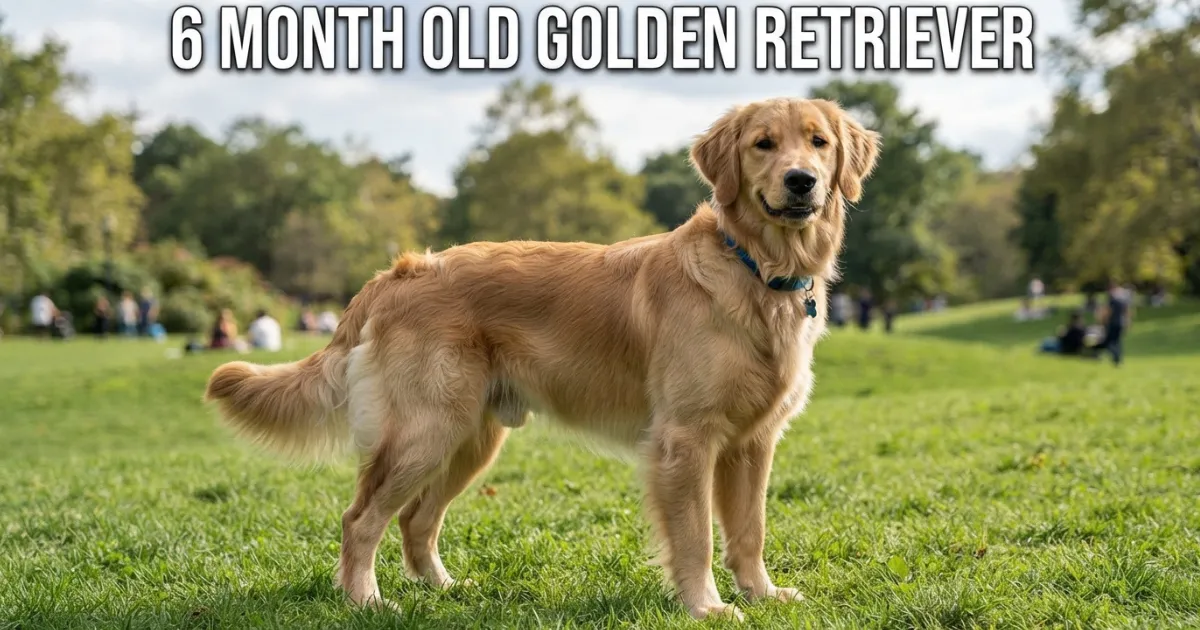
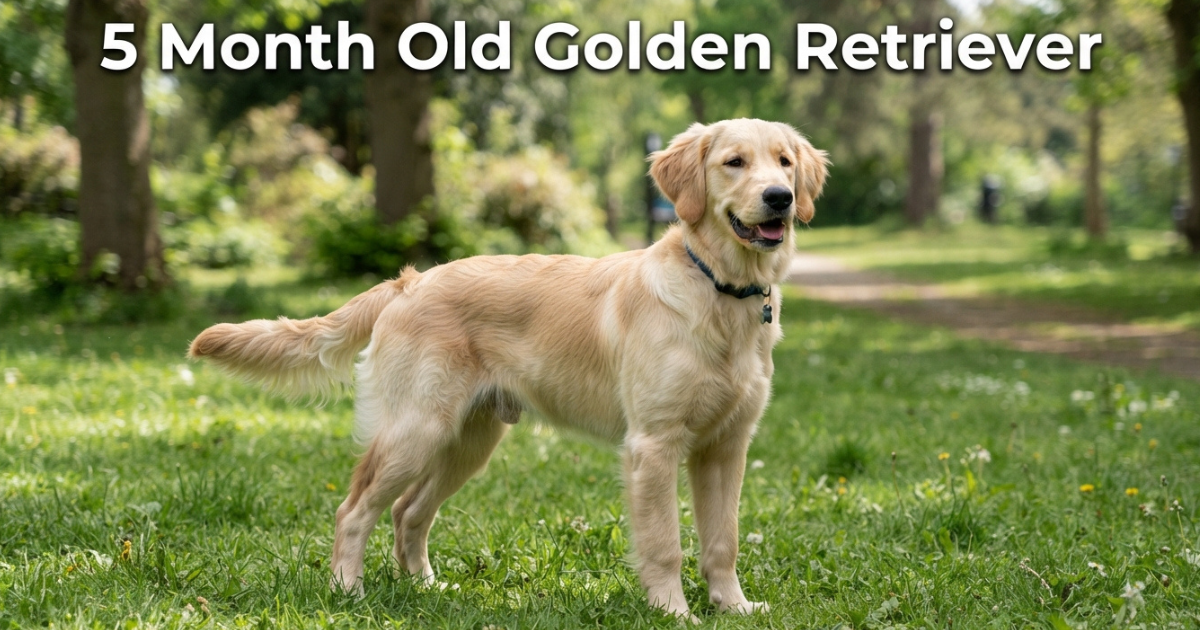
A 3 month old golden retriever looks like a proper puppy now, not a newborn, weighing around 20 pounds with a fuller coat and longer legs. The color is deepening, though the adult shade is still settling in.
The body is growing fast but unevenly, so a leggy, slightly awkward look is normal. Ears and paws often seem a size too big, which is a good hint that more growing is still to come. The double coat is starting to fill in, so you may spot the first light feathering on the legs and tail. Nails grow fast now too, so a gentle weekly trim keeps them comfortable and builds calm handling.
Energy and the land shark phase
Expect intense bursts of play, chewing, and nipping, followed by hard crashes into sleep. This mouthy behavior is the famous land shark phase, and it peaks right around now. None of it is aggression. A 3 month old golden retriever explores the whole world with its mouth, exactly as the breed was built to.
It builds on the first week’s home, which you can revisit in your puppy’s first weeks home. For how this stage fits the breed, browse more Golden Retriever breed reading and the whole Golden Retriever library.
3 month old golden retriever weight and growth
Average weight at 3 months
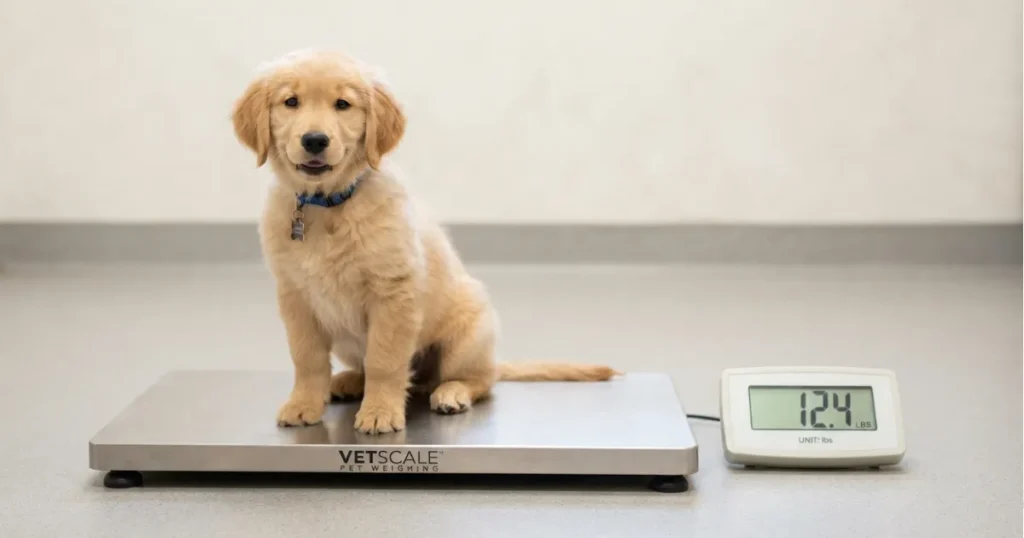
The typical 3 month old golden retriever weighs around 20 pounds, roughly 30 percent of adult weight. Males usually run about 20 to 26 pounds and females about 17 to 22 pounds, though the healthy range across the breed is wide.
Do not panic if your puppy sits outside these numbers. Litter, genetics, and build all shift the figure, and a steady upward trend matters far more than any single reading.
| Age | Male weight | Female weight | Share of adult |
| 10 weeks | 14 to 20 lb | 12 to 17 lb | ~22% |
| 12 weeks (3 months) | 20 to 26 lb | 17 to 22 lb | ~30% |
| 14 weeks | 24 to 30 lb | 20 to 26 lb | ~38% |
| 16 weeks (4 months) | 28 to 36 lb | 25 to 31 lb | ~50% |
Healthy growth and body condition
Between now and 4 months, a 3 month old golden retriever nearly doubles in weight, so steady, moderate growth is the goal. Fast growth stresses developing joints in this large breed.
Judge condition with your hands rather than the scale. You should feel the ribs under a thin layer of fat and see a slight waist. For the wider stage map, see the puppy stages timeline.
Resist the urge to feed a fast-growing puppy on the top of the range. Keeping a 3 month old golden retriever lean now, with ribs you can just feel, is one of the simplest ways to protect its hips and elbows for life.
Teething and biting: the land shark phase
Why the biting peaks now
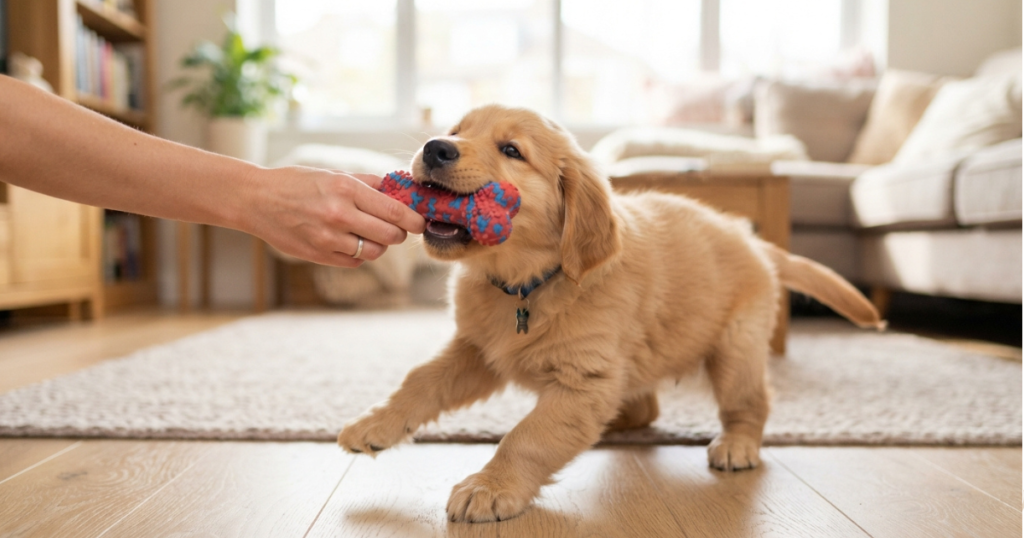
Around 3 months, baby teeth start falling out and adult teeth begin pushing through, which is uncomfortable. That soreness drives a 3 month old golden retriever to chew and bite far more than usual.
There is another trigger people miss. An overtired puppy bites more, not less, so a puppy that seems relentlessly mouthy is often simply overdue for a nap. Losing baby teeth adds to it, and you may even find tiny teeth on the floor this month, which is a normal, healthy part of the process.
How to manage puppy biting
The goal is to redirect, never to punish. Every time those teeth meet skin, calmly swap in a chew toy, and reward the puppy for choosing the toy instead. A lightweight house line left on indoors makes it easy to guide your puppy away without grabbing at it. Keeping your own energy low is half the battle, since excitement only feeds the biting.
The table below sorts what helps from what backfires.
| Helps with biting | Makes biting worse |
| Redirect to a chew toy every time | Yelling or rough handling |
| Offer frozen chews for sore gums | Fast hand movements and wrestling |
| Enforce regular naps | Letting an overtired puppy stay up |
| End play calmly when teeth touch skin | Chasing games that wind the puppy up |
Feeding your 3 month old golden retriever puppy
How much and how often
Feed a 3 month old golden retriever puppy three meals a day, spread across the day. A rough guide is around two cups of large-breed puppy food daily, but let your vet set the exact amount for your puppy and adjust as it grows.
Keep fresh water down at all times. Watch body condition rather than emptying the bowl, since a lean, steadily growing puppy is far healthier than a chubby one at this age. Three small meals suit a growing stomach better than one large one, and scheduled meals also give you a natural potty rhythm to work with.
Chews for teething
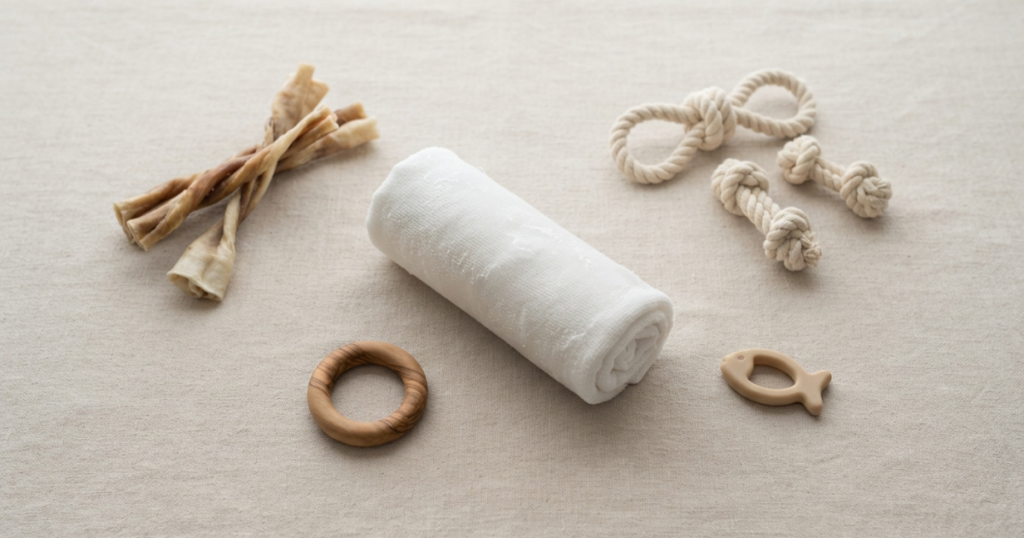
Give your puppy plenty of appropriate things to gnaw on, since a chewing puppy will find something whether you provide it or not. Frozen puppy-safe chew toys and a wet washcloth chilled in the freezer soothe sore gums.
Rotate a few chews to keep them interesting, and put valuables and shoes out of reach. This stage passes once the adult teeth are in, usually by around 6 months. Skip hard items like antlers, bones, and hooves, which can crack developing teeth. Softer, puppy-specific chews are the safer choice while the adult teeth are still coming through.
Exercise and the 5 minute rule
How much exercise at 3 months
A common vet-informed guideline is about 5 minutes of structured exercise per month of age, twice a day. For a 3 month old golden retriever, that means roughly 15 minutes, twice daily.
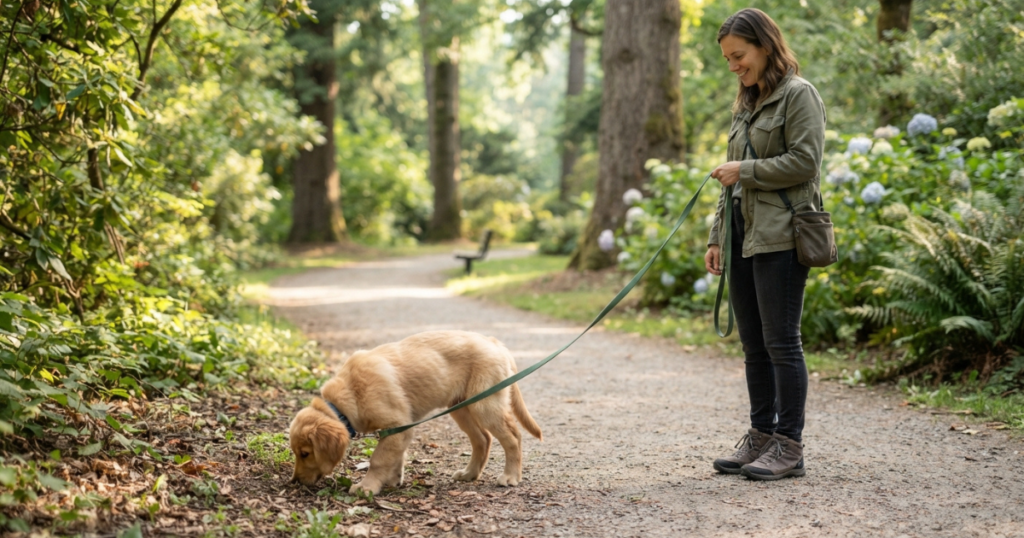
Free play in the yard and sniffing walks are perfect. The point is to avoid long, forced exercise that a fast-growing body cannot yet handle. A puppy that marched for an hour is not calmer; it is overworked, and its joints pay the price. Little and often is the rule for a 3 month old golden retriever.
Protecting the joints
The growth plates are still open and soft at this age, so high-impact activity can harm them. Avoid long runs, repeated jumping, and stairs where you can.
Mental work tires a puppy as much as physical play. Short training games, puzzle feeders, and sniff-and-find games burn energy without stressing young joints. Slippery floors are worth managing too, since rugs and runners give a bounding puppy better grip and fewer awkward slips.
Training and socialization at 3 months
House training and crate training
House training should be well underway. Take your 3 month old golden retriever out often, after meals, naps, and play, and reward every success outside straight away.
The crate stays your ally for house training and calm rest. Keep it a positive space, never a punishment, and your puppy will start to settle there on its own. Accidents will still happen, and they are never worth punishing. Clean up calmly, watch more closely for the next signal, and celebrate every success outside. Consistency is what makes it click, so keep the routine the same for everyone in the house.
Basic commands
Attention spans are short but capable now. Keep training sessions to a few minutes, use tiny food rewards, and teach one simple cue at a time, such as sit, name recognition, and a beginning recall.
End every session on a win while the puppy is still keen. Short and frequent beats long and boring at this age. Bring training into daily life too. Ask for a quick sit before meals, before going out, and before play, so good manners become a habit rather than a party trick. These everyday reps teach more than any formal session, because your puppy learns that listening pays off all day long.
The closing socialization window
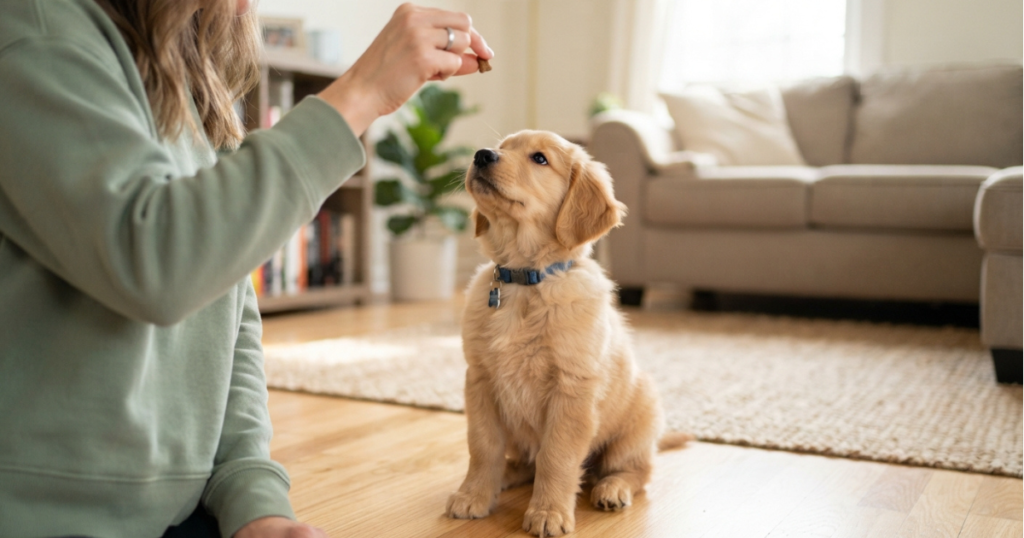
The prime socialization window runs to about 14 to 16 weeks, so time is short. Keep introducing new sounds, surfaces, calm dogs, and friendly people, always gently and positively.
For the behavior map that runs alongside these weeks, see the puppy behavior timeline. Good exposure now shapes a confident, easygoing adult. Quality beats quantity here, so a few calm, positive new experiences a day do far more than one overwhelming outing while your puppy is still building confidence.
Health and vaccinations at 3 months
Where your puppy is in the vaccine series
At 12 weeks, your puppy is partway through its core vaccine series, usually a second or third DHPP dose, with the course finishing around 16 weeks. Immunity is not complete yet.
Because of that, keep avoiding dog parks and unknown dogs. Your vet will confirm when full outings are safe and will keep the booster schedule on track. You can still socialize safely in the meantime by carrying your puppy in busier places, hosting calm visitors, and inviting healthy, vaccinated adult dogs onto your own clean ground. A well-run puppy class that requires proof of vaccination is another safe, structured way to socialize at this age.
Signs to call your vet
Most of what a 3 month old golden retriever does is normal puppy chaos. Call your vet, though, for persistent vomiting or diarrhea, a puppy that will not eat, sudden lethargy, or any limp that does not quickly resolve.
Trust your instincts. A quick call is always cheaper and calmer than waiting on a puppy that seems genuinely unwell. Keep the breeder’s and vet’s records handy so any worry can be checked against your puppy’s history quickly.
From 3 months to the months ahead
Growth stays fast from here. Your puppy moves next through the 4 months old stage and the five months mark, reaching about half of adult weight by four months.
The adolescent months follow, all the way to the one year mark. Each stage builds on the routines and manners you are teaching right now.
Expert Insight
The owners who struggle most at 3 months are the ones fighting the biting head-on. Nine times out of ten the fix is more sleep and more appropriate chewing, not more correction. Manage the environment, protect naps, and the land shark phase passes on its own.
The land shark survival kit.
Expect a mouthy, high-energy puppy that weighs about 20 pounds and sleeps 18 to 20 hours a day. Keep chew toys everywhere, cap exercise at about 15 minutes twice a day, and keep socializing gently while the window is still open. Overtired puppies bite more, so protect naps.
Frequently asked questions
What is the average 3 month old golden retriever weight?
The average 3 month old golden retriever weighs about 20 pounds, roughly 30 percent of adult size. Males run about 20 to 26 pounds and females 17 to 22, but the healthy breed range is wide.
Why does my 3 month old golden retriever bite so much?
Biting peaks now because of teething and high energy, and it is normal, not aggression. An overtired puppy bites more, so protect naps, redirect to chew toys every time, and never punish the behavior.
How much should I feed a 3 month old golden retriever puppy?
Feed a 3 month old golden retriever puppy three meals a day, roughly two cups of large-breed puppy food total, though your vet should set the exact amount. Watch body condition and adjust as your puppy grows.
How much exercise does a 3 month old golden retriever need?
Use the 5 minute rule, about 5 minutes per month of age, twice a day, so roughly 15 minutes twice daily. Add gentle play and sniffing. Avoid long runs, jumping, and stairs to protect growing joints.
Is my 3 month old golden retriever fully vaccinated?
No. At 12 weeks your puppy is partway through its vaccine series, which usually finishes around 16 weeks. Immunity is incomplete, so keep avoiding dog parks and unknown dogs until your vet gives the all clear.
When do golden retriever puppies stop teething?
Teething runs from about 3 months, when baby teeth fall out, until roughly 6 months, when the adult teeth are fully in. Biting eases noticeably once the adult teeth arrive and the gums stop hurting.
How much should a 3 month old golden retriever sleep?
A lot. Expect 18 to 20 hours of sleep a day in cycles of play and deep rest. Overtired puppies bite and misbehave more, so enforced naps in a crate or pen are genuinely helpful.
Can I start training a 3 month old golden retriever?
Yes, and you should. Keep sessions short and reward-based, teaching one simple cue at a time like “sit” or “recall.” This is a prime learning window, so consistent, gentle training now sets lifelong habits.
Is my 3 month old golden retriever the right size?
Check body condition over the scale. You should feel the ribs under a thin layer of fat and see a slight waist. A steady growth trend matters more than hitting an exact weight for the breed.
Why is my 3 month old golden retriever puppy so hyper?
High energy is normal for the breed and the age. Much of the wildness is actually overtiredness, so more sleep, appropriate chewing, and short mental games settle a 3 month old golden retriever puppy far better than more running.
When can my 3 month old golden retriever meet other dogs?
Meet only calm, healthy, fully vaccinated dogs in safe settings for now. Avoid dog parks and unknown dogs until the vaccine series finishes around 16 weeks and your vet confirms it is safe.
Should my 3 month old golden retriever still be biting furniture?
Yes, chewing is normal during teething. Manage it by offering plenty of appropriate chews, freezing some for sore gums, and moving valuables out of reach. It fades once the adult teeth come in around 6 months.
The bottom line
A 3 month old golden retriever is a roughly 20-pound bundle of teeth, energy, and rapid learning, which makes this stage both exhausting and important. Keep growth steady, cap exercise, protect naps, and keep socializing while the window is open. None of the chaos lasts long, but the habits you build now do.
The biting will not last. Redirect it, meet it with more sleep and better chews rather than correction, and it fades as the adult teeth come in. Focus on gentle training, safe socialization, and a lean, steadily growing body, and enjoy this wild, fast-changing stage, because your puppy will look very different in just a month.
Every hard part of this month is temporary, and the calm, confident dog you are building is permanent. Show up with patience now, and the payoff lasts the whole of your dog’s life.
How is the land shark phase treating you, and what finally helped with the biting? Share your 3 month old golden retriever’s weight and your best tip in the comments for other owners.