A 4 month old golden retriever weighs around 30 pounds, roughly half its adult size, and is deep in teething and early adolescence. Expect peak chewing, a testing streak, and a big milestone as the vaccine course finishes and your puppy can finally go out in public. Steady growth and gentle training matter most now.
Four months can feel like the hardest stretch of puppyhood. Teething, a growth spurt, and the first flickers of independence all arrive at once, and plenty of owners quietly wonder what happened to their easy little puppy.
Nothing is wrong. This is a normal, busy stage, and it gets easier fast. This guide covers what to expect from a 4 month old golden retriever, healthy weight, the teething peak, exercise, the big vaccine milestone, and the training that pays off now. For where this fits the full timeline, see our Golden Retriever growth hub.
What to expect from a 4 month old golden retriever
Size and appearance
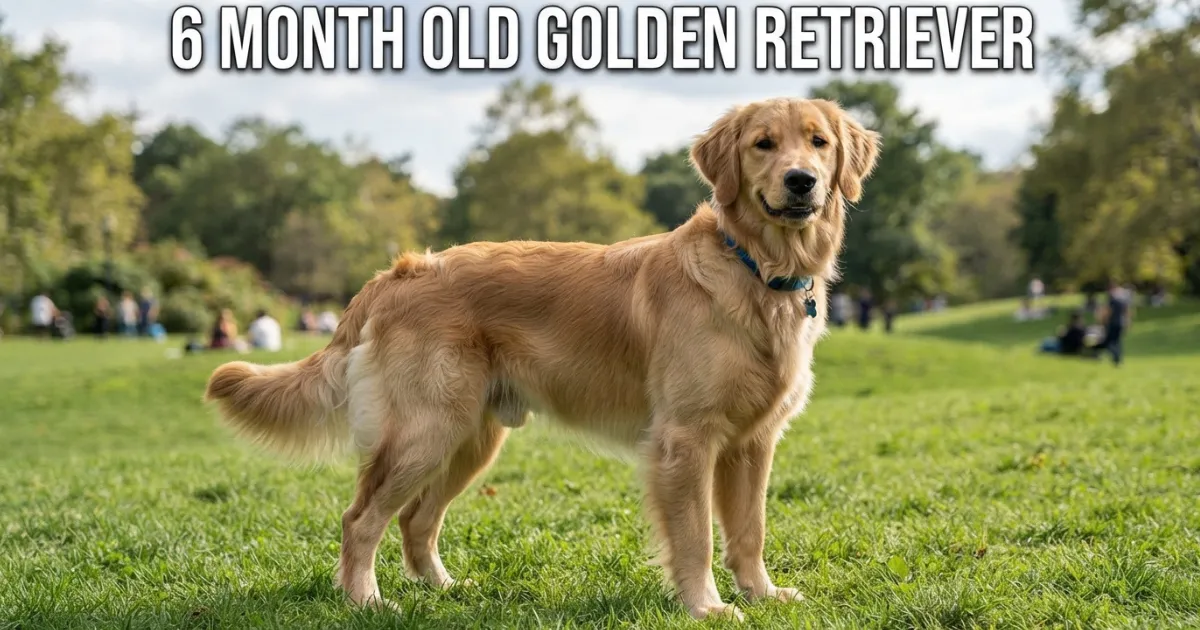
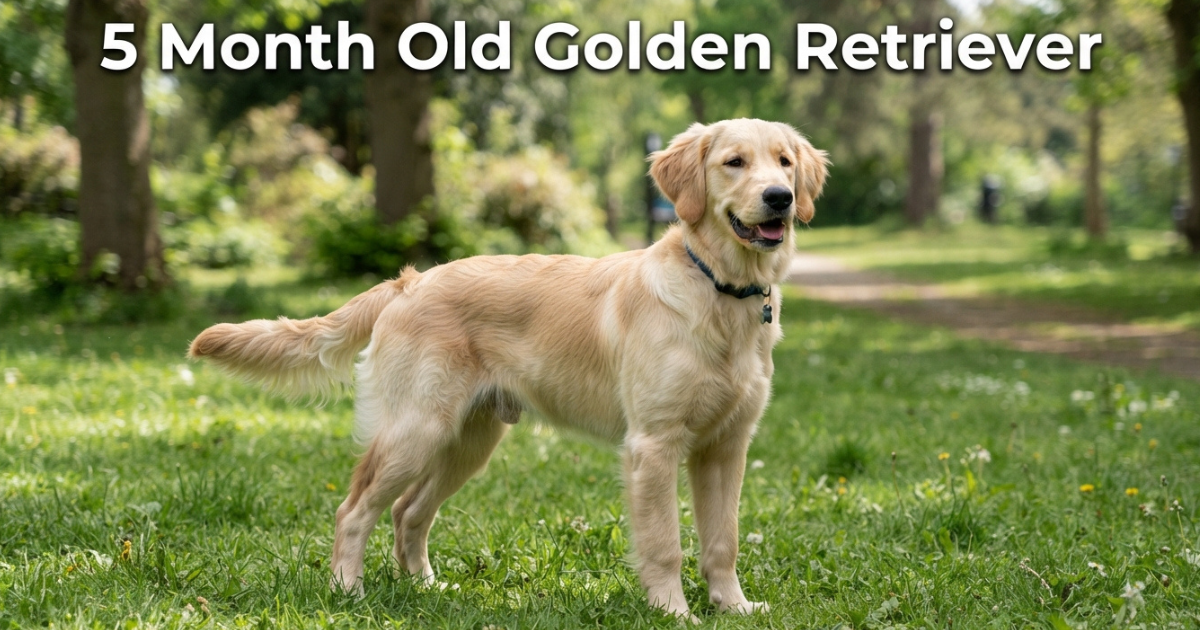
A 4 month old golden retriever looks like a leggy teenager, around 30 pounds. The body is longer now, and the coat is filling in and darkening toward the adult shade. The classic feathering is starting on the legs, tail, and chest.
Proportions can look a little gangly, since the legs often grow before the body catches up. That awkward, coltish stage is completely normal and a sign there is plenty of growing left to do. You may also notice the ears finally starting to suit the head, and the puppy fluff giving way to a smoother, shinier coat. Underneath, the chest is beginning to deepen, the first hint of the broad adult frame to come.
The 16 week threshold
At 16 weeks, teething, a growth spurt, and emerging independence collide. That is why a 4 month old golden retriever can suddenly seem mouthier, more distracted, and more stubborn than it was a few weeks ago. None of it means you did anything wrong. It simply means several big developments are landing at once, and the owners who push through this stretch calmly come out with the easiest adult dogs.
This builds on the earlier land shark weeks, which you can revisit in the three months stage. To see how this fits the breed, browse our Golden Retriever breed section and our main Golden Retriever Insight.
4 month old golden retriever weight and growth
Average weight at 4 months
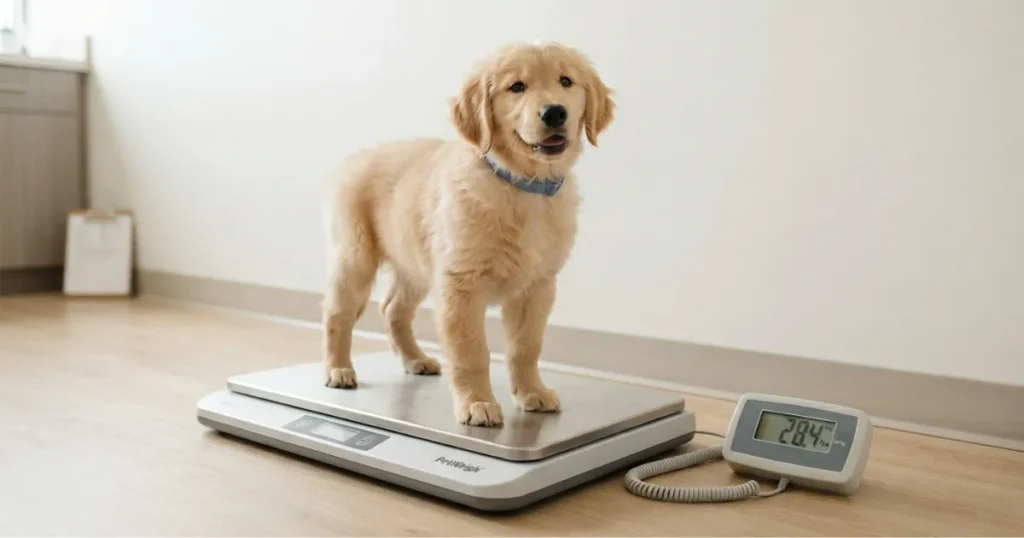
The typical 4 month old golden retriever weighs about 30 pounds, roughly half of adult weight. Males usually run about 28 to 36 pounds and females about 25 to 31 pounds, though the healthy range across the breed is wide and some Goldens sit lighter.
Do not fixate on the exact number. Genetics, litter, and build all shift it, and a steady upward trend paired with good body condition matters far more than matching a chart to the pound. Males and females start to separate more clearly now, with males carrying more bone and a broader head. Still, a lean female at the low end of the range is every bit as healthy as a bigger male at the top.
| Age | Male weight | Female weight | Share of adult |
| 14 weeks | 24 to 30 lb | 20 to 26 lb | ~38% |
| 16 weeks (4 months) | 28 to 36 lb | 25 to 31 lb | ~50% |
| 18 weeks | 32 to 40 lb | 28 to 34 lb | ~55% |
| 20 weeks (5 months) | 35 to 43 lb | 30 to 37 lb | ~60% |
The halfway rule and body condition
Four months is a handy checkpoint, because weight now is roughly half of adult weight. Doubling your 4 month old golden retriever’s weight gives a fair estimate of its grown size, though the size of the parents is a better guide still.
Judge condition with your hands, not the scale. You should feel the ribs under a thin layer of fat and see a slight waist from above. For the wider stage map, see the puppy growth roadmap.
Keep resisting the urge to fatten up a fast-growing puppy. A lean 4 month old golden retriever, with ribs you can just feel, is far better set up for healthy hips and elbows. Racing a heavier puppy up the chart is not worth the risk.
Teething and the velociraptor phase
Why chewing peaks now
Teething runs from about 3 months to 6 or 7 months, and the discomfort tends to peak between 14 and 18 weeks. As adult teeth push through and baby teeth fall out, the urge to chew goes into overdrive.
That soreness, plus a big spike in energy, is why some owners call this the velociraptor phase. It feels intense, but it is biological, not bad behavior, and it eases as the adult teeth settle in. You may find the odd baby tooth on the floor, or none at all, since many puppies swallow them harmlessly while eating. Either way, expect drool, red gums, and a strong need to chew through this stretch.
How to manage biting and chewing
The plan is simple and consistent. Redirect to a chew toy every single time teeth meet skin, and reward your puppy for choosing the toy. Never punish the biting, since that only winds the puppy up. A dragging house line makes it easy to guide your puppy away without grabbing, and rotating a few chews keeps them novel enough to actually use.
The table below sorts what helps from what backfires.
| Helps with teething | Makes it worse |
| Redirect to a chew toy every time. | Yelling or rough handling |
| Frozen or chilled puppy-safe chews | Fast hand movements and wrestling |
| Enforced naps, since tired puppies bite more | Letting an overtired puppy stay up |
| Calm, low energy from you | Chasing games that ramp them up |

Feeding your 4 month old golden retriever puppy
How much and how often
Feed a 4 month old golden retriever puppy three meals a day, spread across the day. A common range is around two to three cups of large-breed puppy food daily, but let your vet set the exact amount for your puppy and adjust as it grows.
Keep fresh water available at all times. A large-breed puppy formula is important here because it is calorie and calcium-controlled to keep growth steady and protect developing joints. Skip rich table scraps and calorie-dense adult food, both of which can push growth faster than the joints can handle. Steady and slightly lean is always the goal.
Adjusting as they grow
Appetite can swing during a growth spurt, so expect some hungrier days. Rather than free-feeding, keep to scheduled meals and adjust portion size based on body condition, aiming for lean rather than round.
If you ever change foods, mix the new into the old over about a week to avoid an upset stomach. Sudden switches are a common cause of loose stool at this age.

Exercise at 4 months
The 20 minute rule
A widely used, vet-informed guideline is about 5 minutes of structured exercise per month of age, twice a day. For a 4 month old golden retriever, that works out to roughly 20 minutes, twice daily.
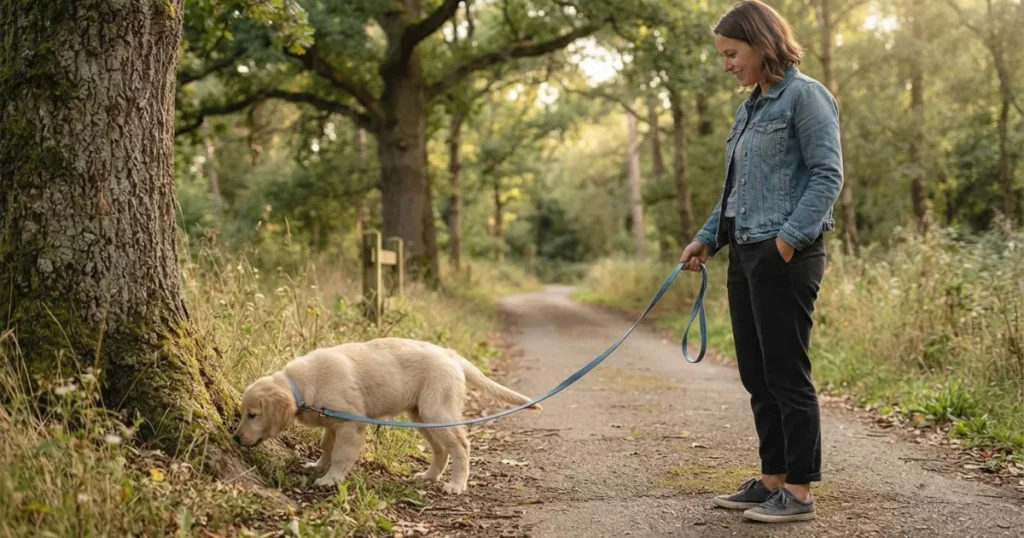
Gentle walks, sniffing time, and free play in the yard are ideal. The aim is to avoid long, forced exercise that a still-growing body is not ready for. A good sign you have the balance right is a puppy that is pleasantly tired rather than wired. If your 4 month old golden retriever seems sore after activity, ease back and check in with your vet.
Protecting growing joints
The growth plates stay open until around 12 to 18 months, so high-impact activity can damage them. Skip long runs, repeated jumping, and stairs where you can, and hold off on agility or distance work for now.
Mental work tires a puppy just as well. Short training games, puzzle feeders, and scent games burn real energy without stressing young joints, and Goldens love them. Swimming, where it is safe and supervised, is one of the few higher-energy options that is gentle on joints, which is why so many Goldens take to water early.
Training and the second fear period
Your puppy is a learning sponge
Four months is a golden window for training. Attention spans are longer than they were, and a 4 month old golden retriever can genuinely learn sit, down, come, and loose-leash walking with short, upbeat, reward-based sessions.
Keep sessions to a few minutes and weave cues into daily life. Ask for a sit before meals and doorways, so good manners become a habit rather than a trick. Short daily reps beat one long weekly session every time, and they deepen the bond that makes a Golden such a willing partner.
The socialization window closes
The prime socialization window is closing by about 16 weeks, so these are the final, valuable days of it. Keep introducing new sounds, surfaces, calm dogs, and friendly people, always gently and positively.
For the behavior map running alongside these weeks, see how your puppy’s mind develops. What your puppy meets calmly now, it is likely to take in stride as an adult.
A second fear period
Around 4 to 6 months, many Goldens hit a second fear period, when a previously confident puppy suddenly acts spooked by ordinary things. This is normal and temporary.
Do not force your puppy toward whatever worries it. Stay calm, let it investigate at its own pace, and reward brave choices. Pushing a frightened puppy can turn a passing wobble into a lasting fear.
Health and vaccinations at 4 months
The vaccine milestone
This is the stage many owners have been waiting for. By about 16 weeks, your puppy usually completes its core vaccine series, and a rabies shot is often given around now too.
About one to two weeks after the final round, once your vet confirms full protection, your 4 month old golden retriever can finally visit public places and meet unknown dogs. Check with your vet before that first big outing.
Signs to call your vet
Most of what happens at 4 months is normal puppy chaos. Call your vet, though, for persistent vomiting or diarrhea, a puppy that will not eat, or sudden lethargy. See them for any limp that does not quickly resolve, since hip issues can rarely start young.
Trust your instincts. A quick call is always cheaper and calmer than waiting on a puppy that seems genuinely unwell.

From 4 months to the months ahead
Growth stays quick from here, then starts to slow. Your puppy moves next through life at five months and a half years mark, reaching about two-thirds of adult weight by six months.
The longer adolescent stretch follows, all the way to the first birthday. Each stage builds on the training and routines you are setting right now.
Expert Insight
Four months is where I see owners either relax too early and let training slide or panic at the sudden mouthiness and independence. The dogs that turn out best have owners who stay boringly consistent through this stretch, protect naps, keep exercise sensible, and treat the vaccine milestone as a chance to socialize widely, not to over-exercise.
The 16-week threshold.
Expect a fast-growing, mouthy, increasingly independent puppy of about 30 pounds. Teething peaks now, so keep the chews coming. Cap exercise near 20 minutes twice a day, and finish the vaccine course so your puppy can finally head out into the world. Enforced naps still matter.
What is the average 4 month old golden retriever weight?
The average 4 month old golden retriever weighs about 30 pounds, roughly half of adult size. Males run about 28 to 36 pounds and females 25 to 31, but the healthy breed range is wide, so trends beat exact numbers.
How much should I feed a 4 month old golden retriever puppy?
Feed a 4 month old golden retriever puppy three meals a day, often two to three cups of large-breed puppy food total, though your vet should set the exact amount. Watch body condition and aim for lean, not round.
Is my 4 month old golden retriever fully vaccinated?
Usually around now. The core vaccine series typically finishes near 16 weeks, and a rabies shot is often given too. About one to two weeks after the final round, your vet can confirm it is safe to go out.
How much exercise does a 4 month old golden retriever need?
Use the 5 minute rule, about 5 minutes per month of age, twice a day, so roughly 20 minutes twice daily. Add gentle play and sniffing walks. Avoid long runs, jumping, and stairs to protect growing joints.
Why is my 4 month old golden retriever biting so much?
Teething peaks between 14 and 18 weeks, so chewing and nipping surge. It is biological, not aggression. Redirect to chews every time, protect naps since tired puppies bite more, and never punish the behavior.
Why is my confident puppy suddenly scared of everything?
Many Goldens hit a second fear period around 4 to 6 months. A once-bold puppy may act spooked by ordinary things. Stay calm, never force it, and let your puppy explore at its own pace. It passes.
When can my 4 month old golden retriever go to the dog park?
Once the vaccine course is complete, usually near 16 weeks, and your vet confirms full protection, often one to two weeks later. Until then, stick to calm, healthy, fully vaccinated dogs in safe settings.
How much should a 4 month old golden retriever sleep?
Around 16 to 18 hours a day, in cycles of play and deep rest. Overtired puppies get mouthy and hard to manage, so enforced naps in a crate or pen are genuinely helpful at this age.
Can I predict my puppy’s adult size at 4 months?
Roughly, yes. Weight at 4 months is about half of adult weight, so doubling it gives a fair estimate. The size of the parents is an even better guide, since genetics drives final size more than anything.
Is my 4 month old golden retriever the right weight?
Check body condition over the scale. You should feel the ribs under a thin layer of fat and see a slight waist. A steady growth trend matters more than matching a chart exactly for the breed.
What training should a 4 month old golden retriever know?
This is a prime learning window, so sit, down, come, and early loose-leash walking are all realistic. Keep sessions short and reward-based, and weave cues into daily life so manners become automatic.
Why does my 4 month old golden retriever ignore me now?
Early adolescence brings a streak of independence and selective hearing. It is normal. Keep training short, fun, and rewarding, stay consistent, and the responsiveness returns as your puppy matures.
The bottom line
A 4 month old golden retriever is about 30 pounds, half grown, teething hard, and testing its independence. That is exactly why this stage can feel like the hardest part of puppyhood. It is not. It is a busy, normal phase that rewards steady, patient owners. Think of these weeks as an investment that pays back for the next decade.
Keep growth moderate, cap exercise, protect naps, and use the vaccine milestone as a chance to socialize widely rather than to over-exercise. The biting eases as the adult teeth arrive, the fear period passes, and the independent streak settles with consistent training. Lean on your vet for the details, and enjoy this fast-changing stage, because the confident young dog you are shaping is just around the corner.
Are you deep in the 16-week chaos or just out on the other side? Share your 4 month old golden retriever’s weight and the tip that helped you most in the comments for other owners.