Puppy growth stages are the developmental periods every puppy moves through from birth to adulthood, usually grouped into five: neonatal, transitional, socialization, juvenile, and adolescence. Each brings its own physical and behavioral changes. Knowing the puppy growth stages helps you match care, training, and expectations to what your puppy actually needs right now.
Watching a puppy grow up can feel like a series of surprises, from the day the eyes open to the day a calm little dog turns into a wild teenager. It is far less baffling once you know the map.
That map is what this guide gives you. It walks through the puppy growth stages one by one, sets out the milestones to watch, and shows how the stages differ from a simple count of weeks. For the weight side of the story, see our month by month growth chart.
The five main puppy stages
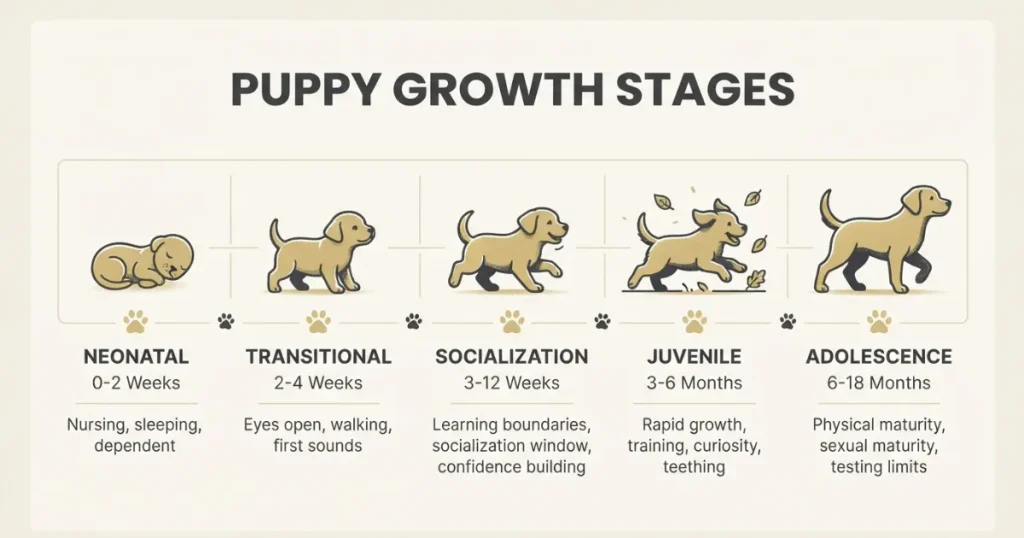
Most experts group puppy development into five broad puppy stages, each defined by what is changing rather than by an exact date. The lines between them blur, and individual puppies move at their own pace.
Thinking in stages is more useful than thinking in weeks alone. A stage tells you what your puppy is working on, which tells you what it needs from you. This is one guide in our health and care library, and you can explore the wider site from our full Golden Retriever guides.
You do not need to memorize exact dates. What helps is knowing roughly where your puppy is and what it is working on. A newborn needs warmth and rest. A young puppy needs gentle new experiences. A teenager needs patience and steady rules. Read those needs, and most of the guesswork disappears.
Puppy development stages explained
The five puppy development stages below run in order, though they overlap at the edges. Each links to the deeper detail elsewhere in this cluster.
Stage 1: Neonatal, birth to 2 weeks.
Newborns are blind, deaf, and fully dependent on their mother, doing little but sleep and nurse. This fragile window has its own full guide in our newborn puppy guide. At this age there is little for an owner to do. You keep the area warm and let the mother do the rest, since the puppies cannot yet warm themselves.
Stage 2: Transitional, 2 to 4 weeks.
The senses switch on. Eyes and ears open, the first teeth appear, and the puppy starts to stand, wobble, and notice its littermates for the first time. It is a short but striking window. In about two weeks, a helpless newborn becomes a curious little dog that toddles and plays.
Stage 3: Socialization, 3 to 14 weeks.
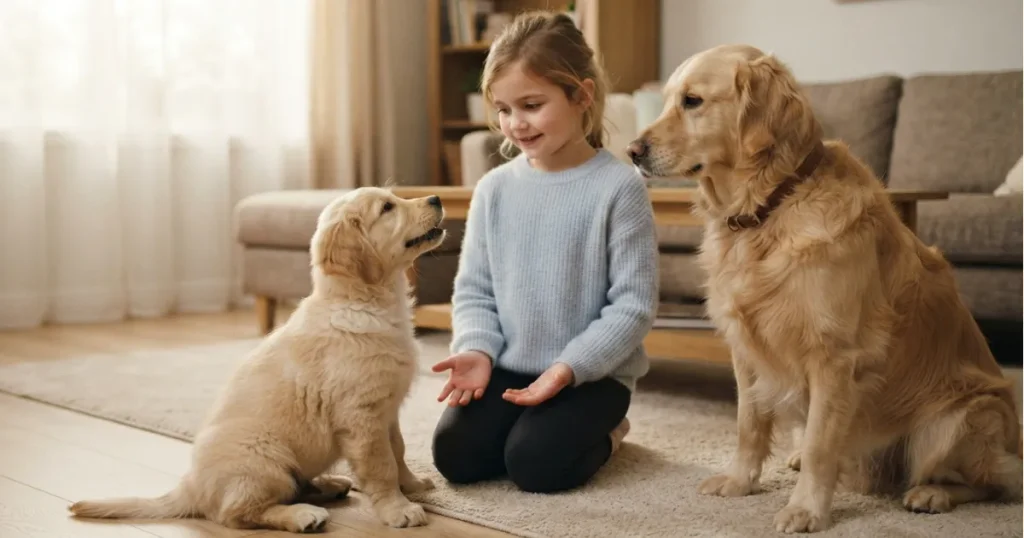
This is the single most important stage. What a puppy meets calmly now, from sounds to surfaces to people, it tends to accept for life. Puppies usually go home near 8 weeks, covered in our 8 weeks old guide, right in the middle of this window.
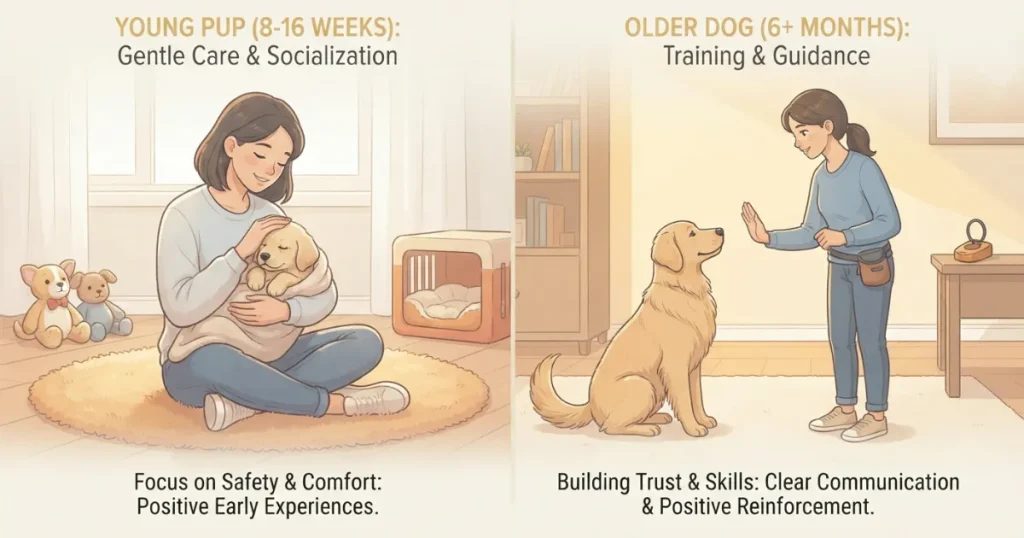
Keep every new experience short, gentle, and positive. A bad scare now can leave a lasting mark, so aim for small, calm wins rather than big outings. A trip to a quiet friend’s house beats a loud, crowded event every time at this age.
Stage 4: Juvenile, 3 to 6 months.
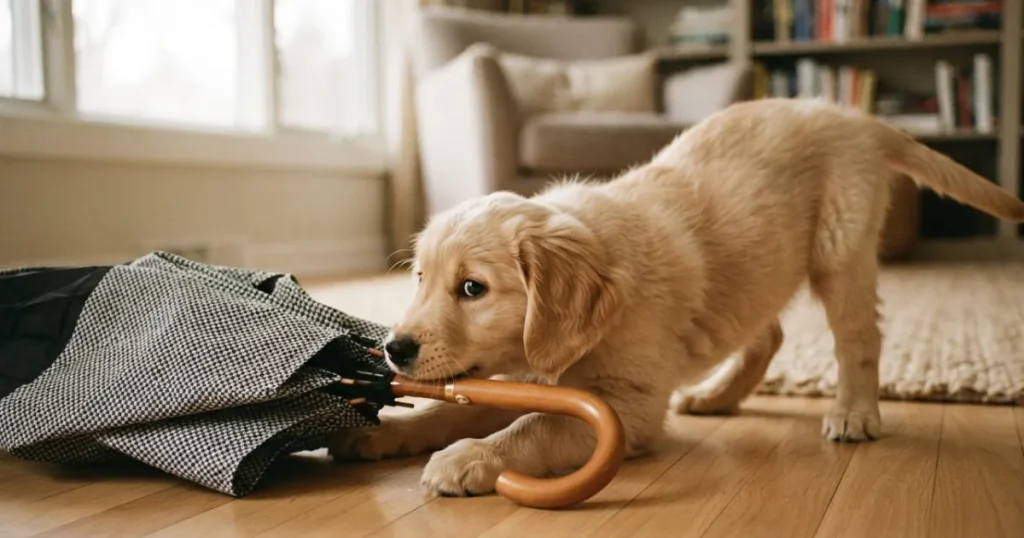
Growth is fast, teething peaks, and training takes hold. The puppy looks less like a baby and more like a smaller version of the adult, as seen around the four months checkpoint. House training, crate work, and basic cues all take hold here. Keep sessions short, since a young puppy still has a brief attention span. Little and often is the rule, and ending on a win keeps your puppy keen to learn more.
Stage 5: Adolescence, 6 months to 2 years.
The teenage stretch. The body finishes growing long before the brain catches up, so expect testing, energy, and selective hearing all the way to the 1 year milestone and beyond. Most owners find this the hardest part. The good news is that it ends, and a calm adult waits on the other side. Steady, kind training through this stretch is what shapes that calm adult, so it is worth the effort even on the hard days.
Key puppy milestones by age
Stages describe periods, while puppy milestones mark the specific moments within them. The table below lists the milestones most worth watching and why each one matters. Use it as a rough guide, not a strict schedule. If your puppy hits a marker a week or two early or late, that is usually fine, as long as it keeps moving forward. Steady progress in the right direction matters far more than perfect timing on any single marker.
| Milestone | Typical age | Why it matters |
| Eyes and ears open | 2 to 3 weeks | Sensory learning begins |
| Walking and first teeth | 3 to 4 weeks | Weaning and play can start |
| Ready to go home | 8 weeks | Weaned and socially ready |
| Fear responses appear | 8 to 11 weeks | Handle new things gently |
| The socialization window closes | 14 to 16 weeks | Last easy chance to socialize |
| Adult teeth all in | 6 months | Heavy chewing eases |
| Sexual maturity | 6 to 12 months | Spay or neuter decision |
| Emotional maturity | 2 to 3 years | Real calm settles in |
Puppy developmental milestones to track
Not every milestone is physical. The most useful puppy developmental milestones split into two groups, and both deserve attention.
Physical milestones.
These are the visible ones: eyes opening, teething, growth spurts, and the growth plates closing around 12 to 18 months. They follow a fairly predictable clock and are easy to check against a chart. You can see the teeth come in and watch the growth spurts happen. Your vet also tracks these at each checkup, so you get a second set of eyes.
Behavioral and social milestones.
These are quieter but just as important, like the first fear period, the closing of the socialization window, and emerging independence. Missing key puppy developmental milestones here, especially socialization, is harder to fix later than any physical one.
The behavior side has its own timeline in the behavioral side of puppyhood. These are easy to miss, because they do not show up on a chart. Yet they shape the adult dog more than height or weight ever will. So much of raising a good dog happens in these early, almost invisible moments.
Stages versus calendar age: why they differ
It is tempting to treat a puppy’s age in weeks as the whole story, but the stages matter more. Two puppies of the same age can sit in slightly different places, since breed, size, and individual pace all shift the timing.
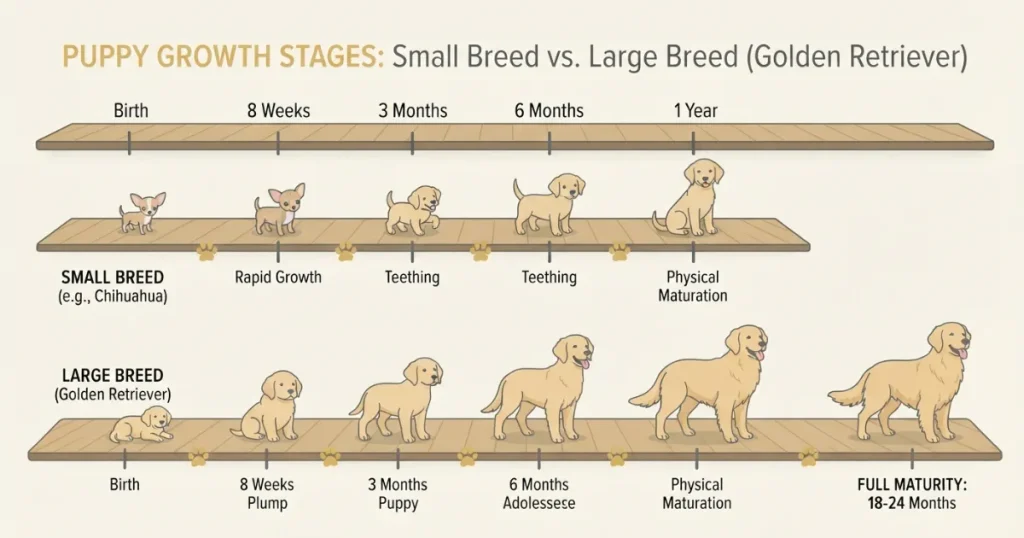
Large breeds are a clear example. They pass the early puppy growth stages on a similar schedule to small dogs, then stretch adolescence out far longer, maturing physically and mentally much later.
So use age as a rough guide and the stage as the real one. A puppy that is a little ahead or behind the calendar is usually just following its own version of the same puppy growth stages.
Every puppy is a little different.
Breed is the biggest factor, but personality matters too. A bold puppy and a shy one can move through the same stage in very different ways. Neither is wrong. Support the puppy you have, not the one a chart describes. A shy puppy may need a slower, gentler approach, while a bold one needs clear, calm limits. Both can grow into lovely adults with the right support.
Puppy growth stages in Golden Retrievers
What is different for a large breed.
Golden Retrievers illustrate the large-breed pattern well. The neonatal, transitional, and socialization stages track the general puppy growth stages closely, but the juvenile and adolescent stages run long, with full maturity often near two to three years.
Their growth plates also close later, around 12 to 18 months, which shapes how much exercise is safe at each stage. Matching activity to the stage protects the joints of a slow-maturing breed. This is why a big dog can still act like a puppy at eighteen months. The body looks grown, but the mind is still catching up.
Why the socialization stage is critical.
For a dog bred to be a friendly family companion, the socialization stage carries extra weight. A Golden that meets the world calmly during that window tends to become the easygoing adult the breed is famous for.
Because this stage closes around 14 to 16 weeks, before vaccinations are fully complete, safe socialization means creativity, such as carrying a puppy in busy places and inviting healthy, vaccinated dogs to visit. A little effort here saves a lot of work later. A well-socialized Golden grows into a dog that takes new people and places in stride.
When does puppyhood end?
Puppyhood wraps up when a dog reaches full maturity. For small breeds that can be around a year. For large breeds it often takes two to three years, because the body and the mind finish at different times. The exact point where a puppy counts as grown is covered in when a puppy becomes an adult. Until then, keep treating your dog like the youngster it still is inside. A grown-up body does not mean a grown-up brain.
How to use the stages as an owner
Match care to the stage.
The practical payoff of the puppy growth stages is simple. Feed, train, exercise, and socialize for the stage in front of you, not the one you wish you were in. Gentle handling suits a neonate, heavy socialization suits a young puppy, and patient consistency suits a teenager.
Each age page in this cluster covers the day-to-day detail, while this guide keeps the whole arc in view. When you get this right, life gets easier for both of you. You stop fighting your puppy and start working with the stage it is in. That small shift in mindset changes everything. The tricky phases start to feel like normal steps rather than problems to solve.
When to talk to your vet.
Stages give you a baseline for what is normal, which makes the unusual easier to spot. Call your vet if a puppy misses major milestones by a wide margin, stops progressing, or shows signs of illness at any stage.
Trust the pattern and trust your instincts. The stages are a guide, not a rulebook, and your vet can reassure you when a puppy simply marches to its own beat. There is no harm in a quick call for peace of mind. A short check is easier than worrying for days about whether a delay is normal. Your vet has seen thousands of puppies and can tell quickly whether something is a normal quirk or worth a closer look.
Expert Insight
The most valuable thing owners can take from the puppy growth stages is the socialization window. Everything else can be nudged or corrected later, but that early window for building a confident dog does not reopen. If I could push one message, it would be to socialize hard, safely, and early.
The five stages at a glance.
Neonatal (birth to 2 weeks), transitional (2 to 4 weeks), socialization (3 to 14 weeks), juvenile (3 to 6 months), and adolescence (6 months to about 2 years). The socialization window is the most important and the most time-sensitive. Match your care to the stage your puppy is in, not just to its age in weeks.
What are the puppy growth stages?
The puppy growth stages are the developmental periods from birth to adulthood, usually grouped as neonatal, transitional, socialization, juvenile, and adolescence. Each brings distinct physical and behavioral changes, and knowing them helps you match care to what a puppy needs.
What are the five main puppy stages?
The five main puppy stages are neonatal, transitional, socialization, juvenile, and adolescence. They run in order from birth to around two years, though the edges overlap and each puppy moves through the puppy stages at its own individual pace.
What are the key puppy development stages?
The key puppy development stages are the socialization stage, which shapes lifelong temperament, and the long adolescent stage, which tests training. The earlier neonatal and transitional puppy development stages are shorter and mostly about basic sensory and physical growth.
What puppy milestones should I watch for?
Important puppy milestones include eyes opening around two weeks, the fear period near eight weeks, the socialization window closing by sixteen weeks, adult teeth by six months, and emotional maturity by two to three years.
What are the most important puppy developmental milestones?
The most important puppy developmental milestones are behavioral, especially socialization before sixteen weeks and navigating the first fear period. These shape adult temperament and are harder to fix later than physical milestones like teething or growth-plate closure.
How long does each puppy stage last?
Roughly, neonatal is two weeks, transitional two weeks, socialization runs to about fourteen weeks, juvenile to six months, and adolescence to around two years. Large breeds stretch the later stages out considerably longer than small dogs.
Why does my puppy seem ahead of or behind the stages?
Stages are guides, not fixed dates. Breed, size, and individual temperament all shift the timing, so a puppy a little ahead or behind is usually normal. Focus on steady progress rather than hitting each stage on an exact day.
What is the most important puppy stage?
The socialization stage, roughly three to fourteen weeks, is widely considered the most important. What a puppy experiences calmly then tends to shape its adult confidence, and the window does not fully reopen once it closes.
When does the socialization window close?
The prime socialization window closes around fourteen to sixteen weeks. Because that is before vaccinations are complete, safe early socialization takes some creativity, like meeting healthy vaccinated dogs and exploring new places carefully.
Do large breeds go through the stages differently?
The early stages are similar, but large breeds like Golden Retrievers stretch the juvenile and adolescent stages much longer, often maturing at two to three years. Their growth plates also close later, which affects safe exercise.
When is a puppy no longer a puppy?
Physically, most dogs finish growing between one and two years, sooner for small breeds and later for large ones. Behaviorally, full maturity can take two to three years, so the puppy growth stages end later than many owners expect.
Can I speed up my puppy’s development?
No, and you should not try. Development follows its own biological clock. What you can do is support each stage well, especially socialization, so your puppy reaches adulthood confident, healthy, and well adjusted.
The bottom line
The puppy growth stages turn a confusing year of change into a map you can actually follow. Five stages, from a helpless newborn to a boisterous teenager, each with its own needs, milestones, and quirks.
The single most important takeaway is the socialization stage, the one window that shapes lifelong temperament and does not reopen. Beyond that, use the stages to set fair expectations, match your care to where your puppy actually is, and lean on the age guides in this cluster for the day-to-day detail. Understand the puppy growth stages, and the whole first year makes sense.
Take it one stage at a time, and the journey feels far less overwhelming. Above all, do not waste the socialization window, because it is the one thing you cannot get back.
Which of the puppy growth stages caught you most off guard, the fragile newborn weeks or the wild teenage months? Share your experience in the comments to help other owners know what is coming.