
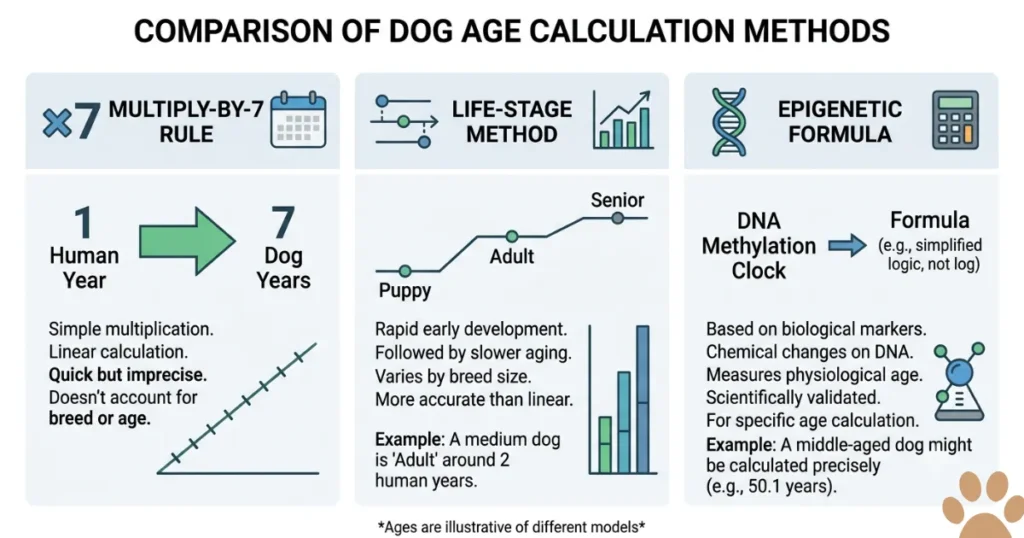
Curious, how is dog age calculated? The dog age is calculated in two main ways, and neither is the old “multiply by 7.” The life-stage method counts year one as about 15 human years, year two as 24, then adds roughly 4 to 7 per year, depending on size. The peer-reviewed UCSD method uses the formula human age = 16 × ln (dog age) + 31 for dogs over one. Both replace the ×7 rule, which was never accurate.
If you’ve ever wondered how a dog age calculator or a dog age chart comes up with its number, this is the page. The math isn’t mysterious, but it isn’t a single multiplier either. The AKC and the UC Davis School of Veterinary Medicine both describe a curved, size-aware approach because dogs age fast early and at different rates by size.
In my practice, owners are surprised that there’s real science here, including a formula built from DNA. Understanding how dog age is calculated helps you read any tool critically. For the calculator itself, our dog years to human years guide runs the numbers, and the dog age chart in human years shows them by size. This page explains what’s happening underneath.
How is dog age calculated? The two real methods
There are two credible methods, and they answer slightly different questions.
The life-stage method (developmental)
This is the one most calculators and charts use. The first year counts as about 15 human years, the second brings the total to about 24, and after that, you add a size-based amount each year. The AKC and AVMA publish this as a general guideline. It estimates developmental and functional age, which is what owners and vets usually plan around.
The epigenetic formula (molecular)
In 2019, researchers at the University of California, San Diego, measured DNA methylation, the methyl groups that attach to DNA as both species age, and produced a formula:
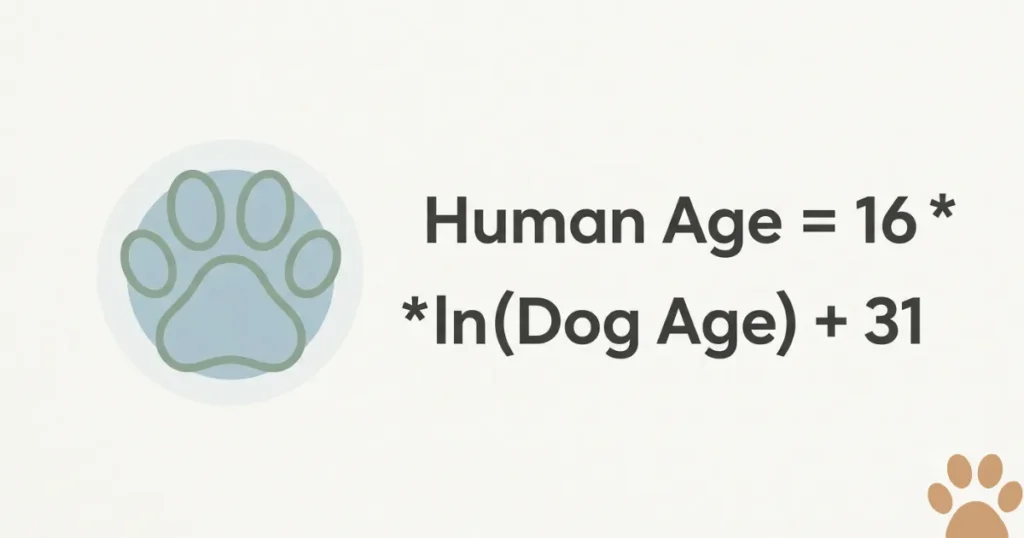
- Human age = 16 × ln (dog age) + 31.
It estimates molecular age and, per Science/AAAS, applies to dogs older than one. It was built from Labrador Retrievers, a large retriever much like a golden.
Neither method is “the” answer. The life-stage method is more practical for care decisions; the epigenetic formula is the peer-reviewed molecular view. Knowing both is why this page exists.
The dog age formula, step by step
Here’s how to actually calculate dog age, both ways, so you can do it yourself.
The life-stage math.
Start at 15 for year one. Add 9 for year two, reaching 24. Then, for each year after two, add about 4 for a small dog, 5 for medium, 6 for large, or 7 for giant.
- A 4 years old large-breed dog: 24 + 6 + 6 = 36.
- A 6 years old: 24 + four added years at 6 = 48.
The epigenetic formula.
Take the natural log of your dog’s age, multiply by 16, and add 31.
- For a 5 years old: ln (5) = 1.609, times 16 = 25.7, plus 31 = about 57.
- For a 10 years old: ln (10) = 2.303, times 16 = 36.8, plus 31 = about 68.
You’ll notice the two give different numbers for the same dog. That’s expected, and the next section explains why. To skip the arithmetic entirely, the calculator does both, and to reverse it, the human years to dog years calculator runs in the other direction.
Why every dog age calculator and chart gives a different answer
If you’ve plugged your dog into two tools and gotten two numbers, you’re not doing it wrong. Calculators and charts disagree for three honest reasons.
Method.
A tool using the life-stage approach and one using the epigenetic formula will diverge, especially in the early adult and senior years, because the formula’s log curve flattens with age, while the life-stage method adds fixed increments.
Size.
Many calculators default to a “medium dog.” Switch to large for a Golden, and every number after age two climbs. A tool that ignores size can’t be accurate for a large breed.
Rounding and calibration.
Different publishers round differently and calibrate from different data, so charts vary by a few years even when they agree on the method.
The takeaway isn’t that one tool is right, and the rest are wrong. It’s that you match the method and size to your dog and treat the result as a solid estimate. Our dog age in human years hub covers reading those numbers in practice.
How the calculation changes for puppies and large breeds like Goldens
The standard formulas have two important exceptions, and both matter for a golden.
Puppies break the formula.
The UCSD epigenetic equation applies only to dogs over one because puppy development is too fast and nonlinear for it. For the first year, the life-stage approach works better, which is why a dedicated puppy age chart maps the early months by milestone rather than by equation.
Size changes the slope.
Large breeds like the Golden add more human years per dog year after age two, around 6 versus 4 for a small dog, and reach senior status earlier, around 7 to 8. So the same calculation, run with the large-breed setting, ages a Golden faster than a toy breed.
For a Golden specifically, this is why getting the method right matters for health, not just curiosity. The breed reaches its senior years sooner, and the Morris Animal Foundation’s Golden Retriever Lifetime Study has found cancer to be the leading cause of death, so an accurate age helps you time screening. The senior end of that math is covered in our senior dog age guide.

Calculating your Golden’s age from 3 to 14: worked examples
Here’s the method applied across the ages owners ask about most for a large-breed Golden. The first column is the life-stage estimate, the second the epigenetic formula.
| Golden’s age | Life-stage method | Epigenetic formula | Where to go deeper |
| 3 | ~30 | ~49 | ages 2–4 |
| 5 | ~40–42 | ~57 | ages 5–8 |
| 7 | ~50–54 | ~62 | ages 5–8 |
| 10 | ~66–72 | ~68 | senior age |
| 13 | ~84–90 | ~72 | ages 9–14 |
| 14 | ~88–96 | ~73 | ages 9–14 |
Notice the two methods sit close in the middle years and split apart at the senior end, where the life-stage method runs higher. That gap is the clearest sign that dog age calculation is an estimate, not a precise birthday conversion.
The Dog Age Calculation Method
Here’s the repeatable method I give owners so they can calculate dog age for any dog, not just look up one number.
The Dog Age Calculation Method:
Step 1: Pick the size.
A golden is large. Then use 15 for year one, 24 for year two, and add 6 per year after that.
Step 2: Cross-check with the formula.
For a dog over one, run 16 × ln (age) + 31. Then compare the two numbers and expect a gap, especially in senior years.
Step 3: Convert to a life stage.
Translate the number into puppy, adult, or senior and act on the stage. Call your vet when your dog crosses into senior (around 7-8 for a golden) to start appropriate screening.
This method isn’t a diagnosis. It’s a way for dog age calculation to be correct and, more importantly, to turn it into the right care timing.
How is dog age calculated?
Two ways: the life-stage method (year 1 = 15, year 2 = 24, then 4-7 per year by size) and the UCSD epigenetic formula, human age = 16 × ln (dog age) + 31, for dogs over one.
What is the dog age formula?
The peer-reviewed formula is human age = 16 × ln (dog age) + 31. Multiply the natural log of your dog’s age by 16, then add 31. It applies to dogs older than one.
How do you calculate dog years to human years?
Count year one as about 15 human years and year two as 24, then add roughly 4 for small dogs, 5 for medium, 6 for large, or 7 for giant per year after that.
Why is the multiply by 7 rule wrong?
It assumes steady aging, but dogs age fast early and at different rates by size. A 1 year old dog is closer to 15 human years than 7, so ×7 fails immediately.
Why do dog age calculators give different answers?
They use different methods, size settings, and calibration. A life-stage tool and the epigenetic formula diverge, and “medium dog” defaults to underage large breeds.
Which dog age method is most accurate?
Neither is exact. The life-stage method is more practical for care; the epigenetic formula is the peer-reviewed molecular view. Using both, with the right size, is best.
How do I calculate my dog’s age by size?
After year two (24 human years), add about 4 per year for small dogs, 5 for medium, 6 for large, or 7 for giant. Match the column to your dog’s adult weight.
Can I calculate a dog’s age without knowing its birthday?
Not with a formula. A vet estimates an unknown age from teeth, eyes, and coat, and then you convert that estimate using the size-based method.
Does the epigenetic formula work for puppies?
No. It applies to dogs older than one, because puppy aging is too fast and nonlinear. Use a milestone-based puppy chart for the first year.
Why do the two methods disagree for old dogs?
The epigenetic formula’s log curve flattens with age, while the life-stage method keeps adding fixed years, so the two split apart in the senior years.
How do I calculate my Golden Retriever’s age?
Use the large-breed setting: 15 for year one, 24 for year two, and then add 6 per year. Cross-check with the formula, and expect a golden to reach senior around 7 to 8.
Why does size change the dog age calculation?
Large breeds age faster after their first years. So a Golden adds about 6 human years annually after age two, versus about 4 for a small dog.
Is the UCSD formula good for Golden Retrievers?
More than for most breeds. It was built from Labrador Retrievers, a large retriever much like a golden, so it maps to the breed better than to very small or giant dogs.
How does dog age relate to senior screening for a Golden?
Calculating age tells you when senior status begins, around 7 to 8 for a Golden. That’s the cue for twice-yearly exams and cancer-aware screening for the breed.
When should I see the vet instead of a calculator?
Any time you’re worried. Call your vet promptly for a new lump, sudden weakness, or pale gums. A calculator estimates age; only an exam assesses health.
The bottom line on how dog age is calculated
Dog age is calculated on a curve, not a flat ×7: about 15 human years for year one, 24 by year two, and then 4 to 7 more per year by size, with the UCSD formula (16 × ln (age) + 31) as the molecular cross-check for dogs over one year old.
Calculators and charts disagree because of method, size, and calibration, so match both to your dog and treat the result as a strong estimate. The one move that matters is to turn the number into a life stage and act on it, because for a Golden, senior starts around 7 to 8, and that’s when accurate calculation pays off in care.
Did you ever get two different numbers from two dog age tools? Tell me in the comments which method matched your golden best and whether running the formula yourself changed how you think about your dog’s age. Real examples help the next owner calculate with confidence.