
A dog age chart in human years converts your dog’s real age onto the human aging curve, and the most accurate version is size-based. All sizes count year one as about 15 human years and year two as about 24, then each later year adds roughly 4 for small dogs, 5 for medium, 6 for large, and 7 for giant breeds. A Golden Retriever follows the large column, so a 5 years old Golden is about 42 and an 8 years old is about 60.
Owners want a chart they can actually read at a glance, not a paragraph of math. Fair. So this page leads with the chart. The one thing to get right before you read it is your dog’s size category, because that single choice changes the human-age number more than anything else. The AKC and AVMA both build their guidance around size, since large breeds age faster after the first two years.
In my practice, the size step is where owners slip. They read a generic chart, land on a comfortable number, and miss that their large-breed dog should be on a faster line. If you’d rather compute an exact figure or see the molecular estimate, the dog years to human years calculator does that.
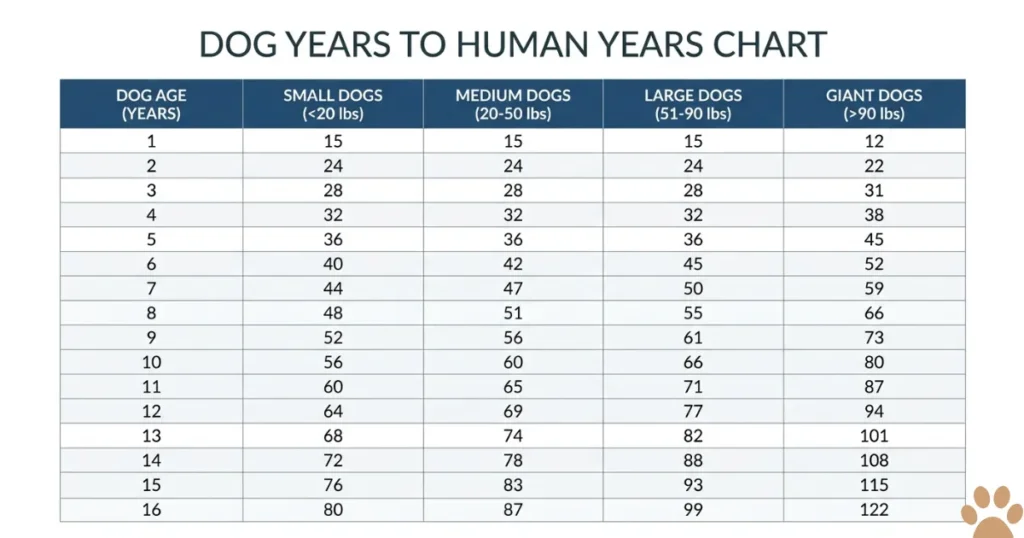
The dog years to human years chart, by size
Here’s the full chart. Find your dog’s age in the left column, then read across to the size that matches their adult weight.
| Dog’s age | Small (under 20 lb) | Medium (20–50 lb) | Large (50–100 lb) | Giant (100+ lb) |
| 1 | 15 | 15 | 15 | 15 |
| 2 | 24 | 24 | 24 | 24 |
| 3 | 28 | 29 | 30 | 31 |
| 4 | 32 | 34 | 36 | 38 |
| 5 | 36 | 39 | 42 | 45 |
| 6 | 40 | 44 | 48 | 52 |
| 7 | 44 | 49 | 54 | 59 |
| 8 | 48 | 54 | 60 | 66 |
| 9 | 52 | 59 | 66 | 73 |
| 10 | 56 | 64 | 72 | 80 |
| 11 | 60 | 69 | 78 | 87 |
| 12 | 64 | 74 | 84 | 94 |
| 13 | 68 | 79 | 90 | 101 |
| 14 | 72 | 84 | 96 | 108 |
| 15 | 76 | 89 | 102 | — |
| 16 | 80 | 94 | 108 | — |
This chart uses the size-adjusted method:
Year 1 = 15, year 2 = 24. Then add about 4, 5, 6, or 7 human years per year for small, medium, large, and giant breeds. A golden reads on the large column. Treat these as estimates, not exact ages. Published charts differ by a few years, and the peer-reviewed UCSD epigenetic formula runs higher in the early adult years, which is why the dog years to human years guide shows both methods together.
How to read the dog age chart in human years
Reading the chart is two steps: pick the size column, then read down to your dog’s age. The size choice does the heavy lifting, so get it right by adult weight, not puppy weight.
A Golden Retriever sits at roughly 55 to 75 pounds, squarely in the large column. A beagle is medium, a chihuahua small, and a Great Dane giant. Mixed breed? Use the adult size your dog grew into, and if you’re between columns, round toward the larger one for safer screening timing.
One honest caveat. No chart is exact, and they disagree by a few years because different groups calibrate them differently. The value of a chart isn’t a precise birthday to human number. It’s placing your dog in the right life stage so care lands on time. To pin a single age more tightly, the human years to dog years calculator runs the formula, and our how old is my dog guide helps when you don’t know the birthday.
Where a Golden Retriever falls on the chart
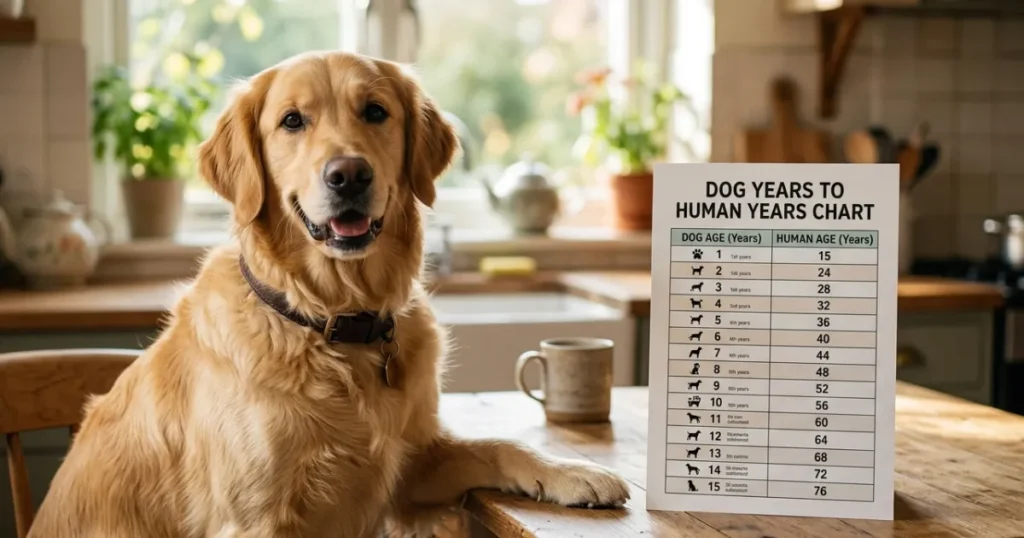
A Golden is a large breed, full stop, so the large column is your line. That means a 5 years old Golden reads near 42, a 7 years old near 54, and a 10 years old near 72. Same calendar age as a small dog, noticeably older in human terms.
The reason is size-driven aging. Large breeds mature a touch slower as puppies, then age faster as adults, which is why a Golden’s later numbers climb quicker than a terrier’s. The AKC and AVMA both tie senior status to size, putting large breeds in the senior range earlier than small dogs.
For a Golden, a senior arrives around 7 to 8. That’s the chart’s most important takeaway for the breed, because it sets when screening should intensify. The Morris Animal Foundation’s Golden Retriever Lifetime Study, following thousands of Goldens, has found cancer, including hemangiosarcoma, to be the breed’s leading cause of death, and early detection depends on starting senior screening on time, not late. The specific older ages are unpacked in terms of how old your Golden is at 2, 3, 9, 13, and 14.

Reading the chart by life stage
Numbers land better when grouped into stages, so here’s how the chart’s bands map for a Golden, using the large column.
Puppy to young adult (1–2 ≈ 15–24).
Rapid growth and maturity. Joint protection and large-breed nutrition matter most, covered in our puppy age chart.
Prime adult (3–6 ≈ 30–48).
Peak years. The cheapest time to bank a health baseline is detailed in what 2, 3, and 4 mean in dog years.
Senior (7+ ≈ 54 and up).
The chart climbs fast here. Twice-yearly exams, omega-3 and joint support, and cancer-aware screening earn their place, covered in what a 10 years old Golden’s age signals.
The American Animal Hospital Association frames these as five stages: puppy, young adult, mature adult, senior, and end of life. The chart is just a faster way to find which one your Golden is in today.

Why a single-number dog age chart misleads
Plenty of charts show one column and call it “dog years.” For a small dog, that’s roughly fine. For a large-breed Golden, it undercounts the later years, and the gap widens every year. By age 10, a small dog reads about 56 while a large dog reads about 72, a 16-year difference for the same calendar age.
The most common mistake I see is an owner reading a one-size chart, deciding their 8 years old Golden is “about 51 and fine,” and putting off senior bloodwork. Understandable, because the chart looked authoritative. But on the correct large line, that dog is closer to 60, and that’s exactly when early screening pays off.
The fix is simple. Always read the size-matched column, and when two charts disagree, let the older number guide your caution. To convert in the other direction, our reverse human to dog calculator sanity-checks the result.
The Size-First Chart Read
Here’s the quick read I give owners so the chart turns into the right action. Do it in order.
The Size-First Chart Read:
Pick the column by adult weight.
A Golden is large (55–75 lb). Then read down to your dog’s age. Between sizes? Round up.
Convert to a stage, not just a number.
Under 7 on the large line is adult; 7+ is senior. Then book the matching vet schedule.
Act on the senior line.
For a Golden at 7+, move to twice-yearly exams and cancer-aware screening. Call your vet immediately for a fast-growing lump, sudden weakness, or pale gums, which can signal hemangiosarcoma.
This read isn’t a diagnosis. It’s how the chart stops being trivia and starts setting your Golden’s care on time.
What is a dog age chart in human years?
A reference table mapping a dog’s real age to a human equivalent. A size-based chart is most accurate, since large breeds add about 6–7 human years per year after age 2 while small dogs add about 4.
Is the dog years to human years chart the same for every breed?
No. The first two years are similar for all sizes, then large and giant breeds age faster. A Golden Retriever follows the large-breed column.
Which column should a Golden Retriever use?
The large column (50–100 lb). A Golden at 5 reads about 42, at 8 about 60, and at 10 about 72 in human years.
Why do dog age charts disagree with each other?
Because different groups calibrate them differently. Most land within a few years, so use a chart for life-stage placement, not an exact birthday to human figure.
Is there a printable dog age chart?
Yes, this size-based chart is built to print or screenshot. Read the column that matches your dog’s adult weight, then find their age.
How accurate is a dog age chart in human years?
It’s a solid estimate, not exact. Genetics, weight, and health shift the real figure, which is why a vet exam matters alongside the chart.
How old is a large breed dog at 7 in human years?
About 54 on the large column. For a Golden, 7 is also the start of senior status, so it’s a cue to step up screening.
When is a dog considered senior on the chart?
It depends on size. Small dogs reach senior status around 10, medium around 7–8, and large or giant breeds as early as 5–7. Goldens are typically senior by 7–8.
Why do bigger dogs age faster on the chart?
Larger dogs grow rapidly and appear to accumulate age-related cellular damage sooner, which shortens lifespan and steepens the later part of the curve.
Does the chart work for a mixed-breed dog?
Yes, using an adult size. Match the column to the size your mix grew into, and round toward the larger column if you’re unsure.
How old is my Golden Retriever at 10 in human years?
About 72 on the large column. A 10 years old Golden is solidly senior and benefits from twice-yearly exams and cancer-aware screening.
Why does my Golden read older than my friend’s small dog, the same age?
Because Goldens are large and age faster after two. At 10, a Golden reads near 72 while a small dog reads near 56, despite the same birthday.
What health screening does the chart’s senior line suggest for a Golden?
Cancer-aware screening and joint care, with hemangiosarcoma and lymphoma the breed’s top concerns per the Golden Retriever Lifetime Study, plus twice-yearly exams.
Is a size-based chart better than the multiply by 7 rule?
Yes. The ×7 rule ignores fast early aging and size entirely. A size-based chart reflects how a golden actually ages.
When should I call the vet based on my Golden’s chart age?
For a senior-line Golden, call immediately for a fast-growing lump, sudden weakness, or pale gums. Monitor at home for 24 hours for mild, gradual stiffness, then book a senior exam.
Conclusion
A dog age chart in human years is only as good as the size column you read. All dogs start the same, about 15 at year one and 24 at year two, then small dogs add roughly 4 a year, and large breeds like the Golden add about 6, so a 5 years old Golden is near 42 and a 10 years old near 72.
The one move that matters is to read the large line for your golden and convert it to a life stage, because senior starts around 7 to 8, and that’s when screening should ramp up. Use the chart to get the timing right, not just the number.
Find your Golden in the large column. Did the human-age number land higher than you expected, and has it changed how you think about senior screening? Tell me in the comments which age and stage your dog is in. Real numbers help the next owner read the chart correctly.