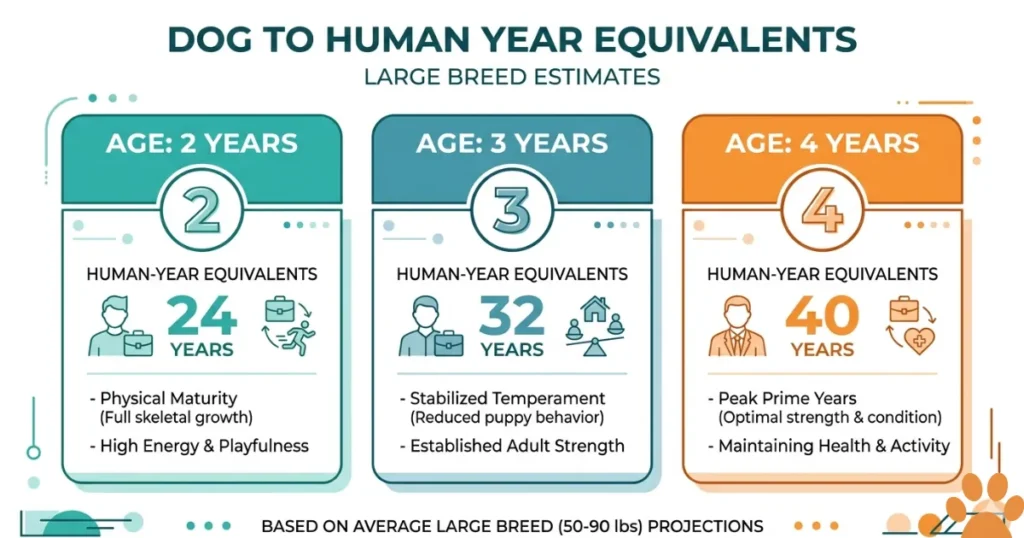
Curious: How Old Is 3 Years in Dog Years? A 2 years old dog is about 24 human years, a 3 years old about 30, and a 4 years old about 35 to 36 for a large breed like a Golden Retriever. These are the prime adult years, not puppyhood and nowhere near senior, which for a golden starts around 7 to 8. The peer-reviewed UCSD epigenetic formula puts the same ages higher, near 42, 49, and 53.
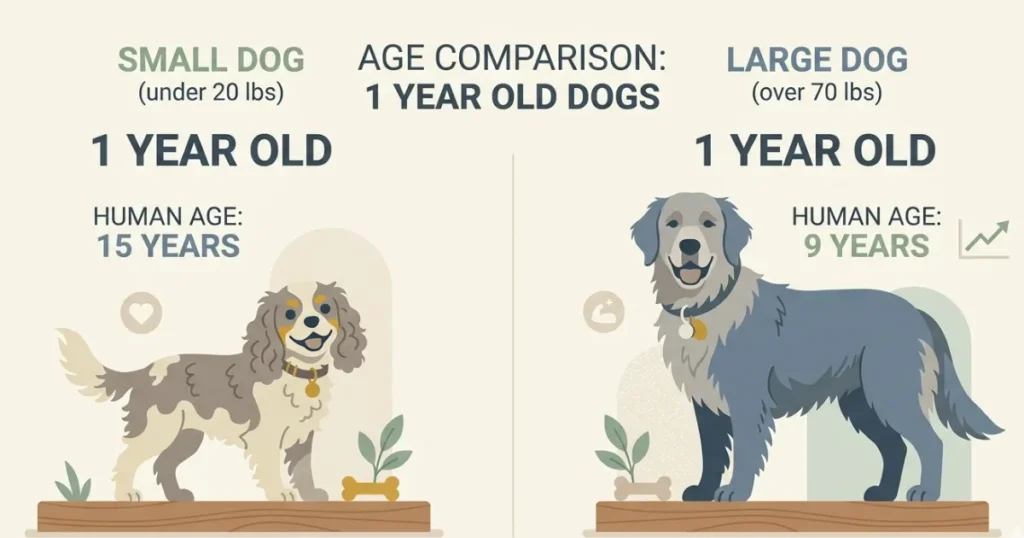
Owners ask me about these exact ages more than any others, usually with a worried “Wait, is my dog already middle-aged?” The short answer is no, not yet. A Golden at 2, 3, or 4 is a healthy young adult. The longer answer is that the old “multiply by 7” rule would tell you a 4 years old is 28 and still basically a kid, and that’s wrong. The AKC and the UC Davis School of Veterinary Medicine both put a dog’s first year at about 15 human years and the second at about 24, which is a very different curve.
In my practice, these are the years I most want owners to use well. Your Golden feels invincible at 3, which is exactly why it’s the right time to bank a health baseline. If you want any other age, our full dog age chart and calculator cover the whole range.
How old is a 2 years old dog in human years?
A 2 years old dog is roughly 24 human years. The first year counts as about 15, and the second adds about 9 more, a pattern the AKC and UC Davis both publish. By the UCSD epigenetic formula, a 2 years old comes out near 42, because that method tracks molecular aging and runs higher in the early adult years.
For a Golden specifically, age 2 is more than a number. It’s a health milestone. The Orthopedic Foundation for Animals won’t issue final hip or elbow certification until a dog is 24 months old, and the GRCA recommends both clearances for the breed. So your Golden’s second birthday is the moment those joints can be formally cleared.
That matters because elbow dysplasia is estimated to affect about 10% of Goldens, per the GRCA. A 2 years old Golden is physically grown and full of energy, but the large-breed joint story is just becoming readable. If your dog came from a breeder, this is the age to ask for those OFA numbers. The puppy stage that led here gets its own breakdown in our puppy age chart.
How old is a 3 years old dog in human years?
A 3 years old dog is about 30 human years for a large breed like a Golden. After age two, large dogs add roughly 6 human years for that next year, which is the pattern the vet-authored Zoetis method uses. The UCSD epigenetic formula puts a 3 years old near 49.
A 3 years old Golden is the canine version of someone in their early thirties. Fully mature, mentally settled, past the chaotic adolescent phase, and usually at peak physical condition. This is the dog at its athletic best.
Here’s what I tell owners of 3 years old. Don’t coast. A Golden this age rarely shows problems, so it’s tempting to skip the yearly exam. But a clean baseline now, bloodwork, a recorded healthy weight, and a joint check is what let your vet spot the first subtle change years later. The breed’s biggest threats arrive in the senior years, and catching them early starts with knowing what “normal” looked like at 3. For the exact-age lookup, our how old is my dog guide walks through it.
How old is a 4 years old dog in human years?
A 4 years old dog is about 35 to 36 human years for a large breed. Following the large-breed pattern, you add roughly 5 to 6 human years for that fourth year, landing in the mid-thirties. The UCSD epigenetic formula puts a 4 years old near 53.
A 4 years old Golden is squarely in prime adulthood. Not young anymore in the puppy sense, not remotely senior, just a confident grown dog. For comparison, the AKC notes a 4 years old Great Dane would already be about 35 in human years too, but a Great Dane is a giant breed that ages faster, so a Golden at 4 sits at a similar human age for a different reason: large size, longer runway than a giant breed.
This is the age I treat as the last “easy” checkpoint before the senior shift. Weight management gets real here, because the extra pounds that creep on at 4 are the same ones that strain a Golden’s hips and shorten lifespan later. Keep your dog lean, and you’ve done one of the highest-impact things possible. The older ages, where the math changes again, are covered in how old your Golden is at 9, 13, and 14.
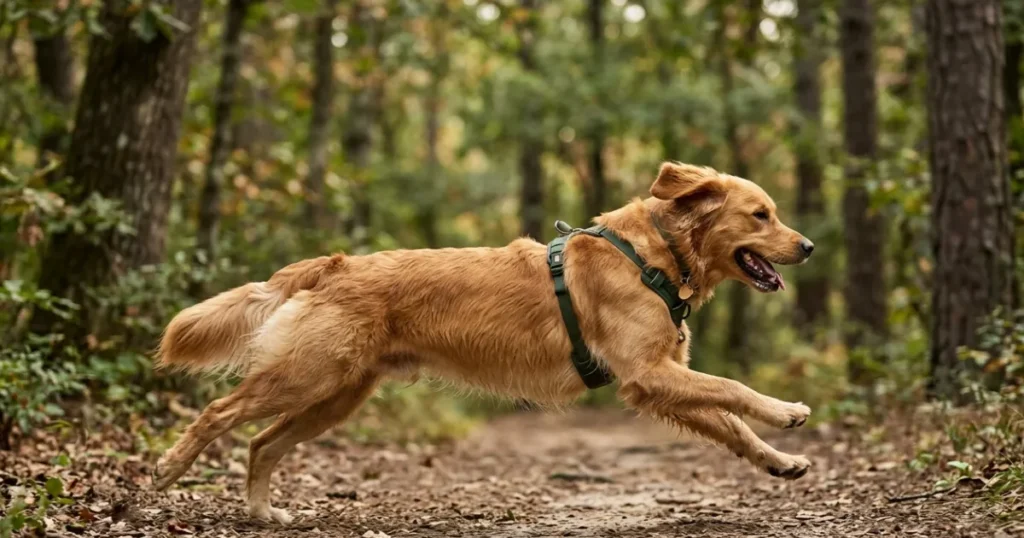
Why are 2 to 4 your Golden’s prime adult years
These three ages share a life stage, and naming it helps. The American Animal Hospital Association calls this window the young-adult to mature-adult phase. For a Golden, it runs from full physical maturity around age 2 to the early edge of middle age. Senior status is still years off, arriving around 7 to 8 for the breed, earlier than the 10-ish mark for small dogs.
The reason a Golden hits these human-age numbers faster than a Chihuahua is size. Large breeds mature a touch slower as puppies, then age faster as adults. That’s why a 4 years old Golden reads as mid-thirties while a 4 years old toy breed reads younger.
What I want owners to take from this stage is simple. Your Golden’s prime years are a window, not a permanent state, and they’re the cheapest time to protect the years ahead. Lean weight, joint awareness, and a recorded baseline now pay off when the senior screening starts. The breed’s leading later-life threat, cancer, including hemangiosarcoma, is tracked by the Morris Animal Foundation’s Golden Retriever Lifetime Study, and early detection later depends on knowing your dog’s normal today.
What dog-age charts get wrong for a young Golden
Most charts and calculators quietly default to a “medium dog.” For ages 2 to 4, that undercounts a Golden, which is a large breed and ages faster after two. The gap is small at these ages, a few human years, but the habit it creates is the problem.
The most common mistake I see is an owner reading a generic chart, deciding their 4 years old is “only 32 and basically young,” and skipping the baseline visit. Understandable, because the number felt reassuring. But in a large breed, 4 is precisely when I want weight and joints on record, while everything still looks perfect.
The fix is to pick a large breed wherever a tool allows it or lean on the dual-method table below, which shows both the life-stage estimate and the UCSD figure side by side. When they disagree, that’s normal. Use the gap as a reminder that no single number is exact, and let it nudge you toward earlier care, not later. To pinpoint your own dog, the calculator handles every age.
Dual-method age table (dog → human, large-breed Golden):
| Golden’s age | Life-stage estimate (large breed) | UCSD epigenetic estimate: 16·ln(age)+31 | What it means |
| 2 yr | ~24 | ~42 | Grown OFA hip/elbow clearance age |
| 3 yr | ~30 | ~49 | Young adult, peak condition |
| 4 yr | ~35–36 | ~53 | Prime adult: watch weight |
The Young-Golden Baseline Check
Here’s the simple tool I give owners of 2 to 4 years old so these easy years actually set up the hard ones. Run it once on your dog’s birthday.
The Young-Golden Baseline Check:
At age 2: confirm the joints.
Then ask your breeder or vet about OFA hip and elbow status, since 24 months is the certification age. Call your vet if you notice front-leg lameness or stiffness after rest, which can signal elbow dysplasia.
At age 3: lock the baseline.
Then get bloodwork on file and a recorded healthy weight while your dog is at peak health. Call your vet if appetite, energy, or weight shifts without a reason.
At age 4: defend the waistline.
Then keep your Golden lean, because weight at 4 drives joint strain and shortens lifespan. Call your vet if you can no longer easily feel the ribs.
This isn’t a diagnosis. It’s how you turn your Golden’s real young-adult age into the groundwork that protects its senior years.
How old is 3 in dog years?
A 3 years old dog is about 30 human years for a large breed like a Golden, or roughly 49 by the UCSD epigenetic formula. Either way, a 3 years old Golden is a fully mature young adult.
How old is a 2 years old dog in human years?
About 24 human years. Age 2 is also when Goldens can get final OFA hip and elbow certification, so it doubles as a health milestone.
How old is 4 in dog years?
A 4 years old dog is roughly 35 to 36 human years for a large breed. That’s prime adulthood, well short of the senior stage that starts around 7 to 8 in Goldens.
How old is 3 years in dog years?
Same as a 3 years old: about 30 human years for a Golden. The wording “3 years in dog years” asks the same thing, and the answer doesn’t change.
How old is 4 years in dog years?
About 35 to 36 human years for a large-breed Golden. Large dogs add roughly 5 to 6 human years for that fourth year.
Is a 2 years old dog still a puppy?
No. By 2, a Golden is fully grown physically and mentally maturing, though the playful temperament can make them seem puppyish for years.
Why do different charts give different ages for a 3 years old dog?
Because they use different methods and sizes. A medium-dog chart, a large-breed method, and the UCSD formula each give a slightly different number for the same age.
Is a 4 years old dog middle-aged?
Not for a Golden. At 4 a Golden is in prime adulthood. Middle age and senior status arrive later, around 7 to 8 for the breed.
How accurate is the dog years to human years math at these ages?
It’s a good estimate, not exact. Size, genetics, and lifestyle shift the real figure, which is why behavior and a vet exam matter alongside the chart.
When does a dog stop aging quickly?
After about age two. The first two years are front-loaded, then the pace slows to a steadier 4 to 7 human years per dog year, depending on size.
Why does a 4 years old Golden seem older than a 4 years old small dog?
Because Goldens are a large breed and age faster after two. A 4 years old Golden reads as mid-thirties, while a small breed of the same age reads younger.
What health checks matter for a 2 to 4 years old Golden Retriever?
Joint clearances and a health baseline. OFA hip and elbow certification happens at age 2, and bloodwork plus weight tracking at 3 to 4 set up early detection later.
Can Golden Retrievers get dysplasia this young?
Yes. Hip and elbow dysplasia are inherited and large-breed concerns, with elbow dysplasia affecting about 10% of Goldens per the GRCA. Many affected dogs show no early symptoms.
Is 4 a good age to switch my Golden’s food?
Possibly, based on weight and activity, not age alone. Keeping a 4 years old Golden lean matters more than the label, so ask your vet before changing diets.
When should I call the vet about my young Golden?
Call promptly for limping that lasts more than a few days or stiffness after rest, which can signal joint disease. Monitor at home for 24 hours for a single off day with a normal appetite.
Conclusion.
At 2, 3, and 4, your Golden is in its prime adult years: roughly 24, 30, and 35 to 36 in human terms for a large breed, far from the ×7 myth and far from senior.
The one move worth making in this window is to bank a baseline OFA joint status at 2, bloodwork, and a lean weight at 3 and 4, because these are the cheapest, healthiest years to protect the ones ahead. Knowing your Golden’s real age at 2, 3, or 4 is how you start that early.
How old is your Golden right now, and does the human-age number match how grown-up your dog actually acts? Tell me in the comments whether your 2 to 4 years old has already had a baseline vet visit and what your vet flagged, if anything. Young dog stories help the next owner know what to set up early.