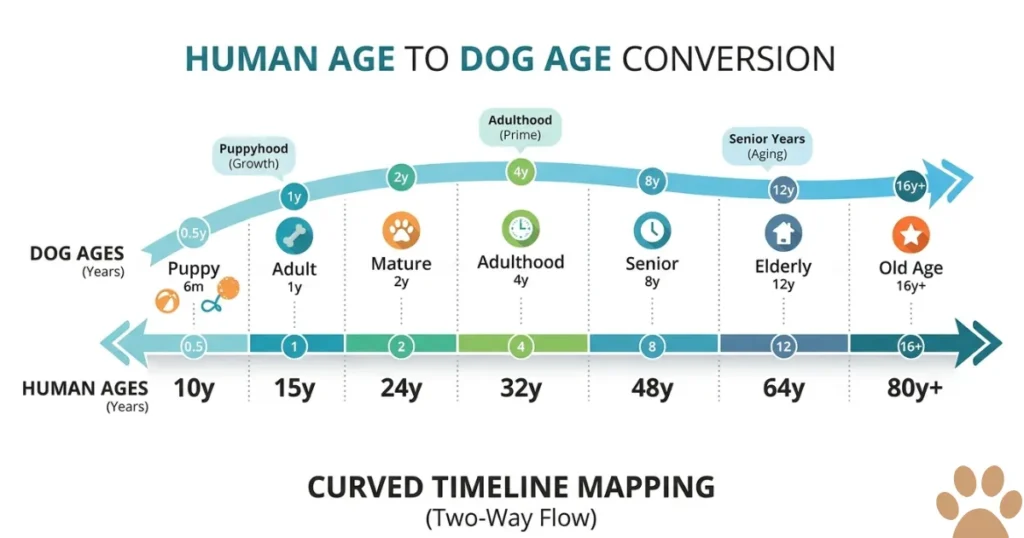
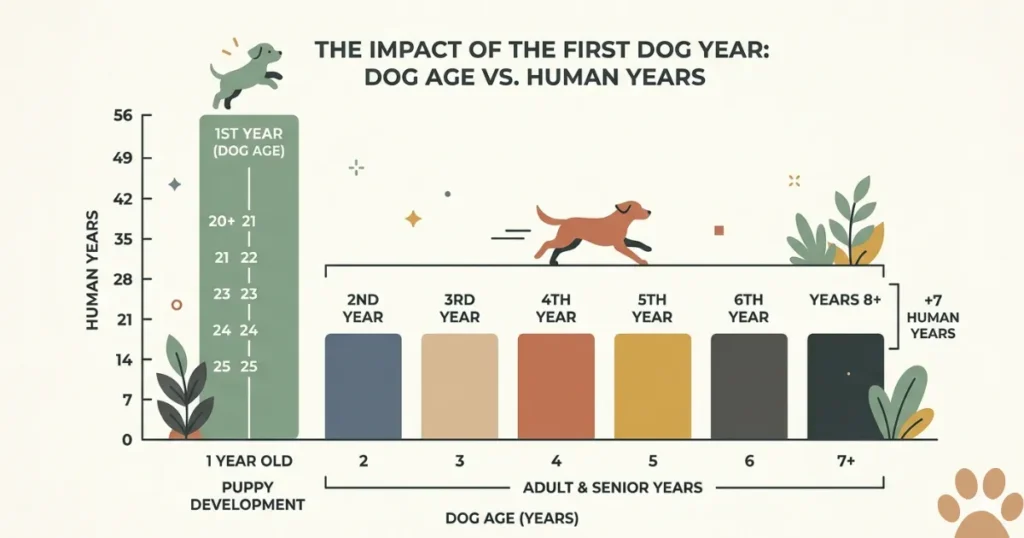
Curious about human years to dog years? One human year does not equal a fixed number of dog years, and it’s definitely not seven. Aging runs on a curve. A dog’s first year is worth about 15 human years, so early on, a single year counts for far more, while a large breed like a Golden later adds roughly 6 to 7 human years per dog year. To run it in reverse, about 15 human years match a Golden’s first year, 24 matches year two, and then each additional 6 to 7 human years equals one more dog year.
Owners ask me this in two ways, and the wording flips the answer. Sometimes they mean “how much human aging does one year of my dog’s life equal,” and sometimes they mean “if I’m 40, how old is that in dog terms.” Both are fair, and neither has a tidy single number. The reason is the same thing that breaks the old myth: dogs front-load their aging. The AKC and the UC Davis School of Veterinary Medicine both peg a dog’s first year at roughly 15 human years, not seven.
In my practice, the reverse question usually comes from a good instinct. An owner is trying to feel where their golden is in life, not just read a chart. That empathy is worth getting right because a Golden reaches its senior years earlier than most owners expect. If you want the standard forward direction instead, our full dog years to human years breakdown is the place to start.
How many dog years is one human year? It’s not seven.
Let’s kill the ×7 answer first. It came from rough division, people living to about 70 and dogs to about 10, and a Kansas State University vet told the Wall Street Journal it was likely a marketing nudge to get owners booking annual checkups, as the AKC reports. It stuck because it’s easy, not because it’s right.
Here’s the honest version. One human year is worth a different amount of dog development depending on when you measure it. During your Golden’s first year, twelve months deliver about 15 human-equivalent years of growth, so that year is enormously dense. By the time she’s an adult, a single calendar year adds far less proportionally. So “one human year equals X dog years” only makes sense if you say which year.
I tell owners to drop the search for one magic number and use the curve instead. Early life moves fast; later life slows down. That single idea explains every reverse and forward conversion you’ll ever do, and it’s the foundation for the reverse table below.
How to convert human years to dog years (reverse method)
To flip the math, you read the aging curve backward. The same milestones that turn one dog year into 15 human years also tell you which dog age a human age corresponds to.
The life-stage reverse method
Start from the standard guideline the AKC and UC Davis publish: year one ≈ 15 human years, year two ≈ 24 total, and then a large breed adds about 6–7 per year. Reverse it, and you get a clean ladder for a Golden. About 15 human years match your Golden’s first birthday; 24 matches her second, and from there, every 6 or 7 human years step back one dog year. A 50 years old person lands near a 7 to 8 years old Golden, right at the edge of senior.
The UCSD formula caveat
The peer-reviewed UCSD epigenetic formula (human age = 16 × ln(dog age) + 31) can also be inverted, but Science/AAAS notes it only applies to dogs older than one. It also tends to return a younger dog age for a given human age than the life-stage method does. When the two disagree, that’s expected. Use the life-stage ladder for everyday reverse matching, and treat the formula as the molecular second opinion.
Reverse conversion table (human → your Golden’s dog age, large breed)
| Your (human) age | Equivalent Golden age | Life stage |
| ~15 | 1 yr | Puppy |
| ~24 | 2 yr | Young adult |
| ~30 | 3 yr | Adult |
| ~36 | 4 yr | Adult |
| ~40 | 5 yr | Adult / early-mid |
| ~50 | 7 yr | Entering senior |
| ~66 | 10 yr | Senior |
| ~77 | 12 yr | Senior |
| ~88 | 14 yr | Geriatric |
Why one human year isn’t a fixed number of dog years for a Golden
Size is the reason the ratio keeps moving, and Goldens sit on the large-breed side of that line. Large dogs mature slightly slower as puppies, then age faster as adults, so the “dog years per human year” trade shifts as your Golden gets older. The AKC has covered the body-mass pattern, where researchers estimate every extra 4.4 pounds shaves roughly a month off life expectancy.
For your dog, the takeaway is blunt. A Golden’s later years are “worth more” on the aging curve than a small dog’s, which is why senior status arrives around age 7 to 8 rather than 10. That earlier line is the whole reason this math matters for care.
It matters because of what shows up in those senior years. The Morris Animal Foundation’s Golden Retriever Lifetime Study, following more than 3,000 Goldens since 2012, has found cancer to be the leading cause of death in the breed, with hemangiosarcoma and lymphoma among the most common forms. The average Golden lifespan runs about 10 to 12 years per the AKC breed profile. Knowing your reverse number isn’t trivia. It tells you when to start watching harder.
Matching your age to your Golden’s life stage
Reverse conversion gets more useful when you stop thinking in single years and think in stages. The American Animal Hospital Association frames canine life in five stages: puppy, young adult, mature adult, senior, and end of life. Mapping those to human equivalents helps the number actually mean something.
Puppy (8 weeks to ~18 months) ≈ human infancy through the mid-teens.
Enormous change packed into a short window. Joint protection and large-breed puppy nutrition matter most here, and our puppy age chart covers the month by month version.
Young to mature adult (2 to 6 years) ≈ human 20s to mid-40s.
Prime years. Steady, healthy, and the right time to bank baseline bloodwork so later changes stand out.
Senior (7+) ≈ human 50s and beyond.
For a Golden, this stage starts earlier than the medium-dog charts admit. Twice-yearly exams, omega-3 support, and cancer-aware screening earn their place. We go deep on this in what a 10 years old Golden’s age signals.
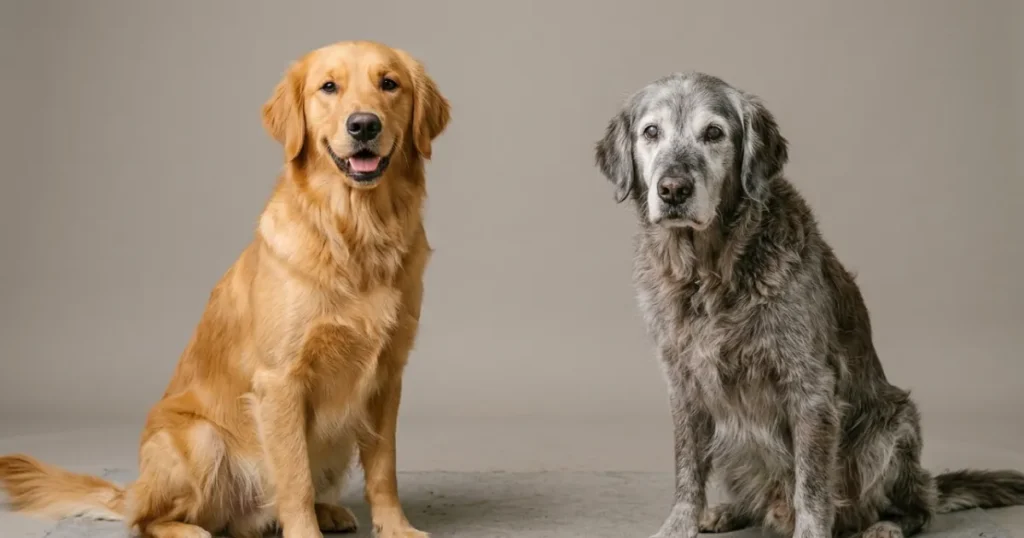
What reverse dog-age calculators get wrong for Goldens
Most reverse tools quietly assume a “medium dog.” One widely shared method even traces back to an AVMA resource that the AVMA has since removed from its site. For a 55 to 75-pound Golden, that default undercounts the later years and makes your dog look younger than she is.
The most common mistake I see is an owner running their own age through a generic reverse tool, getting a comfortable answer, and concluding their 7 years old Golden is “still basically an adult.” Understandable, because the tool looked official. But in a large breed, 7 is the doorway to senior care, and that’s exactly when early screening pays off.
The fix is the same one I give for forward conversion. Pick a large breed if the tool lets you, or use the life-stage ladder above, which is already built for a Golden’s faster aging. To pin your own dog against both directions, our how old is my dog guide walks through it.
The Human to Golden Age Match
Here’s the reverse decision tool I hand to owners so the equivalency turns into action. Find your own age band, read across to your golden stage, then do the one thing that matters.
The Human to Golden Age Match:
You feel “young adult” (≈20s–30s) → your Golden is roughly 2–4.
Then bank baseline bloodwork and a recorded healthy weight. Call your vet if your appetite or energy shifts for no clear reason.
You feel “midlife” (≈40s–50s) → your Golden is roughly 5–7.
Then start watching for early senior signs and book the transition exam. Call your vet if you find a new or growing lump.
You feel “senior” (≈60+) → your Golden is 8+.
Then move to twice-yearly exams and cancer-aware screening. Call your vet immediately for sudden weakness, pale gums, or a fast-growing mass, which can signal hemangiosarcoma.
This match isn’t a diagnosis. It’s a way to make your Golden’s real stage, not a flattering reverse number, the thing that sets your care schedule.

How many dog years is one human year?
There’s no fixed number. Aging is non-linear, so a dog’s first year is worth about 15 human years, while a large breed later adds only about 6–7 human years per dog year.
How do you convert human years to dog years?
Reverse the curve: about 15 human years equals a dog’s first year, 24 equals year two, and then each extra 6–7 human years equals one more dog year for a large breed like a Golden.
Is one human year seven dog years?
No. The ×7 rule is a debunked oversimplification. It ignores how fast dogs age early and how breed size changes the rate later in life.
How old is a 50 years old person in dog years?
Roughly a 7 to 8 years old large-breed dog by the life-stage method. For a Golden, that’s right at the start of senior status.
What’s the best human years to dog years calculator?
One that lets you pick breed size. Large breeds like Goldens age faster after age two, so a tool defaulting to “medium dog” will misjudge them.
How old is my dog in human years instead?
That’s the forward direction. A Golden’s first year is about 15 human years, and the second is about 24; our main dog years to human years guide has the full chart.
Does a dog years calculator work for any breed?
Roughly, but size matters most. Small dogs add about 4 human years annually after age two; large dogs, about 6–7, so one calculator setting can’t fit every breed.
Why isn’t there one number for dog to human aging?
Because dogs age on a curve, not a line. The first two years are front-loaded, then the pace slows, and breed size shifts it further.
Can I estimate my dog’s age without a birthday?
Yes, approximately. Vets read teeth, coat, eyes, and muscle tone. By about 7 months, a dog usually has all permanent teeth, and wear increases with age.
Is the reverse calculation accurate?
It’s a solid estimate, not a precise figure. Behavior, mobility, and a vet’s exam tell you more than any reverse number alone.
Can Golden Retrievers live past the average lifespan?
Yes. Goldens average 10–12 years per the AKC, but lean weight, exercise, and early cancer screening help many reach their teens.
Why do Golden Retrievers reach senior status so early?
Because they’re a large breed. Goldens are typically senior by 7–8, earlier than the medium-dog default in most calculators, which makes them seem to age suddenly.
Is the UCSD reverse formula good for Goldens?
Better than for most breeds. It came from Labrador Retrievers, a large retriever built like a golden, though it only applies to dogs older than one year.
What changes for a golden once the reverse math says “senior”?
Cancer surveillance becomes central, with hemangiosarcoma and lymphoma the breed’s top concerns per the Golden Retriever Lifetime Study. Joint and heart screening also steps up.
When should I call the vet about my aging Golden?
Call immediately for sudden weakness, pale gums, or a fast-growing lump. Monitor at home for 24 hours for mild, gradual stiffness, then book a routine senior exam.
Conclusion
One human year isn’t a set number of dog years, and it’s never seven. Aging runs on a curve: a Golden’s first year is worth about 15 human years, year two reaches 24, and then each added 6–7 human years steps back one dog year for a large breed. Running in reverse, a 50 years old human matches a 7 to 8 years old Golden, right at the senior line.
The one move worth making today: figure out your Golden’s real stage, then match the care, because for this breed, the senior years arrive sooner, and early cancer screening is where you win time back.
Try the reverse match on yourself and your dog. Which life stage did your Golden land in, and did it line up with how old your dog actually feels day to day? Tell me in the comments, especially if the number surprised you or changed when you started senior screening.