To find dog age in human years, convert the real age on a curve: about 15 human years for year one, 24 by year two, then roughly 6 to 7 per year for a large breed like a Golden Retriever. If you don’t know the birthday, a vet estimates age from teeth, eyes, coat, and muscle tone. A 5 years old Golden lands near 40 in human years and is a healthy adult, with senior status starting around 7 to 8.
“How old is my dog?” sounds like one question, but owners ask it two ways. Some know the birthday and want the human-years translation. Others adopted a Golden with no paperwork and genuinely don’t know. I’ll answer both, because the second case is the one most articles skip.
In my practice, the unknown-age question comes up constantly with rescues. A family brings in a lovely Golden that the shelter guessed was “around 4,” and that guess quietly sets the whole care plan. Getting it closer to right matters, because a golden age is faster than the old “multiply by 7” rule suggests, and senior care should start on time. If you already know the age and just want the full conversion, our complete dog years to human years guide has the master chart and calculator.
How old is my dog in human years?
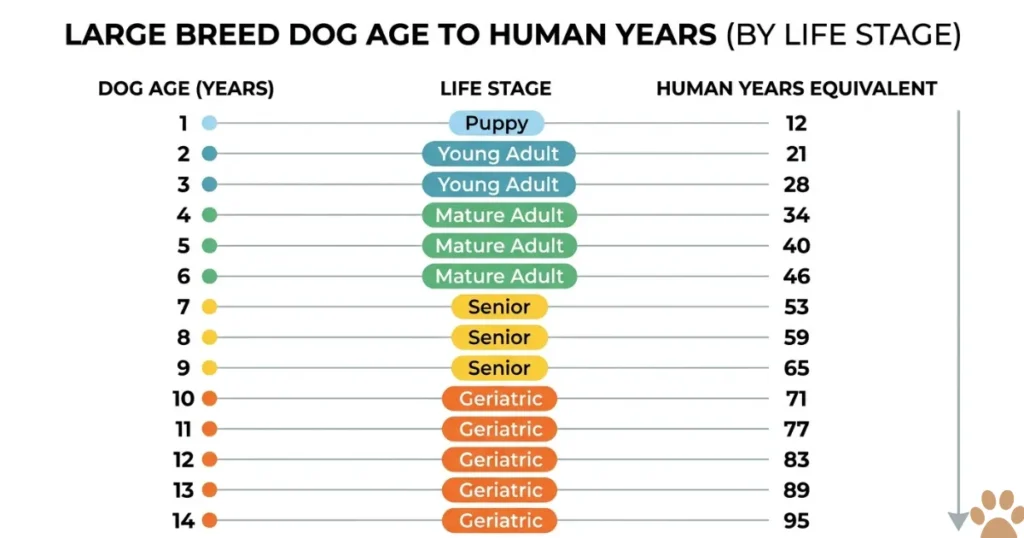
If you know your dog’s real age, the conversion runs on a curve, not a flat multiplier. The first year counts as about 15 human years, the second brings the total to about 24, and after that, a large breed like a golden adds roughly 6 to 7 human years per year. So a 5 years old golden is around 40, and a 7 years old is about 50.
That curve is why the ×7 rule fails. It was a rough guess from average lifespans, and the AKC has noted it was likely a marketing nudge to get owners into annual checkups. Dogs front-load their aging, so a 1 years old isn’t 7 in human terms; she’s closer to a 15 years old.
For the exact figure at any age, including the molecular estimate from the 2019 UCSD epigenetic study, you can run the numbers on our forward dog-age calculator. The rest of this page is for the other version of the question, the one where you don’t have a birthday to convert.
How to tell how old your dog is when you don’t know
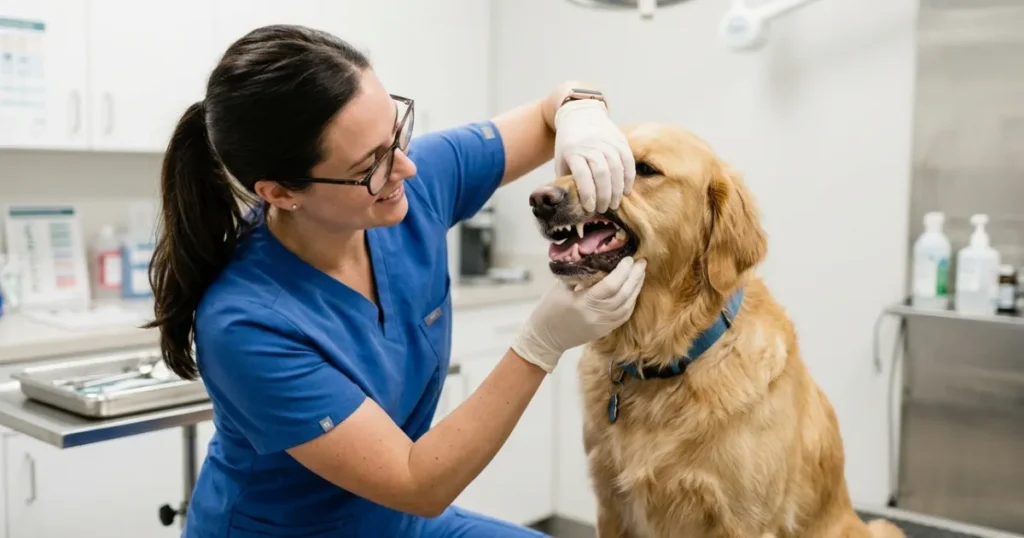
When there’s no paperwork, your vet reads the body like a timeline. You can do a rough version of the same read at home.
Start with the teeth
Teeth are the most reliable early clue. A puppy has all 42 permanent adult teeth in by about six months, clean and white, per PetMD and the AKC. Before that, the size and number of teeth pin age down tightly. After about a year, it gets fuzzy. Tartar buildup, staining, and wear increase with age, but genetics muddy it, and small breeds get worse dental disease than large dogs. For a Golden, that large-breed advantage means relatively cleaner teeth for longer, so don’t over-read mild tartar as “old.”
Then check the eyes and coat
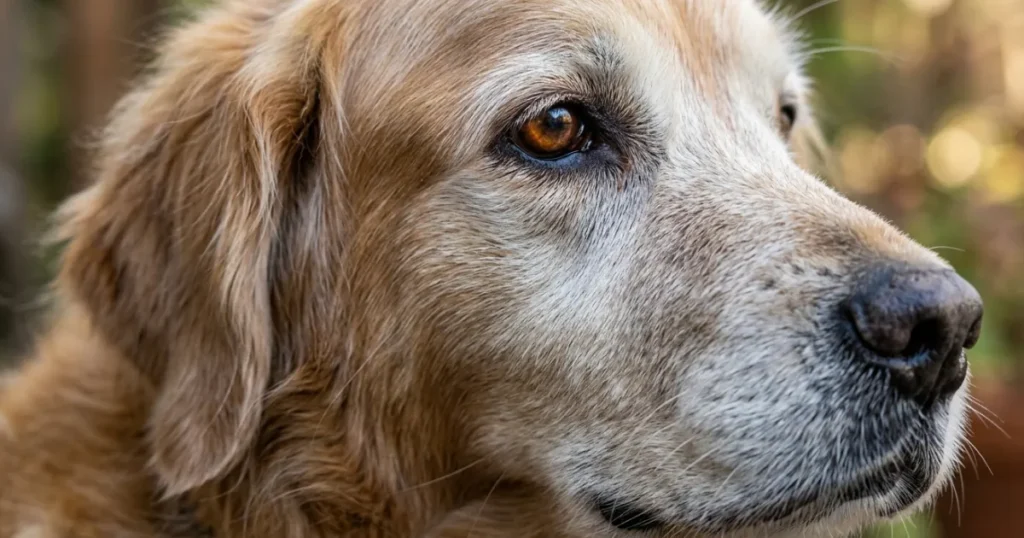
A bluish, hazy look to the lens, called nuclear or lenticular sclerosis, is common in middle-aged and older dogs and doesn’t harm vision, which sets it apart from cataracts. A graying muzzle and gray around the eyes and paws point to a mature adult, though some dogs gray early, so the coat is a soft signal, not proof.
Finish with the body and behavior
Muscle tone, stiffness after rest, and slowing energy round out the picture. None of these alone gives an exact number. Together, they place your dog in a life stage, which is what actually drives care. To convert that estimate once you have it, the age chart does the math.
Reading a Golden Retriever’s age, specifically
The general method works for any dog, but a Golden has quirks worth knowing. As a large breed, Goldens tend to keep cleaner teeth longer than small dogs, so tooth wear runs a little “behind” the calendar. Read a Golden’s teeth as a floor for age, not a ceiling.
The coat is its own puzzle. A Golden’s lighter feathering can hide early gray, and some Goldens lighten naturally with sun and age, so muzzle gray is a gentler clue here than on a dark-coated breed. Eye changes are more telling. I often see early nuclear sclerosis around the time a Golden crosses into senior territory at 7 to 8.
Here’s what I tell adopters. Anchor your estimate to the teeth and eyes, treat the coat as a tiebreaker, and then assume a Golden is closer to “senior soon” than the shelter’s cheerful guess. That bias toward older people is protective, because it gets screening started on time. The breed’s leading later-life threat, cancer, including hemangiosarcoma, is tracked by the Morris Animal Foundation’s Golden Retriever Lifetime Study, and early detection depends on knowing roughly where your dog sits.
Your Golden’s age by life stage, at a glance
Numbers matter less than stage, so here’s the quick reference I use. These are large-breed human-year estimates for a Golden. The peer-reviewed UCSD formula runs higher in the early years, and the pillar’s master chart shows both side by side.
| Your Golden’s age | Human-years (large breed) | Life stage |
| 1 yr | ~15 | Puppy |
| 2 yr | ~24 | Young adult |
| 3 yr | ~30 | Adult |
| 4 yr | ~36 | Adult |
| 5 yr | ~40 | Adult / early-mid |
| 7 yr | ~50 | Entering senior |
| 8 yr | ~55 | Senior |
| 10 yr | ~66 | Senior |
| 12 yr | ~77 | Senior |
| 14 yr | ~88 | Geriatric |
The American Animal Hospital Association frames these as five stages: puppy, young adult, mature adult, senior, and end of life. For a Golden, the senior switch flips around 7 to 8, earlier than the 10-ish mark for small dogs. The young ages get a deeper look in what 2, 3, and 4 mean in dog years, and the older ones at how old your Golden is at 9, 13, and 14.
What generic “how old is my dog?” tools miss for Goldens
Most quick calculators ask only for a birthday you might not have, then default to a “medium dog.” For an unknown-age, large-breed Golden, that’s two misses at once. The tool can’t help you estimate, and the size setting undercounts the later years.
The most common mistake I see is an adopter trusting a shelter’s round-number guess, plugging it into a medium-dog tool, and landing on a human age that feels reassuringly young. Understandable, because both inputs looked official. But in the golden retriever breed, that combination can delay senior screening by a year or more, right when early detection matters most.
The fix is to estimate first from teeth and eyes, biased slightly older for a large breed, then convert with a large-breed setting. When your estimate and the chart disagree, let the older read guide your caution. To pin your own dog against both directions, our reverse human to dog calculator helps sanity-check the result. Visit our website for health guides.
The How Old is my Dog Read
Here’s the simple read I give owners and adopters so a guessturns into a usable age. Work from top to bottom and stop when you have enough.
The How Old is my Dog Read:
Teeth:
All 42 adult teeth, clean and white → likely under ~2. Then convert with the chart. Light tartar on a Golden → don’t assume old; large breeds stay cleaner longer.
Eyes:
Clear lens → likely young adult. Bluish haze (nuclear sclerosis) → likely 7+ and entering senior. Then start a senior screening conversation with your vet.
Body:
Lean and springy → adult; stiff after rest or a gray muzzle on a Golden → mature to senior. Call your vet to set a baseline and, for a likely senior Golden, begin cancer-aware screening.
This read isn’t a diagnosis, and it won’t give a birthday. It gives a life stage, which is the thing that actually sets your Golden’s care.
How old is my dog in human years?
Convert on a curve: about 15 human years for year one, 24 by year two, then 6–7 per year for a large breed. A 5 years old Golden is roughly 40.
How can I tell how old my dog is without a birthday?
A vet estimates from teeth, eyes, coat, and muscle tone. All 42 adult teeth are in by about 6 months; then wear, a gray muzzle, and a cloudy lens suggest an older dog.
How old is my dog in dog years if I adopted her?
Estimate the stage from teeth and eyes first and then convert it. For a large-breed Golden, bias your guess slightly older so senior screening starts on time.
How accurate is guessing a dog’s age from teeth?
Very accurate under 6 months, much rougher after. Tartar and wear increase with age but vary by genetics, and large breeds keep cleaner teeth longer than small dogs.
What is a dog age chart in human years?
A quick reference that maps your dog’s real age to a human equivalent by life stage. A size-aware chart is more accurate, since large breeds age faster after two.
Is “dog age” the same as “dog age in human years”?
No. Dog age is the calendar age in years lived. Dog age in human years is that figure converted onto the human aging curve, which front-loads early years.
What’s a cloudy or bluish look in my older dog’s eyes?
Usually nuclear (lenticular) sclerosis, a normal aging change that doesn’t harm vision. Cataracts look similar but do affect sight, so a vet should confirm which it is.
Does a gray muzzle mean my dog is old?
Not always. Graying around the muzzle and eyes suggests a mature adult, but some dogs gray early, so treat coat color as a soft clue, not proof.
How do vets estimate a senior dog’s age?
By combining clues: worn or missing teeth, a cloudy lens, a gray coat, reduced muscle, and stiffness. No single sign is exact, so vets read them together.
Why does my dog seem older than the chart says?
Size and lifestyle shift the real figure. Large breeds age faster after two, and weight or health issues can push a dog’s biological age past the calendar number.
How old is my Golden Retriever in human years at 5?
About 40 for a large breed, or near 57 by the UCSD epigenetic formula. A 5 years old Golden is a healthy adult, not yet senior.
When is a Golden Retriever considered a senior?
Around 7 to 8 years old, earlier than small dogs. That’s when twice-yearly exams and cancer-aware screening become worthwhile for the breed.
Can I tell a Golden Retriever’s age from its coat?
Only loosely. A Golden’s feathering can hide early gray, and sun and age lighten the coat naturally, so teeth and eyes are more reliable than the coat for the breed.
What health checks follow once I know my Golden’s age?
Joint clearances in young adults (OFA at age 2) and cancer-aware screening in seniors, with conditions like hemangiosarcoma a focus per the Golden Retriever Lifetime Study.
When should I call the vet about my dog’s age-related changes?
Call promptly for a rapidly cloudy eye, sudden vision loss, or a new lump. Monitor at home for 24 hours for mild, gradual stiffness, then book a routine exam.
Conclusion
“How old is my dog?” has two answers, and you may need both. If you know the birthday, convert it on the curve: about 15 human years for year one, 24 by year two, then 6–7 a year for a large breed, putting a 5 years old Golden near 40. If you don’t, read the teeth, then the eyes and coat, and for a Golden, bias your estimate slightly older.
The one move worth making today is to turn your best age estimate into a life stage, then match the care, because for this breed, senior screening should start around 7 to 8, not whenever a guess catches up.
Did you adopt your Golden without knowing her age? Tell me in the comments how you and your vet estimated it, what the teeth or eyes told you, and how close the shelter’s guess turned out to be. Real estimation stories help the next adopter read their dog better.