
How long a dog can live with cancer depends almost entirely on type, ranging from a few weeks to several years. Aggressive cancers like hemangiosarcoma often allow only weeks to months, while lymphoma treated with chemotherapy averages around a year. The canine cancer prognosis turns on the type, stage, grade, and treatment.
How long a dog can live with cancer is the first question almost every owner asks after a diagnosis, and the honest answer is that it varies enormously. Some cancers steal only weeks, while others can be managed for years. The canine cancer prognosis depends on which cancer it is, how far it has spread, and what treatment is possible.
In my practice, I never give a single number because a number alone is misleading. A dog with a low grade mast cell tumor that is fully removed may live a completely normal lifespan, while a dog with hemangiosarcoma may have only weeks. This guide lays out realistic survival times by type, the factors that shape the outlook, and why a Golden Retriever’s prognosis swings so widely depending on which of the breed’s common cancers is involved. The goal is clarity, without false comfort or false despair.
How Long a Dog Can Live With Cancer? Why It Ranges From Weeks to Years
How long a dog can live with cancer is impossible to answer with one figure because canine cancer is not a single disease. It is dozens of different diseases that happen to share a name, and they behave in wildly different ways. One dog lives for years, another only weeks, and both technically had cancer.
A few patterns help make sense of the range. Cancers caught early, while still in one place, carry a far better prognosis than cancers that have already spread. Slow growing tumors allow more time than fast, aggressive ones. And cancers that respond to treatment, like lymphoma, can be held back for many months, while those that resist it, like hemangiosarcoma, move quickly no matter what. Timing matters too.
The same cancer found as a small, single lump carries a far brighter prognosis than that cancer found after it has spread to the lymph nodes or lungs. Two dogs with identical diagnoses, caught at different points, can have outcomes that are months or even years apart.
It also helps to know that survival figures are medians, the middle of a range. Half of dogs live longer than the median, sometimes far longer, and half live less. Your dog is an individual, not a statistic. The full picture of how these cancers first show up is covered in our pillar on Golden Retriever cancer symptoms, which helps you understand what you are facing before you weigh the prognosis.

Canine Cancer Prognosis by Type: A Survival Time Table
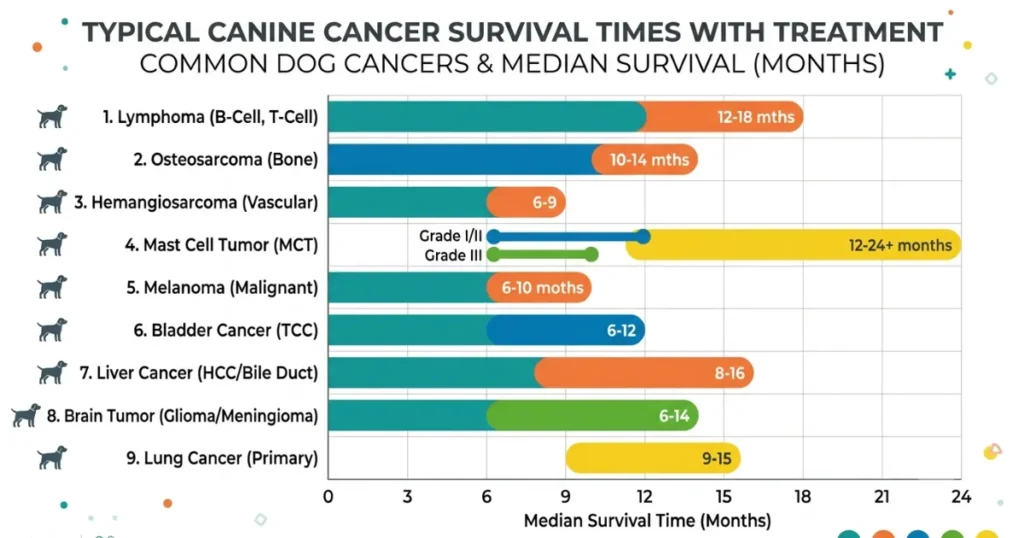
Because the canine cancer prognosis hinges on type, the most useful thing I can give you is a side by side look at the common cancers and their realistic survival times. The table below shows typical figures both without treatment and with the best standard treatment. These are averages drawn from veterinary oncology sources, and individual dogs vary widely.
Treatment here usually means buying good quality time rather than a cure, with a few exceptions where surgery can be truly curative. One note on reading the table. The with treatment figures reflect dogs who actually receive that treatment and tolerate it, so they describe a best realistic case rather than a guarantee. Benign tumors are left entirely alone, because once removed, they usually carry no shortened lifespan at all.
Canine Cancer Prognosis by Type: Typical Survival Times
| Cancer type | Without treatment | With treatment |
| Lymphoma | 1 to 2 months | 12 to 14 months on average |
| Hemangiosarcoma | Days to weeks | 2 to 7 months |
| Osteosarcoma (bone) | 1 to 4 months | Around 12 months with amputation and chemo |
| Mast cell tumor, low grade | Variable | Often cured if fully removed |
| Mast cell tumor, high grade | Weeks to months | 6 to 12 months |
| Mammary cancer, malignant | Under a year | 6 to 10 months, or cured if benign and removed |
| Oral melanoma | Under 2 months | 12 to 18 months or more at lower stages |
| Brain tumor, meningioma | 2 to 4 months | 6 months to over 2 years |
| Lung cancer, single primary | Months | Around 12 months with surgery |
| Liver cancer, massive tumor | Under a year | Around 4 years if surgically removed |
| Bladder cancer | 4 to 6 months | 6 to 12 months |
Several of these cancers have their own detailed guides on this site. You can read more on the outlook and the decisions involved for bladder cancer, a brain tumor, lung cancer, and liver cancer, each breaking down survival and quality of life in depth.
Two lessons jump out of this table. The first is that the same word, “cancer,” covers outcomes from a near certain cure to only days, so the diagnosis label alone tells you very little. The second is that for most of these cancers, treatment buys quality time rather than a cure, which makes your dog’s comfort during that time the real measure of success.
The 7 Factors That Determine Your Dog’s Cancer Prognosis
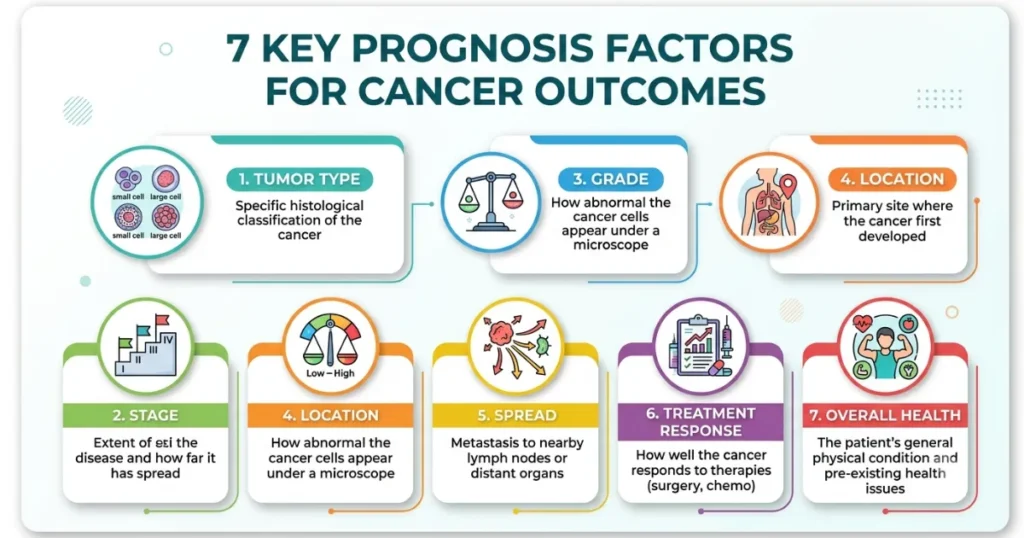
Two dogs with the same diagnosis can have very different outcomes, because the prognosis depends on more than the cancer’s name. Seven factors shape it most.
First is the type of cancer, the single biggest driver, as the table above shows. Second is the stage, meaning how far the cancer has spread, often described with the TNM system that looks at the tumor, the lymph nodes, and any metastasis. Third is the grade, how aggressive the cells look under a microscope, since a low grade tumor behaves far more gently than a high grade one. Fourth is location, because a tumor in an operable spot can be removed while one wrapped around vital structures cannot.
Fifth is whether the cancer has metastasized, or spread to distant organs, which almost always worsens the outlook. Sixth is the treatment chosen and how well the cancer responds to it. Seventh is your dog’s age and overall health, since a younger dog with no other illness tolerates treatment better and recovers more strongly.
Understanding these seven factors helps you ask your vet sharper questions and set realistic expectations for the canine cancer prognosis ahead, rather than fixating on a single frightening number. It is worth knowing which of these factors you can influence. You cannot change the type or the grade, but you can affect the stage at which the cancer is caught by acting quickly on early signs, and you can shape the treatment plan together with your vet. Those two levers, early action and informed choices, are where an owner makes the biggest difference.
Why a Golden Retriever’s Cancer Prognosis Depends on the Type
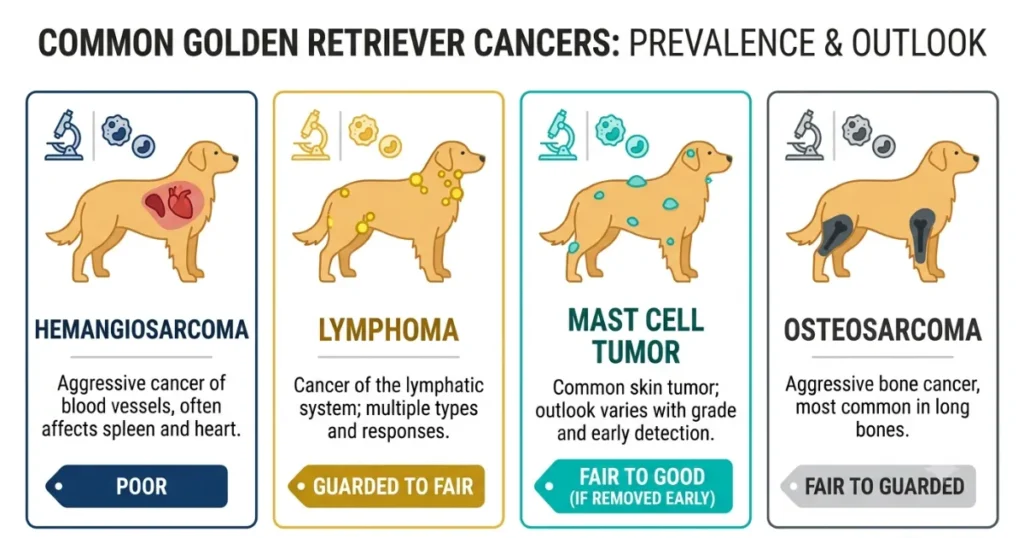
For Golden Retrievers, prognosis comes with a hard truth and a hopeful one side by side. The hard truth is that Goldens face one of the highest cancer rates of any breed. The Morris Animal Foundation’s long running study found that around three quarters of the study dogs’ deaths were cancer related, and of those, close to seventy percent involved hemangiosarcoma.
That is the painful part, because hemangiosarcoma carries one of the worst outlooks of any canine cancer, often only weeks to a few months even with treatment, as we explain in why a dog can bleed before dying. It is the breed’s most common cancer and one of its most aggressive. Osteosarcoma, the breed’s bone cancer, is also serious, and histiocytic sarcoma, another cancer seen in Goldens, carries a poor outlook too. Complicating matters, there is still no reliable early screening test for hemangiosarcoma, so it often hides until it bleeds.
Here is the hopeful part. The breed’s other common cancers carry far better outlooks. Lymphoma often responds well to chemotherapy for a year or more, and low grade mast cell tumors are frequently cured by surgery alone. So a Golden’s canine cancer prognosis is not one number. It swings from grim to genuinely good depending entirely on which cancer the diagnosis turns out to be, which is why pinning down the exact type and grade matters more for this breed than for almost any other.
How Treatment Changes the Prognosis
Treatment can transform a canine cancer prognosis, but it helps to understand what it realistically offers, which is usually time and comfort rather than a cure. Surgery is the most likely route to an actual cure, especially for a single, contained tumor like a low grade mast cell tumor or a massive liver mass that can be fully removed. When the whole cancer comes out and has not spread, some dogs are truly cured.
Chemotherapy works differently. For cancers like lymphoma, it does not cure, but it induces remission, a period when the cancer is dormant and the dog feels well, often for many months. Importantly, dogs tolerate chemotherapy far better than people do, and most keep a good quality of life throughout. Radiation therapy targets tumors that cannot be removed surgically, such as some brain tumors, and can extend good time.
Newer options are emerging as well, including a therapeutic vaccine used for oral melanoma that can lengthen survival and immunotherapy approaches under active study. These are not right for every dog or every budget, which is a fair part of the conversation, since cost and a dog’s tolerance for treatment matter alongside the medicine itself.
When a cure is not possible, palliative care steps in, using pain relief, anti-nausea medication, and steroids to keep a dog comfortable for whatever time remains. Choosing comfort over aggressive treatment is a valid, loving decision, not a failure. The right path depends on the cancer, the prognosis, and, above all, your dog’s quality of life.
A Prognosis Is Not a Deadline: Quality of Life, Early Signs, and the Road Ahead
The most important thing I tell families is that a prognosis is an average, not a deadline stamped on your dog. Plenty of dogs outlive their numbers, and what matters far more than the calendar is how your dog feels day to day. A good prognosis with poor quality of life is worse than a guarded one with happy, comfortable days.
This is also where early detection earns its place. Catching the early signs of canine cancer, such as a new lump, unexplained weight loss, lasting lethargy, or abnormal bleeding, often means catching the disease while the prognosis is still good. The earlier the signs of cancer are found and diagnosed, the more treatment options remain open, which is the single best thing an owner can do to improve the outlook.
When the prognosis is poor and the time grows short, our guides on the stages of cancer leading to death and knowing when it is time to say goodbye can help you face what comes next with compassion. For ongoing support, our Golden Retriever health library is always here. Whatever the prognosis, your love and your daily care shape your dog’s experience more than any statistic ever will.

Expert Insight
The most useful mindset I can offer is to treat a prognosis as a weather forecast, not a sentence. It tells you what is likely, not what is certain. I have seen dogs given weeks to live a year, and the reverse. So learn your dog’s specific numbers, then set them aside and focus on good days. That is where the real time is found.
Canine cancer prognosis at a glance
| Outlook tier | What it tends to mean | Example cancers |
| Often good | A cure or long, comfortable time is possible | Low grade mast cell tumor, benign mammary tumor, massive liver tumor removed |
| Guarded | Treatment buys good months to a year or more | Lymphoma, bladder cancer, a single primary lung tumor |
| Poor | Often only weeks to a few months | Hemangiosarcoma, osteosarcoma, advanced metastatic cancer |
How long a dog can live with cancer?
It depends entirely on the type, from a few weeks with aggressive cancers like hemangiosarcoma to several years with treatable ones. The canine cancer prognosis turns on type, stage, grade, and treatment.
What is the prognosis for canine cancer?
The canine cancer prognosis ranges from poor to excellent. Lymphoma averages around a year with chemotherapy, hemangiosarcoma only weeks to months, and a fully removed low grade tumor can mean a normal lifespan.
Which dog cancers have the best prognosis?
Low grade mast cell tumors removed by surgery, benign mammary tumors, and a resected massive liver tumor carry the best prognosis. Lymphoma also responds well, around twelve to fourteen months, to chemotherapy.
Which dog cancers have the worst prognosis?
Hemangiosarcoma has one of the worst outlooks, often only weeks to months even with treatment. Osteosarcoma, high grade and metastatic cancers, and advanced oral melanoma also carry a poor prognosis.
How long a dog can live with cancer without treatment?
Without treatment, survival is much shorter. Lymphoma may allow one to two months, osteosarcoma one to four months, and hemangiosarcoma only days to weeks after a bleed. Comfort care can still keep these dogs peaceful.
What happens if a dog’s cancer is caught early?
Catching cancer early usually means a much better prognosis. A smaller, localized tumor is more likely to be fully removed by surgery before it spreads, which is why early signs of canine cancer matter so much.
Do Golden Retrievers have a worse cancer prognosis?
Goldens face very high cancer rates, and their most common cancer, hemangiosarcoma, carries a poor prognosis. But other common ones, like lymphoma and low grade mast cell tumors, often respond well, so the outlook depends on the type.
Why do Golden Retrievers get so much cancer?
Golden Retrievers carry a strong genetic predisposition to cancer, and studies attribute around sixty percent of deaths in the breed to it. The exact genes are still being studied through the Golden Retriever Lifetime Study.
Can Golden Retrievers be cured of cancer?
Sometimes. Low grade tumors fully removed by surgery and some massive liver tumors can be cured. Most others, including hemangiosarcoma and lymphoma, are not curable, but treatment grants good time.
Is it safe to treat dog cancer with chemotherapy?
Yes, and dogs tolerate chemotherapy far better than people do. Because the goal is quality of life, doses are gentler, and most dogs keep eating, playing, and feeling well, with only mild side effects.
How is canine cancer prognosis determined?
Vets determine the prognosis from the cancer type, stage, grade, location, spread, and the dog’s overall health. Staging tests like bloodwork, imaging, and biopsy guide the estimate.
What are the early signs of canine cancer?
Common early signs of canine cancer include a new or growing lump, unexplained weight loss, lasting lethargy, abnormal bleeding, non healing sores, and appetite changes. Any of these in an older dog warrants a vet’s visit.
How long a dog can live with cancer in remission?
A dog in remission, most often from lymphoma, can feel completely normal, frequently for many months to over a year. Remission means the cancer is dormant, not gone, but the quality of life is usually excellent.
Are survival times for dog cancer accurate?
Survival times are medians, meaning half of dogs live longer and half shorter. They are useful guides, not predictions for an individual. Type, treatment response, and overall health move the real outcome either way.
When should I see a vet about my dog’s cancer prognosis?
See your vet as soon as you notice possible signs of canine cancer, or after any diagnosis, to get staging and a realistic prognosis. Early information opens more treatment options and protects quality of life.
Conclusion
How long a dog can live with cancer has no single answer, because the prognosis depends on the type, stage, grade, and treatment you choose. Some cancers, like hemangiosarcoma, allow only weeks, while a removed low grade mast cell tumor or a massive liver tumor can mean years or even a cure.
For a Golden Retriever, the outlook swings widely with the diagnosis, so pin down the exact type before you despair or hope. Remember that survival figures are averages, not deadlines, and catching the early signs of canine cancer keeps the prognosis on your side. Above all, let quality of life, not a number, guide the road ahead.
If your dog has faced a cancer diagnosis, what was the prognosis you were given, and how did your dog’s actual journey compare? Your experience, shared below, could bring realistic hope or honest comfort to another owner who needs it. What helped you most after the diagnosis?