An 8 week old golden retriever weighs about 10 pounds on average and is ready to leave its mother for a new home. Expect a curious, sleepy, sometimes timid puppy that needs frequent potty trips, gentle socialization, and its first vaccinations. This is the week real training and bonding begin.
Eight weeks is the week everything changes. Your puppy leaves the litter, meets a new family, and starts learning what life will look like from here.
It is exciting and a little daunting. This guide covers what to expect from an 8 week old golden retriever, healthy weight ranges, the first days of home, feeding, early training, and the health basics that matter now. For where this milestone sits on the full timeline, see our Golden Retriever growth chart.
What to expect from an 8 week old golden retriever
Size and appearance
An 8 week old golden retriever is a soft, round bundle of about 10 pounds, with a fluffy coat that is usually lighter than the adult color to come. The ears are floppy, the paws look slightly too big, and the whole puppy is built for cuteness.
At 8 weeks the needle-sharp baby teeth are all in, which is why chewing and mouthing ramp up now. An 8 week old golden retriever also has a surprisingly loud voice for its size, and it will use that voice when lonely, bored, or overtired.
Personality is already showing. By this age you can see hints of a bold explorer or a cautious watcher, though plenty will change as the puppy grows.
Personality and energy at 8 weeks
Expect short bursts of frantic play followed by long, deep naps. An 8 week old puppy sleeps around 18 to 20 hours a day, and that sleep is when growing happens, so let a napping puppy rest. Between naps, expect the classic puppy zoomies, short frantic laps around the room that end in a sudden crash. That is healthy energy release, not misbehavior, and a good sign of a thriving puppy.
This stage also builds on the newborn weeks. If you want the earlier picture, see the newborn stage before this. For how this fits the breed, browse the rest of our breed guides and the wider Golden Retriever Insights.
8 week old golden retriever weight and growth
Average weight at 8 weeks
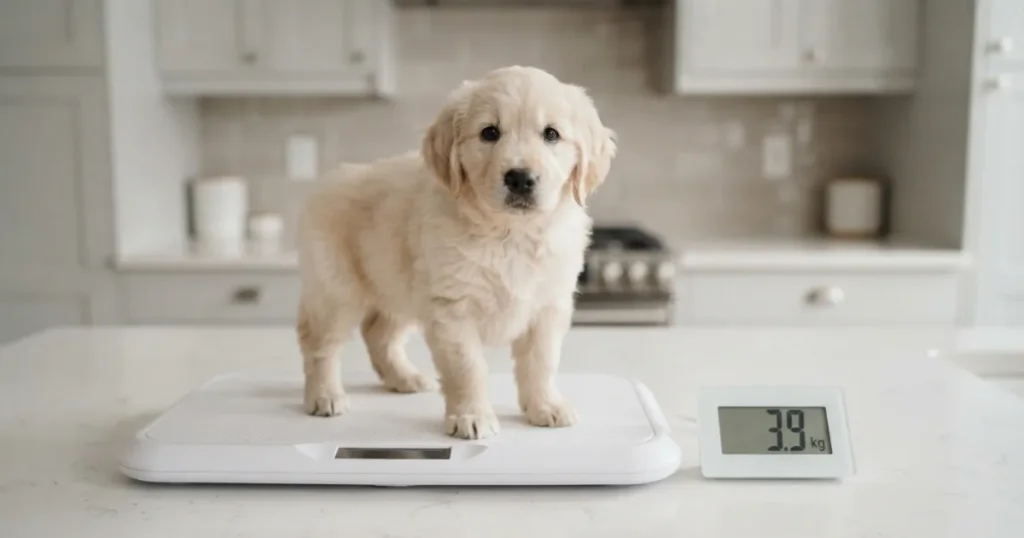
The typical 8 week old golden retriever weighs around 10 pounds, with a healthy range of roughly 8 to 15 pounds. Males sit a little heavier than females, though the two are close at this age.
Littermates vary widely, and a smaller puppy from a big litter often catches up. The exact number matters less than a steady upward trend.
| Age | Male weight | Female weight |
| 7 weeks | 8 to 13 lb | 6 to 11 lb |
| 8 weeks | 10 to 15 lb | 8 to 13 lb |
| 9 weeks | 12 to 17 lb | 10 to 15 lb |
| 10 weeks | 14 to 20 lb | 12 to 17 lb |
What healthy growth looks like now
Between 8 weeks and 4 months, an 8 week old golden retriever grows faster than at any other time. Aim for steady gains, not the top of the range, since fast growth stresses developing joints in this large breed.
Judge condition with your hands. You should feel the ribs under a thin layer of fat. For the full month-by-month picture, see the stage by stage growth map.
Resist the urge to fatten up a roly-poly puppy. A lean 8 week old golden retriever with plenty of energy is exactly right, and keeping growth moderate now lowers the risk of hip and elbow problems later.
Bringing home an 8 week old golden retriever puppy
The first 48 hours
Bringing home an 8 week old golden retriever puppy works best when you keep the first days calm. Use the same food the breeder used to avoid stomach upset, and switch brands slowly over a week if you want to change.
Keep visitors few and quiet at first. Your puppy is processing an enormous amount of newness, so a predictable, gentle routine helps it settle. Start using your puppy’s name in happy moments from day one, and keep the first days low key. There is plenty of time for visitors and adventures once your puppy feels safe and settled.
The first night
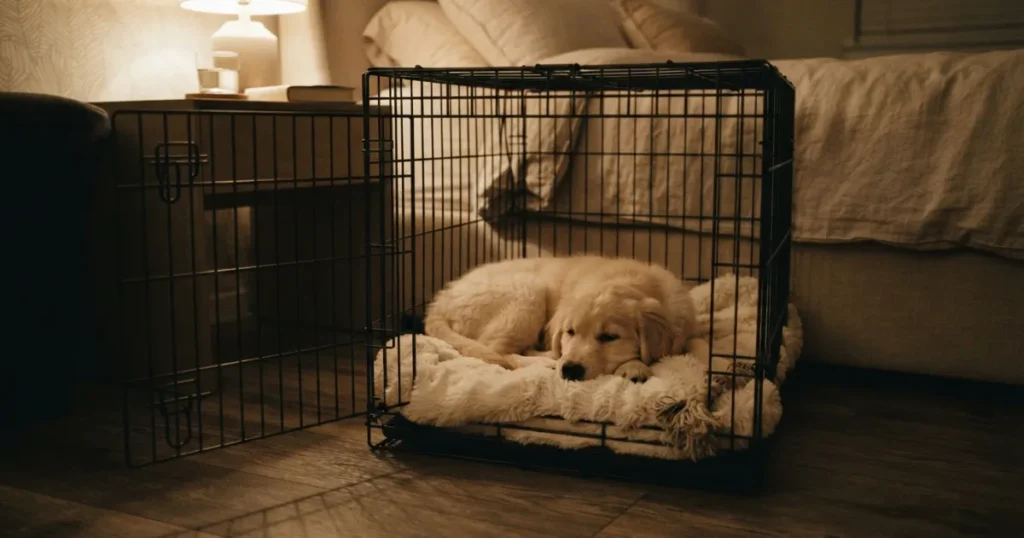
The first night is often the hardest. Set up a crate beside your bed so your puppy can hear and smell you, which eases the stress of the first nights away from the litter.
Expect some crying. A warm, safe crate, a last potty trip before bed, and a calm response to whimpers usually settle a puppy within a few nights. Avoid bringing the puppy into your bed to soothe it, since that habit is hard to undo later. A hand resting on the crate or a soft ticking clock nearby is often comfort enough.
Puppy-proofing your home
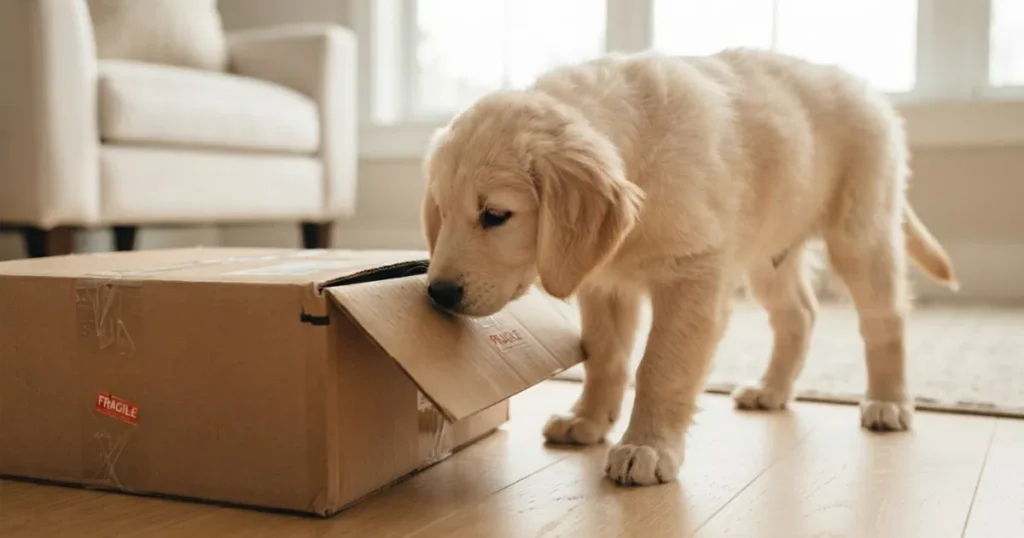
Get down to puppy height and look for hazards. Tuck away cords, remove toxic plants, and move shoes and small objects that invite chewing.
A confined, safe space with a bed, water, and a couple of chew toys gives your puppy somewhere secure to be when you cannot watch every second. A baby gate or playpen makes this far easier than supervising a curious puppy in an open house. Think of it as setting your puppy up to succeed rather than restricting it.
Feeding your 8-week-old golden retriever
How much and how often
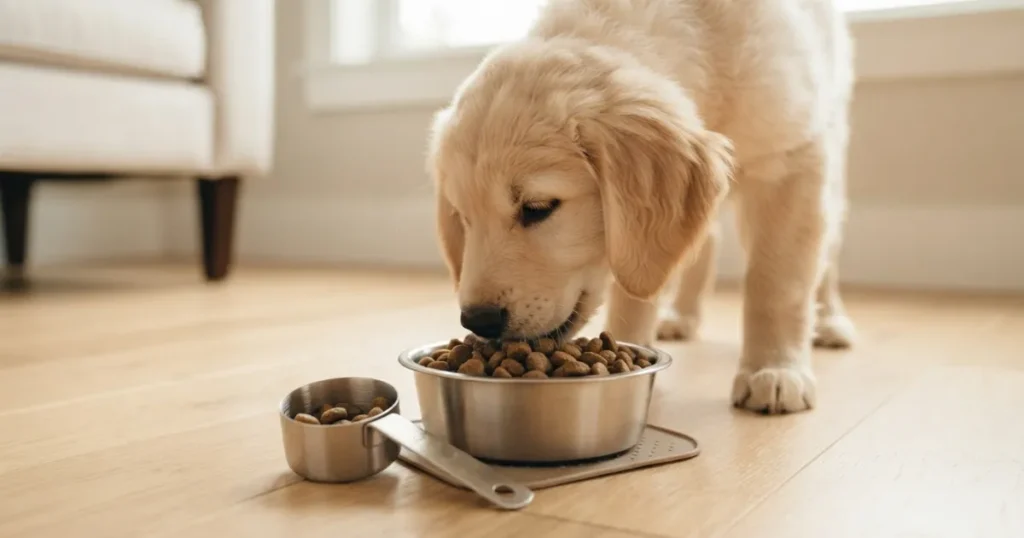
At 8 weeks, feed three to four small meals a day, spread across the day to match a small stomach. A rough starting point is a third to a half cup of large-breed puppy food per meal, but let your vet set the exact amount for your puppy.
Keep fresh water available at all times. Watch the ribs and body shape rather than emptying the bowl, and adjust portions as your puppy grows. Free-feeding, where food is left out all day, makes house training harder and hides how much your puppy is really eating. Scheduled meals give you a clear picture and a natural potty rhythm.
Choosing the right food
Pick a food formulated for large-breed puppies. These are calorie and calcium controlled to keep growth steady, which protects the joints of a fast-growing breed.
Avoid rich table scraps and sudden food changes, both of which upset a young stomach. When in doubt, your vet is the best guide to your dog’s needs. If you do change brands, mix a little more of the new food into the old over about a week. A sudden switch is a common cause of an upset puppy stomach.
Training and socialization at 8 weeks
Start house training and crate training
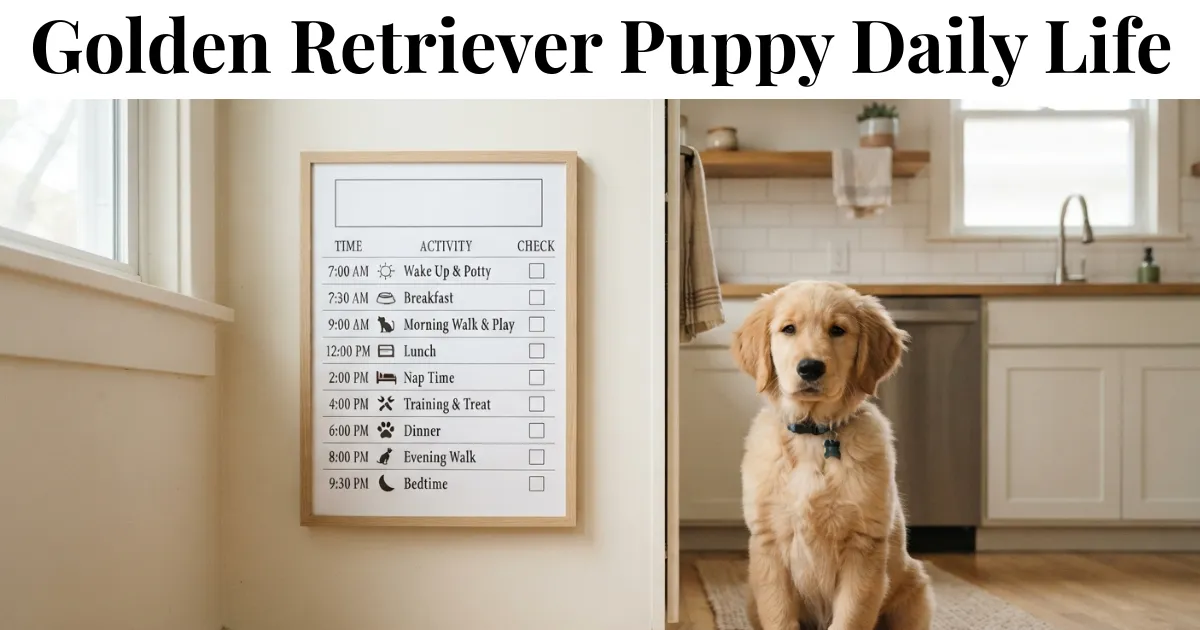
House training starts the moment your puppy comes home. Take your 8 week old golden retriever out every hour or two, and always after meals, naps, and play, then reward every success outside right away.
Crate training builds on the same idea. A crate becomes a safe den, helps with house training, and gives your puppy a calm place to rest. Never use the crate as punishment, or your puppy will learn to dread it. Keep early crate time short and positive, with a chew toy and a calm voice, then build up the minutes slowly.
The socialization window
Weeks 3 to 14 are the prime socialization window, so 8 weeks sits right in the sweet spot. Gently introduce new sounds, surfaces, people, and calm, vaccinated dogs, keeping every experience short and positive.
For the behavior map that runs alongside these weeks, see how puppy behavior unfolds. Good early socialization now shapes a calm, confident adult. Aim for quality over quantity. A few calm, positive new experiences each day do far more good than one overwhelming outing that leaves your 8 week old golden retriever frightened.
The 8 week fear period
Many puppies enter a fear period around 8 weeks, when scary experiences can leave a lasting mark. This is why socialization must be gentle, never forced.
The table below sorts helpful early experiences from ones to avoid for now.
| Do at 8 weeks | Avoid at 8 weeks |
| Introduce new sounds gently | Overwhelming or frightening events |
| Invite calm, vaccinated dogs over | Busy dog parks and unknown dogs |
| Handle paws, ears, and mouth daily | Forcing a scared puppy forward |
| Reward calm curiosity | Punishing fearful behavior |
Health, vaccinations, and grooming at 8 weeks
First vaccinations and vet visit
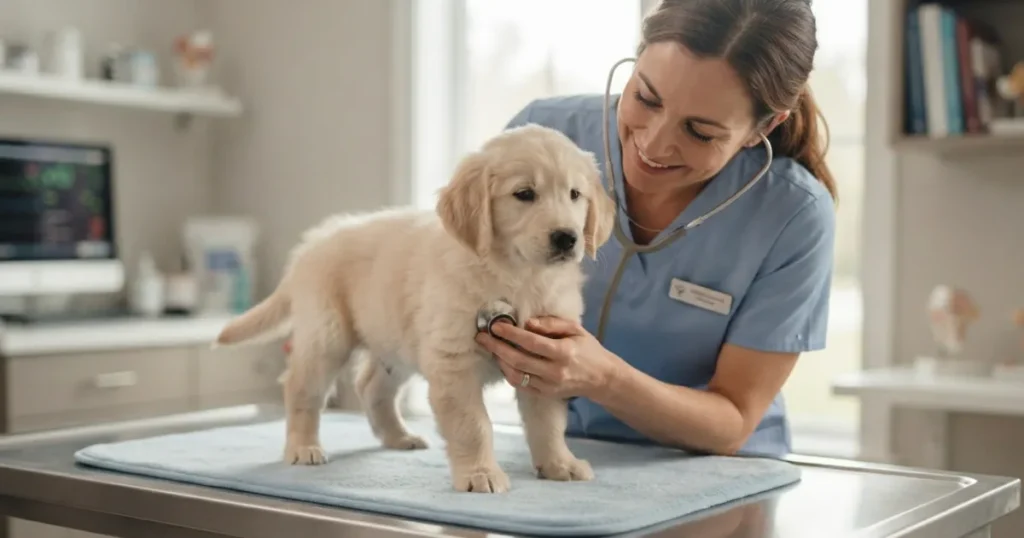
By 8 weeks your puppy should have had its first vaccinations, usually against distemper and parvovirus, often given as a combined DHPP shot. Book a vet check within the first few days of home to confirm the schedule.
Because immunity is not complete yet, avoid public places and unknown dogs until the vaccine course is further along, often around 16 weeks. Your vet will confirm when it is safe to venture out. In the meantime you can still socialize safely by carrying your puppy in busier places, hosting calm visitors at home, and inviting healthy, vaccinated adult dogs onto your own clean ground.
Deworming and parasite prevention
Most puppies are dewormed before 8 weeks and continue on a schedule set by the vet, since puppies commonly carry parasites from birth. Ask about flea, tick, and heartworm prevention suited to your dog’s age and region.
Bring any records from the breeder to the first appointment so your vet can pick up the schedule without gaps. Keep an eye on the stool in these weeks too. Soft stool, visible worms, or a pot-bellied look are common in young puppies and are usually simple for your vet to treat.
Gentle grooming introductions
Start grooming now, while it is easy to shape a positive habit. Brush the coat briefly, touch the paws and nails, and lift the lips to look at the teeth, rewarding calm behavior each time.
Short, happy sessions now make future nail trims, ear cleaning, and vet exams far less stressful for both of you. Goldens are heavy shedders as adults, so teaching an 8 week old golden retriever to enjoy the brush now is an investment that pays off for years.
From 8 weeks to the months ahead
Growth speeds up from here. Your puppy will move through life at three months and the four months stage, reaching about half its adult weight by four months.
The lanky adolescent months follow, all the way to your dog at twelve months. Each stage builds on the routines you set in these first weeks home. The consistency you show now, with feeding, potty trips, and gentle handling, is the foundation every later stage rests on.
Expert Insight
The biggest mistake I see at 8 weeks is owners either over-isolating a puppy out of fear of germs or over-exposing it in busy public places too soon. The sweet spot is controlled socialization and lots of new but safe experiences at home and with healthy, vaccinated dogs.
First 48 hours.
Keep things calm and quiet. Offer the same food the breeder used, in small meals. Take your puppy out to potty every hour or two and right after meals, naps, and play. Set up a crate for safe sleep, and book a vet check within the first few days.
What is the average 8 week old golden retriever weight?
The average 8 week old golden retriever weighs about 10 pounds, with a healthy range near 8 to 15 pounds. Males run slightly heavier than females. A steady upward trend matters more than any single reading.
How much should I feed an 8 week old golden retriever puppy?
Feed an 8 week old golden retriever puppy three to four small meals a day, roughly a third to a half cup of large-breed puppy food per meal. Let your vet set the exact amount, and watch body condition.
Can an 8-week-old golden retriever leave its mother?
Yes. Eight weeks is the recommended age to leave the litter, since the puppy is weaned and has learned early social skills. Leaving much earlier can lead to behavior problems, so reputable breeders wait until now.
How much does an 8 week old golden retriever sleep?
A lot. Expect around 18 to 20 hours of sleep a day, in short cycles of play and deep rest. Growing happens during naps, so let a sleeping puppy rest and avoid overstimulation.
When does an 8 week old golden retriever get vaccinated?
First vaccinations usually happen between 6 and 8 weeks, so your puppy likely has its first shot on arrival. Boosters continue every few weeks until about 16 weeks, on a schedule your vet confirms.
Is it normal for an 8 week old golden retriever to be scared?
Yes. Many puppies enter a fear period around 8 weeks and can seem timid or startled. This passes with gentle, positive experiences. Never force a frightened puppy, since bad scares at this age can linger.
How often should an 8 week old puppy pee?
Very often. Plan a potty trip every one to two hours, plus right after meals, naps, and play. Young puppies have little bladder control, so frequent trips and quick rewards make house training much faster.
Can I start training an 8 week old golden retriever?
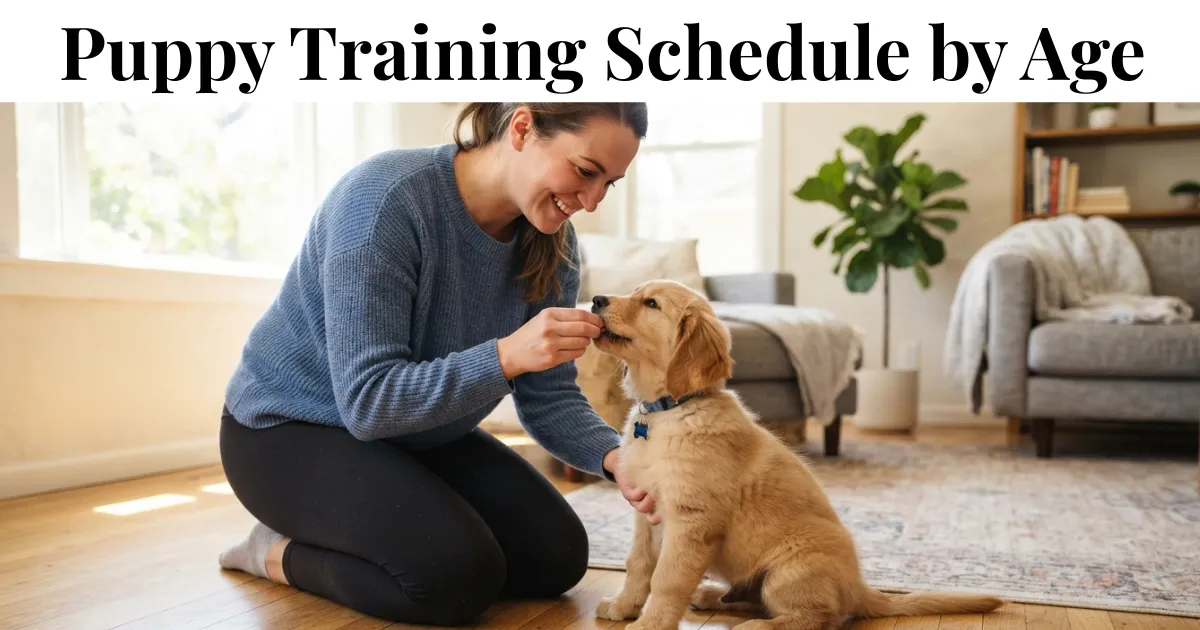
Absolutely. House training, crate training, and simple cues like “sit” begin now. Keep sessions short, playful, and reward-based. Early, gentle training sets the foundation for the more focused work of the coming months.
When can my 8 week old golden retriever meet other dogs?
Meet only calm, healthy, fully vaccinated dogs in safe settings for now. Avoid dog parks and unknown dogs until the vaccine course is further along, usually around 16 weeks, when your vet gives the go-ahead.
Why is my 8 week old golden retriever biting so much?
Puppy mouthing is normal exploration and teething. Redirect to a chew toy every time, and yelp or pause play if teeth touch skin. It fades with consistency, never with punishment, over the coming weeks.
How do I survive the first night with a puppy?
Place the crate beside your bed so your puppy can sense you. Offer a last potty trip, keep the room calm, and respond gently to crying. Most puppies settle into the routine within a few nights.
Is my 8 week old golden retriever the right weight?
Check body condition rather than the scale alone. You should feel the ribs under a thin layer of fat and see a slight waist. If the ribs are buried or sharply visible, ask your vet.
The bottom line
An 8 week old golden retriever is a roughly 10-pound sponge for new experiences, which makes these first weeks of home some of the most important of its life. Keep growth steady, keep socialization gentle, and keep the routine predictable. Small, consistent habits at this age beat any single big effort.
Focus on the basics and the rest follows. Frequent potty trips, calm nights, a large-breed puppy food, early vaccinations, and lots of safe, positive introductions are what turn a nervous new arrival into a confident young dog. Watch body condition over the scale, lean on your vet for the details, and enjoy this stage, because it passes fast.
The puppy in front of you today will be close to twice this size in a month. Take plenty of photos while your 8 week old golden retriever still fits in your arms.
Are you counting down to pickup day, or is your 8 week old puppy already home and running the show? Tell us the trickiest part of these first weeks in the comments.