
How long a dog can live with cancer ranges from weeks to several years, and the biggest factor is the type. Lymphoma with chemotherapy averages about a year; a low grade skin tumor removed by surgery can mean a normal lifespan, while hemangiosarcoma often allows only weeks to months. The exact cancer is the key.
How long can a dog live with cancer is the question every owner needs answered after a diagnosis, and the honest reply is that it depends almost entirely on the type of cancer. Some are slow and treatable, granting years, while others move fast and allow only weeks.
Rather than a single number, this guide walks through the common canine cancers one by one, from lymphoma and skin cancer to bone, blood, lung, liver, and bladder cancer, with realistic life expectancies for each. Because Golden Retrievers face high cancer rates, knowing what each diagnosis typically means helps you plan and make the most of the time you have. For the factors that shape these numbers and how treatment affects them, our companion guide on canine cancer prognosis goes into greater depth. Here, the focus is simple: How long can a dog live with cancer of each specific type?
How Long Can a Dog Live With Cancer? Why the Type Matters Most
How long can a dog live with cancer cannot be answered with one figure, because cancer is not one disease. The word covers dozens of conditions that behave very differently, so a diagnosis of lymphoma and a diagnosis of hemangiosarcoma point to completely different timelines.
The type sets the baseline, and then a few things shift it. Catching the cancer early, before it spreads, usually means longer. The grade, or how aggressive the cells look under the microscope, matters too, as does whether treatment is pursued and how well the cancer responds. We cover those drivers in depth in our guide to canine cancer prognosis, so this article stays focused on the survival times themselves. To see how much the type matters, consider two dogs diagnosed on the same day.
One has lymphoma and, with chemotherapy, may enjoy well over a year of normal life. The other has hemangiosarcoma and may have only weeks left. Same word, cancer, and yet completely different roads, which is why the sections below are organized by type so you can find the answer that fits your dog.
One reminder before the numbers. Every figure here is a median, the middle of a wide range, which means half of dogs live longer and many live far longer. Your dog is an individual, not a statistic. To understand how each cancer first appears, our pillar on Golden Retriever cancer symptoms is the place to start.
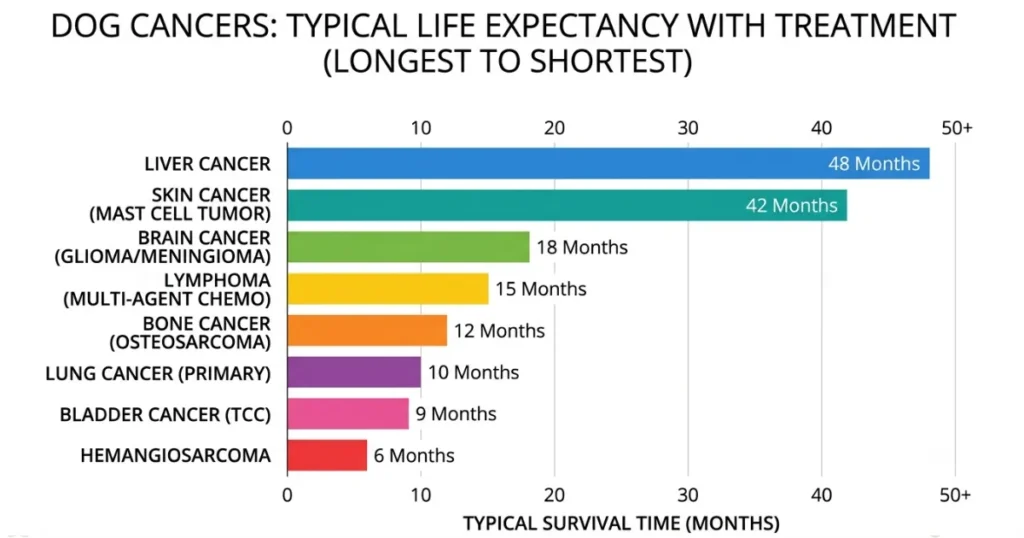
Life expectancy by cancer type, best to worst
| Cancer type | Typical life expectancy with treatment |
| Liver cancer, single massive tumor | Up to around 4 years |
| Skin cancer, low grade mast cell | Often a normal lifespan |
| Brain tumor, meningioma with radiation | 6 months to over 2 years |
| Lymphoma | 12 to 14 months |
| Lung cancer, single primary | Around 12 months |
| Bone cancer, amputation and chemo | Around 12 months |
| Bladder cancer | 6 to 12 months |
| Hemangiosarcoma | 2 to 7 months |
How Long Can a Dog Live With Lymphoma?
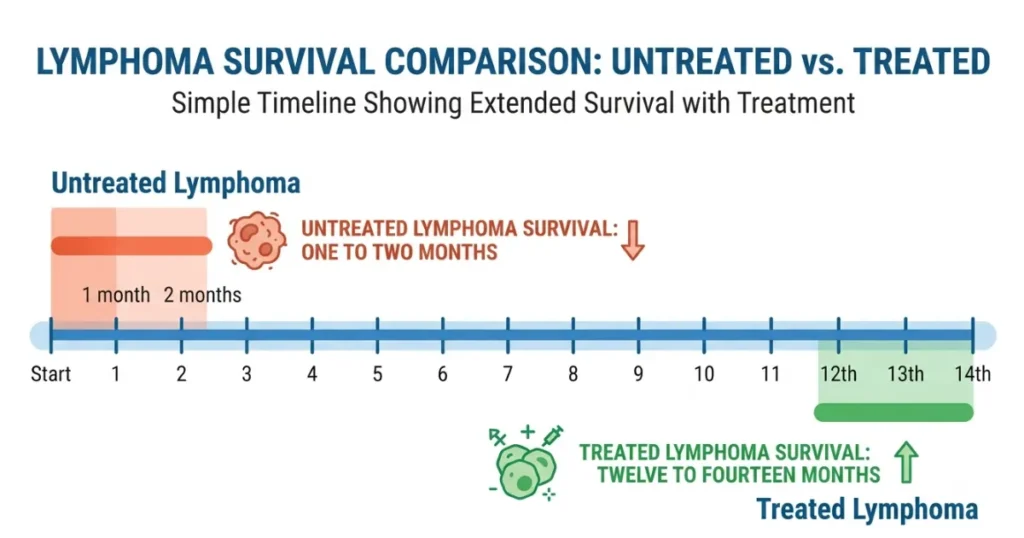
Lymphoma is one of the most common cancers in dogs and, encouragingly, one of the most treatable. So how long can a dog live with lymphoma? Without treatment, the answer is sobering, usually just one to two months, because lymphoma progresses quickly once it takes hold.
With chemotherapy, the picture changes dramatically. Around eighty to ninety percent of dogs reach remission, and the average survival climbs to roughly twelve to fourteen months, with some dogs living well beyond that. Dogs with low grade or indolent lymphoma can live for years. The subtype matters, since B cell lymphoma generally carries a better outlook than T cell lymphoma, which tends to be more aggressive and may allow closer to six months.
Stage plays a role too. Lymphoma is graded in five stages based on how many lymph nodes and organs are involved, and earlier stages generally respond better. Most dogs eventually relapse out of remission, but a second round of chemotherapy can often win back more good time, which is why lymphoma is treated as a manageable disease rather than an immediate goodbye.
What makes lymphoma different from many cancers is that dogs usually feel well during treatment. Chemotherapy for dogs is gentle by design, aimed at quality of life, so most keep eating, playing, and enjoying their days while in remission. Remission is not a cure, since the cancer is dormant rather than gone, but it can buy many happy months. For that reason, lymphoma is often one of the more hopeful answers to how long can a dog live with cancer.
How Long Can a Dog Live With Skin Cancer?
Skin cancer in dogs covers several tumor types, and the life expectancy depends heavily on which one and how early it is caught. The two that matter most are mast cell tumors and melanoma.
Mast cell tumors are the most common skin cancer in dogs, and their outlook varies with grade. A low grade mast cell tumor that is completely removed by surgery often carries an excellent prognosis, sometimes amounting to a cure with a normal lifespan. A high grade mast cell tumor, or one that has spread to the lymph nodes, is far more serious, with a life expectancy of roughly six to twelve months even with treatment.
Melanoma is the other key skin cancer. On the skin or in the mouth of older dogs, it can be aggressive. Without treatment, oral melanoma often allows less than two months, but caught at a lower stage and treated with surgery, dogs can live well over a year, and some reach two to three years. Other skin cancers exist too, such as squamous cell carcinoma, which is often slow growing and treatable when caught early.
The reassuring reality is that most lumps and bumps on a dog are benign, such as fatty lipomas, so a new growth is not automatically cancer. Still, the lesson with skin cancer is that early removal of any new or changing lump gives the best possible answer to how long can a dog live with cancer of the skin.

How Long Can a Dog Live With Bone Cancer or Hemangiosarcoma?
Two of the most aggressive cancers in dogs, and sadly two that Golden Retrievers are prone to, are bone cancer and hemangiosarcoma. Both carry difficult answers.
Bone cancer, usually osteosarcoma, is painful and spreads early to the lungs. Without treatment, the pain alone usually limits life expectancy to around one to four months. The standard treatment, amputating the affected limb followed by chemotherapy, extends the average to close to a year, and about one in five dogs is still enjoying life two years later. Palliative care that controls pain without surgery typically gives around six months. Osteosarcoma most often strikes the limbs of large breeds, which is why a sudden limp or swelling on a leg in an older Golden should never be ignored.
Hemangiosarcoma is a cancer of the blood vessel lining, often striking the spleen, heart, or liver, and it is the most common cancer in Golden Retrievers. It is known as a silent killer because it frequently causes sudden internal bleeding, which we explain in why a dog can bleed before dying.
After a bleeding episode without surgery, life expectancy is often only days to weeks. With surgery and chemotherapy, most dogs live two to seven months, and survival beyond a year is rare. On a kinder note, hemangiosarcoma that appears in the skin rather than an internal organ tends to carry a better outlook, since it can often be removed before it spreads. Even so, these are among the hardest answers to how long can a dog live with cancer.
How Long Can a Dog Live With Lung, Liver, Bladder, or Brain Cancer?
The organ cancers each have their own detailed guides on this site, so here is the short version of how long a dog can live with each, with links to go deeper.
Lung cancer varies with type. A single primary lung tumor removed by surgery averages around twelve months, while metastatic spread to the lungs, more common in Goldens, usually allows only weeks to months, as our full guide on lung cancer and when to put a dog down explains. Liver cancer swings the widest of all. A single massive liver tumor removed by surgery can grant around four years, while inoperable or spread liver cancer allows roughly three to six months, as detailed in liver cancer and when to euthanize.
Bladder cancer, usually transitional cell carcinoma, typically allows four to six months without treatment and six to twelve months with it, but it’s covered in the final stages of bladder cancer. A brain tumor gives around two to four months with palliative steroids or six months to over two years with radiation or surgery, as explained in a dog brain tumor and when to euthanize.
For every one of these organ cancers, the exact type and stage drive the timeline, which is why a precise diagnosis matters so much. Each figure assumes the specific tumor type named. A cancer found in an organ may be a treatable primary tumor or a sign that another cancer has spread there, and those two situations carry very different timelines.

For a Golden Retriever, How Long and How to Make the Most of It
For Golden Retrievers, the answer to how long can a dog live with cancer is especially hard to pin down, because the breed’s four most common cancers span the entire range. Hemangiosarcoma, the most frequent, is among the worst, while lymphoma and low grade mast cell tumors can allow a year or more, and osteosarcoma sits in between. So a Golden’s timeline hinges entirely on which cancer is diagnosed.
Whatever the type, a few things help you make the most of the time. First, pin down the exact diagnosis and grade, since it changes everything. Second, weigh treatment realistically, choosing what protects quality of life rather than merely extending days. Third, track good days against bad so you can see the trend honestly. Fourth, keep your dog comfortable with your vet’s help. Fifth, cherish the ordinary moments, which is where the real time is found.
When the time does grow short, our guides on the stages of cancer leading to death and knowing when it is time to say goodbye can help. For more support, our Golden Retriever health library is always here. A cancer diagnosis is frightening, but for many dogs it is the start of a meaningful stretch of good living, not an immediate goodbye.

Expert Insight
When a family asks me how long, I gently reframe it. The better question is not how many days, but how many good days, and how do we protect them. I have watched dogs given weeks enjoy a wonderful year and the reverse. Learn your dog’s likely timeline, then pour your energy into quality, not the calendar.
How long can a dog live with cancer?
It ranges from weeks to years, depending almost entirely on the type. Aggressive cancers like hemangiosarcoma allow only weeks to months, while lymphoma with chemotherapy averages a year, and a removed low grade skin tumor can mean a normal lifespan.
How long can a dog live with lymphoma?
Untreated, usually one to two months. With chemotherapy, dogs average twelve to fourteen months, and low grade lymphoma can allow years. Around eighty to ninety percent reach remission and feel well during treatment.
How long can a dog live with skin cancer?
It depends on the type. A low grade mast cell tumor removed by surgery can mean a normal lifespan, while high grade skin cancer allows six to twelve months. Oral melanoma is more aggressive under two months untreated.
How long can a dog live with bone cancer?
Without treatment, bone cancer usually allows one to four months due to pain. Amputation with chemotherapy raises the average to about a year, and roughly one in five dogs is still doing well at two years.
How long can a dog live with hemangiosarcoma?
Hemangiosarcoma carries one of the shortest outlooks. After a bleeding episode without surgery, often only days to weeks. With surgery and chemotherapy, most live two to seven months, rarely beyond a year.
How long can a dog live with lung cancer?
A single primary lung tumor removed by surgery averages around twelve months. Metastatic lung cancer, spread to the lungs from elsewhere, is more common in Goldens and usually allows only weeks to months of survival.
How long can a dog live with liver cancer?
It varies widely. A single massive liver tumor removed by surgery can grant around four years, since the liver regenerates. Inoperable or metastatic liver cancer allows roughly three to six months.
How long can a dog live with bladder cancer?
Bladder cancer, usually transitional cell carcinoma, allows about four to six months without treatment. With medication and chemotherapy, dogs typically live six to twelve months while staying comfortable.
How long can a dog live with cancer without treatment?
Much less than with treatment. Untreated lymphoma allows one to two months; bone cancer, one to four; and hemangiosarcoma, only days to weeks after a bleed. Comfort care can still keep an untreated dog peaceful.
Can Golden Retrievers survive cancer?
Sometimes. Low grade skin tumors and single massive liver tumors can be cured by surgery, and lymphoma often responds well for a year or more. Hemangiosarcoma, the breed’s most common cancer, has a poorer outlook.
Do Golden Retrievers get cancer more than other dogs?
Yes. Golden Retrievers face one of the highest cancer rates of any breed, with around sixty percent of deaths attributed to cancer. Their most common cancers are hemangiosarcoma, lymphoma, mast cell tumors, and osteosarcoma.
Is it safe to treat dog cancer with chemotherapy?
Yes. Dogs tolerate chemotherapy far better than people, since the goal is quality of life over aggressive dosing. Most keep eating, playing, and feeling well, with only mild side effects.
What happens if dog cancer is left untreated?
Untreated cancer progresses, and life expectancy is usually much shorter. But palliative care focused on comfort can still give a dog peaceful, good quality time, a valid, loving choice when a cure is not possible.
Which dog cancer has the longest life expectancy?
A single massive liver tumor removed by surgery has one of the longest, averaging about four years. Low grade skin tumors fully removed can mean a normal lifespan. Lymphoma averages about a year with chemotherapy.
When should I see a vet about my dog’s cancer?
See your vet as soon as you notice a new lump, unexplained weight loss, lasting lethargy, or abnormal bleeding. Early diagnosis usually means longer life expectancy, since catching cancer before it spreads opens more options.
Conclusion
How long can a dog live with cancer depends above all on the type, and the range is enormous. Lymphoma and low grade skin tumors can mean a year or more, while hemangiosarcoma and bone cancer often allow only weeks to months, and the organ cancers fall in between.
For a Golden, the outlook swings widely, so first pin down the exact type and grade. Remember these figures are averages, not deadlines, and many dogs beat them. Focus on comfort and good days, and let quality of life guide the road ahead, not any single number.
If your dog has faced cancer, what type was it, and how did the time you were given compare to what actually unfolded? Your story, shared below, could give another owner a realistic, hopeful sense of what lies ahead. What helped you make the most of your dog’s good days?