Curious, how old is 13 in dog years? For a large breed like a Golden Retriever, a 9 years old is roughly 62 to 66 in human years, a 13 years old about 84 to 90, and a 14 years old about 88 to 96 by the size-based life-stage method. The peer-reviewed UCSD epigenetic formula runs lower at these ages, near 66, 72, and 73, because its curve flattens in old age. Either way, a Golden at 9 is a senior or at 13 to 14 is geriatric, well past the breed’s 10 to 12 years average lifespan.
These are the ages owners ask about with a tight voice, because the real question underneath is”Howw much time do we have?” I’ll answer the numbers honestly, then tell you what actually matters at each stage, which is rarely the number itself. A Golden ages faster than small dogs, so 9 isn’t “late middle age” the way the old ×7 rule implies. It’s senior, and the care should already reflect that.
In my practice, the older a golden gets, the more the exact human-age figure stops mattering and the life stage takes over. If you want any other age or the calculator, the pillar’s dog years to human years guide has it. The younger ages live in what 2, 3 and 4 mean in dog years.
How old is a 9 years old dog in human years?
A 9 years old dog is about 62 to 66 human years for a large breed like a Golden. The size-based method keeps adding roughly 6 human years per year at this point, and the UCSD epigenetic formula lands near 66, so the two methods sit close together at 9. This is the age where they roughly agree.
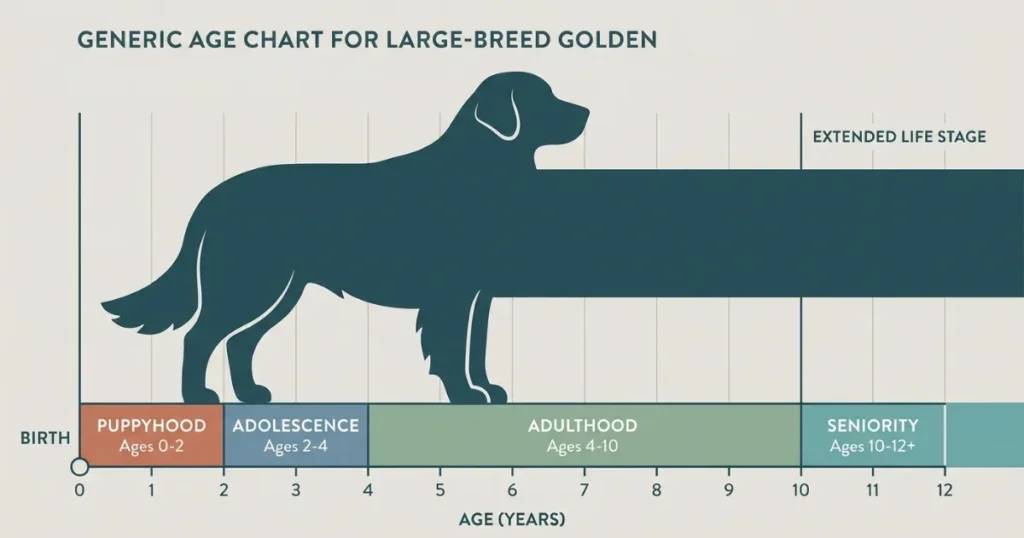
What matters more than the number: a 9 years old Golden is firmly senior. The breed crosses into senior territory around 7 to 8, so by 9, your dog is a few years into it. Metabolism has slowed, muscle mass is dropping, and the screening that catches the breed’s biggest threats should already be running twice a year.
Here’s what I tell owners of 9 years old. Don’t wait for symptoms. The Morris Animal Foundation’s Golden Retriever Lifetime Study has found cancer to be the leading cause of death in the breed, with hemangiosarcoma a frequent and fast-moving form. At 9, baseline senior bloodwork and a careful physical twice a year are the highest-value things you can do. The qualitative side of senior care is covered in what a 10 years old Golden’s age signals.
How old is a 13 years old dog in human years?
A 13 years old dog is roughly 84 to 90 human years for a large breed by the life-stage method. The UCSD epigenetic formula puts a 13 years old near 72, a wide gap I’ll explain shortly. For a Golden, 13 is genuinely old. The breed averages 10 to 12 years, per the AKC, so a 13 years old has already outlived the typical lifespan.
A 13 years old Golden is geriatric, not just senior. Think of a human in their late eighties: still themselves, but frailer, slower to recover, and more prone to several conditions at once. Arthritis, reduced hearing and vision, and canine cognitive dysfunction, the canine version of dementia, become common.
At this age, my advice shifts from “screen and prevent” to “monitor and keep comfortable.” Joint support with glucosamine, chondroitin, and omega-3 fatty acids, soft bedding, traction on slick floors, and watching for night-time restlessness or disorientation all matter. Quality of life becomes the metric, checked often. For the size by size view of these numbers, see our dog age chart in human years.
How old is a 14 years old dog in human years?
A 14 years old dog is about 88 to 96 human years for a large breed, or near 73 by the UCSD formula. If you searched “14 years in dog years is how old,” that’s the answer: a 14 years old Golden lands in the high eighties to mid-nineties in human terms by the conventional chart. Reaching 14 as a Golden is a real achievement, since it’s well beyond the breed’s 10 to 12 years average.
A 14 years old golden is deep into geriatric life. Most dogs this age have some combination of arthritis, sensory decline, and slower cognition. None of that means a poor life. Plenty of 14 years old Goldens are content, just slower and needing more support.
Here’s what I tell families at this stage. The number is almost beside the point now. What counts is daily quality of life: is your dog eating, comfortable, engaged, and free of unmanaged pain. Frequent gentle vet contact, pain control, and honest quality of life check-ins lead the plan. The reverse-direction perspective, how your own age maps to your dog’s, is in our human to dog years calculator, which some owners find grounding here.
Why a senior Golden’s age runs higher than the formula predicts
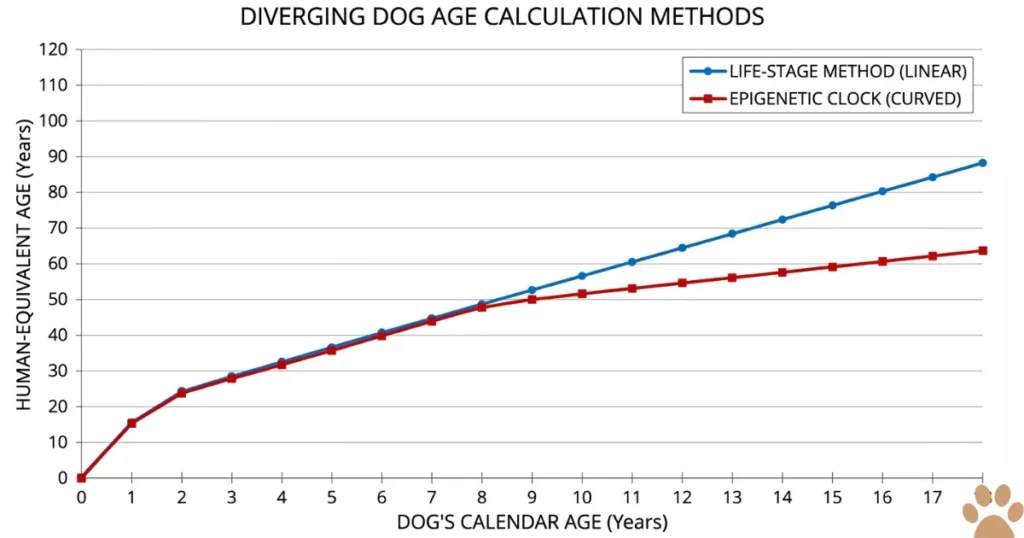
You may have noticed the two methods drift apart as dogs get older, and the reason is worth understanding. The size-based life-stage method adds a fixed number of human years every year, so it climbs in a straight line. The UCSD epigenetic formula uses a natural-log curve that flattens with age, so its numbers rise more slowly in the senior years. By 14, the life-stage chart says high eighties to mid-nineties, while the formula says about 73.
Neither is “wrong.” They measure different things. The UCSD formula reflects molecular aging measured through DNA methylation in Labrador Retrievers, a large retriever much like a golden. The life-stage method reflects functional and developmental aging, which is what most owners and vets actually plan around. For care decisions, the life-stage view is usually the more useful of the two.
For a Golden specifically, the practical reading is to take the older life-stage number seriously. Large breeds age faster late in life, and treating a 13 years old as if it were merely “senior” rather than geriatric risks under-managing pain, cognition, and cancer surveillance. The AKC and AVMA both tie senior status to size, and Goldens sit on the faster-aging large-breed track. When the two methods disagree in old age, let the more cautious number guide how closely you watch. Visit our website for golden retriever health guides.
What dog-age charts get wrong about older Goldens
Most charts run a single column and stop early, which fails old large-breed dogs twice. They under-read the age by using a medium-dog default, and many simply don’t go past 12 or 13. For a Golden that might reach 14, that leaves the most fragile years uncharted.
The most common mistake I see is an owner reading a generic chart, deciding their 13 years old is “about 74 and doing fine,” and easing off vet visits to spare the dog stress. Understandable and kind in intent. But geriatric Goldens often hide pain and decline well, and that’s exactly the stage where more frequent, gentle monitoring catches treatable problems.
The fix is to read the large-breed line, treat 13 to 14 as geriatric regardless of the precise number, and keep quality of life checks frequent. To find your dog’s stage when you don’t know the exact age, our how old is my dog guide walks through estimating it from teeth and eyes.
Senior vs geriatric: how to read 9, 13, and 14 (large-breed Golden):
| Age | Human-years (life-stage) | UCSD formula | Stage | Care focus |
| 9 | ~62–66 | ~66 | Senior | Twice-yearly screening, cancer surveillance |
| 13 | ~84–90 | ~72 | Geriatric | Pain, cognition, comfort, quality of life |
| 14 | ~88–96 | ~73 | Deep geriatric | Daily quality of life, frequent gentle contact |
The Senior-Golden Age Check
Here’s the decision tool I give families of older Goldens so the number turns into the right care. Run it at every vet visit.
The Senior-Golden Age Check
At 9 (senior):
Screen hard. Then commit to twice-yearly exams with bloodwork, and learn the early signs of the breed’s cancers. Call your vet immediately for a fast-growing lump, sudden collapse, or pale gums, which can signal hemangiosarcoma.
At 13 (geriatric):
Manage comfort. Then add joint support and floor traction, and watch for disorientation or night restlessness that can signal cognitive dysfunction. Call your vet for new limping, appetite loss, or behavior changes lasting more than a day or two.
At 14 (deep geriatric):
Lead with quality of life. Then track eating, comfort, mobility, and engagement weekly, and discuss pain control openly. Call your vet promptly for any sudden decline, and ask for an honest quality of life assessment when you’re unsure.
This check isn’t a diagnosis. It’s how a senior Golden’s real age becomes a care plan that protects comfort and dignity in the years that matter most.

How old is 13 in dog years?
A 13 years old dog is about 84 to 90 human years for a large breed like a Golden, or near 72 by the UCSD epigenetic formula. Either way, 13 is geriatric for the breed.
How old is 14 in dog years?
A 14 years old dog is roughly 88 to 96 human years for a large breed, or about 73 by the UCSD formula. A 14 years old golden is deep into geriatric life.
How old is 9 in dog years?
A 9 years old dog is about 62 to 66 human years for a large breed. At 9 a Golden is a true senior, a few years past the breed’s senior threshold of 7 to 8.
14 years in dog years is how old?
About 88 to 96 in human years for a large breed like a Golden. That’s the high eighties to mid nineties range, well beyond the breed’s 10 to 12 years average lifespan.
Is a 9 years old Golden Retriever a senior?
Yes. Goldens reach senior status around 7 to 8, so a 9 years old is firmly senior and should already be on twice-yearly exams and cancer screening.
When is a dog considered geriatric instead of senior?
Usually in the last quarter of the expected lifespan. For a Golden averaging 10 to 12 years, that means roughly 11 and up, so 13 and 14 are geriatrics.
Why do the two age methods disagree for old dogs?
Because they measure differently. The life-stage method adds fixed years annually, while the UCSD formula’s log curve flattens with age, so it reads lower in the senior years.
How long do Golden Retrievers usually live?
About 10 to 12 years per the AKC. Lean weight, exercise, and early cancer screening help some Goldens reach their teens, but 13 to 14 is genuinely old.
What changes most as a dog reaches 13 or 14?
Recovery slows, and several conditions stack up: arthritis, sensory loss, and canine cognitive dysfunction. Care shifts from prevention to comfort and quality of life.
Is it cruel to keep doing vet visits with a very old dog?
No, when they’re gentle and purposeful. Geriatric dogs hide pain well, so frequent low-stress checks catch treatable problems and protect comfort.
How old is a 14 years old Golden Retriever in human years?
About 88 to 96 by the large-breed life-stage chart. A 14 years old Golden has outlived the breed average and deserves a quality of life first plan.
What cancers should I watch for in a senior Golden?
Hemangiosarcoma and lymphoma are among the most common in the breed per the Golden Retriever Lifetime Study. Watch for lumps, sudden weakness, and pale gums.
Does my 13 years old Golden need different food?
Possibly, based on weight, kidney values, and appetite rather than age alone. Senior diets with omega-3 fatty acids can help joints, but ask your vet first.
Can a Golden Retriever live to 15 or 16?
It’s uncommon but happens. Most Goldens reach 10 to 12; some make their teens, and a few reach 15 to 16 with good genetics, lean weight, and a bit of luck.
When should I call the vet about my old Golden?
Call immediately for sudden collapse, pale gums, a fast-growing lump, or trouble breathing. Monitor at home for 24 hours for mild, gradual stiffness, then book a senior exam.
The bottom line on how old your dog is at 9, 13, or 14
At 9, 13, and 14, your Golden is roughly 62–66, 84–90, and 88–96 in human years by the large-breed chart, with the epigenetic formula reading lower because its curve flattens with age. The more useful truth is the stage: 9 is senior, 13 and 14 are geriatric, all past the breed’s 10 to 12 years average.
The one move that matters now is to let the older, life-stage number guide you, screen twice yearly from the senior stage, and put quality of life first in the geriatric years. Knowing your Golden’s real older age is how you protect comfort when it counts most.
How old is your Golden now, and what changed in your care once your vet called your dog senior or geriatric? Tell me in the comments what’s helped most: joint support, traction, or more frequent checks so the next family with an older Golden knows what to expect.