
A first seizure that comes from nowhere is frightening, but a single seizure is rarely an immediate threat once it ends. Most last one to two minutes. Any first seizure deserves a vet visit soon, and a seizure over 5 minutes, or a second seizure within 24 hours, means the emergency vet now.
A dog seizures out of the blue is almost always sudden but not causeless. Seizures are bursts of abnormal electrical activity in the brain, so by their nature, they arrive without warning. In a young, otherwise healthy dog, a first sudden seizure is most often the debut of idiopathic epilepsy. In older dogs, the same event more often points to a toxin, an organ problem, or a brain tumor. Whatever the age, a first seizure deserves a veterinary visit to find out why.
If you just watched your dog seize for the first time and you’re shaken, that reaction is normal, and so is the feeling that it came from nowhere. You almost certainly didn’t cause it, and you didn’t miss some glaring warning sign.
Here’s the reframe that helps. “Out of the blue” describes how a seizure looks, not whether it has a cause. The cause is usually hidden inside the body, an inherited tendency that’s been quiet until now, something your dog ate, or a change in the brain you can’t see from the outside. For the full landscape of what causes dogs to have seizures, start with our causes guide and see the seizure cluster overview for the bigger picture.
Why Seizures Strike “Out of the Blue”
The phrase owners always use is “It came from nowhere.” I understand why, because there’s rarely a visible build-up. One second, your dog is fine; the next, it’s on its side. That suddenness is the seizure itself, not evidence that nothing caused it.
Think of it like a circuit breaker tripping. The overload may have been building quietly for a long time, but the trip happens in an instant. A brain prone to seizures can sit perfectly normal for months or years, then misfire in a moment when some internal threshold is crossed.
Two things also make a first seizure feel more out of the blue than it was. The first is that you may simply be seeing the first one you witnessed, not the first one that happened, since some seizures occur during sleep or while you’re out. The second is that the trigger can be invisible, like a toxin already swallowed or a missed meal that dropped blood sugar. To match what you saw against the real thing, compare it with what a dog seizure looks like and how to tell if your dog is having a seizure.

What Actually Causes a Sudden First Seizure
A first seizure usually traces to one of a handful of causes, and the most likely one shifts with your dog’s age and situation. According to VCA Animal Hospitals, the single most common cause of recurrent seizures is idiopathic epilepsy, an inherited condition whose first seizure typically appears between six months and six years of age.
Here’s how the likeliest “out of the blue” causes sort out.
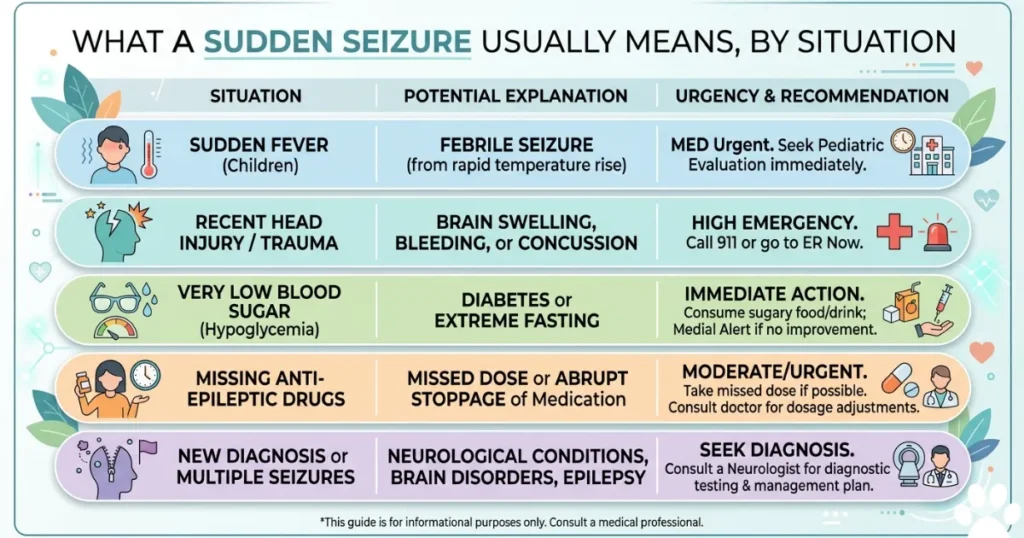
| If your dog is… | The likely cause | The tell | Urgency |
| A young adult (1–5 yrs), otherwise healthy | Idiopathic epilepsy debuting | Normal between episodes; tends to recur over time | Vet visit soon |
| Any age, may have eaten something | A toxin | Recent access to chemicals, plants, meds, or xylitol | Emergency now! |
| Around mealtime or after hard exertion | Low blood sugar | Small, young, or working dogs; skipped meals | Urgent vet |
| A senior (7+), first seizure ever | Brain tumor or organ disease | New seizures late in life, other subtle changes | Vet plus imaging |
| Quick to collapse and recover, no confusion after | Possibly fainting, not a seizure | Fast full recovery, no dazed aftermath | Vet (heart check) |
Toxins deserve special attention because they’re the cause you can sometimes catch and reverse. Scan our list of toxins that trigger seizures if there’s any chance your dog got into something, and treat a suspected poisoning as an emergency. For more, browse our Golden Retriever health guides.
Was It Even a Seizure? Seizure vs Fainting vs Tremor.
Not every sudden collapse is a seizure, and getting this right changes what your vet looks for. A true seizure has a tell that fainting doesn’t, and it’s what happens afterward.
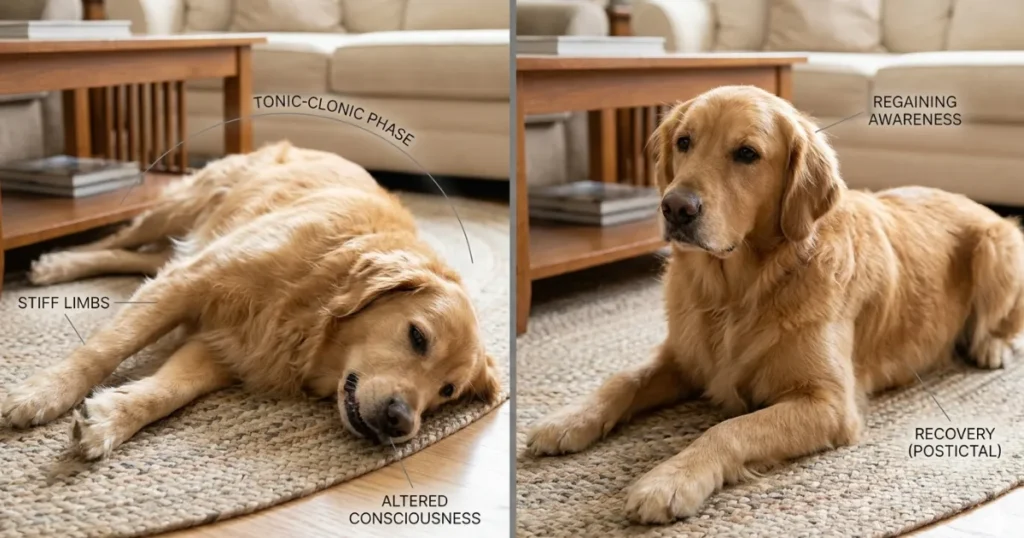
After a real seizure, a dog goes through the post-ictal phase, a stretch of confusion, pacing, drooling, or temporary blindness that can last minutes to hours. The American Kennel Club notes that this post-event phase is what defines a neurological event as a seizure. A dog that collapses, goes limp, then pops back to normal within seconds with no confusion may have fainted instead, which is called syncope and often points to a heart problem rather than the brain.
Trembling and shivering get mistaken for seizures, too. A dog that’s shaking but alert, responsive, and able to stop when you call is almost certainly not seizing. A focal seizure can also be subtle, showing as one-sided twitching or repetitive chewing, and you can read more about those in our guide to focal seizures. The takeaway is simple. Film what you can, note whether your dog was confused afterward, and let your vet sort a seizure from a faint.
Golden Retrievers: What a Sudden First Seizure Usually Means.
For Goldens, age is the strongest clue to what an out of the blue seizure means, and the two ends of the age range point in very different directions.
A young adult Golden whose first seizure occurs between one and three years of age is following the classic pattern of idiopathic epilepsy in the breed. The Srenk study documented that Goldens with inherited epilepsy usually have their first seizures in that window and tend toward generalized, whole-body events. That’s the more hopeful scenario, because idiopathic epilepsy is often well managed with seizure medication, and many of these dogs go on to live full lives. Our guide to canine epilepsy covers what comes next.
A senior Golden whose first seizure appears after about age 6 is a more serious conversation. New-onset seizures in an older dog raise the possibility of a brain tumor, and Golden Retrievers are among the breeds predisposed to meningiomas. North Carolina State’s veterinary neurologists treat new seizures in any dog over five or six as a reason to rule out a tumor with imaging. If your older Golden is the one who seized, read what causes fits in older dogs and explore the breed in our Golden Retriever guides.
The signs of the seizure itself look identical at any age. What changes with age is the likely cause, and that’s what your vet will chase down.

What Most “Dog Seizures Out of the Blue” Articles Get Wrong.
Most articles on sudden seizures hand you a generic cause list and stop. Three things get missed, and they’re the ones that actually help.
The first is the reframe. Telling a panicked owner their dog “just had a seizure” without explaining that suddenness is normal for seizures leaves them hunting for a dramatic trigger that often isn’t there. “Sudden” does not mean “causeless,” and it does not mean you did something wrong.
The second is the fainting mimic. Plenty of “my dog had a seizure” stories are actually syncope, a heart-related faint, and treating it as a seizure sends everyone down the wrong path. The post-ictal tells it all.
The third is the missing trigger search. In a representative case I see often, an owner swears nothing happened, then on careful questioning remembers the dog raided the trash that afternoon or skipped breakfast before a long hike. The trigger was there. It just wasn’t obvious.
And they let owners carry guilt they haven’t earned. A first seizure rarely means you fed the wrong thing or missed an obvious sign, and it doesn’t doom your dog to a lifetime of epilepsy. Many dogs have one seizure and never another, so the goal is finding the cause, not assigning blame.
What to Do After a Sudden First Seizure.
Once the seizure ends, you have two jobs. Keep your dog calm and safe, and gather the information your vet needs to find the cause. For the in the moment steps, follow our guide on what to do during a seizure, then turn detective.
The 48-Hour Rewind.
Before you call the vet, mentally replay the two days before the seizure across four areas. I call it the 48-Hour Rewind, and it surfaces hidden triggers more often than owners expect.
- Ate — any new food, treats, table scraps, or a skipped meal that could drop blood sugar?
- Access — could your dog have reached a toxin, plant, medication, trash, or compost?
- Activity — a recent head bump, overheating, hard exertion, or intense excitement?
- Age & history — young adult points toward epilepsy, while a senior raises other causes.
Write down what you find, the time and length of the seizure, and which body part moved first, and film any future episode. That record is what helps your vet narrow the cause fast.
Then get the visit on the calendar. Any first seizure should be checked by a vet, who will run a history, physical, neurological exam, and bloodwork to look for an underlying problem. Go to the emergency vet right away if the seizure lasted over 5 minutes, if a second one follows within 24 hours, if your dog is a puppy under six months, or if you suspect a toxin.
Here’s the reassuring part. Many dogs that have a single seizure never have another, and many of those that do are well controlled, so one frightening event is rarely the whole story.

Expert Insight
“When an owner tells me it came from nowhere, I don’t doubt them; I just go looking for the part they couldn’t see. Nine times out of ten, the seizure was sudden, but the reason behind it was quietly there all along.”
What does it mean when a dog has a seizure out of the blue?
It means a sudden seizure with no obvious warning, but rarely any cause. In young dogs, it’s often early idiopathic epilepsy; in older dogs, a toxin, organ disease, or a brain tumor is the cause.
Can a dog have a seizure for no reason? Not truly.
A seizure can have no identifiable structural cause, which we call idiopathic epilepsy, but that isn’t the same as no cause. A first seizure always deserves a vet workup.
What causes a sudden seizure in a dog with no history?
The most common cause is idiopathic epilepsy debut, especially in young adults. Other causes include toxins, low blood sugar, head trauma, organ disease, and brain tumors, more likely in seniors.
How often do dogs have a single seizure that never repeats?
It happens fairly often, especially when a one-time trigger like a toxin or low blood sugar causes it. Many dogs never seize again, though your vet should still check for an underlying cause.
Is it safe to wait and see after a first seizure?
No. Even if your dog seems fine, book a vet visit soon, since a first seizure can signal a problem that needs treatment. Go immediately if it lasts over 5 minutes or repeats.
What happens if a dog has a seizure out of nowhere?
Your dog briefly loses control of its body, then enters a confused post-ictal phase before recovering. A single short seizure rarely causes lasting harm, but the cause still needs a vet check.
How to tell a seizure from fainting in dogs?
Watch what happens afterward. A seizure is followed by minutes of confusion, pacing, or drooling, while fainting (syncope) ends in a quick, clear-headed recovery. Fainting often points to a heart issue.
When should I worry about a single seizure?
Worry enough to book a vet visit after any first seizure. Worry urgently and go now if it lasted over 5 minutes, repeated within 24 hours, struck a young puppy, or followed possible exposure to a toxin.
Can stress or excitement trigger a dog seizure?
Yes, in dogs already prone to seizures, stress, excitement, or exhaustion can help tip the brain into one. The trigger doesn’t cause the underlying tendency, but it can be the moment a susceptible dog seizes.
Will my dog have another seizure after the first one?
Maybe not. Some dogs have a single seizure and never another, while others develop epilepsy. Your vet uses the cause, your dog’s age, and the workup to estimate how likely a repeat is.
Can Golden Retrievers have seizures out of the blue?
Yes. Golden Retrievers are predisposed to idiopathic epilepsy, which often debuts as a sudden first seizure in a young adult. In a senior Golden, it more often points to another cause, like a tumor.
Why do young Golden Retrievers suddenly start having seizures?
In young Goldens, sudden seizures usually mark the onset of inherited idiopathic epilepsy. The Srenk study found these typically begin between one and three years of age and are often generalized.
Do Golden Retrievers need testing after a first seizure?
Yes. A first seizure warrants a vet exam and bloodwork in any dog, and imaging is wise for a senior Golden, since the breed’s brain-tumor risk makes ruling one out important.
Can a Golden Retriever have a one-time seizure?
Yes. A Golden can have a single seizure from a one-off trigger like a toxin or low blood sugar and never seize again. A vet check after the first event helps confirm there’s no ongoing cause.
When is a sudden dog seizure an emergency?
Go to the vet immediately if a seizure lasts over 5 minutes, your dog has two or more within 24 hours, it’s a puppy under six months, or you suspect a toxin. A first seizure needs a prompt visit.
Conclusion.
If your dog had a seizure out of the blue, hold onto the reframe. Sudden is how seizures always look, but it rarely means there’s no cause. In a young Golden, it most often signals manageable idiopathic epilepsy; in a senior, it warrants a closer look for a tumor or organ problem.
Run the 48-Hour Rewind for hidden triggers, watch whether your dog was confused afterward to separate a seizure from a faint, and book a vet visit urgently if it ran long or repeated itself. One frightening seizure is often the start of answers.
Did your Golden’s first seizure seem to come from nowhere, then turn out to have a cause you spotted later? Share what it was and how your vet figured it out. Your story might help another owner stop the blame.