
No single seizure and no specific number of seizures mean it’s automatically time. This is a decision about quality of life and the cause behind the seizures, made gently and together with your vet. Considering it doesn’t mean you’re giving up. It means you love your dog.
Dog Seizures: When to Put Down. There’s no magic seizure count that tells you it’s time to put your dog down. The decision rests on your dog’s overall quality of life and the cause of the seizures, to be weighed together with your vet. Many dogs with seizures live happy years. Euthanasia becomes the kind choice when seizures can’t be controlled despite treatment, when the underlying illness is terminal, or when the bad days have clearly started to outnumber the good.
If you’re asking when to put a dog down because of seizures, you’re carrying one of the hardest questions a dog owner ever faces, and the care you’re bringing to it says everything about your bond. Take a breath. You don’t have to decide anything this minute, and you don’t have to decide it by yourself.
Here’s the honest part first. Most dogs with epilepsy live full, happy lives once their seizures are managed. When seizures do drive this decision, it’s usually because they can’t be controlled or because the cause is something serious. About a third of dogs with idiopathic epilepsy don’t fully respond to medication, and that group is where this question most often arises. For the wider picture, see our overview of seizures in dogs.
There’s No Magic Number: How the Decision Actually Gets Made
I’ll tell you what I tell owners at the exam table. Stop looking for a number. There’s no “five seizures a month, and it’s time” rule, because the same seizure frequency means very different things in different dogs.
What actually matters is three things together. The first is your dog’s quality of life, both during the rare minutes of a seizure and across the long stretches in between. The second is the cause, because a young dog with manageable epilepsy and an old dog with a brain tumor are facing completely different roads. The third is whether good treatment has genuinely been tried, since many seizures that look uncontrollable simply haven’t met the right medication yet.
A single seizure, however frightening, is rarely a reason to consider euthanasia. Most seizures last only one to two minutes, and dogs are unconscious and unaware during them, not in pain. If your dog is still wagging, eating, and greeting you between episodes, that’s a dog whose quality of life is still intact, even if the seizures scare you both.
This is a decision you make with your veterinarian, who can weigh the cause and the prognosis you can’t see from home. It is never a decision you have to reach alone. Find more in our Golden Retriever health guides.

Dog Seizures: When to Put Down
There are specific situations where seizures move from manageable to genuinely life-limiting. None of these is a verdict on its own, but together they’re the honest signals to talk with your vet about letting go.
The seizures can’t be controlled.
When seizures keep breaking through despite the right drugs at the right doses, the epilepsy is called refractory. The Merck Veterinary Manual notes that roughly a third of dogs with idiopathic epilepsy are drug-resistant, and uncontrolled seizures wear a dog down.
The clusters or long seizures are frequent.
Repeated cluster seizures and episodes of status epilepticus, a seizure lasting over 5 minutes, carry real danger. Dogs with these patterns have shorter survival and a harder time finding seizure freedom.
The cause is terminal.
When seizures come from an untreatable brain tumor or advanced organ failure, the seizures are a symptom of a disease that sets its own timeline.
The life between seizures is fading.
This is the quietest signal and the most important. If the dog you know is disappearing between episodes, slow, withdrawn, and no longer eating or enjoying anything, that loss of the in-between life matters more than any seizure count.
One thing here is not an end of life decision at all. A seizure lasting more than 5 minutes is a medical emergency, so go to the vet immediately. Read how to handle a seizure in the moment so you’re ready, and treat the emergency first.
The Quality of Life Scale: A Tool to See Clearly
When love clouds the picture, a simple scoring tool can help you see your dog’s days more honestly. The most widely used is the HHHHHMM scale, created by veterinary oncologist Dr. Alice Villalobos and shared by VCA Animal Hospitals. You score seven areas from 1 to 10, and a total above 35 out of 70 suggests quality of life is still acceptable.
| Category (HHHHHMM) | What you’re honestly scoring, 0–10 |
| Hurt | Is pain controlled? Can your dog breathe easily? |
| Hunger | Eating enough, willingly? |
| Hydration | Drinking enough or needing fluids? |
| Hygiene | Able to stay clean and dry, no sores? |
| Happiness | Still engaged, responsive, and finding joy? |
| Mobility | Able to move, get up, avoid injury? |
| More good days than bad | Are the good days winning? |
Score it every few days, not just once, because trends tell the truth better than a single bad afternoon. The scale isn’t a verdict, just a mirror that helps you and your vet talk in the same language.
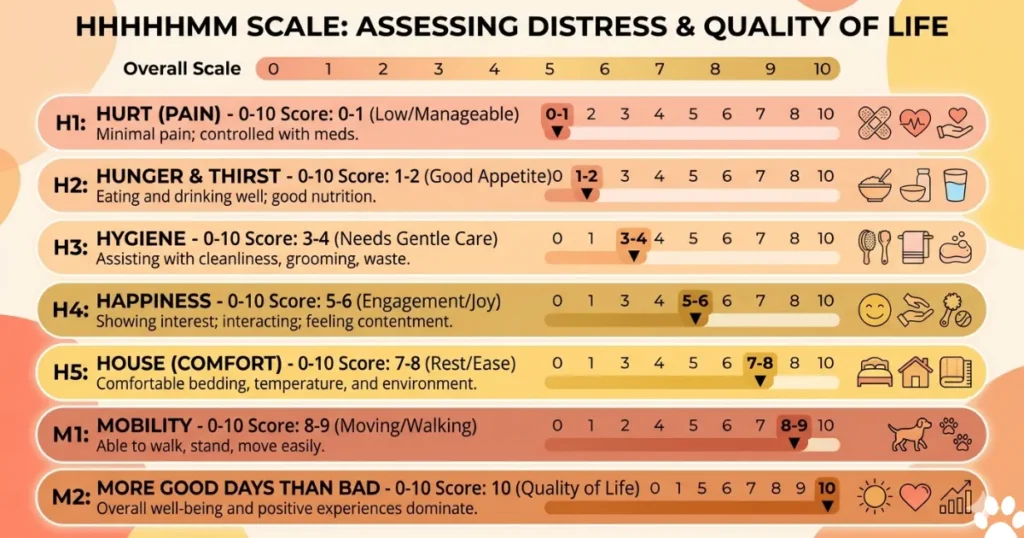
The Between-Seizures Check.
For seizures specifically, I give owners three plain questions to sit with:
- Is your dog still your dog between seizures? Or has the spark, you know, gone quiet?
- Over the last two weeks, did good days outnumber bad? Be honest, even when it hurts.
- Is the cause treatable, or is it something medicine can’t fix? Your vet can answer this one with you.
If the honest answers are no, no, and not fixable, that’s the picture pointing toward goodbye. Not a failure. A mercy.
Golden Retrievers: Why the Cause Matters So Much.
For Goldens, the single most important step before any end of life decision is finding out why the seizures are happening, because the cause changes everything about the prognosis. The handling of a seizure is the same for every breed, but the likely cause shifts with age.
A young adult Golden whose seizures start between one and three years of age most often has idiopathic epilepsy, the inherited kind documented in the breed by the Srenk study. That’s the hopeful scenario. With the right seizure medication, many of these dogs live long, full lives, and euthanasia may be years away or never driven by the epilepsy at all. Read more in our guide to canine epilepsy.
A senior Golden whose seizures start for the first time after about age 6 is a different and more serious conversation. New-onset seizures in an older dog raise the real possibility of a brain tumor, and Golden Retrievers are one of the breeds predisposed to meningiomas, where seizures are often the first and only sign. North Carolina State’s veterinary neurologists treat new seizures in any dog over five or six as a reason to rule out a brain tumor with imaging.
This matters for your decision because the prognosis varies widely. According to VCA, the outlook for a dog with a brain tumor is generally guarded to poor, and without treatment, many dogs live only several months. If that’s your senior Golden’s diagnosis, the quality of life clock is genuinely shorter, and knowing that helps you plan a gentle, unhurried goodbye. Our guide to seizures starting in older dogs goes deeper, and you can explore the breed across our Golden Retriever guides.

What Most Articles Get Wrong About This Decision.
Most “when to put your dog down” articles hand you a generic checklist and leave out the parts that actually torment owners. Here’s what they miss.
They skip the cause because it outranks the seizures. A checklist treats every seizing dog the same, when a controllable epilepsy and a terminal tumor sit at opposite ends of the road. Diagnosis first, decision second.
They ignore caregiver reality. The exhaustion of nighttime seizures, the cost of imaging and lifelong medication, and the fear of being away from home are real, and research on caregiver burden shows these weigh heavily and legitimately on this choice. Considering your own limits doesn’t make you selfish. It makes you human.
And they pretend there’s a perfect moment. There rarely is. Vets often share a gentle rule of thumb that it’s kinder to be a week too early than a day too late, because a week too early spares your dog a final stretch of suffering you can’t take back. In a representative situation I’ve sat with many times, an owner waits for an unmistakable sign that never quite comes and later wishes they’d trusted the quiet decline they were already seeing.

Making the Decision and the Days Around It.
When the time comes, knowing what to expect can take a little fear out of it. Talk openly with your vet, who can confirm the prognosis and talk you through options, including hospice and palliative care if you want more good time first.
Euthanasia itself is peaceful and quick. Your vet typically gives a sedative so your dog drifts into a calm sleep, then a final injection that gently stops the heart without pain. You can choose to be present or not, and there’s no wrong choice. Many owners want to be the familiar face and voice at the end, and others simply can’t, and both kinds of love are valid. You can also ask about at-home euthanasia services if a quiet, familiar setting feels right.
Afterward, you’ll have choices about your dog’s remains, usually burial where it’s allowed or cremation, with the option to keep the ashes. Give yourself room to grieve, because the bond was real, and so is the loss. If the grief feels heavy, a pet-loss support line or counselor can help, and leaning on people who understand is a strength, not a weakness.

Expert Insight
“In twenty years, I’ve never had an owner tell me they regretted giving their dog a peaceful ending a little early. The regret I hear is always the other way. When you’re loving them this carefully, you already know more than you think you do.”
When should you put a dog down for seizures?
There’s no fixed seizure count. Euthanasia becomes the kind choice when seizures can’t be controlled despite treatment, the cause is terminal, or quality of life between seizures is poor. Decide this with your vet.
Do seizures alone mean it’s time to euthanize a dog?
No. Many dogs with epilepsy live full, happy lives once seizures are managed. Seizures usually drive this decision only when uncontrollable, very frequent, or caused by a serious illness like a brain tumor.
How to know when a dog’s quality of life is too poor?
Use the HHHHHMM scale, scoring pain, appetite, hydration, hygiene, happiness, mobility, and good vs bad days. A total under 35 out of 70 suggests poor quality of life and a serious talk with your vet.
How many seizures are too many for a dog?
There’s no set number. What matters is whether seizures are controlled and how your dog is between them. Frequent clusters, or seizures breaking through proper medication, matter more than a raw count.
Is it selfish to euthanize a dog with epilepsy?
No. Choosing to end genuine, unfixable suffering is an act of love, not selfishness. Caregiver exhaustion and cost are real and valid to weigh. A peaceful goodbye spares your dog a harder ending.
What happens during dog euthanasia?
Your vet usually gives a sedative so your dog falls into a calm sleep, then a final injection that painlessly stops the heart. It’s quick and peaceful. You can stay or not; either is okay.
Is it safe to keep treating a dog with frequent seizures?
Often yes, especially early on, since many dogs respond well to medication. The harder question is the quality of life. If treatment no longer keeps good days outnumbering bad, talk with your vet about what’s kind.
When should I rush my dog to the vet for a seizure?
Go immediately if a seizure lasts over 5 minutes, your dog has two or more in 24 hours, or doesn’t recover between them. That’s a medical emergency to treat, separate from any end of life decision.
Can dogs die from seizures?
Yes, though it’s uncommon. A prolonged seizure called status epilepticus can be fatal without emergency care, and up to a quarter of affected dogs don’t survive, per Today’s Veterinary Practice. Most single seizures aren’t deadly.
How to cope after euthanizing your dog?
Let yourself grieve fully, since the loss is real. Talk to people who understand, consider a pet-loss support line or counselor, and hold onto the truth that you made a loving choice for your dog.
Can Golden Retrievers live a long life with epilepsy?
Yes, many do. Goldens with idiopathic epilepsy that’s well controlled on medication often live full, happy lives, and the epilepsy may never be what shortens their time with you.
Why do older Golden Retrievers suddenly develop seizures?
A first seizure in a senior Golden often signals a new problem, especially a brain tumor. Goldens are predisposed to meningiomas, where seizures are often the first sign, so imaging is strongly advised.
Do Golden Retrievers need to be put down for seizures sooner?
No, not because of the breed. A Golden’s prognosis depends on the cause. Young dogs with controlled epilepsy do well, while a senior dog with a brain tumor faces a shorter, guarded outlook.
Can a Golden Retriever recover from a brain tumor causing seizures?
Recovery is uncommon, and the prognosis is generally guarded to poor. Some dogs gain good months with surgery, radiation, or steroids, per Lap of Love. Your vet and a neurologist can outline realistic options.
When is a dog seizure a life-threatening emergency?
A seizure over 5 minutes, called status epilepticus, is life-threatening and needs emergency care now. Two or more seizures in 24 hours are also an emergency. Drive in immediately rather than waiting.
Conclusion.
If you’re weighing dog seizures and when to put your dog down, hold onto this. There’s no magic number. What guides you is quality of life, the cause behind the seizures, and an honest talk with your vet.
Score the good days against the bad, ask whether your dog is still themselves between episodes, and find out what’s driving the seizures because controllable epilepsy and a brain tumor are very different roads.
Whatever you decide, a gentle ending for a suffering dog is one of the kindest gifts you can give. You’re not failing your dog by asking this. You’re loving them through it.
If you’ve walked this road with a Golden, your experience could comfort someone standing where you stood now. What helped you find clarity, and what do you wish you’d known sooner?
Note: Always consult your veterinarian before making any decision.