Can dogs have peas as part of their regular diet? Yes, within the 10% daily caloric treat guideline that applies to all dog treats. For a 65-pound adult Golden Retriever eating approximately 1,400 calories per day, the daily treat budget sits at around 140 calories. One cup of green peas contains roughly 62 calories. Half a cup, a generous serving for a large Golden, contains around 31 calories. Peas fit comfortably into a daily treat rotation at these amounts without displacing necessary nutrition from the primary diet.
Can dogs eat peas from the freezer? Frozen peas labelled “ready to eat” or pre-cooked are safe and convenient. Frozen peas, served straight from the bag, provide an additional cooling benefit in warm weather and work well as small, individual training rewards. Avoid frozen pea products with added salt, butter sauce, or mixed seasoning blends. Check the ingredient list before feeding any packaged frozen vegetables to a Golden Retriever.
Peas contain higher levels of natural sugars and starch than vegetables like green beans or cucumbers, making them a slightly higher-calorie vegetable treat. For Golden Retrievers on calorie-restricted diets, green beans remain the leaner option. For Goldens at a healthy weight, peas are a nutritional step up from most commercial treats and a reasonable daily snack in the serving sizes above.
For more on the full range of vegetables safe for Golden Retrievers, including how peas compare to carrots and green beans across caloric load and nutrient value, see our dog safe vegetables guide.
Can Dogs Eat Snow Peas and Other Pea Varieties?
Can dogs eat snow peas specifically? Yes. Snow peas are safe for dogs, including the pod. The flat, tender pod of a snow pea does not carry the same toughness or choking risk as a garden pea pod, making it one of the most convenient pea varieties to serve to a Golden Retriever without additional preparation. Rinse them thoroughly and remove any tough strings along the seam before feeding.
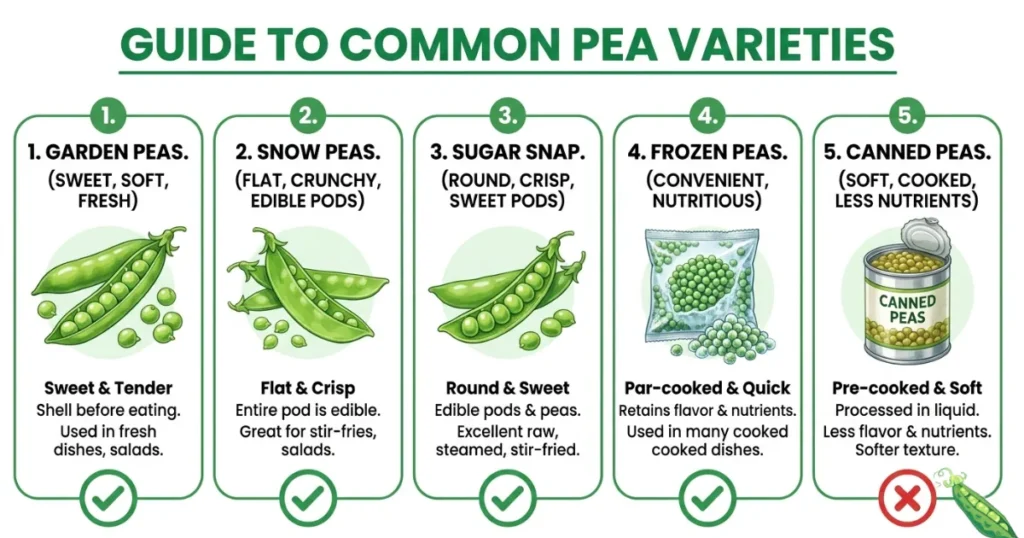
The table below covers the most common pea varieties and how they differ in terms of preparation and suitability for Golden Retrievers.
| Pea Variety | Pod Safe? | Best Preparation | Notes for Golden Retrievers |
| Garden peas (English peas) | No | Shell and serve fresh or frozen | Pods can be tough; remove before serving |
| Snow peas | Yes | Raw, rinsed, strings removed | Flat pod is safe and easy to chew |
| Sugar snap peas | Yes | Raw or lightly steamed | Crisp pod, sweet flavour, safe whole |
| Frozen peas | No pod | Thawed or served frozen | Check label for “ready to eat” |
| Split peas | N/A (dried) | Cooked only, plain | Higher starch when cooked; limit amounts |
| Canned peas | N/A | Never feed | High sodium regardless of pea variety |
Notes: All peas must be served plain with no seasoning, butter, or sauce. Canned peas with any sodium content should never be fed to Golden Retrievers. Split peas are significantly higher in starch than fresh varieties and should be limited to occasional small amounts.
Peas, Golden Retrievers, and the DCM Question
This is the section that most “can dogs eat peas” articles do not write, and it is the one Golden Retriever owners most need to read.
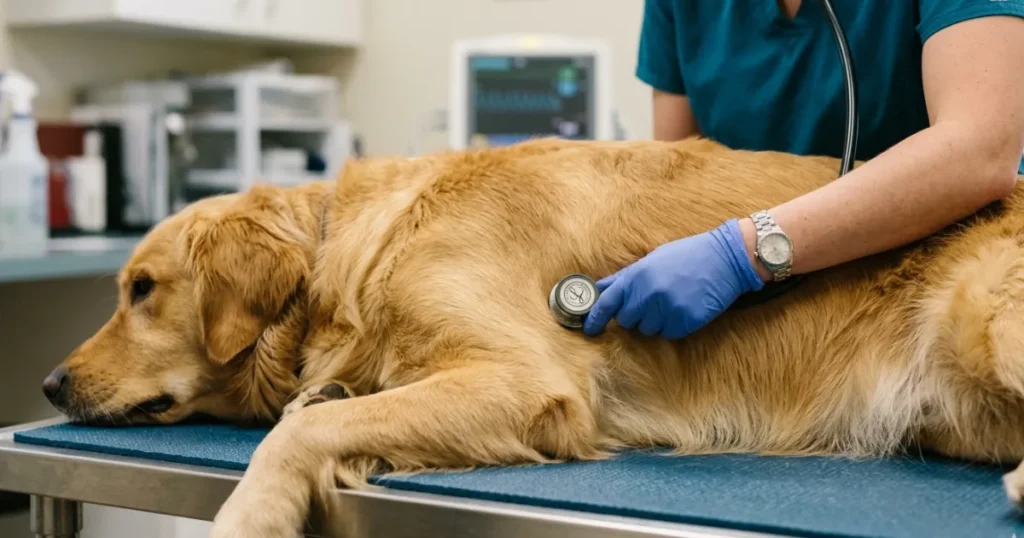
In July 2018, the FDA began investigating reports of dilated cardiomyopathy (DCM) in dogs eating grain-free diets containing high proportions of legumes, particularly peas and lentils, as the first ten ingredients. Golden Retrievers were the most frequently reported breed in the FDA’s DCM data. Between January 2014 and April 2019, the FDA received 95 DCM reports in Golden Retrievers from the 553 total cases on record, making this breed significantly overrepresented relative to its population.
DCM is a condition in which the heart muscle weakens and becomes unable to pump blood effectively. Golden Retrievers and American Cocker Spaniels have been documented to have a genetic susceptibility to taurine deficiency, a pathway associated with DCM development, according to the Animal Medical Center’s clinical review of FDA findings.
The FDA has not established a causal link between peas as a treat and DCM. The investigation focused on diets in which peas, lentils, or potatoes were the primary ingredients in the first 10 items of a food formulation, meaning they accounted for a substantial proportion of the dog’s total nutritional intake. The concern is not that peas are toxic. The concern is that when legumes replace traditional grain-based carbohydrates as the primary energy source in a complete diet, something in that formulation may interfere with taurine metabolism or availability in genetically susceptible breeds.
What this means practically for a Golden Retriever owner is clear. Giving your Golden a handful of peas as a treat is not the same risk as feeding a grain-free kibble in which peas appear among the top three ingredients. I would not switch a Golden to a grain-free, legume-heavy diet without first discussing it with a veterinary nutritionist. I would, however, continue feeding peas as occasional treats without concern, because the volume involved is incomparable to a primary dietary formulation.
Expert Insight
Golden Retrievers are genetically distinct from other large breeds in their taurine metabolism. Unlike Doberman Pinschers, whose DCM is primarily hereditary, Goldens have shown susceptibility to taurine-deficient DCM that appears to be diet-modifiable. This makes Golden’s entire dietary pattern, not just individual food items, and the relevant unit of cardiac risk assessment. Occasional pea treats in the context of a balanced, grain-inclusive diet are a different risk category from legume-primary grain-free diets that replace conventional carbohydrate sources.
Peas and Kidney Health in Golden Retrievers
Peas contain purines, naturally occurring compounds that the body metabolises into uric acid. In healthy dogs, uric acid is filtered and excreted without issue. In dogs with impaired kidney function or a history of urate kidney stones, high purine intake can accelerate kidney stress and stone formation, according to VCA Animal Hospitals.
Golden Retrievers, as a breed, are not particularly predisposed to urate kidney stones compared to breeds like Dalmatians, which have a documented metabolic abnormality in uric acid excretion. For a Golden with normal kidney function, peas in treat quantities pose no clinically meaningful purine risk.
For Golden Retrievers with confirmed chronic kidney disease, the calculus changes. Peas should be removed from the diet and replaced with lower-purine options like carrots or zucchini, which have comparable low-calorie loads without purine. If your Golden has received a kidney disease diagnosis, dietary decisions, including which vegetables to feed, should be confirmed with your veterinarian. For context on safe vegetable swaps in this situation, our carrot feeding guide for Golden Retrievers covers which lower-purine alternatives offer similar nutritional value.
What I Actually Recommend: Feeding Peas to a Golden Retriever
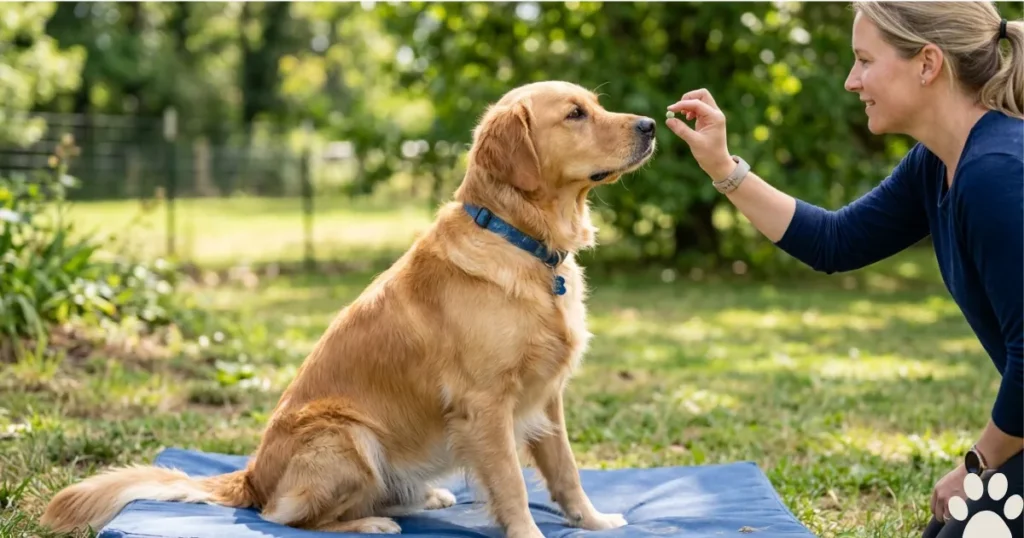
I regularly use peas as training treats for Golden Retrievers, and I do so for a specific reason beyond their low calorie count. Goldens are large-mouthed, fast-eating dogs. Many treat options either crumble in a pouch, leave grease on hands, or are large enough that repeated delivery in a training session skews the caloric budget. Frozen peas solve all three problems. They are firm, small enough to deliver quickly, carry about 1 calorie each, and most Goldens accept them willingly because of their natural sweetness.
For a 65-pound adult Golden Retriever in a 15-minute training session, 20 to 25 frozen peas as rewards add approximately 20 to 25 calories. That is a treat-budget-friendly training session by any metric.
Outside of training, peas work well mixed into a meal topper for a Golden on a weight management plan. A tablespoon of plain, frozen peas, thawed and mixed into kibble, adds bulk, fiber, and variety without significant calories. This is particularly useful for Goldens who finish their meals too quickly and seek additional food within minutes of eating.
The non-negotiable rules for all pea feeding with Golden Retrievers: plain only, no canned products with sodium, no creamed or buttered preparations, and no grain-free kibble with peas as a primary ingredient unless formulated under veterinary nutritional guidance.
Decision Framework: Peas for Golden Retrievers at Every Life Stage
If your Golden Retriever is under 3 months old, skip peas entirely. The digestive system is not yet equipped for legume fiber, and there are no meaningful nutritional gaps that peas fill at this stage that the primary food does not already cover.
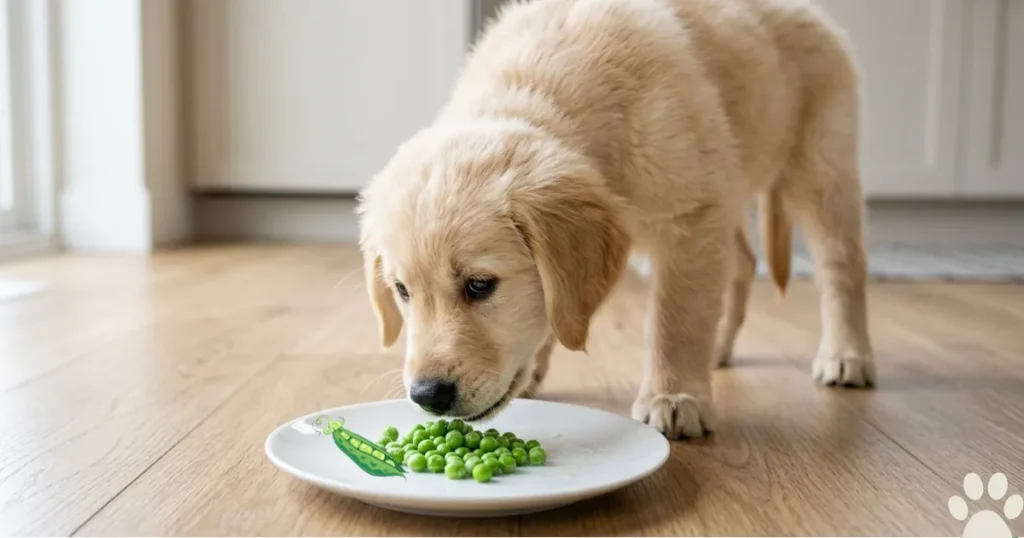
If your puppy is between 3 and 6 months old, introduce peas one at a time, starting with plain frozen peas thawed to room temperature. Watch for loose stools in the 24 hours following the first feeding. Sugar snap peas should be cut in half at this stage, as the whole pod can be bulky for a puppy’s smaller mouth, even though it is not toxic.
If your adult Golden weighs between 55 and 75 pounds and is at a healthy body condition score, fresh, frozen, or lightly steamed peas are appropriate daily in the serving sizes described above. Any variety except canned is suitable.
If your adult Golden is overweight or on a calorie-restricted diet, substitute green beans as the primary vegetable treat. Peas carry more starch than green beans and contribute more to the caloric treat budget. Use peas occasionally for variety rather than as the daily staple.
If your Golden is over 8 years old, lightly steamed peas are preferable to raw. Senior Goldens have reduced gut motility and enzyme production, and the legume fiber in raw peas can contribute to gas and digestive discomfort that is harder to manage in older dogs. Steaming softens the fiber and makes the peas easier to break down.
If your Golden has been diagnosed with kidney disease, remove peas from the treat rotation entirely and consult your vet for approved vegetable alternatives appropriate to your dog’s kidney function level.
If your Golden eats a grain-free kibble where peas, lentils, or potatoes appear in the first five ingredients, discuss switching to a grain-inclusive formulation with your veterinarian, particularly given the FDA’s breed-specific DCM data for Golden Retrievers.
Warning: When Peas Are Not Safe for Dogs
PROBLEMATIC – Monitor for 24 to 48 hours
A Golden Retriever who eats a large quantity of peas at once may experience gas, bloating, and loose stools from the concentrated legume fiber load. These symptoms typically resolve within 12 to 24 hours. Reduce serving size for subsequent feedings. If loose stools persist beyond 24 hours or are accompanied by lethargy or vomiting, call your vet.
UNSUITABLE – Avoid, not toxic in small amounts
Canned peas with added sodium are unsuitable for Golden Retrievers regardless of the amount. The sodium content in standard canned peas averages 310 milligrams per half-cup serving, which is excessive for a dog’s dietary sodium requirements. Peas in cream sauce, buttered peas, and seasoned frozen pea blends share concerns about added fat and salt, as well as potential contamination with harmful seasonings.
Pea pods from garden peas should be removed before feeding. Unlike snow pea and sugar snap pea pods, garden pea pods are tough and fibrous and do not digest easily. They also present a blockage risk for a large-breed dog that swallows them whole.
When to Call the Vet
| URGENT — Call immediately | MONITOR — Watch 24 to 48 hours |
| Signs of intestinal blockage: repeated straining without bowel movement, distended abdomen, whimpering when abdomen is touched | Loose stools after first pea introduction |
| Suspected ingestion of canned peas with very high sodium: tremors, excessive thirst, swelling | Mild gas or bloating after a large pea serving |
| Allergic reaction: facial swelling, hives, sudden lethargy, vomiting immediately after eating | Reduced appetite at the next meal |
| Suspected DCM symptoms: exercise intolerance, coughing, rapid breathing, collapse | Soft stools persisting for more than 24 hours |
A single pea-treat session does not cause the DCM symptoms in the urgent column above. They are included because Golden Retriever owners should know these signs regardless of diet, given this breed’s documented cardiac vulnerability. If your Golden shows exercise intolerance, unexplained coughing, or rapid, laboured breathing at rest, call your vet immediately, regardless of what they have eaten recently.
Can dogs eat peas from a can if rinsed thoroughly?
No. Canned peas should not be fed to dogs, even after rinsing. A standard half-cup serving of canned peas contains approximately 310 milligrams of sodium. Rinsing reduces surface sodium but does not remove sodium absorbed into the pea itself during the canning process. Always use fresh or frozen plain peas instead.
Can dogs eat peas every day without health risks?
Yes, healthy adult dogs can eat peas daily within the 10% caloric treat guideline. For a 65-pound Golden Retriever, 2 to 4 tablespoons of plain peas per day is a safe, nutritionally beneficial amount. Dogs with kidney disease or on grain-free pea-primary diets should discuss pea feeding with their veterinarian before making it a daily habit.
Can dogs have peas if they have a sensitive stomach?
Dogs with sensitive stomachs should be introduced to peas gradually, starting with five to ten peas and observing for 24 hours before increasing the amount. Lightly steamed peas are easier to digest than raw and are preferable for dogs with known digestive sensitivity. Avoid raw peas in large amounts for any dog with a history of inflammatory bowel disease.
Can dogs have peas mixed into their kibble every meal?
Yes, a small amount of plain peas mixed into kibble is safe for most healthy Golden Retrievers. Keep the total amount within the daily treat caloric budget. If your dog’s primary kibble already contains peas as a top-five ingredient in a grain-free formulation, adding more peas on top is unnecessary. It increases legume load, which carries relevance for Golden Retrievers given the breed’s documented DCM vulnerability.
Can dogs eat snow peas raw, or do they need to be cooked?
Dogs can eat snow peas raw. The pod of a snow pea is flat and tender, making it easy to chew and digest without cooking. Rinse them thoroughly and remove any tough strings along the seam before feeding. Raw snow peas are one of the most convenient vegetable treats for Golden Retrievers because no preparation beyond washing is required.
How many peas can a dog eat at one time without getting sick?
For most healthy medium to large-sized dogs, 2 to 4 tablespoons of peas per serving is a reasonable single serving. More than this at once increases the legume fiber load and raises the risk of gas, bloating, and loose stools. For a Golden Retriever, spread pea servings across the day rather than offering a large amount in one sitting.
Are peas good for Golden Retrievers with joint problems?
Peas contain vitamin K, magnesium, and antioxidant compounds that support general musculoskeletal and cellular health. They are not a targeted joint supplement and do not replace veterinary-recommended joint support products such as fish oil or glucosamine for Golden Retrievers with confirmed hip dysplasia or arthritis. As a low-calorie treat that supports weight management, peas help reduce the mechanical load on already-compromised joints by keeping body weight within a healthy range.
Is it safe to give my Golden Retriever peas every single day?
Yes, daily pea feeding is safe for healthy Golden Retrievers in appropriate amounts. Stick to plain fresh or frozen peas, two to four tablespoons for a 65-pound dog, and keep total daily treat calories within the 10% budget. Monitor stool consistency for the first week of daily feeding. If loose stools or gas appear, reduce the daily serving and reintroduce more gradually.
Do peas help Golden Retrievers maintain a healthy weight?
Peas support weight management in Golden Retrievers primarily by replacing higher-calorie commercial treats with calories, and secondarily by promoting fiber-driven satiety. At approximately 62 calories per cup, peas have a low caloric density, reducing total daily treat calories when substituted for commercial biscuits. They are not as calorie-lean as green beans, but they provide more protein and a broader vitamin profile, making them a nutritionally superior swap for most commercial treat options.
What happens if my Golden Retriever eats a whole bag of frozen peas?
A Golden Retriever who eats a full bag of frozen peas will almost certainly experience significant gas, loose stools, and abdominal discomfort from the concentrated legume fiber and starch intake. These symptoms typically resolve within 24 hours. Ensure access to water and monitor stool output. Contact your vet if vomiting persists beyond 12 hours, if the dog becomes lethargic, or if the abdomen appears visibly distended and hard to the touch, which could indicate bloat rather than simple digestive upset.
Are peas safe for Golden Retriever puppies under 6 months?
Plain peas can be introduced carefully from around 3 months of age in very small amounts. Start with five to eight plain frozen peas thawed to room temperature and observe stool consistency for 24 hours. Sugar snap pea pods should be cut in half for puppies to reduce the volume per piece. Do not feed garden pea pods to puppies. Skip peas entirely before 3 months. Steamed is preferable to raw for puppies under 6 months.
Should I avoid grain-free kibble with peas for my Golden Retriever?
This is worth a direct conversation with your veterinarian. The FDA’s DCM investigation found Golden Retrievers were the most-reported breed, and research published in peer-reviewed journals has identified peas as the ingredient most associated with non-traditional diets linked to DCM cases. No causal mechanism has been confirmed, but the breed-specific taurine vulnerability in Golden Retrievers makes grain-free, legume-rich diets a reasonable subject of veterinary discussion for this breed. Occasional pea treats on a grain-inclusive diet do not carry the same concern.
Are peas a good training treat for Golden Retrievers?
Yes. Frozen peas are among the most efficient training treats for Golden Retrievers: small enough for rapid delivery, firm enough to carry without crumbling, sweet enough for most Goldens to accept willingly, and approximately 1 calorie each. Twenty-five peas in a full training session adds roughly 25 calories, which sits well within the daily treat budget for any adult Golden. Thaw slightly for faster consumption during high-repetition training drills.
Can my Golden Retriever eat peas and carrots together?
Yes. Peas and carrots together are safe for Golden Retrievers and are a common combination in commercial dog food formulations for good reason. They provide complementary nutrients: carrots contribute beta-carotene and dental abrasion benefit, while peas add protein, vitamin K, and a broader mineral profile. Plain, unseasoned, and in appropriate amounts, this combination is one of the most nutritionally balanced vegetable treat pairings available for this breed.
My Golden Retriever refuses to eat plain peas. What should I try?
Some Goldens are indifferent to peas, particularly if their treat baseline is high-value commercial options. Try mixing a small number of plain frozen peas into kibble at mealtime for the first week so the dog encounters them alongside familiar food rather than as a standalone novelty. Steamed peas have a slightly sweeter smell than raw peas and sometimes generate more interest. Sugar snap peas, served whole and raw, offer a different texture experience than shelled peas and occasionally earn acceptance from dogs who have previously rejected plain garden varieties.
Conclusion
Dogs can eat peas safely, and Golden Retrievers benefit from them as a low-calorie, nutrient-dense treat that supports immune function and digestive health. The practical serving for a 65-pound adult Golden is two to four tablespoons of fresh or frozen peas per day, plain, without any added seasoning or sauce. Snow peas are the most convenient variety because the pods are edible, eliminating one preparation step. What this breed’s owners should understand is the clear distinction between occasional pea treats, which carry no meaningful cardiac or kidney risk in healthy dogs, and grain-free, pea-primary diets, which require a more careful conversation with your veterinarian given this breed’s documented susceptibility to taurine-deficient DCM.
Goldens vary in how they respond to peas as a treat, and the variety matters more than most owners expect. Some Goldens treat frozen peas as a high-value reward they will consistently work for, while others show complete indifference.
I’d love to know which pea variety your Golden actually responds to in practice.
- Does your dog take frozen peas as training rewards, or do they need them mixed into food before showing any interest?
- Have you made any changes to your Golden’s diet after reading about the DCM research, and if so, what did your vet recommend?
Share your experience in the comments. This is exactly the kind of breed-specific dietary history that helps other Golden owners make more informed decisions.