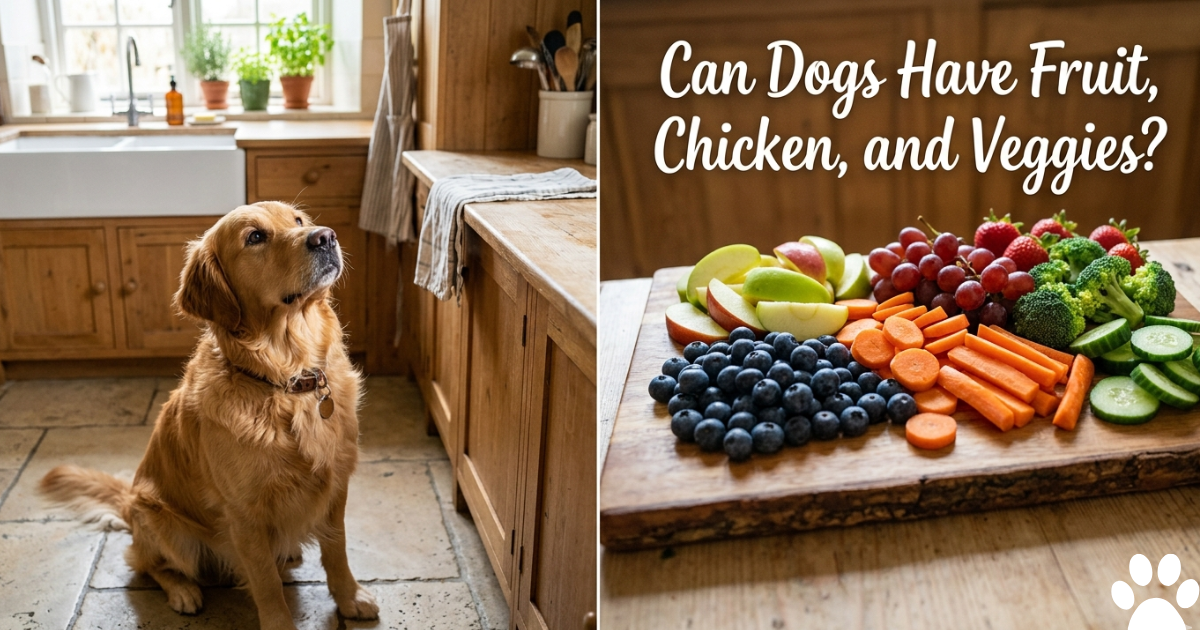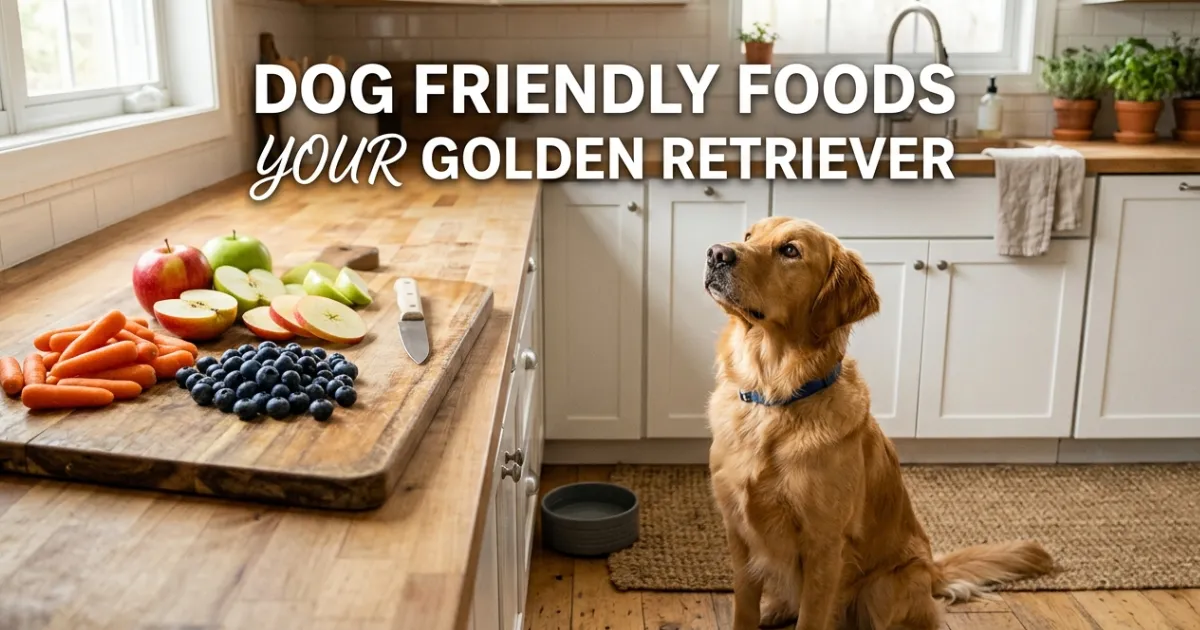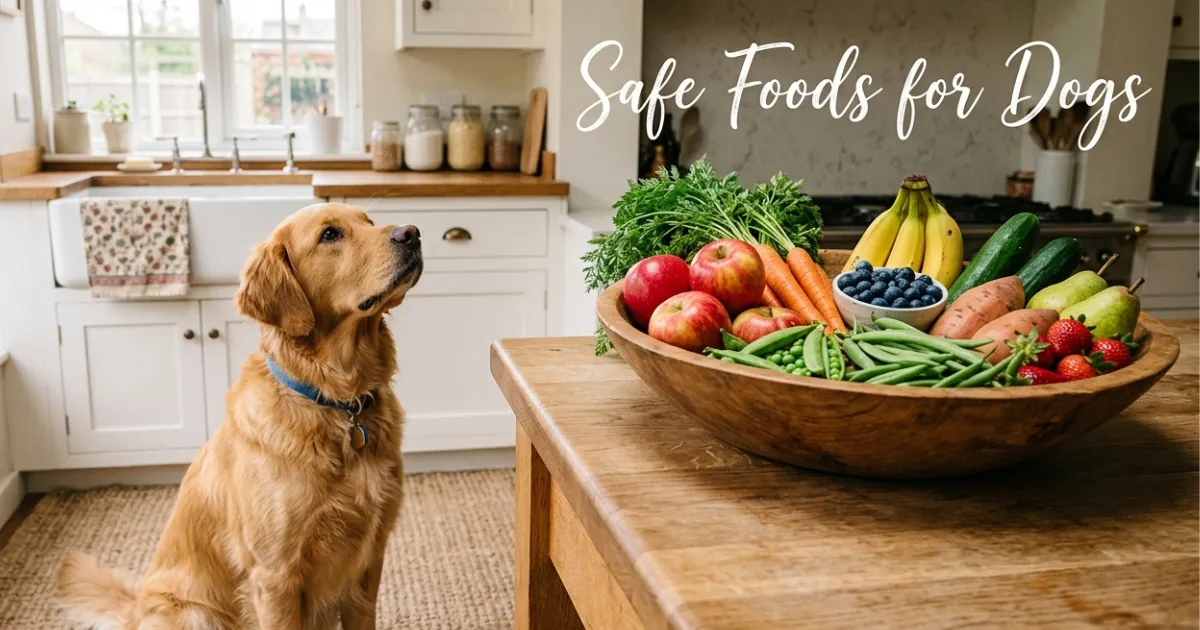
Dogs eat carrots safely. Carrots are non-toxic, low in calories, and well tolerated by most dogs, whether raw, steamed, or frozen. For Golden Retriever owners specifically, carrots are one of the most practical daily treats available because they deliver real nutritional value at a caloric cost that suits a breed predisposed to weight gain and obesity.
Most owners who ask whether dogs eat carrots regularly are not asking about toxicity. They already know carrots are safe. What they are actually trying to figure out is frequency, serving size, and whether their specific dog, at its specific age and weight, can have carrots every day without a problem. Those are the right questions. The answers depend on your Golden’s life stage, body condition score, and health history.
Golden Retrievers are food-motivated by nature and, in many cases, will eat carrots with the same enthusiasm they bring to commercial treats. According to the Association for Pet Obesity Prevention’s 2022 survey, over 55% of dogs in the United States are classified as overweight or obese. Golden Retrievers are consistently overrepresented in that figure. A breed that will eagerly eat a carrot instead of a calorie-dense biscuit is one you can guide toward better daily nutrition with minimal resistance. Carrots are that lever. Understanding how to use them correctly makes the difference.
Are Carrots Ok for Dogs as a Daily Treat?
Are carrots ok for dogs every day? Yes, for most healthy adult dogs. The key constraint is the 10% treat rule: all treats combined, including carrots, should not exceed 10% of your dog’s total daily caloric intake. For a 65-pound adult Golden Retriever eating approximately 1,400 calories per day, that is a 140-calorie treat budget shared across everything your dog receives outside of its main meals. One medium carrot contains roughly 25 calories. Three baby carrots contain approximately 15 calories. Both sit well within that daily budget and can be fed without disrupting your Golden’s nutritional balance.
Fiber content matters when considering daily frequency. A medium carrot provides approximately 1.7 grams of dietary fiber. For a Golden Retriever with a sensitive gut or one prone to loose stools, daily carrot feeding at high volumes can tip the fiber balance and cause soft or orange-tinted stools. One to two medium carrots per day is the practical ceiling for most adult Goldens. More than that is not toxic, but it does increase the likelihood of digestive disruption.
For the full safe vegetable guide for Golden Retrievers, including which vegetables to combine and which to avoid, see our dog safe vegetables guide.
Are Carrots Okay for Dogs at Every Life Stage?
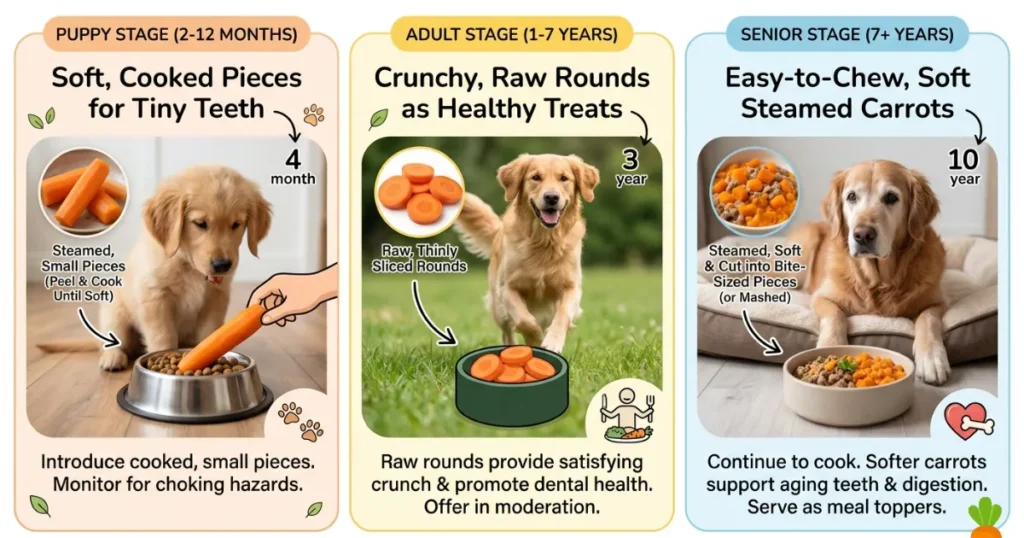
Are carrots okay for dogs at every age? Broadly, yes, with preparation and portion adjustments based on life stage. Golden Retrievers move through meaningfully different digestive and metabolic phases from puppyhood through senior years, and carrot feeding needs to reflect those differences.
Puppies Under 6 Months
Golden Retriever puppies under 6 months of age have developing digestive systems with lower tolerance for concentrated plant fiber. Small steamed carrot pieces the size of a fingernail are safe from around 10 to 12 weeks. Raw carrots at this stage are too hard and dense for a puppy’s smaller jaw and less efficient chewing. Frozen baby carrots are useful during the teething window between 3 and 7 months, providing gum relief and appropriate chewing resistance. Limit servings to 2 or 3 fingernail-sized pieces per session, and watch for loose stools in the 24 hours following any introduction.
Adult Goldens Between 6 Months and 7 Years
This is the stage at which dogs eat carrots most easily and most beneficially. Raw baby carrots or sliced large carrots are appropriate daily. The mechanical chewing action provides mild dental benefit, and the low caloric load makes carrots a practical replacement for commercial treats in training sessions. For a 65-pound healthy adult Golden, one medium carrot or four to five baby carrots per day is a sensible daily amount that provides fiber and beta-carotene without disrupting caloric balance.
Senior Goldens Over 8 Years
Senior Golden Retrievers have reduced chewing efficiency and slower gut motility. I’ve seen owners persist with raw carrots for senior Goldens who no longer have the jaw strength or the molar surface area to chew them properly. A senior Golden chewing a raw carrot often swallows larger, less broken-down pieces than a younger dog would, increasing the risk of partial blockage and reducing the digestibility of nutrients. Switch to lightly steamed carrots for any Golden over 8 years. The nutritional profile is essentially equivalent, and the softer texture is far more appropriate for an aging digestive system.
What Happens When Dogs Eat Carrots Too Fast
Generic articles on whether dogs eat carrots cover safety and nutrition but fail to address one specific risk that disproportionately affects Golden Retrievers: rapid eating behaviour and its interaction with carrot preparation.
Golden Retrievers are hardwired to eat quickly. This is a breed trait rooted in their working history as retrievers, who are expected to respond quickly to reward incentives. A Golden presented with a carrot does not approach it the way a small or medium breed does. Large breeds at the upper end of the Golden size range, typically between 65 and 80 pounds, will bite a large carrot in half, swallow the distal piece with minimal chewing, and move to the next piece before the first has fully cleared the oesophagus.
The practical risks from this behaviour are two. First, a large chunk of raw carrot can cause an oesophageal obstruction. The oesophagus of a large breed can accommodate bigger pieces than a small dog’s, but the speed of swallowing means the piece does not get the mechanical compression it would from a slower chewing process. Second, a pointed carrot piece bitten at an angle can scrape the soft palate, causing bleeding and discomfort that owners often mistake for a dental problem.
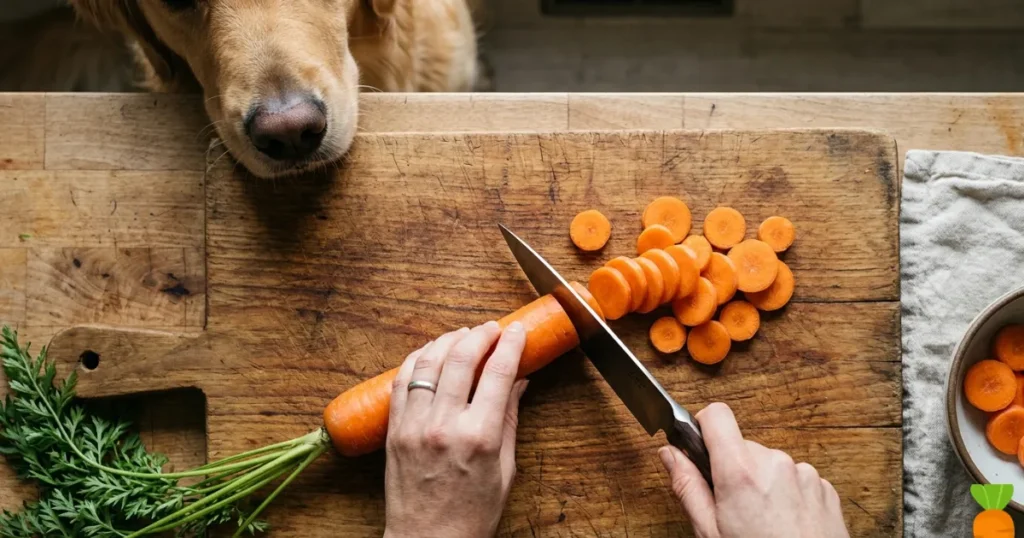
The fix is simple. Cut large carrots into rounds no thicker than one centimetre, or into sticks no longer than five centimetres. Baby carrots are safe for adult Goldens because they are small enough to manage even at speed. Supervise the first few carrot feedings with a new Golden to assess your individual dog’s eating pace before settling on a preparation method.
Expert Insight
In large-breed dogs, the combination of food motivation, jaw strength, and fast consumption behaviour changes the risk profile of even low-hazard foods like carrots. What is a safe treat for a Beagle, handed whole, may become a mechanical hazard for a Golden Retriever who bites and swallows without the chewing sequence that makes plant fiber digestible and pieces safe to pass. Preparation is not a formality for this breed. It is the primary safety variable.
What I Actually Recommend: How Golden Retriever Owners Should Use Carrots
I use carrots as a functional part of a Golden Retriever’s daily treat structure, not just as an occasional snack. Here is the protocol I follow and recommend.
For training sessions, slice raw carrots into rounds roughly the size of a five-pence or one-cent coin. These are small enough to deliver quickly, firm enough not to crumble in a treat bag, and low in calories enough that you can give 20 to 30 repetitions in a session without significantly affecting the daily caloric budget. Most Goldens respond to carrots with genuine enthusiasm during training because of their natural sweetness, making them useful as a primary reward for repetitive behaviours where high-value treats are unnecessary.
For between-meal satisfaction, three to four baby carrots served in the afternoon reduces the begging behaviour that many Golden owners manage daily without a sustainable strategy. Goldens beg because their food motivation does not switch off between meals. A low-calorie, filling snack served at a consistent time each day reduces that behaviour more reliably than simply ignoring it.
For Goldens on calorie-restricted diets, replace up to 10% of the daily kibble volume with plain steamed carrots. This creates a larger meal volume at a lower caloric density, which reduces hunger-driven behaviour without adding significant calories. Check this approach with your vet before implementing it if your Golden has a confirmed health condition.

Carrot Myths Golden Retriever Owners Should Stop Believing
Myth 1: Dogs eat carrots for the vitamin A, which is stored and can cause toxicity.
This is inaccurate for carrot-sourced nutrients. Carrots contain beta-carotene, a precursor to vitamin A, not preformed retinol. The conversion of beta-carotene to vitamin A in dogs is self-limiting: when the body has adequate vitamin A stores, conversion slows automatically, according to research in the Journal of Animal Science. Vitamin A toxicity in dogs comes from preformed retinol found in liver supplements and cod liver oil, not from vegetables.
Myth 2: Cooked carrots lose all their nutritional value.
Light steaming reduces the heat-sensitive vitamin C by a small amount. Beta-carotene, fiber, potassium, and vitamin K are largely preserved through steaming and boiling. For a Golden Retriever who needs the digestive ease of a softer texture, cooked carrots are not a nutritional compromise. They deliver the same core benefits with better digestibility for puppies and senior dogs.
Myth 3: Orange stools after carrot feeding mean something is wrong.
Orange-tinted stools are a normal result of excess beta-carotene passing through the gut before being fully absorbed. This is harmless. It resolves when carrot serving sizes are reduced. No veterinary attention is needed unless the orange stools are accompanied by diarrhea, lethargy, or blood.
Myth 4: Carrots clean a dog’s teeth as well as brushing does.
Carrots provide mild mechanical abrasion on accessible tooth surfaces during chewing. The AKC identifies this as a supplementary dental benefit. It is not a substitute for brushing or professional dental cleaning. Plaque on the inner surfaces of teeth and along the gumline is not affected by carrot chewing. Treat it as a useful supplement, not an equivalent.

Warning: When Carrots Are Not Okay for Dogs
PROBLEMATIC – Monitor for 24 to 48 hours:
A Golden Retriever who eats a large quantity of raw carrots in one sitting may develop loose stools, gas, or mild abdominal discomfort from the concentrated fiber load. These symptoms typically resolve within 12 to 24 hours. Reduce the serving size for subsequent feedings. If loose stools persist beyond 24 hours or are accompanied by vomiting or lethargy, call your vet.
UNSUITABLE – Avoid, not toxic:
Canned carrots with added sodium are unsuitable for Golden Retrievers regardless of carrot content. Dogs do not require added dietary sodium, and high-sodium snacks contribute to blood pressure issues in older dogs. Always use fresh, frozen, or plain cooked carrots. Read ingredient labels on any packaged carrot product before feeding.
Seasoned, glazed, or honey-roasted carrots from a human meal are also unsuitable. Sugar glazes, butter, onion powder, garlic powder, and similar seasonings are common in carrot recipes and pose risks ranging from digestive upset to genuine toxicity, depending on the ingredient.

When to Call the Vet
| URGENT — Call immediately | MONITOR — Watch 24 to 48 hours |
| Signs of choking after carrot feeding: pawing at mouth, extended neck, respiratory distress | Loose or soft stools after first carrot introduction |
| Suspected oesophageal obstruction: repeated retching without productive vomiting | Mild gas or bloating after large carrot serving |
| Vomiting blood or dark material after eating a large carrot piece | Orange-tinted stools from high beta-carotene intake |
| Allergic reaction: facial swelling, hives, sudden collapse | Reduced appetite at next meal following new food introduction |
None of the “monitor” symptoms requires emergency action unless they escalate. Orange stools specifically require no veterinary contact at all, provided the dog is otherwise well. For broader guidance on safe and unsafe vegetables for this breed, our carrot feeding guide for Golden Retrievers covers preparation, choking risk, and life-stage serving sizes in full detail.
Do dogs eat carrots naturally, or is it an acquired taste?
Most dogs eat carrots readily because of their natural sweetness, which comes from their sugar content of roughly 4.7 grams per 100 grams. Some dogs need a short introduction period, particularly if they have only eaten processed treats. Offering small pieces alongside familiar food for the first few sessions usually builds acceptance within a week.
How often should dogs eat carrots to get a consistent nutritional benefit?
Dogs who eat carrots three to five times per week at appropriate serving sizes receive consistent beta-carotene and fiber intake without the risk of digestive disruption from daily high-volume feeding. Daily feeding at modest amounts, one medium carrot or four baby carrots for a 65-pound adult Golden, is also well-tolerated by most healthy dogs.
Are carrots ok for dogs who are sensitive to high-fiber foods?
Carrots are ok for most dogs with mild fiber sensitivity when served in small, infrequent amounts. Start with one baby carrot and observe stool consistency for 24 hours. If stools remain firm and normal, gradually increase to a regular serving. Dogs with confirmed digestive conditions, such as inflammatory bowel disease, should have dietary changes approved by a vet before introducing new fiber sources.
Are carrots okay for dogs who are already on a high-fiber kibble?
Carrots are okay for dogs on high-fiber kibble in small amounts, but monitor total daily fiber intake. If your Golden’s primary food already contains 6% or more crude fiber, adding multiple carrots per day may push total fiber intake beyond the comfortable range and cause loose stools. Limit to one or two baby carrots as a supplement rather than a main treat source.
How many days a week is it okay for a dog to eat carrots?
Daily carrot feeding is fine for most healthy adult dogs at appropriate serving sizes. The practical limit is dietary balance: carrots should stay within the 10% daily caloric treat allocation. For a 65-pound adult Golden Retriever eating 1,400 calories per day, one medium carrot or four to five baby carrots daily comfortably fits within that budget without displacing necessary nutrition from main meals.
Are carrots okay for dogs of all sizes in the same preparation?
Preparation should vary by size. Small breeds can safely handle baby carrots whole. Large breeds, including Golden Retrievers, should have carrots cut into rounds or short sticks because of their tendency to eat quickly and swallow large pieces without fully chewing. Baby carrots are safe for Golden Retrievers in their whole form due to their smaller size.
Do carrots help Golden Retrievers manage their weight over time?
Carrots support weight management in Golden Retrievers primarily by providing calories. Substituting commercial treats with carrots significantly reduces caloric treat intake. Approximately 56% of dogs in the United States are classified as overweight or obese, according to the Association for Pet Obesity Prevention. For a breed prone to weight gain, this substitution creates a sustainable daily calorie reduction without requiring changes to main meal portions.
Are carrots ok for Golden Retrievers with a cancer diagnosis?
Carrots are generally ok for Golden Retrievers with cancer, but dietary decisions during treatment should be made with your veterinary oncologist. Beta-carotene in carrots acts as an antioxidant that supports immune function. Some oncology protocols have specific dietary restrictions around antioxidant supplementation during certain treatment phases. Plain carrots, as a low-calorie treat, are unlikely to cause problems, but confirm with your specialist before making them a regular part of the diet during active treatment.
Is it safe to give my Golden Retriever carrots every single day?
Yes, daily carrot feeding is safe for most healthy Golden Retrievers when serving sizes stay within the 10% treat caloric limit. One medium carrot or three to four baby carrots per day for a 65-pound adult Golden sits well within that range. Monitor stool consistency for the first week of daily feeding and reduce the amount if loose stools appear.
What happens if my dog eats a whole bag of carrots?
A Golden Retriever who eats a full bag of carrots will likely experience significant gastrointestinal upset: loose stools, gas, and possibly vomiting from the concentrated fiber and natural sugar load. These symptoms typically resolve within 24 hours without veterinary intervention. Ensure the dog has access to water and monitor stool output. Contact your vet if vomiting persists beyond 12 hours, if blood appears in the stools, or if your dog becomes lethargic.
Are carrots a good treat for Golden Retrievers during training sessions?
Yes. Carrots are an effective training treat for Golden Retrievers, particularly for repetitive reward-based training where high-value treats are unnecessary. Sliced into small rounds, they are easy to carry, firm enough not to crumble, and low in calories at roughly 4 to 5 calories per baby carrot. This allows for 20 to 30 treat repetitions per session without significantly affecting the daily caloric budget.
Do Golden Retrievers digest carrots differently than other breeds?
Golden Retrievers do not metabolise carrot nutrients differently from other dogs, but their eating speed affects how well carrots are physically broken down before digestion. A Golden who swallows large carrot pieces whole absorbs fewer nutrients from them than one who chews thoroughly, because plant cell walls in carrots require mechanical breakdown to release their beta-carotene and fiber content. Smaller pieces and steamed preparation both improve nutrient availability.
How do I know if my Golden Retriever has eaten too many carrots?
Watch for orange-tinted stools, loose stools, or excessive gas in the 12 to 24 hours following a large carrot feeding. Orange stools alone are harmless. Loose stools that persist for more than 24 hours suggest the serving was too large for that dog’s digestive tolerance. Reduce the daily amount by half and reintroduce gradually. These symptoms do not require veterinary attention unless they are accompanied by lethargy, vomiting, or blood.
Can my Golden Retriever eat carrots from the garden without washing them?
No. Garden carrots should always be washed before feeding. Soil residue can carry bacteria, parasites, and contamination from pesticides or fertilisers, depending on which products have been used in the growing area. Rinse under running water and scrub the surface before feeding. If your garden uses any pesticides, herbicides, or systemic fertilisers, peel the carrot before serving.
My Golden Retriever refuses to eat carrots. What should I try?
Some Goldens initially resist carrots because their texture and smell differ from their usual treats. Try grating raw carrot over their regular meal for the first week, so they consume it mixed with familiar food. Steamed carrots have a softer texture and a slightly sweeter smell that some resistant Goldens accept more readily than raw carrots. Frozen baby carrots are a third option that some dogs use as chew toys rather than food treats.
Conclusion
Dogs eat carrots without issue across most life stages when preparation and serving sizes are matched to the individual dog. For Golden Retrievers, carrots are among the best daily treat options: low-calorie, filling, naturally sweet, and useful for training. The one variable most owners skip is preparation. Cut large carrots down to rounds or short sticks before handing them to a Golden. Use steamed for puppies and seniors. Keep daily servings within the 10% caloric treat budget. That is the complete framework. Goldens vary more than most owners expect in how they actually respond to carrots. Some pick them up and carry them around before eating. Others bolt them whole if given the chance.
I’d love to know where your Golden falls.
- Does your dog treat carrots as a serious reward, or do they need something higher value to stay engaged during training?
- Has switching from commercial treats to carrots made any difference to your Golden’s weight or energy over time?
Share the specifics in the comments. Do share your experience, as a real owner, with this breed or other breeds.