Banana for puppy feeding is safe in Golden Retrievers. The fruit contains no toxic compounds at any life stage, and in small amounts, it delivers potassium, vitamin B6, and soluble fiber that support growing muscles and digestion. For a Golden Retriever puppy between 3 and 6 months old, one to two thin, peeled slices per session, two to three times a week, is the right amount.
What generic articles consistently miss is the breed-specific complication. Golden Retrievers are one of the most food-motivated breeds on earth. I’ve watched Golden puppies eat bananas with the same locked-in focus they bring to kibble and anything else edible within reach. That temperament makes overconsumption a real risk. Unlike a less food-driven breed that takes one bite and walks away, a Golden puppy will eat every slice you put down. This is not just a sugar concern. It is a caloric displacement problem during the growth window, when protein to calorie ratios directly shape skeletal and joint development, and Goldens are already genetically predisposed to hip and elbow dysplasia.
Bananas contain approximately 14 grams of natural sugar per medium fruit, according to the USDA Food Data Central database. For a Golden Retriever puppy weighing 15 to 25 pounds, that entire fruit represents a significant caloric load from a single treat, pulling energy away from the protein intake that supports joint development between 8 and 15 months of age.
Banana for Puppy Safety: What the Fruit Actually Contains
Banana flesh contains no compounds toxic to dogs. It is a safe fruit for dogs. The ASPCA’s toxic food database does not list bananas as harmful at any life stage, making bananas for puppy use legitimate from a toxicity standpoint. Safety and suitability are different things, though, and for Golden Retriever puppies that distinction matters.
The nutritional case is real. Potassium supports muscle contraction and nerve signaling, both of which are critical for a rapidly growing Golden puppy. Vitamin B6 supports brain development and energy metabolism during the intensive first six months. Pectin, the soluble fiber in bananas, can firm loose stools during dietary transitions, one of the most common challenges new Golden puppy owners face when bringing a puppy home.
The risk is caloric density. A single medium banana delivers roughly 105 calories and 27 grams of carbohydrate. For a 20-pound Golden puppy, that is approximately 10 to 12 percent of daily caloric needs from a single treat, leaving almost no room for other rewards and compressing the protein intake the puppy’s formula is built to prioritize.
Why the 10% Treat Rule Hits Harder for Large-Breed Puppies
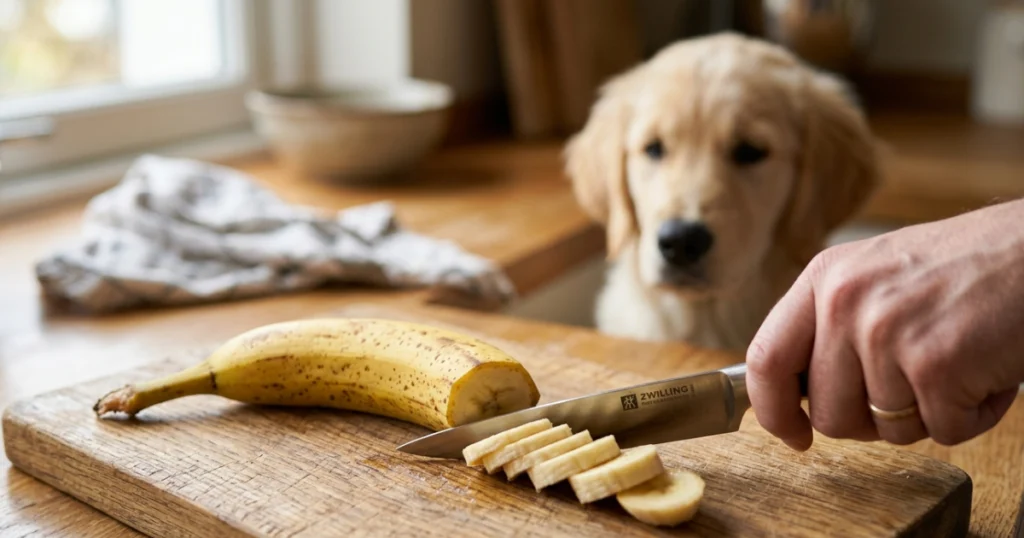
Golden Retrievers typically reach 55 to 75 pounds as adults. Large-breed puppies require controlled calorie intake during growth to prevent accelerated bone development, which raises the risk of joint problems later. The AKC’s nutrition guidance is direct: treats must not exceed 10 percent of daily caloric intake for any dog, and that ceiling is even tighter for puppies on large-breed growth formulas. One or two thin banana slices stay within safe limits. Half a banana does not.
How Much Banana Can a Golden Retriever Puppy Eat
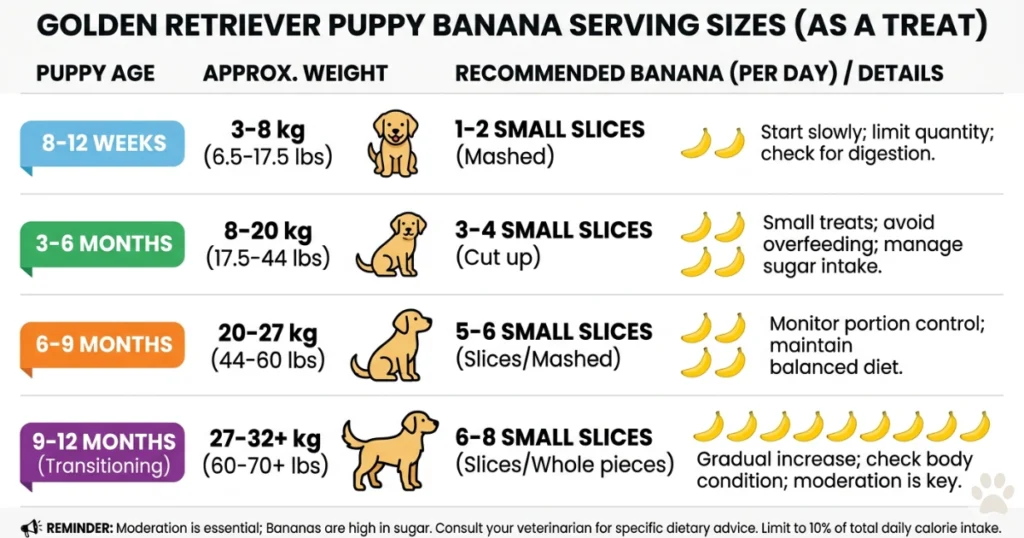
Banana for puppy serving sizes should be measured by body weight and age, not by appetite. With Goldens, appetite is never a reliable guide.
| Puppy Age | Approximate Weight | Safe Banana Amount | Frequency |
| 8–12 weeks | 8–15 lbs | 1 thin slice (¼ inch) | Once per week |
| 3–5 months | 15–30 lbs | 1–2 thin slices | Twice per week |
| 6–9 months | 30–50 lbs | 2–3 thin slices | 2–3 times per week |
| 10–15 months | 45–65 lbs | 3–4 thin slices | 2–3 times per week |
One slice = 1/4 inch thick, peeled, cut into small pieces. Never feed the peel. Never feed half or a whole banana to a puppy at any age.
I use banana for puppy training sessions rather than free snacking. One thin slice cut into four small pieces yields four high-value training reps while keeping volume within safe limits. That single adjustment captures the nutritional benefit without triggering the caloric overload this breed is prone to.
What Banana for Puppy Feeding Actually Delivers Nutritionally
Potassium and Golden Retriever Puppy Muscle Development
Golden Retriever puppies go through rapid muscle development between 3 and 10 months. A medium banana provides roughly 422 milligrams of potassium according to the USDA, supporting muscle contraction and nerve signal transmission after high-activity play sessions without adding fat or sodium to the treat load.
Banana and Puppy Digestion: The Pectin Benefit
Banana’s pectin fiber binds water in the digestive tract, helping to firm stool consistency naturally. This makes banana for puppy use genuinely practical during transition periods when Golden puppies commonly experience loose stools. According to the Association for Pet Obesity Prevention’s 2022 survey, approximately 56 percent of dogs in the United States are classified as overweight or obese, a figure that shows how easily well-intentioned treat feeding becomes a long-term weight problem. Keep bananas within the daily treat ceiling, and the digestive benefit is real without the caloric risk.
Banana for Puppy Preparation: The Right Way to Serve It
Serving banana for puppy feeding correctly matters as much as the amount you serve.
Peel completely and discard the skin.
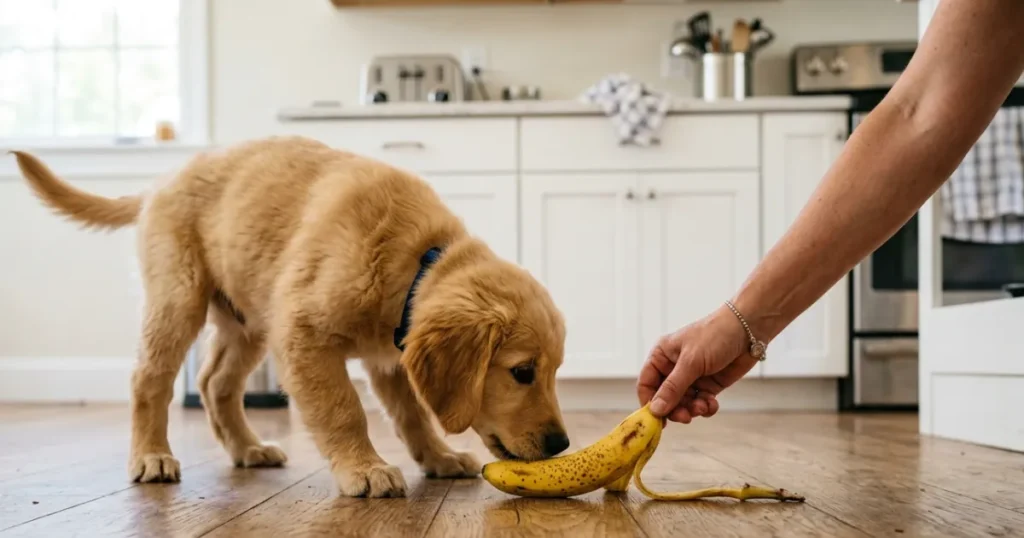
According to PetMD, signs of intestinal blockage include vomiting, loss of appetite, lethargy, and straining to defecate. A Golden puppy that swallows a peel faces a higher risk of blockage than an adult dog because of its smaller intestinal diameter. If your puppy eats peel and shows any of these signs, call your vet immediately.
Choose ripe, not overripe.
A heavily browned or mushy banana has converted most of its starch to simple sugars, unnecessarily raising the glycemic load. Ripe and yellow is always the right choice for a developing metabolic system.
Cut thin and small.
Golden puppies eat fast. Quarter-cut thin slices reduce the risk of choking and encourage chewing rather than gulping.
Avoid all processed banana products.
Banana bread, banana pudding, and dried banana chips are not appropriate for any puppy. Many contain xylitol, which triggers a rapid insulin release in dogs that drives blood glucose to dangerously low levels within 30 to 60 minutes. According to the ASPCA Animal Poison Control Center, as little as 0.1 grams of xylitol per kilogram of body weight is life-threatening in dogs. For a 20-pound Golden puppy, that threshold is extremely small.
What Generic Banana for Puppy Articles Get Wrong About Golden Retrievers
Every top-ranking article on banana for puppy feeding treats the topic as breed-neutral. That fails Golden Retriever owners in three specific ways.
Food motivation amplifies overconsumption.
Research published in Cell Metabolism identified a POMC gene variant in approximately 63 percent of Golden Retrievers linked to reduce satiety signaling. This is a physiological trait, not a training problem. A Golden puppy will consistently push for more banana than any other breed would request, and owners who read enthusiasm as a green light for larger servings are making a predictable, breed-specific mistake.
The large-breed growth window tightens the caloric ceiling.
Generic advice allows up to half a banana for large dogs. That guidance is written for adults. A Golden puppy between 4 and 10 months is in its most sensitive skeletal development phase. Caloric excess during this window, even from fruit, contributes to growth rate acceleration that stresses hip and elbow joints that are not yet fully formed.
Golden puppies have transitional digestive sensitivity.
I’ve seen this consistently. Golden puppies arriving at a new home often have loose stools for the first 2 to 4 weeks. Introducing banana for puppy feeding during this window can backfire if the sugar content feeds bacterial imbalance in an already disrupted gut. Wait for stools to stabilize before introducing any new dog food.
Expert Insight
“In large-breed puppies, every treat calorie competes with the protein and mineral ratios built into the growth formula. Banana for puppy use is nutritionally valid as an occasional reward, but the serving ceiling for a 4-month-old Golden Retriever is considerably lower than most owners assume. Two thin slices capture the benefit without the caloric compromise. The real risk is not the banana itself. It is the cumulative treat load across the day that quietly erodes the precision of the diet.”
Warning: When Banana for Puppy Feeding Becomes a Problem
TOXIC – Call your vet immediately
Any banana product that may contain xylitol, including banana bread, banana pudding, or flavored treats. Xylitol drives blood glucose to dangerous lows within 30 to 60 minutes, affecting the pancreas and liver. Call your vet or the ASPCA Animal Poison Control Center at 888-426-4435 the moment you suspect ingestion.
PROBLEMATIC – Monitor for 24 to 48 hours
Loose stools after a first banana feeding session. This usually resolves within 24 hours if you stop giving bananas and keep your puppy hydrated. Escalate to your vet if diarrhea continues beyond 24 hours or if you see blood in the stool.
UNSUITABLE – Avoid, not dangerous
Banana for puppy feeding in any Golden on a vet-prescribed caloric restriction protocol. The sugar and calorie load conflicts directly with active weight management for this breed during the growth phase.
When to Call the Vet
| URGENT — Call Immediately | MONITOR — Watch 24–48 Hours |
| Puppy ate banana bread or any xylitol-risk product | Soft stool after first banana feeding |
| Vomiting, lethargy, no appetite after eating peel | Mild gas or stomach gurgling |
| Facial swelling, hives, or labored breathing | Slightly reduced appetite at next meal |
| Abdominal distension after peel ingestion | Loose stool that firms within 24 hours |
Decision Framework – Is Banana for Puppy Feeding Right for Your Golden
Under 8 weeks old
No banana or human food of any kind. Puppy kibble or formula only.
Just arrived home in the last two weeks
Wait before introducing banana for puppy treats. Let digestion stabilize on the new food first. Sensitivity during this window is transition-related, not allergy-related.
4 to 10 months old and healthy
One to three thin slices of ripe peeled banana, two to three times per week as a training reward, is within safe limits. Track treat calories against the daily ceiling.
Overweight or on a vet-restricted diet
Skip the banana entirely. Ask your vet for lower-sugar alternatives that fit the protocol.
Sensitive stomach
Introduce a banana for puppy feeding alone, not with other new foods. One slice, one session, watch stool quality for 24 hours before repeating.

Is banana for puppy feeding safe for Golden Retrievers?
Yes. Banana for puppy feeding is safe for Golden Retrievers in small amounts. One to two thin, peeled slices per session, two to three times per week, is appropriate depending on age and weight. The fruit is not toxic, but sugar and calorie content mean portion control is essential for a large-breed puppy on a growth formula.
How do I use a banana for puppy training with a Golden Retriever?
Cut one thin slice into four small pieces and use each as a single training rep. This keeps banana for puppy training within safe caloric limits while delivering a high-value reward. Never exceed one to two slices per session, regardless of session length or how much your Golden pushes for more.
What is the right banana puppy serving size by age for a Golden Retriever?
Banana puppy serving size scales with weight and age. A 3-5 months old Golden weighing 15 to 30 pounds gets 1 to 2 thin slices per session. A 6-9 months puppy gets two to three slices. A 10-15-month puppy gets three to four slices. Always peel fully and cut into small pieces before serving.
What safe fruits for Golden Retriever puppies work well alongside bananas?
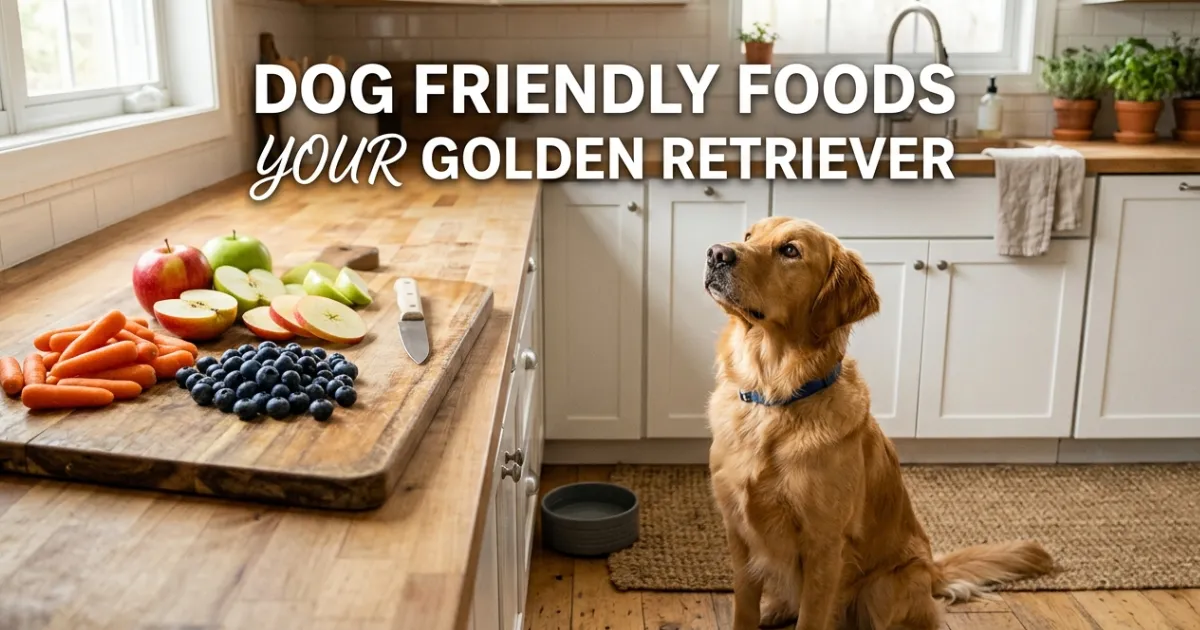
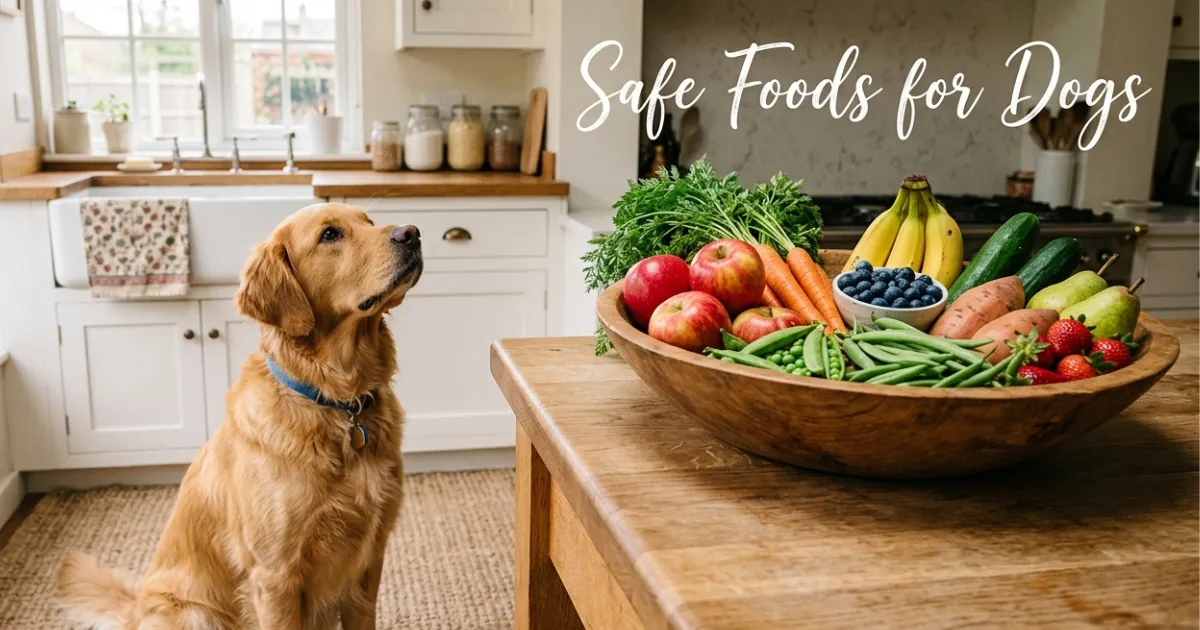
Blueberries, seedless watermelon, and apple slices with the core removed are all safe, lower-sugar options. Blueberries offer antioxidant benefits and significantly less sugar per serving than bananas, making them a strong alternative for puppies on a calorie-restricted diet. See the full breakdown in our best fruits and vegetables for dogs guide.
How does banana and puppy digestion work in Golden Retrievers?
Banana’s pectin fiber can firm loose stools during dietary transitions common in new Golden puppies. However, the sugar content can worsen bacterial imbalance in a puppy already experiencing digestive sensitivity. Introduce one thin slice, monitor stool quality for 24 hours, and do not use a banana during active digestive upset without veterinary guidance.
How should I prepare a banana puppy treat for a Golden Retriever?
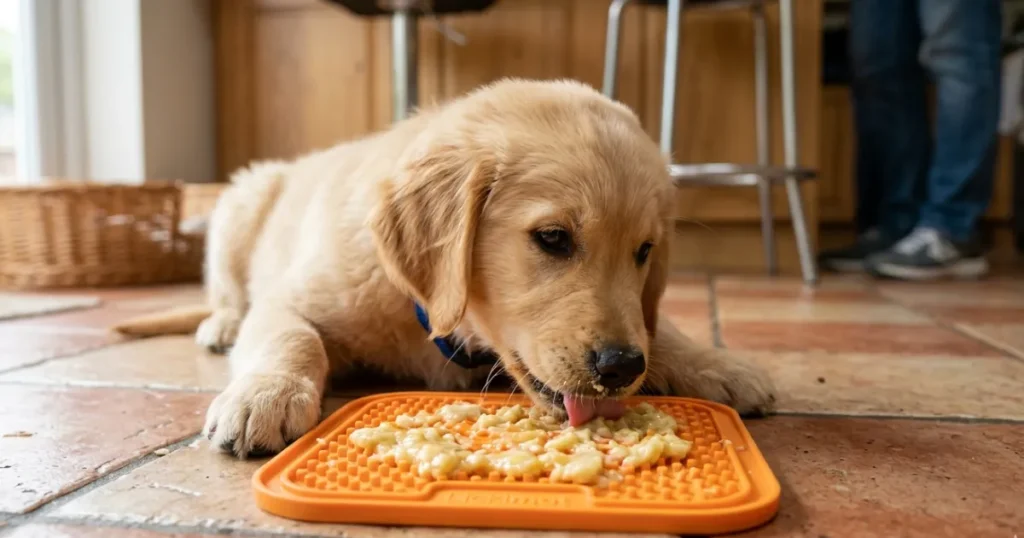
Peel the banana completely, slice it into thin rounds, and cut each round into small pieces to prevent gulping. Serve fresh and ripe. Mashing a small amount onto a lick mat works well for food-motivated Goldens who eat too quickly. More preparation tips at: Are Bananas Healthy for Dogs?
Can puppies eat bananas at 8 weeks old?
Eight weeks old puppies should eat only puppy kibble or formula. Their digestive systems are still adjusting to solid food. Wait until 10 to 12 weeks before introducing any treat, including a banana. Start with one small piece and watch for digestive changes over 24 hours before repeating.
How many bananas can a puppy eat without getting sick?
One to two thin slices is a safe starting amount for most puppies. There is a greater risk of loose stools from the combined fiber and sugar load. Keep the banana within the 10 percent daily treat calorie ceiling. For puppies under 15 pounds, that ceiling allows very little fruit per session. See can dogs eat banana for adult comparisons.
Is a banana good for puppies with an upset stomach?
Only in specific cases. Banana’s pectin can help firm stools caused by dietary transitions. If upset stems from illness or food sensitivity, banana’s sugar can worsen gut imbalance. Plain boiled chicken and rice are a safer short-term intervention. Consult your vet before using a banana therapeutically.
Can puppies eat frozen banana?
Yes, in small pieces with supervision. Frozen banana soothes inflamed gums in teething puppies between 12 and 24 weeks. Keep pieces very small as frozen banana is firmer than fresh, and Golden puppies tend to gulp. One or two small frozen pieces per session is appropriate.
Can Golden Retriever puppies eat banana if they have a hip dysplasia risk?
Banana does not cause dysplasia directly. The concern is caloric excess during the growth phase, increasing mechanical stress on developing joints. Keeping banana for puppy servings small and infrequent supports a healthy weight during the 8-15 months window when joint formation is most active in Golden Retrievers.
Is it safe to give my Golden Retriever puppy bananas every day?
A daily banana is not recommended. Cumulative sugar intake disrupts the precision of a large-breed growth formula. Two to three times per week, as a training reward, is the right frequency. More details on long-term banana feeding at dog eating banana dogs and bananas.
Can Golden Retriever puppies eat banana peel?
No. Banana peel is not toxic but is highly fibrous and does not break down in a puppy’s developing digestive tract. Golden puppies eat quickly and rarely chew the peel thoroughly, making intestinal blockage a real risk. Always peel the fruit completely and discard the skin before giving it to your puppy.
What happens if my Golden Retriever puppy eats too much banana?
Overconsumption typically produces loose stools, stomach gurgling, and reduced appetite at the next meal. These symptoms resolve within 24 hours if you stop giving your puppy bananas and keep your puppy hydrated. If diarrhea persists beyond 24 hours or you notice blood in the stool, call your vet. If your puppy ate any processed banana product, contact your vet immediately due to the risk of xylitol.
What should I do if my Golden Retriever puppy ate a banana peel?
Watch for vomiting, loss of appetite, lethargy, abdominal distension, or straining to defecate. A very small piece may pass without issue. A large piece warrants an immediate vet call. Do not wait for symptoms to worsen. Report what was eaten, the estimated quantity, and the time of ingestion when you call.
Can Dogs Eat Bananas?
Yes. Banana for puppy feeding is safe for dogs in small amounts. One to two thin, peeled slices per session, two to three times per week, is appropriate depending on age and weight. The fruit is not toxic, but sugar and calorie content mean portion control is essential for a large-breed puppy on a growth formula.
Conclusion
Banana for puppy feeding is safe and genuinely useful for Golden Retrievers when you hold the serving boundary. Keep banana for puppy treats to 1 to 3 thin, peeled slices per session, 2 to 3 times per week, and use it as a precision training reward rather than a casual snack.
The breed-specific takeaway: a Golden puppy’s food drive means the portion limit matters more here than with almost any other breed. Set that boundary during the growth window, and you protect the joint health that determines your dog’s quality of life for the next decade.
I’ve found banana for puppy training most effective in the 4-8 months window when recall and focus work are most intensive. One slice cut into quarters gives four high-value reps without pushing past the daily treat ceiling. If you have a preparation that works especially well for your Golden’s age or temperament, or your puppy reacted to a banana in a way I haven’t covered here, share it in the comments.
Has your Golden shown a strong preference for frozen banana over fresh, or do you mash it onto a lick mat during crate training? Every Golden is slightly different, and the first six months of feeding decisions shape the foundation of their long-term health more than most owners realize.