
Can Dogs Eat Bananas? Bananas are one of the most common foods owners reach for when they want to give their dog something fresh and natural – and then immediately wonder whether they should have. The answer is yes, dogs can eat bananas, but the follow-up matters more than the yes: how much, how often, and whether your specific dog’s health profile changes the calculation.
Golden Retrievers make this question more nuanced than most breed-generic guides suggest. This is a breed that gains weight easily, is prone to hypothyroidism in middle age, and has a documented cancer predisposition that makes antioxidant-rich foods genuinely relevant – not just convenient. Bananas sit at an interesting intersection of all three: nutritionally real value, meaningful natural sugar, and a serving size that has to be calibrated to the dog in front of you, not to a generic chart.
Bananas are safe for dogs in controlled portions and provide potassium, vitamin B6, magnesium, and dietary fiber – but for Golden Retrievers specifically, the high natural sugar content means daily feeding is inappropriate for most dogs in this breed, and portion size must account for the dog’s current weight and activity level.
This guide covers the exact serving framework by age and weight, the puppy-specific safety considerations, what the banana peel question actually involves, and the scenarios where bananas shift from a useful treat to a dietary liability for Golden Retrievers.
Can Dogs Have Bananas – What the Nutritional Profile Actually Tells You
From the list of best fruits and vegetables for dogs, dogs can have bananas, and there is genuine nutritional logic behind offering them – but the profile cuts both ways, which is why a blanket “yes, bananas are fine” answer does a disservice to owners managing their Golden Retriever’s weight or metabolic health.
Per 100g of raw banana, the nutritional breakdown relevant to dogs looks like this: approximately 89 kcal, 23g carbohydrate, 12g natural sugar, 2.6 g dietary fiber, 358mg potassium, 0.37 mg vitamin B6, and 27mg magnesium. For a food-motivated breed that already receives caloric treats across a day, that 12g sugar figure is not incidental – it is the primary variable that determines whether bananas belong in a Golden Retriever’s daily routine or their occasional treat category.
The potassium content is genuinely meaningful. Potassium supports cardiac muscle function, nerve transmission, and fluid balance. For senior Golden Retrievers, who carry an elevated risk of dilated cardiomyopathy, a dietary source of potassium from whole dog food has real value – provided it is delivered in a portion that does not simultaneously add a meaningful sugar load.
The fiber content (2.6 g per 100g) aids GI motility and can help regulate the episodic loose stools that are common in Golden Retrievers following dietary changes or high-stress periods. This is where bananas earn their place as a functional treat rather than just a palatable one.

Are bananas good for dogs at the right serving size?
Yes – the combination of potassium, B6, magnesium, and fiber makes them one of the more nutritionally justified fruit options. The ceiling is the sugar content, and for Golden Retrievers, that ceiling is lower than it is for most breeds.
Are Bananas Safe for Dogs – The Risks Owners Consistently Miss
Are bananas safe for dogs in general? Yes. Are there specific risks that most guides gloss over for Golden Retrievers? Also, yes – and this is where breed-specific guidance earns its place.
Natural sugar and weight gain:
A medium banana (approximately 118g) contains about 14g of natural sugar. For a 30kg Golden Retriever on 1,400 kcal per day, adding a full banana daily adds roughly 100 kcal and 14g of sugar on top of whatever else the dog is receiving. Over weeks, this contributes meaningfully to weight gain in a breed already prone to it. The risk is not acute – it is cumulative and slow, which is precisely why owners miss it.
Interaction with hypothyroidism:
Golden Retrievers have a higher prevalence of hypothyroidism than most breeds. Hypothyroidism reduces metabolic rate, making weight management harder and caloric surplus more impactful. A dog on levothyroxine who also receives a daily banana is not in crisis. Still, the combined sugar and caloric addition should be factored into total daily intake more carefully than it would be for a metabolically healthy dog.
Digestive overload:
Banana is high in fermentable carbohydrates. In large amounts – particularly in dogs unaccustomed to fruit – this produces gas, bloating, and loose stools. A full banana given to a Golden Retriever who rarely receives fruit is a common cause of the “I don’t know why my dog had diarrhea last night” conversation. The serving size limits below are set partly for this reason.
Banana peel:
The peel is not acutely toxic, but it is difficult to digest and contains higher concentrations of fiber and tannins than the flesh. Swallowing a whole peel or a large piece of peel is a genuine GI obstruction risk in a large breed dog. Always remove the peel completely before offering a banana to a Golden Retriever.
Golden Retrievers prone to weight gain or managing hypothyroidism need bananas treated as a once or twice weekly treat rather than a daily addition – not because bananas are dangerous, but because the cumulative sugar effect of daily feeding conflicts with the caloric discipline this breed requires. The potassium and B6 content are real benefits, but they are available in lower-sugar alternatives like blueberries and cooked sweet potato for dogs, where sugar management is a priority.
Exact Serving Size: Can Dogs Eat Banana by Weight and Age?
The serving framework below is calibrated for Golden Retrievers specifically – a large breed with a typical adult weight range of 25- 34kg. Generic dog guides often cite portions by body weight tiers that don’t map cleanly onto this breed’s actual size distribution.
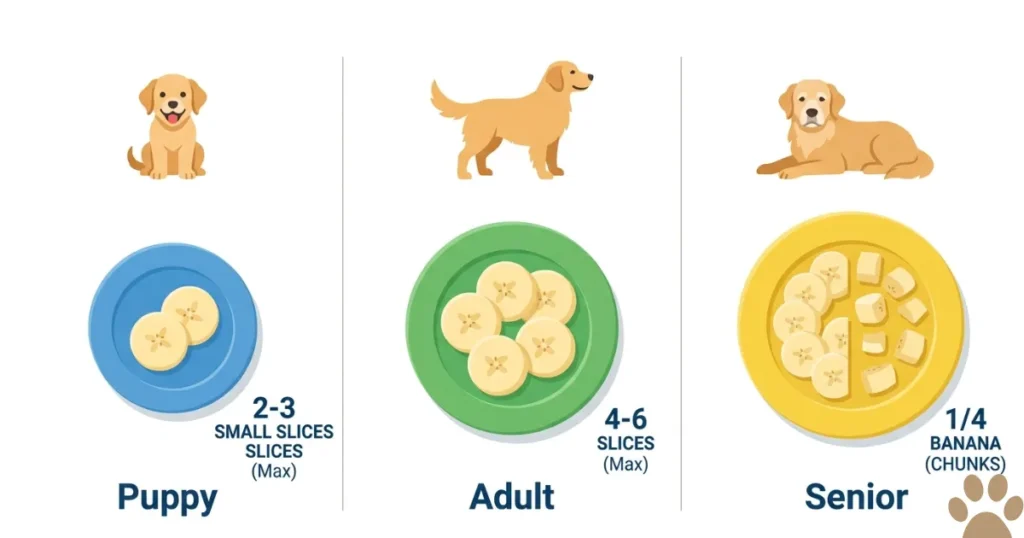
Adult Golden Retriever (healthy weight, 25 – 34kg):
One-quarter to one-half of a medium banana (roughly 30 – 60g), two to three times per week. This delivers meaningful potassium and B6 without a daily sugar surplus. Not as a meal addition – as a standalone treat replacing, not supplementing, other treats that day.
Overweight Golden Retriever:
Remove banana from the rotation until weight returns to the target range. Substitute with blueberries or cucumber, which provide antioxidant and hydration value at a fraction of the caloric and sugar load. This is not a permanent restriction – it is a temporary recalibration.
Senior Golden Retriever (8+ years):
One-quarter of a medium banana, one to two times per week, is appropriate for a senior with normal kidney function. The potassium benefit is relevant at this life stage, given cardiac considerations. If the senior has reduced kidney function, consult a vet before adding potassium-rich foods – elevated potassium can complicate existing renal disease.
Golden Retriever with diabetes or insulin resistance:
Banana is not appropriate. The glycemic load of even a small serving is not compatible with glucose management in a diabetic dog. Substitute with cucumber or raw carrot, which have a negligible glycemic impact.
- If your Golden Retriever is a healthy adult at an ideal weight → offer a quarter to half a banana, two to three times per week, as a treat replacement.
- If your Golden Retriever is overweight → skip the banana; use blueberries or a cucumber instead.
- If your Golden Retriever is a senior with normal kidney function → quarter banana, once or twice weekly.
- If your Golden Retriever has diabetes or hypothyroidism being managed → avoid banana; consult a vet about low-sugar fruit alternatives.
- If you are unsure of your dog’s current health status → start with two to three small pieces, observe for 48 hours, and adjust from there.
Can Puppies Eat Bananas – The Specific Risks for Young Golden Retrievers?
Can puppies eat bananas is a question with a different answer than the adult version, and the distinction matters more than most guides acknowledge.
Golden Retriever puppies under 12 weeks have immature digestive systems that are significantly more reactive to fermentable carbohydrates than adult dogs. The same fiber load that adds beneficial GI motility in an adult can cause bloating, cramping, and loose stools in a puppy – and loose stools in a young puppy have a compounding effect on hydration and electrolyte balance that warrants monitoring.

Can puppies eat bananas after 12 weeks?
Yes, in very small amounts and with careful introduction. The serving guidance for puppies under 6 months is one to two small pieces (roughly the size of a fingertip), introduced alongside a full meal rather than as a standalone treat, no more than once or twice per week. This provides a controlled exposure that lets you observe the digestive response before increasing the quantity.
Puppies between 6 and 12 months can be offered slightly larger amounts – up to one-quarter of a small banana – but the banana should still sit in the occasional treat category rather than the daily rotation. The primary concern at this stage is not acute toxicity; it is establishing a caloric and sugar baseline that supports healthy growth rather than excess weight gain during the rapid growth phase.
Do not offer a banana peel to puppies at any age. The obstruction risk from peel is higher in puppies than in adults because of a proportionally narrower GI tract diameter. If a puppy swallows a significant piece of banana peel, contact a vet.
A practical rule for puppies: if the puppy’s stool is firm and normal 24 hours after a banana introduction, the quantity was appropriate. If stools are loose, remove the banana and wait two weeks before trying again at a smaller portion.
What to Do if your Golden Retriever Eats Too Much Banana.
Banana overconsumption is rarely an emergency, but it produces predictable GI effects that owners should know how to manage.

If a Golden Retriever eats one full banana:
Monitor for loose stools and GI gas over the next 12 – 24 hours. Offer plain water freely. No need for intervention unless vomiting is persistent (more than two episodes) or stools become watery and frequent.
If a Golden Retriever eats several bananas in one sitting:
This constitutes a meaningful sugar and carbohydrate load. Watch for bloating (distended abdomen, restlessness, unproductive retching) – banana overconsumption combined with air ingestion from eating quickly can contribute to GI discomfort. Offer small amounts of water only. If the dog appears distressed, lethargic, or attempts repeated unproductive retching, contact a vet.
If a puppy eats a large amount of banana:
Contact a vet for guidance, particularly for puppies under 4 months. The dehydration risk from resulting diarrhea is more acute in puppies than in adults.
If a Golden Retriever with diabetes eats a banana:
Contact your vet the same day to discuss whether an adjustment to the dog’s insulin protocol is warranted.
| Situation | Urgency | Action |
| Adult GR eats 1 full banana | Monitor | Check stools at 12 and 24 hours; water freely available |
| Adult GR eats 3+ bananas | Same day if symptoms develop | Watch for bloating, unproductive retching; call vet if either appears |
| Puppy under 4 months eats more than 2 small pieces | Call vet same day | Diarrhea risk; dehydration concern in young puppies |
| Diabetic GR eats banana | Call vet same day | Discuss glucose monitoring and insulin adjustment |
| Any GR swallows banana peel whole | Call vet same day | Obstruction risk; peel is not easily digestible |
| Bloating, restlessness, unproductive retching after banana | Emergency | Go to emergency vet — possible GI obstruction or bloat |
Are Bananas Good for Dogs – What the Research and Practice Show.
The question of whether are bananas good for dogs has a cleaner answer than most articles give it, because the answer depends on two things: which dog, and how much.
For a healthy adult Golden Retriever at an ideal weight, bananas are good for dogs in the specific sense that the potassium, vitamin B6, and magnesium they contain have documented physiological roles – cardiac muscle support, nerve function, protein metabolism, and GI motility. These are not marginal contributions. A food that delivers meaningful potassium at a modest caloric cost earns a genuine place in a thoughtful treat rotation.
For a Golden Retriever managing weight, hypothyroidism, or diabetes, bananas are not good in the clinical sense – not because they are toxic, but because the sugar-to-benefit ratio does not justify the metabolic cost relative to lower-sugar alternatives that deliver similar nutritional value.
The practical position: bananas are among the better fruit choices for Golden Retrievers compared to high-sugar alternatives with lower nutrient density. They are not the best choice for daily use in a breed with weight and metabolic predispositions. They are a genuinely useful treat when offered at the right frequency and in the right portion for the specific dog receiving them.

Can dogs eat banana as a daily treat?
Dogs can eat bananas daily only if they are at an ideal weight, metabolically healthy, and receiving no other high-sugar treats. For most Golden Retrievers – a breed prone to weight gain – daily banana adds a cumulative sugar and caloric surplus that conflicts with long-term weight management. Two to three times per week is the recommended frequency for healthy adults.
Can dogs have bananas with the peel on?
No. Can dogs have bananas with the peel included is a common question – the peel is not acutely toxic, but it is difficult to digest and presents a real GI obstruction risk in large breeds. The tannin concentration in the peel also causes GI irritation in many dogs. Always remove the peel completely before offering a banana to a Golden Retriever.
Are bananas good for dogs with digestive problems?
In small amounts, yes – the soluble fiber in bananas supports GI motility and can help regulate mild diarrhea. Are bananas good for dogs with chronic digestive issues depends on the underlying cause. For episodic loose stools or post-antibiotic GI disruption, a few small pieces of banana can be useful. For dogs with diagnosed inflammatory bowel disease or chronic colitis, consult a vet before adding a banana.
Can dogs have bananas if they are on a diet?
Not recommended. Can dogs have bananas during active weight management is a question with a clear answer: the caloric and sugar load conflicts with the purpose of the diet. Substitute blueberries, cucumber, or baby carrots – all deliver treat value at a fraction of the caloric cost. Reintroduce banana as an occasional treat once the dog reaches its target weight.
Are bananas good for dogs as a training treat?
Banana is not ideal as a training treat because of its size, texture, and caloric density relative to the small, repeatable reward training requires. Are bananas good for dogs in a training context depends on whether the session is short and banana pieces are fingertip-sized. For high-frequency reward training with Golden Retrievers, blueberries are a more practical choice – smaller, lower in sugar, and easier to handle.
Can puppies eat bananas at 8 weeks old?
Can puppies eat bananas at 8 weeks is not recommended. At 8 weeks, a Golden Retriever puppy’s digestive system is too immature to process the fermentable fiber in a banana without causing GI upset. Wait until at least 12 weeks, then introduce one or two fingertip-sized pieces alongside a regular meal, observe for 24 – 48 hours, and proceed only if stools remain firm.
Are bananas safe for dogs with kidney disease?
Are bananas safe for dogs with kidney disease requires a careful answer. Banana is high in potassium – approximately 358mg per 100g. Dogs with reduced kidney function often cannot clear excess potassium efficiently, creating a risk of hyperkalemia, as noted in VCA Hospitals’ guidance on canine kidney disease and diet. Do not feed a banana to a Golden Retriever with diagnosed kidney disease without explicit veterinary clearance.
Can puppies eat bananas every day?
No. Can puppies eat bananas daily is not appropriate for Golden Retrievers at any puppy stage. The sugar and fermentable carbohydrate load from daily banana feeding disrupts digestive stability during a period when GI consistency directly supports growth and housetraining. Once or twice per week at most, in the small portions outlined in the puppy section above.
How much banana can a Golden Retriever eat?
A healthy adult Golden Retriever (25 – 34kg) can eat one-quarter to one-half of a medium banana per serving, two to three times per week. Puppies under 6 months should receive no more than one to two fingertip-sized pieces, once or twice weekly. Senior dogs at one-quarter banana per serving, once or twice weekly. Overweight dogs should avoid bananas entirely until their weight is managed.
Are bananas safe for dogs who are pregnant or nursing dogs?
Bananas are safe for pregnant or nursing Golden Retrievers in moderate amounts – the potassium and B6 content are relevant during gestation and lactation. Are bananas safe for dogs in these conditions at larger quantities is less clear, as caloric needs are elevated and total dietary intake should be managed with veterinary input. One-quarter to one-half a banana two to three times per week is a reasonable, conservative range.
What happens if a dog eats a whole banana?
A Golden Retriever eating one whole banana will typically experience loose stools and GI gas within 12- 24 hours. This is unpleasant but not dangerous for a healthy adult dog. Monitor water intake, observe stool quality, and withhold bananas going forward until the dog’s digestive baseline is restored. If vomiting accompanies the loose stools or the dog appears distressed, contact a vet.
Can dogs eat banana chips or dried banana?
No. Dried banana concentrates both the sugar and caloric content significantly – dried banana contains roughly three to four times the sugar of fresh banana per gram. Many commercial banana chips also contain added sugar, salt, or oil. Neither dried banana nor banana chips is appropriate for Golden Retrievers, regardless of serving size. Fresh or frozen plain banana only.
Is banana a good treat for senior Golden Retrievers?
Yes, with the right portion. Senior Golden Retrievers benefit from banana’s potassium content given the breed’s cardiac considerations at this life stage. One-quarter of a medium banana once or twice weekly is appropriate for a senior with normal kidney function. For seniors with reduced kidney function or diagnosed heart disease, consult a vet before adding any high-potassium food to the diet.
Can dogs eat frozen banana?
Yes. Frozen banana is safe for dogs and often preferable in warm weather – the texture change slows consumption, reducing the risk of eating too quickly. Freeze in small pre-portioned pieces using the serving sizes outlined for the dog’s age and weight. Do not freeze banana with added sugar, sweeteners, or other ingredients. Plain frozen banana only.
Conclusion.
Dogs can eat bananas – that is the uncomplicated answer. The detail that matters for Golden Retriever owners is how that yes is implemented. Quarter to half a medium banana, two to three times per week, for a healthy adult at an ideal weight. Much smaller amounts are introduced carefully for puppies. Removed from the rotation for overweight dogs, diabetic dogs, or dogs in active weight management.
Are bananas safe for dogs at the right serving size? Consistently yes. The potassium, B6, and fiber content are real and relevant, particularly for senior Golden Retrievers, where cardiac and digestive support has clinical value. The ceiling is the natural sugar load – and for a breed as weight-sensitive as the Golden Retriever, that ceiling is lower than most generic guides acknowledge.
The serving framework in this guide accounts for the specific health landscape of this breed. Use it as a starting point, observe your individual dog’s response, and adjust from there.
Have you worked banana into your Golden Retriever’s regular treat rotation – or found that it caused issues you didn’t expect? Golden Retriever owners tend to discover very quickly whether their dog handles fruit well or not. Share what the experience looked like for your dog below.
Golden Retrievers respond to bananas very differently – some take to it immediately and show no digestive reaction regardless of portion; others have loose stools from a few small pieces and never fully tolerate it. Senior dogs especially seem to fall into one camp or the other with very little middle ground.
- Has banana worked as a treat in your Golden Retriever’s rotation, or have you had to cut it out because of digestive issues or weight concerns?
- If you have a puppy, did you introduce a banana early or wait?
Share what actually happened – the real owner experience is more useful than any guide.