
If you’ve caught your Golden Retriever eyeing your banana, or you’ve already let them have a piece and started wondering whether that was a good idea, you’re in the right place. A dog eating banana isn’t an emergency – but how often, how much, and in what form genuinely matters for this breed specifically. Golden Retrievers come with a set of nutritional and metabolic tendencies that make casual treat advice from generic dog blogs a poor fit.
Bananas are safe for dogs in controlled portions. A medium banana contains approximately 14 grams of sugar and 3 grams of dietary fiber – nutrients that are benign in small amounts but problematic at scale for a breed already predisposed to weight gain and digestive sensitivity. The key is understanding what “safe” actually means for a 60- 75 pound Golden, not a Chihuahua, and not a Labrador.
In working with Golden Retrievers, I’ve seen owners make two opposite mistakes: avoiding bananas entirely because they heard fruit was dangerous, and offering half a banana daily as a “healthy snack” without accounting for cumulative sugar load. Neither approach serves the dog well. This guide gives you the framework to thread that needle correctly.
For a complete picture of which fruits and vegetables belong in your Golden Retriever’s diet, see our guide to the best fruits and vegetables for dogs – bananas are just one piece of that puzzle.
Are Dogs and Bananas Actually a Good Combination?
Bananas are one of the safest fruits for a dog’s food, provided they are offered as an occasional treat and not a dietary staple. They contain potassium, vitamin B6, vitamin C, magnesium, and dietary fiber – all legitimate nutritional contributors at small serving sizes. The problem is not the banana itself. The problem is the volume at which owners tend to serve it.
A single medium banana carries around 105 calories and 14 grams of sugar. For a Golden Retriever with a daily caloric requirement of roughly 1,300 – 1,700 calories (depending on age and activity level), half a banana represents a meaningful sugar dose. Golden Retrievers have a genetic tendency toward hypothyroidism and obesity, both of which are exacerbated by consistent excess sugar intake. This is the distinction that most articles miss: the fruit isn’t toxic, but the cumulative metabolic load on this specific breed matters.
Dogs and bananas can coexist in a healthy diet – the banana needs to function as a treat, not a supplement. The 10% rule applies: treats of any kind, including fruit, should not exceed 10% of daily caloric intake. For most adult Golden Retrievers, that caps banana consumption at two to three small slices per day, not per snack.

How Much Banana Can a Dog Eating Banana Actually Handle?
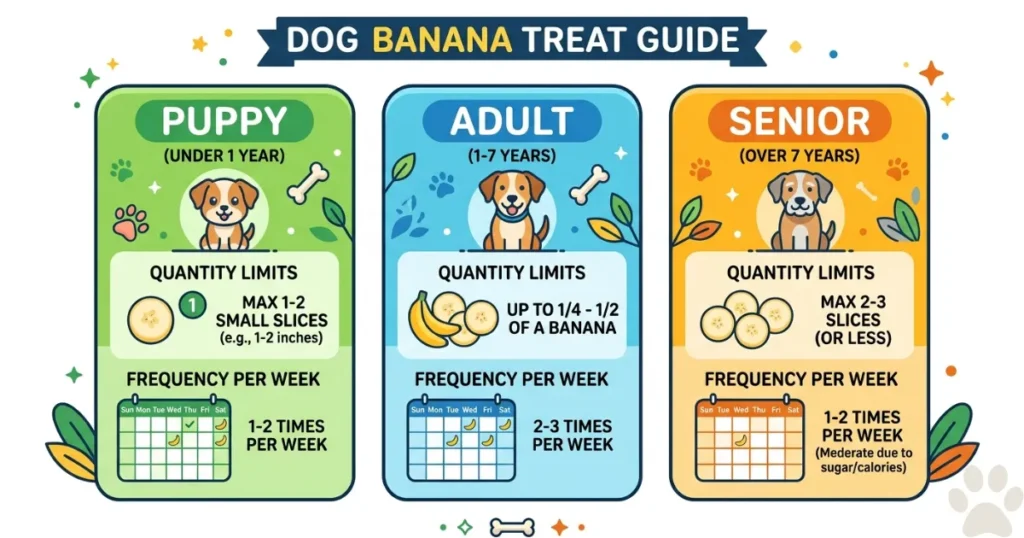
Serving size is where banana feeding goes wrong most often. Here is the framework I use and recommend, broken down by life stage, because a Golden Retriever puppy’s digestive system and a senior’s metabolic rate are not the same calculation.
| Life Stage | Weight Range | Max Banana Per Day | Frequency |
| Puppy (under 12 months) | 20–55 lbs | 1–2 small slices | 2–3 times per week max |
| Adult (1–7 years) | 55–75 lbs | 3–4 small slices | 3–4 times per week |
| Senior (8+ years) | 55–80 lbs | 1–2 small slices | 2–3 times per week max |
Senior Goldens warrant the same caution as puppies. Aging dogs experience reduced kidney efficiency and slower glucose metabolism – both of which make the potassium and sugar content of bananas more relevant to monitor than they are in a healthy adult dog.
One slice, for reference, is approximately 1 cm thick from a standard banana. That’s a meaningful portion for the dog, even when it looks insignificant to a human. Freeze the slices for a longer-lasting treat, or mash a small amount into a Kong – the delivery method doesn’t change the quantity limit.
Can I Feed My Dog Banana Peel? The Part Most Guides Skip
The banana peel is not toxic to dogs, but it is a practical hazard for Golden Retrievers. Peels are dense in cellulose fiber that canine digestive systems cannot break down efficiently. In a large-breed dog with an already voracious appetite, peel ingestion is a reliable path to gastrointestinal obstruction – particularly in younger Goldens who tend to swallow rather than chew.
The risk is mechanical, not chemical. If your dog consumed a small piece of peel, monitor for vomiting, loss of appetite, and abdominal bloating over the next 12 to 24 hours. A full peel swallowed in one motion by a large dog is a vet call, not a wait-and-see situation.
This is the detail that differentiates “is banana ok for dogs” from “is banana ok for Golden Retrievers specifically.” A 12-pound Beagle is less likely to swallow a banana peel whole than a Golden with access to an unattended fruit bowl.
Golden Retrievers have a notoriously low gag threshold for soft foods – they tend to compress and swallow rather than chew. For that reason, banana slices should always be cut into small pieces (thumbnail size or smaller), even for adult dogs. A chunk large enough to lodge in the pharynx is a choking risk regardless of how soft the fruit is.
Is Banana Ok for Dogs With Specific Health Conditions?
For most healthy Golden Retrievers, a banana in the serving sizes above is genuinely fine. The calculus changes when specific health conditions are present.
Obesity:
If your Golden is overweight, a banana is a poor treat choice. The sugar-to-nutrient ratio doesn’t justify the caloric cost when lower-sugar options like blueberries or green beans exist. This is not about bananas being dangerous – it’s about opportunity cost in a calorie-restricted dog.
Diabetes:
Dogs with diabetes should not receive bananas without direct veterinary guidance. The glycemic impact of fruit sugar, even in a breed-appropriate portion, requires monitoring that depends on the individual dog’s insulin protocol.
Kidney disease:
Bananas are high in potassium – approximately 422 mg per medium banana. For dogs with chronic kidney disease, potassium accumulation is a genuine concern. Dogs and bananas do not mix well in this context. Consult your vet before offering any potassium-dense food.
Inflammatory bowel disease or chronic diarrhea:
The fiber content in bananas can either help or worsen GI symptoms, depending on the underlying cause. If your Golden has a sensitive stomach history, introduce bananas in a single small slice and observe stool consistency for 24 hours before continuing.
Decision Framework: Should You Feed Your Golden Retriever a Banana?
Can Dogs Have Bananas? Use this framework before you reach for the fruit bowl:
- If your Golden is a healthy adult at a normal weight → two to four small slices, up to four times per week, is well within safe parameters.
- If your Golden is a puppy under 12 months → limit to one or two slices, no more than three times per week. The priority is developing gut microbiome stability, and introducing too much fruit sugar too early can disrupt it.
- If your Golden is overweight, diabetic, or has kidney disease → skip bananas entirely or seek specific guidance from your vet before proceeding.
- If your Golden is a senior with no diagnosed health conditions → the same puppy limit applies: one to two slices, infrequently. Their slower metabolism doesn’t process fruit sugar as efficiently as a dog in peak adulthood.
- If your Golden consumed an entire banana without warning → no immediate emergency, but monitor for soft stools, vomiting, or lethargy for the next 24 hours. A single accidental large serving is unlikely to cause lasting harm in an otherwise healthy dog.

What to Avoid When a Dog Is Eating Banana
The banana itself is rarely the problem. The form it arrives in often is.
Banana chips (commercially dried):
Most commercial banana chips are fried in oil and salted or sweetened. The dehydration process also concentrates sugar per gram dramatically compared to fresh fruit. A “small handful” of banana chips delivers far more sugar and fat than an equivalent fresh portion.
Banana bread and baked goods:
Banana bread typically contains xylitol, raisins, or chocolate – all of which are genuinely toxic to dogs. Xylitol specifically causes life-threatening hypoglycemia and liver failure in dogs.
The mechanism:
Xylitol triggers a rapid insulin release in dogs that it does not in humans, causing blood glucose to crash within 10 to 60 minutes of ingestion. If your Golden ate banana bread, check the ingredient label immediately. If xylitol is listed, call your vet or ASPCA Animal Poison Control (888-426-4435) without delay – this is not a monitor-at-home situation.
Banana-flavored supplements or treats:
These often contain artificial sweeteners. Read every label. The word “banana” on packaging does not mean the product contains a real banana or that it is safe.

Per the ASPCA’s Animal Poison Control resource, the banana fruit itself (without peel) is non-toxic to dogs – but context always matters.
When to Call the Vet: Urgent vs Monitor
| URGENT — Call Vet Immediately | MONITOR — Watch at Home 24 hrs |
| Dog ate banana bread or product containing xylitol — any amount | Dog ate an entire banana (no peel) and shows soft stool but is otherwise alert and eating |
| Suspected full peel ingestion — dog is retching, drooling excessively, or showing abdominal bloating within 2 hours | Single episode of vomiting after eating a banana, no blood, the dog is acting normally afterward |
| A known diabetic dog consumed a banana without a controlled serving — watch for trembling, disorientation, or collapse | Loose stools lasting less than 24 hours with no blood, mucus, or accompanying lethargy |
| Dog with kidney disease ate multiple banana servings — call vet, do not wait for symptoms | Mild gas or bloating within 4 hours of eating a banana, resolving on its own |
| URGENT — Call Vet Immediately | MONITOR — Watch at Home 24 hrs |
| Dog ate banana bread or product containing xylitol — any amount | The dog ate an entire banana (no peel) and shows soft stool, but is otherwise alert and eating |

How Golden Retrievers Compare to Other Breeds for Banana Tolerance
This section addresses the competitor gap: most articles give banana guidance as if all dogs are the same. Golden Retrievers are not a neutral baseline.
Compared to similarly sized breeds, Golden Retrievers have three characteristics that make fruit sugar management more relevant. First, they are genetically predisposed to hypothyroidism – a condition that slows metabolism and makes weight management harder. A dog with hypothyroidism processes excess dietary sugar less efficiently than a metabolically normal dog of the same weight.
Second, Golden Retrievers have a documented statistical predisposition to certain cancers. While no evidence links banana consumption directly to cancer risk, there is established research suggesting that chronic high-sugar diets may contribute to systemic inflammation – a factor worth noting in a breed with above-average cancer incidence.
Third, Golden Retrievers are highly food-motivated. This matters practically: they will consume whatever is offered, in whatever quantity, without the natural braking mechanism that some more selective breeds demonstrate. None of this makes bananas off-limits. It makes portion discipline more important for this breed than generic dog content implies.
Is a dog eating banana actually safe, or do I need to worry?
A dog eating banana is safe in controlled portions. Bananas are non-toxic to dogs and provide potassium, vitamin B6, and fiber. The concern is not toxicity but volume – too much banana adds significant sugar to the diet, which matters especially for Golden Retrievers prone to weight gain.
How many bananas can a dog eat without it being a problem?
For an adult Golden Retriever, two to four thumbnail-sized slices per day, offered no more than four times per week, is a reasonable and safe limit. Puppies and seniors should get half that amount. The 10% treat rule applies – banana should never exceed 10% of your dog’s daily caloric intake.
Can dogs and bananas mix if my dog has a sensitive stomach?
Dogs and bananas can mix even with a sensitive stomach, but start with a single small slice and observe for 24 hours. The fiber in bananas can either soothe mild GI issues or aggravate them, depending on the cause. If loose stools appear within 12 hours, eliminate the banana from the treat rotation.
Can I feed my dog banana every single day?
Daily banana feeding is not recommended for Golden Retrievers. The cumulative sugar load over time is the issue – not any single serving. Offering bananas three to four times per week in small portions keeps the nutritional benefit without the metabolic cost of daily sugar exposure.
Is banana ok for dogs with diabetes?
Is banana ok for dogs with diabetes? Generally, no – not without explicit veterinary guidance. Bananas contain simple sugars that affect blood glucose. For a diabetic dog on an insulin protocol, any high-sugar fruit requires individualized assessment. Do not introduce banana without consulting your vet first.
What happens if my dog eats a banana peel?
Banana peels are not toxic but pose a real obstruction risk, especially in Golden Retrievers, who tend to swallow rather than chew. A small piece of peel – monitor for vomiting, bloating, and appetite loss over 12 to 24 hours. A full peel swallowed whole warrants a vet call the same day.
Can Golden Retriever puppies have bananas?
Golden Retriever puppies can have banana in very small amounts – one to two small slices, two to three times per week at most. Their digestive systems are still developing, and the sugar and fiber in a banana should be introduced gradually. Never offer a banana as a primary puppy treat or daily snack.
Is it safe for dogs to have bananas if they’re overweight?
For overweight Golden Retrievers, a banana is not the best treat choice. The sugar content does not justify the calorie cost when lower-sugar alternatives like blueberries or cucumber exist. If your Golden is on a weight-management plan, remove the banana from the treat rotation until a healthy weight is reached.
How many bananas can dogs with kidney disease have?
Dogs with kidney disease should not have bananas without direct veterinary approval. Bananas are high in potassium – approximately 422 mg per medium banana – and dogs with compromised kidney function cannot excrete excess potassium efficiently. Potassium buildup can affect heart function in these dogs.
What happens if a dog eats too many bananas at once?
A healthy dog that eats one full banana will likely experience soft stools or mild stomach upset within 12 hours. This is uncomfortable but not dangerous. Monitor for vomiting, lethargy, or bloody stool. If any of those symptoms appear, call your vet. Most healthy Golden Retrievers recover without intervention.
Is it safe to give my Golden Retriever banana chips?
Most commercial banana chips are not safe for dogs. They are typically fried, salted, or sugar-coated – and the dehydration concentrates natural sugars dramatically per gram. Unsalted, unsweetened dehydrated banana in tiny amounts is a different product, but commercial banana chips from human snack aisles should be avoided entirely.
Can dogs have bananas bread or banana muffins?
No. Banana bread and muffins frequently contain xylitol, raisins, chocolate, or macadamia nuts – all of which are toxic to dogs. Xylitol in particular causes life-threatening hypoglycemia in dogs within 10 to 60 minutes of ingestion. If your dog ate banana bread, check the ingredient label immediately and call your vet or ASPCA Poison Control.
Is banana ok for senior Golden Retrievers?
Is banana ok for senior Golden Retrievers? Yes, in reduced portions. Senior dogs have slower glucose metabolism and reduced kidney efficiency, so the same serving size appropriate for an adult is too much for a senior. Limit to one to two small slices, two to three times per week, and avoid bananas if any age-related health conditions are present.
How should I serve a banana to my dog for the first time?
Start with one small slice – roughly thumbnail size – and wait 24 hours before offering more. Watch for loose stools, excessive gas, or vomiting. If none appear, you can establish a regular but limited treat schedule. Frozen banana slices are a safe and popular option that slows consumption and adds enrichment.
What other fruits are safe for Golden Retrievers besides bananas?
Golden Retrievers can also eat blueberries, watermelon (seedless, no rind), apple slices (no seeds or core), and mango (no pit or skin) in controlled amounts. Each fruit carries its own portion rules. For a complete guide to safe and unsafe fruits for this breed, see our full breakdown of the best fruits and vegetables for dogs.
Conclusion
A dog eating banana is not a health event that requires worry – it is a feeding decision that benefits from a clear framework. For Golden Retrievers specifically, the answer is yes to bananas in controlled portions: two to four thumbnail-sized slices, a few times per week, for a healthy adult dog. Avoid the peel, avoid banana-flavored processed foods, and treat the banana as a treat – not a supplement or a daily offering.
The sugar content is real, the breed’s metabolic tendencies are real, and neither fact is captured in the generic “bananas are safe for dogs” articles that dominate search results. Your Golden Retriever deserves more precise guidance than that. If your Golden has a health condition – obesity, diabetes, kidney disease, or a sensitive GI tract – apply the decision framework above before feeding any banana, and loop in your vet for dogs with active diagnoses.
Has your Golden Retriever ever gone rogue with a banana – stolen one off the counter, swallowed it peel and all, or decided it was their favorite treat? Tell me exactly what happened and how they reacted. Golden Retriever owners’ real stories are far more useful to this community than anything I can write in a guide.
My Golden Retrievers have had very different reactions to banana – one treats it like the greatest event in her week, the other will sniff it and walk away. I’m curious where yours falls.
- Have you ever had a Golden steal an entire banana off the counter and eat the whole thing, peel included?
- Did they handle it fine, or did you end up dealing with a rough 24 hours?
- And if banana is a regular treat in your house, how do you serve it – fresh, frozen, mashed into a Kong?
Drop the specifics below.