
Arthritis in golden retrievers is a common joint disease that causes pain, stiffness, and reduced mobility, most often in the hips and back legs. Early signs include stiffness after rest, slowing on walks, and reluctance to climb stairs. Goldens are prone to it because of inherited hip and elbow dysplasia. Arthritis cannot be cured, but weight control, exercise, supplements, and vet care manage it well.
Arthritis in golden retrievers is one of the most common health problems this breed faces as it ages. It is a wear-and-tear joint disease, also called osteoarthritis, that most often affects the hips and hind legs. The good news is that spotting it early changes everything about how well your dog lives with it.
This guide walks you through the signs and symptoms of arthritis in golden retrievers, why the breed is especially prone, and how to care for a dog that has it. Arthritis is closely tied to how comfortably your golden ages, so spotting it early is one of the kindest things you can do for your dog.
What Is Arthritis in Golden Retrievers?
Arthritis, known medically as osteoarthritis, is the slow breakdown of the smooth cartilage that cushions a joint. As that cushion wears away, bone rubs closer to bone, which causes pain, swelling, and stiffness.
In Golden Retrievers, this most often happens in:
- The hips
- The knees, also called the stifles
- The elbows
- The lower spine
Here is what makes it a breed concern. According to the AKC and the American College of Veterinary Surgeons, large breeds like Golden Retrievers are among the most commonly affected by osteoarthritis. It is a progressive disease, which means it gets worse over time. It cannot be cured or reversed. But, and this is the part that matters most, it can be managed very well, and early action slows it down. Arthritis is one of the most important joint problems a Golden faces as it ages, and understanding it is the first step to protecting your dog’s mobility.
Osteoarthritis is not the same as normal aging
Many owners assume stiff joints are just a natural part of a dog growing old. That is only half true. Aging plays a role, but arthritis is a specific disease process, not simply the passage of time. A joint damaged by dysplasia or injury can develop arthritis while a dog is still young, and a healthy-jointed senior may stay remarkably spry.
The difference matters because a disease can be treated, while “old age” often gets accepted and ignored. When you see arthritis as a manageable medical condition rather than an inevitable part of aging, you start acting on it early, and early action is exactly what protects your Golden’s mobility. Visit our website for Golden Retriever health guides.
Signs and Symptoms of Arthritis in Golden Retrievers
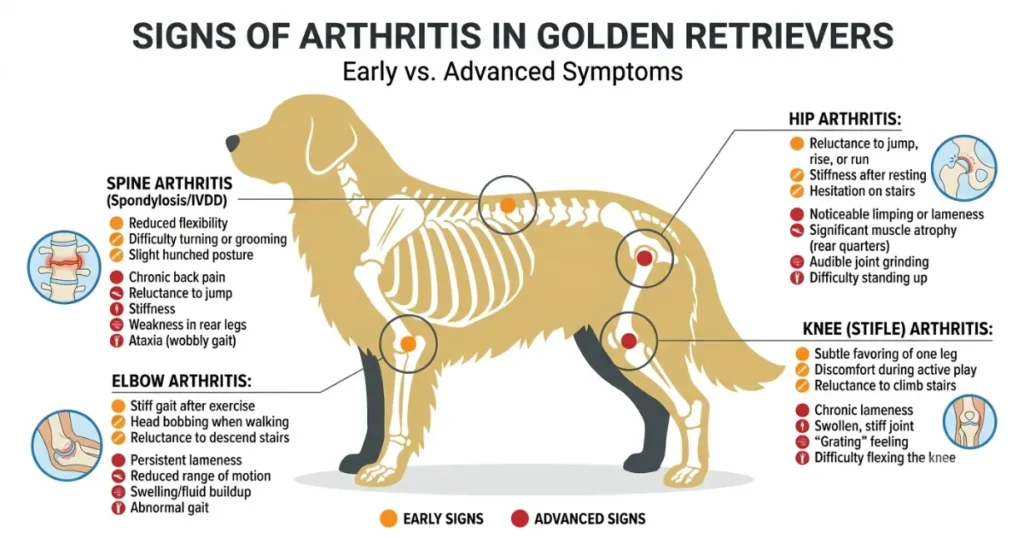
The hardest part about arthritis is that it creeps in slowly. Goldens are stoic and tend to hide pain, so many owners miss the early signs and mistake them for normal aging. Catching it early is the single biggest thing you can do, so learn to spot both stages.
| Early signs (easy to miss) | Advanced signs (harder to ignore) |
| Stiffness after resting or sleep | A clear, steady limp |
| Slowing down on walks | Muscle loss in the back legs |
| Hesitation at stairs or jumping in the car | More weight shifted onto the front legs |
| A brief limp that “warms off” | Trouble standing up or lying down |
| Less interest in play | Yelping or flinching when touched |
| Licking at a hip, knee, or paw | Struggling to walk or squat to toilet |
The early sign owners miss most
The most common thing I see missed is the “warm-up” limp. A Golden is stiff and limping when it first gets up, then loosens as it moves around, so the owner assumes all is well. That warm-up pattern is actually a classic early sign of arthritis, not a sign that nothing is wrong.
Watch the back legs closely
Because Goldens most often develop arthritis in the hips, the back legs tell the story first. Look for muscle wasting in the thighs, a swaying or “bunny-hop” gait, and a dog that sits with a leg kicked out to the side. If you notice your Golden’s back legs looking thinner or weaker, that is worth a vet visit.
Why Are Golden Retrievers Prone to Arthritis?
Goldens are not unlucky by accident. The breed carries specific risk factors that make joint disease more likely, and knowing them helps you act early.
Inherited joint conditions come first. The leading cause of arthritis in Golden Retrievers is hip and elbow dysplasia, inherited conditions where the joint forms imperfectly and wears out early. If you want the full detail on that root cause, we cover it in depth in our guides to hip dysplasia in dogs and the first signs of hip dysplasia. Preventing it starts young, which we explain in how to prevent hip dysplasia.
Other risk factors stack on top:
- Size and weight. Goldens are large and heavy, so every joint carries more load. Excess weight multiplies the strain.
- Past injuries. A torn cruciate ligament or old fracture often turns into arthritis in that joint years later.
- Age. Wear adds up. Arthritis becomes common in Goldens from middle age onward.
- Genetics. Some lines simply carry more joint risk than others, which is why breeder health testing matters.
The takeaway is simple. Some of these you cannot change, like genetics, but the biggest one, weight, is fully in your hands. A lean Golden is doing the most powerful thing possible to protect its joints.

When Does Arthritis Start in Golden Retrievers?
Arthritis is not only an old-dog disease, and that surprises many owners. It can begin quietly years before it becomes obvious.
- Puppy and young adult (under 2 years). Arthritis itself is rare here, but the dysplasia that causes it is already present. A young Golden with a limp or a bunny-hop gait needs a vet, not a “wait and see.”
- Middle age (around 4 to 7 years). Early arthritis often takes hold now, especially in dogs with dysplasia or extra weight. This is the window where catching it changes the long-term outcome most.
- Senior (8 years and older). Arthritis becomes common. By the senior years, a large share of Goldens show some degree of joint wear.
The lesson from these stages is to stop treating early stiffness as “just getting older.” In a Golden, slowing down at 6 or 7 is often the first whisper of arthritis, and it is the best possible time to act.
How to Care for Arthritis in a Golden Retriever
Once arthritis is diagnosed, your job shifts to slowing it down and keeping your dog comfortable. Good care for arthritis in a golden retriever rests on a few pillars that work best together.
Keep your Golden lean.
This is first for a reason. Every extra pound adds load to sore joints, and lean dogs live more comfortably and longer. If you cannot easily feel the ribs, trim the food.
Keep moving, gently.
Rest is not the answer. Regular low-impact exercise keeps muscles strong and joints mobile. Swimming is ideal, since it works the body without pounding the joints. Short, frequent walks beat one long hike.
Consider joint supplements.
Ingredients like glucosamine, chondroitin, and omega-3 fatty acids can support the joints and ease inflammation. They work best when started early and used consistently. We cover which ones actually help and how to choose them in our guide to the best supplements for golden retriever arthritis.
Work with your vet on treatment.
For pain and inflammation, your vet may prescribe medication or recommend therapies like physical rehab. The full range of options, from anti-inflammatories to advanced therapies, is covered in our guide to treatments for arthritis in golden retrievers.
Adjust the home.
Soft orthopedic bedding, rugs over slippery floors, and a ramp for the car all reduce daily strain. Warmth helps stiff joints, especially in cold weather. Small changes like these make a real difference to a dog that struggles to rise or settle.
Here is how these pillars fit together in practice. Weight control and gentle exercise are your daily foundation, and they cost nothing. Supplements are a long-term support you add on top, ideally before arthritis is advanced. Vet-guided medication steps in when there is real pain to control. And home changes make every ordinary moment, rising, walking, and resting, a little easier on sore joints. No single pillar carries the load alone. Used together, they let most Goldens stay active and comfortable for years after diagnosis.

The Slow, Stiff, Sore Self-Check for Golden Owners
Not sure whether what you are seeing is arthritis? Use this simple three-part check I give owners. If you answer yes to signs across more than one area, book a vet visit.
Slow.
Is your Golden slowing down? Think shorter walks, less play, more napping, or lagging behind on the trail.
Stiff.
Is your Golden stiff, especially after rest? Watch for a slow, careful rise in the morning, a limp that eases as the dog warms up, or hesitation at stairs and the car.
Sore.
Does your Golden seem sore? Look for licking at a joint, flinching when touched, a new grumpiness, or muscle thinning in the back legs.
Yes, one could be an off day. A pattern of slow, stiff, and sore is very likely early arthritis, and it is your cue to act. Early is always better, because you cannot undo joint damage, only slow what comes next.

Expert Insight
The saddest cases I see are not the Goldens with severe arthritis. They are the ones whose owners waited a year because they thought their dog was “just getting old.” Arthritis found early and managed well can give a Golden years of comfortable movement. The same disease ignored steals those years quietly. When in doubt, get it checked.
Early Vs Advanced Signs
Early arthritis is easy to miss. Watch for stiffness after rest, slowing on walks, and hesitation at stairs or in the car. As it advances, you may see a clear limp, muscle loss in the back legs, and reluctance to play. If your Golden suddenly cannot bear weight on a leg, see the vet promptly, since that can signal an injury on top of arthritis.
What are the first signs and symptoms of arthritis in golden retrievers?
The earliest signs are stiffness after rest, slowing down on walks, and hesitation at stairs or jumping into the car. A brief limp that eases with movement is a classic early clue.
At what age do golden retrievers get arthritis?
Arthritis often begins in middle age, around 4 to 7 years, and becomes common in seniors 8 years and older. Dogs with hip dysplasia can show signs even younger.
Is arthritis in a golden retriever curable?
No. Arthritis is progressive and cannot be cured or reversed. It can be managed very well, though, with weight control, exercise, supplements, and veterinary care to keep your dog comfortable.
How do I know if my golden retriever’s back legs hurt?
Watch for a limp, muscle loss in the thighs, a bunny-hop gait, trouble rising, and weight shifted onto the front legs. Any of these warrants a veterinary exam.
Why is my golden retriever suddenly slowing down?
Slowing down is often the first sign of arthritis, not just aging. In a middle-aged or older Golden, reduced activity and stiffness deserve a vet check rather than a wait-and-see approach.
Can arthritis in golden retrievers be prevented?
Not entirely, but the risk drops sharply with lean body weight, joint-safe exercise as a puppy, and buying from health-tested parents. Preventing hip dysplasia early is a big part of it.
What is the best care for arthritis in a golden retriever?
The best care combines lean weight, gentle daily exercise, vet-guided pain control, joint supplements, and home changes like ramps and soft bedding. These work best together, not alone.
Does weight really affect a golden retriever’s arthritis?
Yes, enormously. Excess weight adds load to already sore joints and speeds cartilage breakdown. Keeping your Golden lean is the single most powerful thing you can do for its joints.
Are golden retrievers more prone to arthritis than other breeds?
Yes. As a large breed with high rates of inherited hip and elbow dysplasia, Goldens are among the breeds most predisposed to osteoarthritis, according to veterinary sources.
Is it arthritis or hip dysplasia in my golden retriever?
They are linked. Hip dysplasia is a common cause of arthritis. Dysplasia is the malformed joint, and arthritis is the wear that follows. Only a vet with X-rays can confirm which is present.
Can a golden retriever with arthritis still exercise?
Yes, and it should. Gentle, regular, low-impact exercise like swimming and short walks maintains muscle and mobility. Avoid high-impact activity like jumping and hard running.
What joint supplements help golden retrievers with arthritis?
Glucosamine, chondroitin, and omega-3 fatty acids are the most commonly recommended. They support cartilage and ease inflammation and work best when started early and given consistently.
Do golden retrievers hide arthritis pain?
Yes. Goldens are stoic and often mask discomfort until it is advanced. This is why subtle early signs, like a warm-up limp or slowing down, should never be ignored.
How much does it cost to manage a golden retriever’s arthritis?
Costs vary widely with severity, covering supplements, medication, and vet visits. Managing weight and starting early usually lowers long-term costs by slowing the disease.
When should I take my arthritic golden retriever to the vet urgently?
Go promptly if your Golden suddenly cannot bear weight on a leg, cries out in pain, or a joint is hot and swollen. These can signal an injury on top of arthritis.
The Bottom Line on Arthritis in Golden Retrievers
Arthritis in golden retrievers is common, progressive, and impossible to cure, but it is very manageable when you catch it early. Learn the early signs and symptoms of arthritis in golden retrievers, especially the warm-up limp and the slow decline in the back legs, and act on them instead of writing them off as age.
Keep your dog lean, keep it gently moving, use supplements and vet-guided treatment, and adapt your home. Do those things, and good care for arthritis in a golden retriever can give your dog years of comfortable, happy movement.
How old was your Golden when you first noticed joint stiffness, and what was the very first sign you spotted looking back? If your dog manages arthritis well today, tell us the one change that helped most. Your experience helps the next owner catch it sooner.