
The first signs of hip dysplasia in dogs often appear weeks before any limp develops, and in golden retrievers, that gap between the first sign and visible limping is consistently longer than in other large breeds. What you’ll see first isn’t a limp. It’s a weight shift, a changed sit, a reluctance to do something your dog used to do without hesitation.
In my practice, golden owners describe the same pattern repeatedly: “He seemed fine, then suddenly started limping. ” The limp wasn’t sudden. The early signs were there; they just didn’t look like hip pain. Goldens have high pain tolerance and compensatory muscle strength that masks coxofemoral joint discomfort far longer than Labradors or German Shepherds at comparable disease stages.
According to the Golden Retriever Lifetime Study, conducted by the Morris Animal Foundation, musculoskeletal conditions rank among the top causes of reduced mobility and quality of life in Golden Retrievers, with many cases showing a delayed owner-recognition pattern compared to other breeds. Early identification of clinical signs directly correlates with broader non-surgical treatment options. For deeper context on why Goldens are disproportionately affected, see our full guide on canine hip dysplasia causes and Golden Retriever risk.
What Are the First Signs of Hip Dysplasia in Dogs and Why Goldens Hide Them Longer.
The first signs of hip dysplasia in dogs fall into three categories: gait changes, posture changes, and behavioral avoidance. In Golden Retrievers, the posture and behavioral signs appear first, often within weeks.
Gait Changes: What to Watch on Walks.
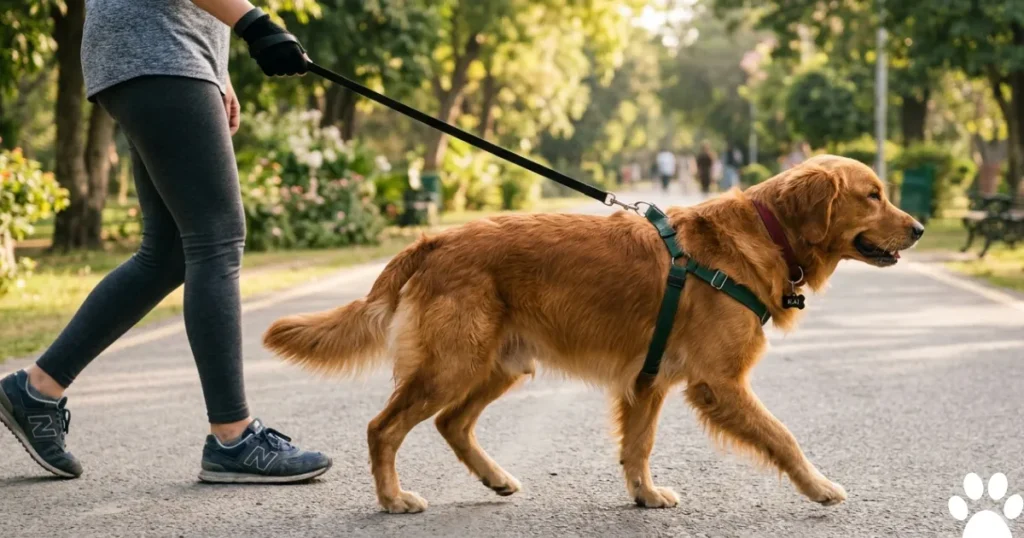
The bunny hop is the most recognized early gait sign. Instead of the normal alternating rear-leg stride, a dysplastic dog pushes off both rear legs simultaneously when trotting and running, reducing the range of motion each hip must produce. Watch your Golden on a loose lead at a trot. If both rear legs move in sync rather than alternating, that’s a clinical flag.
What most sites don’t mention is the forelimb overload pattern. Goldens with developing hip laxity shift their center of gravity forward; they carry more weight on their front legs and less on their rear. You’ll notice a “heavy-shouldered” appearance at a walk, a shortened rear stride, and a tendency to drop the head slightly when the rear end swings. No limp. Just a changed rhythm.
Posture Changes: The Sit That Tells You Everything.
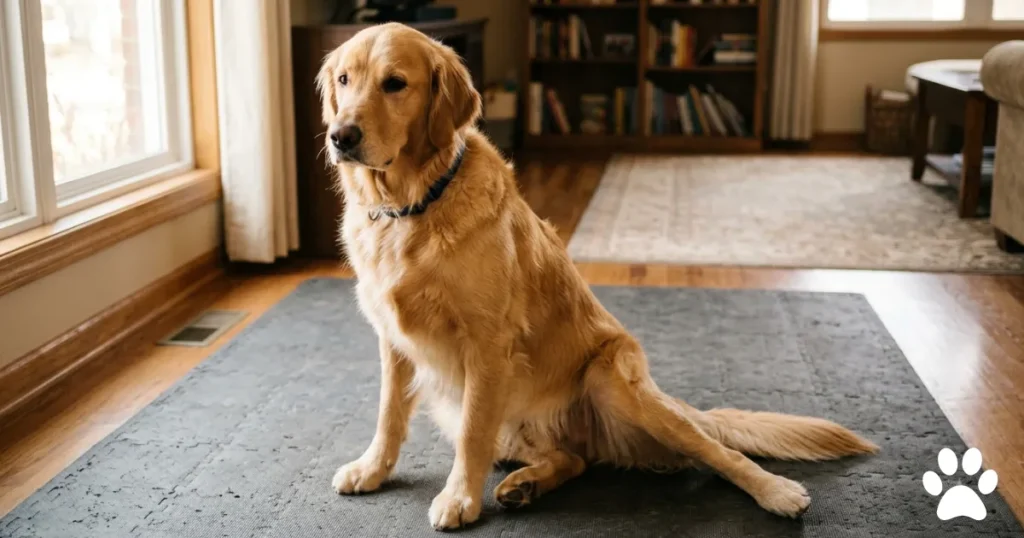
A healthy Golden sits squarely. Both rear legs fold under and beside the body symmetrically. A Golden with hip discomfort, even mild, early-stage discomfort, consistently sits to one side, with one rear leg extended laterally rather than tucked. I’ve used this observation to prompt radiographs in dogs whose owners hadn’t noticed any gait changes at all.
Run this test on a non-slip surface. Ask your Golden to sit. Watch which direction the rear end angles. If it’s the same side every time, log the date. Three occurrences in one week warrant a vet call.
Behavioral Avoidance: The Signs Owners Call “Laziness.”
Reluctance to climb stairs. Hesitation before jumping into a car. Not greeting you at the door with the full-body enthusiasm they used to show. These aren’t personality shifts in a 2-4 year old golden. They’re pain-avoidance responses. The most common mistake I see is owners attributing these to “settling down” with age. It’s understandable; Goldens do mellow. But in a dog under 5, these specific avoidances signal joint discomfort until proven otherwise. Visit here for general dog health guides.
What Hip Dysplasia Looks Like in Golden Retrievers Across Life Stages.
What hip dysplasia looks like in dogs changes significantly depending on age. The visual presentation at 8 months is clinically different from what you’d see at 4 years or 9 years, and the action required differs accordingly.
Golden Retriever Puppies (4-18 Months): Joint Laxity Signs.
At this stage, the joint is loose, but cartilage loss is still minimal. What you’ll see is a wide-based rear stance (rear legs placed wider apart than front legs when standing), bunny-hop gait at a run, and resistance to sitting or lying down on hard surfaces. Some puppies show a subtle “clicking” sound from the hip region during movement, an audible coxofemoral subluxation as the femoral head briefly slips in the shallow socket.
What I tell owners: not “wait until 2 years for OFA evaluation,” but “discuss PennHIP at 4 months if any of these signs are present.” The PennHIP method, recognized by the OFA and AVMA, measures hip distraction index in puppies as young as 16 weeks, giving owners a treatment window that simply doesn’t exist if you wait for symptoms to become obvious.
Adult Golden Retrievers (2-6 Years): Compensation Phase.
This is where Goldens are most deceptive. The joint is deteriorating, but compensatory musculature, particularly the gluteal and semimembranosus muscle groups, partially masks dysfunction. What you’ll see is morning stiffness resolving within 5-10 minutes, a slight rear-end sway at a slow walk, and early hindquarter muscle asymmetry if you run both hands along the rear thighs simultaneously and compare volume.
The adult phase is the critical treatment window. Conservative management initiated here, weight control, EPA/DHA supplementation, glucosamine and chondroitin sulfate, and structured low-impact exercise can delay or prevent surgical consideration for years.
Senior Golden Retrievers (7 Years and Older): Overt Decompensation.
By this stage, secondary osteoarthritis is established. Hindquarter muscle atrophy is visible without touching the dog. The rear end appears narrower than the front. Stiffness no longer fully resolves with a warm-up. These Goldens often shift from bunny-hopping to a slow, deliberate, wide-based rear gait with visible discomfort on inclines and stairs.
What Most Canine Hip Dysplasia Treatment Guides Get Wrong About Golden Retrievers?
Most hip dysplasia treatment guides lead with surgery, specifically total hip replacement (THR) and femoral head ostectomy (FHO), as the definitive options. For Golden Retriever owners reading those guides, this framing is misleading.
The majority of Golden Retrievers with canine hip dysplasia diagnosed between 18 months and 4 years are not surgical candidates at the time of diagnosis. They’re multimodal management candidates. Surgery becomes primary when conservative management fails or when structural damage is severe enough that joint preservation is no longer possible. Leading with surgery causes owners to either panic about cost or, paradoxically, delay acting because they can’t afford it when the actual first step is a radiograph and a weight assessment.
In September 2022, a 4-year-old male Golden presented at 78 lbs, 8 lbs over his ideal weight, with a 6-month history of morning stiffness and reluctance to use the back garden stairs. His owner had read two major veterinary websites and concluded he’d need hip replacement surgery. He didn’t. OFA radiographs confirmed mild bilateral dysplasia. With a structured weight loss protocol, daily EPA/DHA supplementation, carprofen for flare periods, and a hydrotherapy referral, he was stair-climbing without hesitation within 14 weeks. Surgery never entered the conversation.
The correction
According to AAHA pain management guidelines, multimodal non-surgical treatment, combining weight management, joint supplementation, pharmaceutical pain management, and physical rehabilitation, is the first-line protocol for mild-to-moderate canine hip dysplasia. For a 65-lb Golden with mild dysplasia, reaching and maintaining ideal body weight alone reduces hip joint load by roughly 25-30% per stride. That’s a treatment intervention, not a stopgap.
How to Treat Hip Dysplasia in Dogs: The GRI Treatment Ladder for Golden Retrievers.
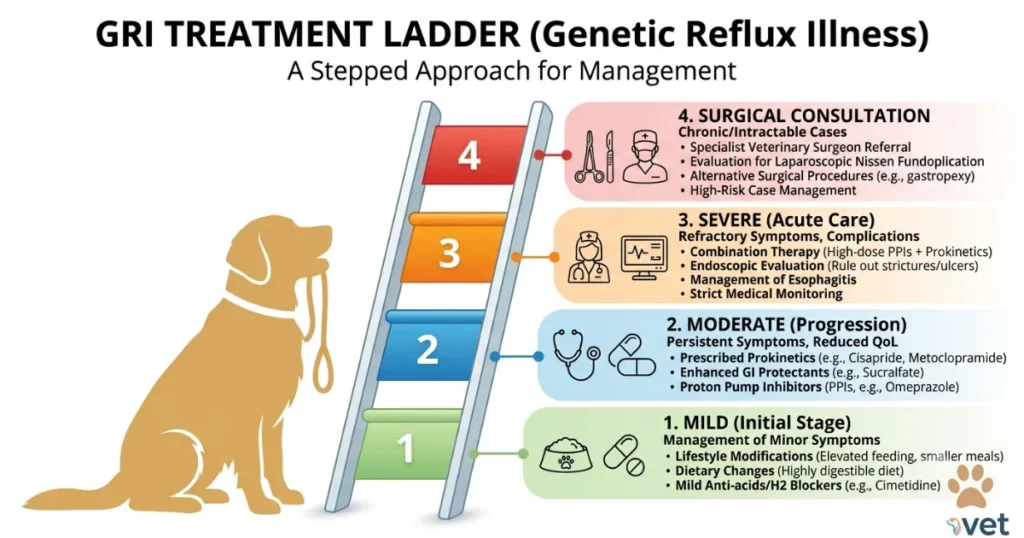
The GRI Treatment Ladder is a staged framework assigning specific interventions to each severity level of canine hip dysplasia in Golden Retrievers. Use it to understand where your dog is and what actions match that stage.
Rung 1-Mild Dysplasia (joint laxity, no or minimal cartilage loss):
Weight management to ideal body condition score (BCS 4-5/9 for Goldens). Daily EPA/DHA at 40 mg/kg body weight. Glucosamine 500 mg and chondroitin sulfate 400 mg daily for a 65-lb Golden. Leash walks on soft surfaces. No jumping, no stairs during the active growth phase for puppies.
If → Then → Call vet
Rung 2-Moderate Dysplasia (cartilage loss present, early osteophyte formation):
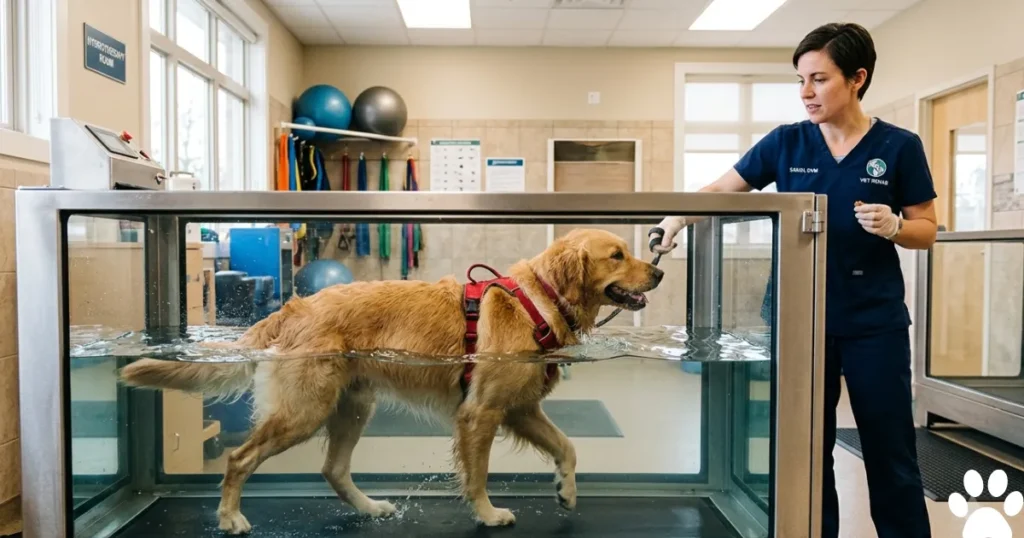
All Rung 1 interventions maintained. Add prescribed NSAID therapy, carprofen or meloxicam, at vet-directed dosing for a Golden’s current body weight. Introduce hydrotherapy or underwater treadmill sessions twice weekly. Modify home environment: orthopedic bedding, ramp access for car and furniture, and non-slip flooring.
If morning stiffness lasts more than 10 minutes daily → Then → Call vet
Rung 3-Severe Dysplasia (significant joint destruction, secondary osteoarthritis):
Multimodal pain management remains in place. Surgical consultation indicated a total hip replacement (THR) for dogs under 7 years in otherwise good health and a femoral head ostectomy (FHO) as an alternative for smaller or older Goldens. Laser therapy and acupuncture as adjunct pain management during surgical recovery or if surgery is declined.
If → Then surgical consultation within 2 weeks → Call vet immediately if
Expert Insight
“The Goldens I see doing best long-term aren’t the ones who had surgery earliest; they’re the ones whose owners caught the lateral sit at age 2, got a radiograph, started weight management and EPA/DHA supplementation, and never reached the point where surgery was the conversation. Treating hip dysplasia in dogs well means acting on subtle signs, not waiting for obvious ones.”
🔴 URGENT vs. MONITOR — Act on This First
| What You’re Seeing | What to Do |
| Golden can’t bear weight on one or both rear legs | Call vet immediately |
| Sudden rear-leg collapse during a walk | Call vet immediately |
| Visible rear-leg muscle loss over 2–4 weeks | Vet exam within 5 days |
| Morning stiffness lasting more than 10 minutes | Vet exam within 14 days |
| Bunny-hop gait replacing normal alternating stride | Vet exam within 14 days |
| Occasional stiffness resolving within 5 minutes | Monitor and log for 2 weeks |
| Reluctance to jump onto furniture (new behaviour) | Monitor and log for 1 week |
What are the first signs of hip dysplasia in dogs?
The first signs of hip dysplasia in dogs are postural and behavioral, not a limp. Watch for consistent lateral sitting (one rear leg extended to the side), bunny-hop gait at a trot, morning stiffness resolving within 5-10 minutes, and reluctance to climb stairs or jump. Limping appears later.
How early can the first signs of hip dysplasia in dogs appear?
The first signs of hip dysplasia in dogs can appear as early as 4-6 months of age in the juvenile form, presenting as a wide-based rear stance and bunny-hop gait. In Goldens, compensatory muscle development often delays owner recognition until 12-24 months, even when joint laxity is present earlier.
What does hip dysplasia look like in dogs day to day?
What hip dysplasia looks like in dogs daily includes a shortened rear stride, reluctance to rise from rest, avoidance of stairs and inclines, and a “front-heavy” posture as the dog shifts weight off painful hips. In Goldens specifically, hindquarter muscle asymmetry, with one thigh visibly smaller, develops over months.
What is the most effective treatment for hip dysplasia in dogs?
The most effective treatment for hip dysplasia in dogs is multimodal: weight management to ideal BCS, daily EPA/DHA and glucosamine with chondroitin sulfate, NSAID therapy for pain, and hydrotherapy. Total hip replacement is the most structurally corrective option for severe cases in Goldens under 7 years old.
How long does canine hip dysplasia treatment take to show results?
Canine hip dysplasia treatment typically shows measurable improvement in mobility and stiffness within 4-8 weeks of initiating multimodal management. Weight reduction alone in an overweight Golden, targeting 1-2 lbs per month, reduces hip joint load and often produces visible gait improvement within 6-10 weeks.
How to treat hip dysplasia in dogs without surgery?
How to treat hip dysplasia in dogs without surgery involves weight control to ideal BCS, EPA/DHA supplementation at 40 mg/kg daily, glucosamine and chondroitin sulfate, vet-prescribed NSAIDs during flare-up periods, and regular hydrotherapy. Most Goldens with mild-to-moderate dysplasia manage well without surgery when this protocol starts early.
Can hip dysplasia in dogs get worse without treatment?
Yes. Without treatment, canine hip dysplasia progresses from joint laxity to cartilage erosion to secondary osteoarthritis, typically over 2-4 years in affected Goldens. Each stage narrows the treatment window. Dogs reaching severe dysplasia without prior management are more likely to need surgical intervention.
How do vets diagnose hip dysplasia in dogs?
Vets diagnose hip dysplasia via radiograph under sedation. OFA evaluates dogs from 24 months and grades hip conformation. Excellent to Severe. PennHIP is available from 16 weeks and measures distraction index, a more precise early laxity metric that the AVMA recognizes for breed-risk screening in Golden Retrievers.
What pain relief options exist for dogs with hip dysplasia?
Prescribed NSAIDs, carprofen and meloxicam, are the most common and provide first-line pain relief for canine hip dysplasia. Gabapentin is sometimes added for chronic nerve-associated pain in senior Goldens. Never administer human NSAIDs like ibuprofen or naproxen; both cause acute gastrointestinal and renal toxicity in dogs.
Does physical therapy help dogs with hip dysplasia?
Yes. Hydrotherapy and underwater treadmill therapy build hip-stabilizing muscle mass without joint-compressive impact. In Golden Retrievers with moderate canine hip dysplasia, consistent twice-weekly hydrotherapy over 8 weeks measurably improves rear-limb muscle volume and stride length, reducing reliance on pharmaceutical pain management.
Do Golden Retrievers show hip dysplasia signs differently than other breeds?
Yes. Golden Retrievers show hip dysplasia signs differently than German Shepherds or Rottweilers because their higher pain tolerance and stronger compensatory musculature delay visible limping. Goldens typically present with posture and gait compensation patterns for weeks to months before owners notice an obvious limp.
What does the Golden Retriever Lifetime Study say about hip dysplasia treatment outcomes?
The Golden Retriever Lifetime Study, conducted by Morris Animal Foundation, identifies early musculoskeletal intervention and maintained healthy body weight as key factors in extending mobility and quality of life in Goldens diagnosed with canine hip dysplasia. Dogs maintaining BCS 4-5/9 showed slower disease progression.
At what age do Golden Retrievers typically show the first signs of hip dysplasia?
Golden Retrievers most commonly show first observable signs between 6 and 18 months during the juvenile laxity phase or between 3 and 5 years as compensatory muscles weaken and secondary osteoarthritis accumulates. The 2-3 year window often appears clinically quiet despite ongoing joint deterioration.
How does canine hip dysplasia treatment differ for senior golden retrievers vs. puppies?
For golden retriever puppies, canine hip dysplasia treatment focuses on controlled growth rate, low-impact exercise, and PennHIP monitoring. Senior golden retrievers require multimodal pain management, NSAIDs, EPA/DHA, environmental modification, and surgery risk assessment since joint destruction is typically irreversible by age 7 and beyond.
My Golden Retriever is struggling to stand up after lying down. Is this a vet emergency?
Not an emergency if they stand within 30 seconds and walk normally after. Schedule a vet exam within 7 days. Call your vet immediately if your Golden collapses trying to stand, cries out when rising, or can’t bear weight on rear legs at all.
Conclusion.
The first signs of hip dysplasia in dogs, in Golden Retrievers specifically, are posture-based and behavioral, not a limp. A lateral sit, a bunny hop, a reluctance to climb stairs your dog used to take without thought. These are the signals worth acting on. Early recognition means the GRI Treatment Ladder starts at rung 1, not rung 3. Most Goldens with mild-to-moderate canine hip dysplasia managed promptly never need surgery. The owners who get that outcome are the ones who call the vet after noticing a changed sit, not after waiting for the limp.
I’d like to hear your specific experience. What was the very first thing you noticed in your Golden that turned out to be hip dysplasia, not a limp, but the thing before the limp? Was it a changed sit, a hesitation on the stairs, or a different way they got up in the morning? Tell me your dog’s age when you first saw it and how long it took to get a diagnosis. Your answer helps other Golden owners know what “early” actually looks like.