
Hip dysplasia in dogs is a developmental malformation of the coxofemoral (hip) joint where the ball and socket fit loosely rather than snugly, causing friction, cartilage damage, and progressive pain. Golden Retrievers rank among the highest-risk breeds, with the Orthopedic Foundation for Animals reporting that approximately 20% of evaluated Goldens show evidence of hip dysplasia, a rate nearly double that of Labrador Retrievers at comparable evaluation ages.
In my practice, Goldens mask hip pain differently than other dogs. Their muscle mass and high pain tolerance mean owners often report a “sudden” onset when the deterioration has actually been progressing for 12-18 months. That delay is the single biggest reason Goldens arrive as surgery candidates rather than managed cases.
According to the Golden Retriever Lifetime Study, conducted by the Morris Animal Foundation, musculoskeletal conditions, including canine hip dysplasia, are among the leading causes of decreased quality of life in adult and senior Golden Retrievers, affecting mobility, exercise tolerance, and long-term weight management.
Why Golden Retrievers Develop Canine Hip Dysplasia More Than Other Retrievers
Golden Retrievers carry a genetic predisposition to hip joint laxity that goes beyond general large-breed health risks. The OFA’s breed statistics show Goldens consistently rank in the top 10 most affected breeds across all evaluations, with a hip dysplasia prevalence hovering between 19 and 21% in tested populations.
The mechanism in Goldens isn’t just about size. It’s about joint laxity relative to muscle development timing. During the 4-8 month growth window, a Golden Retriever puppy’s skeleton grows faster than its surrounding musculature. The hip socket, the acetabulum, doesn’t deepen at the same rate as the femoral head grows, leaving a loose fit that generates abnormal contact pressure on cartilage that isn’t yet mature.
What separates Goldens from Labs at this stage is body composition. Labs tend to develop denser, earlier-maturing gluteal and thigh musculature that provides joint stabilization during this growth window. In my practice, I see Golden puppies with measurably greater passive hip laxity at 6 months than same-weight Labradors, and that laxity, left unaddressed, drives the degenerative cascade.
The most common mistake I see is owners attributing puppy clumsiness or occasional rear-leg slipping on hardwood floors to “just being a puppy.” It’s understandable, because puppies are clumsy. But in Goldens specifically, rear-leg slipping combined with a wide-based stance at 4-6 months is a clinical signal worth examining, not dismissing.
According to the GRCA (Golden Retriever Club of America), responsible breeders screen breeding stock through OFA hip evaluations, but this only filters the severest genetic cases. Environmental and management factors still determine whether a genetically predisposed Golden develops symptomatic canine hip dysplasia.
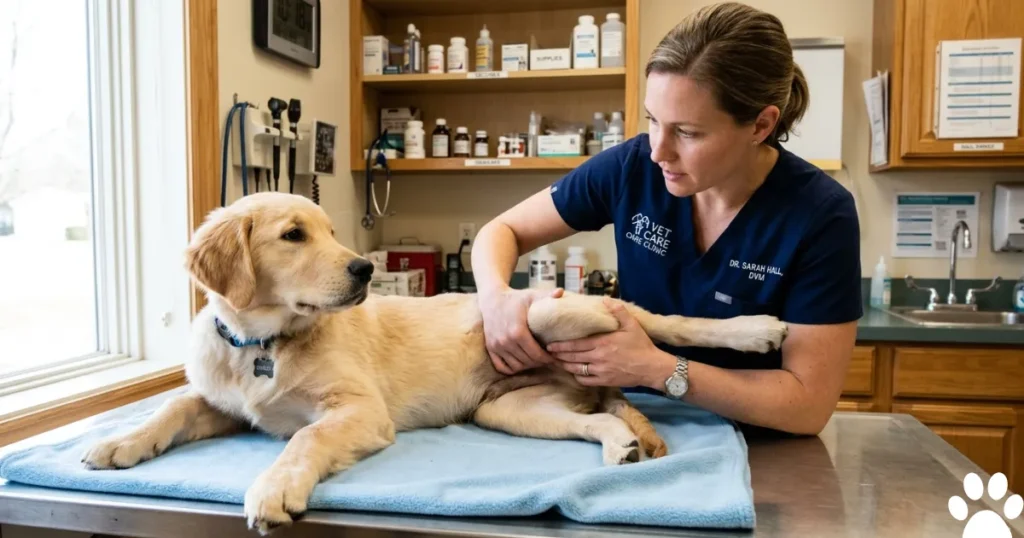
How Canine Hip Displacement Progresses by Age in Golden Retrievers
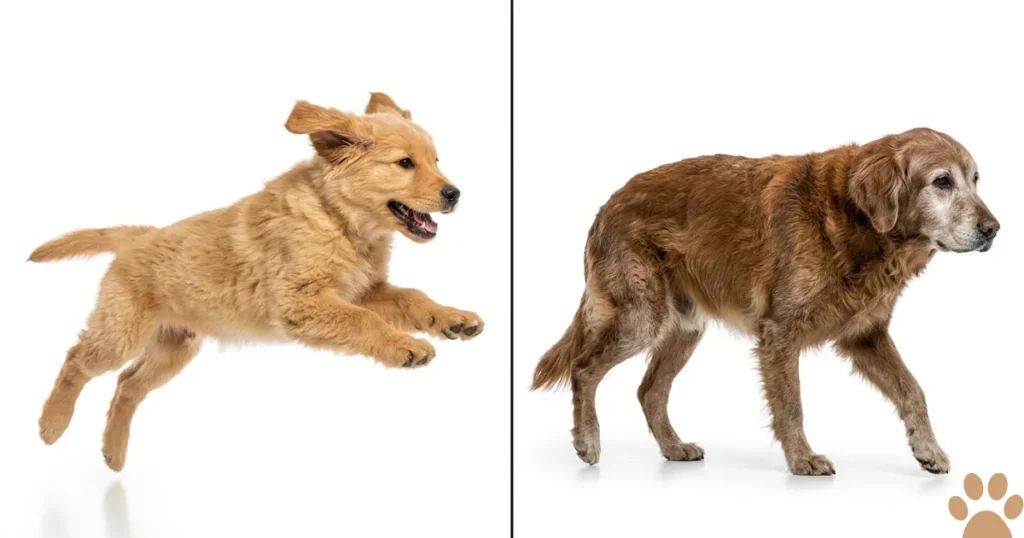
Hip displacement in dogs doesn’t look the same at 6 months as it does at 6 years. Golden Retriever owners need separate frameworks for each life stage; the signs differ, the intervention options differ, and the urgency differs.
Golden Retriever Puppies (4 Months to 18 Months).
This is the highest-leverage window. Joint laxity is present, but cartilage damage is still minimal. Puppies may show a wide-based rear stance, resist sitting squarely, or “bunny hop” rather than use alternating rear legs when running. These signs are often dismissed as growth quirks.
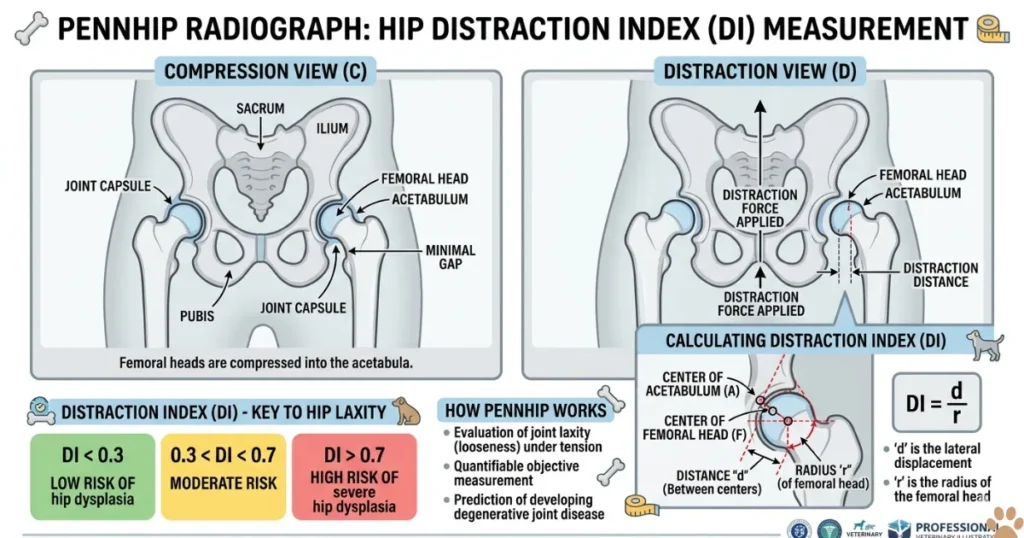
What I tell owners: not “wait until they’re fully grown to evaluate,” but “X-ray at 6 months if any of these signs are present.” The PennHIP method evaluates the distraction index in puppies as young as 16 weeks; earlier detection means more conservative management options remain available.
Adult Golden Retrievers (2-7 Years).
This is when most owners first notice the problem, but the joint has usually been deteriorating since puppyhood. Adult Goldens develop compensatory movement patterns: shifting weight forward, shortening the rear stride, and avoiding inclines. Osteoarthritis begins accumulating in the joint space during this stage.
Management at this stage typically involves NSAIDs, weight control, physical therapy, and joint supplements, including glucosamine and chondroitin sulfate. Surgical options like total hip replacement (THR) are still viable through this stage. The 2-7 year window is when most treatment decisions are made.
Senior Golden Retrievers (8 Years and Older).
By this stage, secondary osteoarthritis is established. The joint space has narrowed, osteophytes (bone spurs) have formed, and pain is often daily rather than episodic. Senior Goldens frequently show muscle atrophy over the hindquarters, visible as a narrowing above the tail base, because they’ve been offloading weight from painful hips for years.
Surgery risk increases with age due to anesthetic considerations and slower recovery. Most senior management focuses on multimodal pain control: prescribed NSAIDs, EPA/DHA supplementation for anti-inflammatory support, laser therapy, and environmental modifications like orthopedic bedding and ramp access.
What Most Canine Hip Problem Guides Get Wrong About Golden Retrievers?
Most hip dysplasia guides state that overweight dogs face a higher risk. That’s true, but it’s the wrong place to focus first for Golden Retriever owners.
The primary missed window is adolescent growth rate, not adult body weight. A Golden Retriever gaining weight too rapidly between 4 and 8 months of age places mechanical overload on a hip joint whose cartilage isn’t yet equipped to handle it. By the time a dog is an overweight adult, the foundational joint damage has often been present for years.
In March 2023, a 6-month-old female Golden presented at 34 lbs, within normal range for her age, with a bilateral bunny-hopping gait, which her owner described as “how she’s always run.” PennHIP evaluation showed a distraction index of 0.68 bilaterally, placing her in the upper quartile for laxity risk. We caught this at a stage where controlled exercise and a structured growth diet could still reduce the rate of cartilage degradation. Her owner had read three major online guides about hip dysplasia, and none had prompted them to evaluate a puppy who wasn’t visibly overweight.
The correction:
OFA and the American Veterinary Medical Association (AVMA) both support early radiographic screening for at-risk breeds. For golden retrievers, waiting until 2 years for a preliminary OFA evaluation means waiting until the most manageable window has already closed. Breed-specific guidance from the GRCA recommends that breeders use OFA evaluations—and that owners of high-pedigree-risk Goldens discuss PennHIP screening with their vet by 4 months.
The GRI Hip Check Protocol: Assessing Canine Hip Problems at Home.
This is a named framework developed from clinical practice patterns. It’s not a diagnostic tool; it’s a structured observation guide that tells you whether your Golden needs a same-week vet appointment or a scheduled exam.
The GRI Hip Check Protocol, 3 Observable Tests:
Test 1—The Sit Check:
Ask your Golden to sit. A dog with comfortable hips sits squarely with both rear legs folded symmetrically. A dog with hip discomfort often sits to one side, with one leg extended laterally. Run this test on a non-slip surface. If your Golden consistently avoids a square sit, log the date and frequency.
If → Schedule a vet exam within 14 days → Call the vet sooner if the rear leg trembles or collapses during a sit.
Test 2—The Morning Stiffness Watch
Observe your Golden during the first 3-5 minutes after waking. Hip-compromised Goldens often show a characteristic stiff, short-strided rear gait that improves after a few minutes of movement. This warm-up period, lengthening over time, is a reliable early indicator.
If stiffness is present but resolves within 5 minutes, → Then → Call the vet if stiffness is present beyond 10 minutes or worsening weekly.
Test 3—The Stair Resistance Test.
Does your Golden hesitate before stairs they previously took without thought? Stair avoidance reflects hip extension discomfort, the exact movement compromised in hip dysplasia. Single hesitation: log it. Three or more occurrences in a week: schedule an exam.
If → Schedule exam within 7 days → Call vet immediately if these three tests together take under 5 minutes. Run them weekly for any Golden over 18 months. I’ve used this sequence to prompt early imaging in dogs whose owners had no idea a problem was developing.

Expert Insight
“The Goldens I worry about most aren’t the ones limping visibly; they’re the ones whose owners describe them as ‘slowing down a bit’ and attribute it to aging. In my experience, premature rear-end slowing in a 3-5 year old Golden is hip-related until proven otherwise. I’d rather X-ray a healthy hip than miss a 2-year window for conservative management.”
🔴 URGENT VS. MONITOR — Quick Reference
| Symptom | Action |
| Sudden inability to bear weight on the rear leg | Call vet immediately |
| Audible click or pop from the hip during movement | Call the vet within 24 hours |
| Progressive rear-leg weakness over 2–4 weeks | Schedule an exam within 7 days |
| Occasional stiffness after rest, improves with movement | Monitor 2 weeks, log frequency |
| Bunny-hopping gait on walks | Schedule an exam within 14 days |
| Reluctance to climb stairs that was normal before | Schedule exam within 14 days |

What is hip dysplasia in dogs?
Hip dysplasia in dogs is a developmental malformation of the hip joint where the femoral head doesn’t fit securely in the acetabulum. This loose fit causes cartilage erosion, inflammation, and progressive pain. It’s hereditary but worsened by rapid growth, excess weight, and high-impact exercise during development.
How is hip dysplasia in dogs diagnosed?
Hip dysplasia in dogs is confirmed via radiograph. OFA evaluates dogs at 24 months for a formal grade (Excellent to Severe). PennHIP can screen as early as 16 weeks and measures the distraction index, a more precise early laxity indicator than standard OFA positioning.
What are the first signs of hip problems in dogs?
Early signs of hip problems in dogs include a bunny-hopping gait, reluctance to rise from rest, stiffness that improves after warm-up, and a lateral sit rather than a square sit. These signs in Golden Retrievers often appear between 5 and 18 months of age.
Can canine hip problems be reversed?
Canine hip problems cannot be fully reversed once cartilage loss occurs. Early-stage cases can be managed to slow progression significantly. Total hip replacement surgery offers the closest outcome to full function restoration in moderate-to-severe cases diagnosed before extensive secondary arthritis develops.
How serious is hip displacement in dogs?
Hip displacement in dogs ranges from mild laxity with minimal symptoms to severe subluxation, causing daily pain and mobility loss. Without management, it progresses to chronic osteoarthritis. Golden Retrievers with bilateral hip displacement face a higher risk of rear-limb muscle atrophy if untreated past age 4.
What does a canine hip X-ray show?
A canine hip X-ray shows the degree of joint socket depth, femoral head roundness, and joint space width. OFA-certified radiologists grade these findings from “Excellent” to “Severe.” A shallow acetabulum with a flattened femoral head confirms hip dysplasia; osteophyte formation confirms secondary osteoarthritis.
At what age do dogs typically develop hip dysplasia symptoms?
Dogs can show hip dysplasia symptoms as early as 4 to 6 months (juvenile form) or develop progressive signs between 1 and 2 years as joint laxity transitions to osteoarthritis. Large breeds, including Goldens, most commonly show clinical symptoms between 12 and 24 months.
Can a dog live a normal life with hip dysplasia?
Yes, many dogs with hip dysplasia live comfortable, active lives with appropriate management. Consistent weight control, low-impact exercise, glucosamine and chondroitin sulfate supplementation, and prescribed pain management allow most dogs to maintain a good quality of life without surgery.
What breeds are most affected by hip dysplasia?
According to OFA data, breeds most affected include German Shepherds, Rottweilers, Golden Retrievers, and Saint Bernards. Golden Retrievers rank consistently in the top 10, with a prevalence of approximately 20% in evaluated populations, higher than Labrador Retrievers at comparable evaluation ages.
Does exercise make hip dysplasia worse in dogs?
High-impact exercise, jumping, repeated stair use, and rough-surface running accelerate cartilage wear in dysplastic joints. Low-impact exercise like leash walking and swimming preserves muscle support without worsening joint damage. For Goldens, swimming is the preferred exercise during active flare periods.
Are Golden Retrievers genetically predisposed to hip dysplasia?
Yes. Golden Retrievers carry a polygenic hereditary predisposition to hip joint laxity. The OFA reports approximately 20% of evaluated Goldens test positive for hip dysplasia. The GRCA recommends OFA or PennHIP screening for all breeding stock to reduce prevalence across generations.
What does the Golden Retriever Lifetime Study say about hip dysplasia?
The Golden Retriever Lifetime Study, conducted by the Morris Animal Foundation, identifies musculoskeletal conditions, including canine hip dysplasia, as a leading cause of quality-of-life decline and early veterinary intervention in Golden Retrievers. The study supports early screening and weight management as primary preventive measures.
At what age do Golden Retrievers typically show hip dysplasia symptoms?
Golden Retrievers most commonly show first clinical signs between 6 and 18 months (growth-phase laxity) or between 4 and 6 years as secondary osteoarthritis becomes symptomatic. The 2-3 year window often appears symptom-free despite ongoing joint degeneration, which is why imaging matters more than symptoms alone.
Do English Cream Golden Retrievers have lower hip dysplasia rates than American Goldens?
Current OFA data doesn’t show a statistically significant difference in hip dysplasia prevalence between English Cream and American Golden Retrievers. Both lines carry a polygenic hip laxity risk. Breeding selection practices of individual breeders, not geographic or color variation, remain the strongest predictors of offspring health.
My golden retriever is limping on a back leg. Should I call the vet now?
Call your vet the same day if the limp is non-weight-bearing, appears suddenly, or is accompanied by whimpering when touched. Monitor at home for 24 hours if the limp is mild and intermittent and your dog is bearing weight and eating normally. Don’t wait more than 48 hours either way.
Conclusion.
Hip dysplasia in dogs is one of the most preventable-severity conditions affecting Golden Retrievers, but only when owners catch it in the right window. The core takeaway: don’t wait for a limp. A bunny-hopping gait, lateral sits, and morning stiffness in a Golden under 2 years old are early signals worth a vet call. Use the GRI Hip Check Protocol weekly, discuss PennHIP screening with your vet if your golden retriever is from an unscreened line, and know that early management nearly always outperforms late intervention. Canine hip problems managed at 8 months look very different from the same dog managed at 4 years.
Has your Golden Retriever been diagnosed with hip dysplasia, or are you watching for early signs? I’d like to know what age your dog was when you first noticed something was off, what that symptom actually looked like day-to-day, and whether a vet visit confirmed what you suspected. Your specific experience helps other Golden owners know what to watch for. Leave your dog’s age and the first sign you noticed in the comments.