Developmental stages of a puppy are the behavioral stages a puppy moves through as its mind matures, from the socialization window to the teenage brain of adolescence. Along the way come two fear periods, when a confident puppy suddenly turns cautious. Knowing these puppy phases helps you support your dog’s emotions, not just its physical growth.
Your puppy’s body and brain do not grow at the same speed. The body follows a fairly steady clock, but the mind moves through emotional ups and downs that can catch any owner off guard.
This guide is about that inner world. It covers the behavioral puppy phases, the two fear periods that surprise so many owners, and the famous teenage brain. For the physical side, from weight to teething, see the growth and size chart.
What are the puppy phases of behavior?
Behavioral puppy phases are the emotional and mental stages a young dog passes through on the way to a settled adult temperament. They overlap with physical growth but follow their own rhythm.
The key point is that they are normal and expected. Knowing the phases helps you read your dog and respond well. The physical version of this timeline, from weight to teething, is covered on its own page. This guide lives in the health and care hub, part of all our Golden Retriever insights. Think of the puppy phases as your dog’s emotional weather. They arrive whether you plan for them or not, but knowing the forecast lets you prepare well.
The developmental stages of a puppy, behaviorally
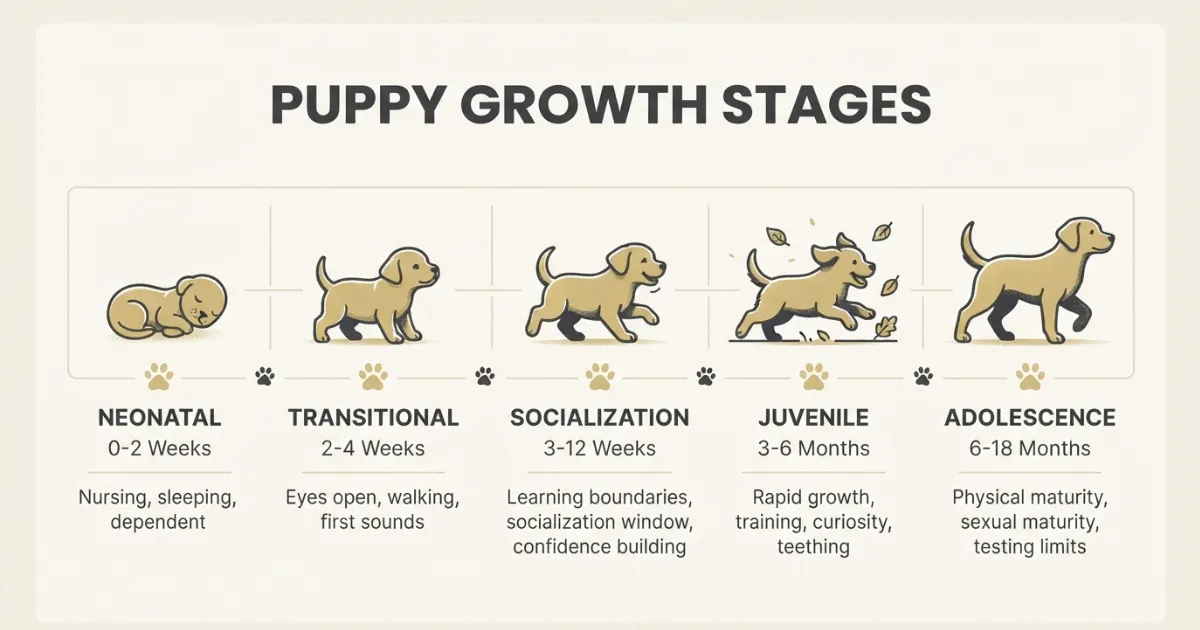
The behavioral developmental stages of a puppy run alongside its physical growth but focus on temperament, confidence, and self-control.
The socialization phase, 3 to 14 weeks
This is the most powerful window in a dog’s life. What a puppy meets calmly now tends to feel safe forever, and what it misses can be hard to add later. Most puppies go home mid-window, around life at 8 weeks. Aim for gentle, varied, positive experiences here. Of all the puppy phases, this one leaves the deepest mark on adult temperament.
The juvenile phase, 3 to 6 months
Confidence grows, and the puppy starts to test small limits. Training sticks well here, so it is a great time to build good habits before adolescence arrives. Enjoy this calmer window while it lasts. It is one of the easier puppy phases, a brief breather before the teenage months.
The adolescent phase, 6 to 18 months
The teenage stretch. Independence surges, rules get tested, and a second fear period often lands. It begins in earnest around your Golden’s 5 months and runs well past the first birthday. This is the longest and most testing of the behavioral phases. Patience and consistency matter more now than in any other stretch.
Maturity, 2 to 3 years
Temperament finally settles. The dog becomes the steady adult its early experiences shaped, which is why the emotional finish line sits at when a dog reaches maturity. Reaching this point does not erase your dog’s personality. It simply means the ups and downs of the earlier puppy phases have finally evened out.

Puppy fear periods explained
The strangest part of puppy development, for many owners, is the fear period. Your confident puppy wakes up one day scared of the vacuum, a bin, or a person it liked yesterday. Nothing is wrong. It is a normal, hardwired phase.
Dogs go through two main puppy fear periods, each usually lasting about two to three weeks. They are tied to the brain rewiring itself for independence. You cannot train them away, and you did not cause them. They are one of the most misunderstood parts of the puppy phases, which is exactly why they catch owners off guard. The good news is that they are temporary and manageable.
| Fear period | Typical age | What you might see | What to do |
| First | 8 to 11 weeks | Sudden caution, spooking at ordinary things | Keep every experience gentle and positive |
| Second | 6 to 14 months | A once-confident dog acts scared | Stay calm and neutral, never force it |
The first fear period, 8 to 11 weeks
This one lands right as a puppy leaves the litter and moves to a new home, so it is easy to miss. A scary or painful event now can leave a lasting mark, so keep the early weeks calm and gentle while your puppy settles in. Let your puppy retreat if it feels unsure, and never flood it with scary situations to toughen it up. Gentle wins build the confidence that lasts.

The second fear period, 6 to 14 months
This one arrives in adolescence and surprises people more, because the dog seems grown. It often appears earlier around your Golden’s fourth months and can return later. Large breeds tend to hit it later than small ones. Because the dog looks grown, owners expect adult composure and get a nervous teenager instead. Recognizing it as a passing phase keeps you calm and helpful. As with the first, keep new experiences low-key for a couple of weeks and let the wobble pass.
How to help through a fear period
The rule is simple. Do not force your dog toward the scary thing, and do not fuss over it either, which can confirm that there is something to fear. Stay relaxed, let your dog choose to investigate, and reward brave, calm choices.
Keep sessions short and end on a good note. Across all the puppy phases, calm and consistent beats big and dramatic every single time. If your puppy freezes at something specific, give it space and try again another day from a greater distance. Patience beats pressure in these moments.

How temperament forms
Genetics plus experience
A puppy’s adult personality comes from two things: the temperament it was born with and the experiences it collects while young. Neither works alone. A well-bred puppy can still grow anxious without good early exposure, and a careful owner can bring the best out of a shy one. This is why two puppies from the same litter can grow into very different adults. The developmental phases are shared, but each puppy travels through them in its own way.
Why early experiences stick
Learning during the socialization window and the first fear period can be close to permanent. That is why gentle, positive exposure early on matters so much. You are not just entertaining a puppy, you are wiring an adult.
That responsibility sounds heavy, but it is really good news. A little thoughtful effort during these early puppy phases pays back for the dog’s whole life. Simple things count: new floor surfaces, gentle car rides, and meeting calm people of all kinds. None of it needs to be dramatic, just varied and positive.
The teenage brain: why adolescents test everything
Adolescence is the phase owners find hardest, and the brain explains why. The parts that handle excitement and drive mature early, while the parts that handle impulse control mature last.
The result is an adult-sized dog with a learner’s brakes. It is not defiance, it is biology, the same mismatch that makes a one-year-old act like a giant puppy, as seen at the first birthday stage. Calm, consistent training is what carries you both through it.
It also helps to lower your expectations for a while. A teenager will have off days, and meeting them with patience rather than frustration shortens the phase for everyone. Keep the rules the same even on the hard days, since consistency is what a wobbly adolescent brain needs most to steady itself.

Do all puppies go through the same phases?
Yes, in broad strokes. Every puppy passes through the same developmental phases and both fear periods, because they are wired into the species. What differs is the timing and the intensity.
Breed is the biggest factor. Small dogs move through the phases faster and mature sooner, while large breeds like Golden Retrievers stretch adolescence out to two or three years. Temperament matters too. A naturally bold puppy may barely notice a fear period, while a sensitive one needs extra gentle support through the same puppy phases.
How the behavioral phases differ from physical growth
It helps to hold two timelines in your head. The body grows on a fairly predictable schedule and finishes first. The mind moves in emotional phases and finishes much later.
That gap is the source of most confusion at a year, when a fully grown dog still behaves like a puppy. Owners who track both timelines panic far less. When a grown dog acts like a puppy, they recognize the behavioral phases at work rather than a fault. Track the physical side with the physical growth stages, and use this guide for the emotional side. Read together, they explain the whole dog, the body, and the mind side by side.
Supporting your puppy through every phase
Match your response to the phase
Each phase asks something different of you. The socialization window asks for lots of gentle exposure. The fear periods ask for calm and patience. Adolescence asks for consistency when your dog seems to have forgotten everything.
Meet the phase your dog is in, not the one you expected. That single habit prevents most behavior problems before they start. You do not need to be a trainer to do this. You just need to know which of the puppy phases your dog is in, and add a little patience where it counts. When you feel stuck, ask one question: what does this stage need from me right now? The answer is usually simpler than it feels.
When to get help
Most fearful behavior is a normal phase that passes in a few weeks. Get help, though, if fear is intense, keeps growing, or comes with snapping or biting. A fear period comes on suddenly and fades, while true trouble tends to escalate.
If you are worried, talk to your vet, who may refer you to a qualified veterinary behaviorist. Early help is far easier than undoing a fear that has set in. Trust your gut here. If something feels beyond a normal phase, a quick professional check brings peace of mind and often a simple plan.

Expert Insight
The behavior that worries owners most, the sudden fear at eight weeks or in adolescence, is almost always a normal phase, not aggression. The difference is the pattern. A fear period appears overnight and lifts within weeks. Behavior that steadily worsens, or involves biting, deserves a professional look sooner rather than later.
The behavioral phases at a glance.
A puppy’s mind grows in phases, not on a neat schedule. The big ones are the socialization window (3 to 14 weeks), the juvenile phase (3 to 6 months), and adolescence (6 to 18 months). Two fear periods sit inside them, around 8 to 11 weeks and again in adolescence. Support the phase, and you shape a confident adult.
What are the puppy phases of behavior?
The puppy phases of behavior are the emotional stages a young dog passes through, mainly the socialization window, the juvenile phase, and adolescence. Two fear periods sit inside them. These puppy phases shape adult temperament and run separately from physical growth.
What are the developmental stages of a puppy?
Behaviorally, the developmental stages of a puppy are socialization from three to fourteen weeks, a juvenile phase to about six months, adolescence to around eighteen months, and maturity by two to three years. Each shapes confidence and self-control.
What are puppy fear periods?
Puppy fear periods are normal developmental phases when a confident puppy suddenly becomes cautious or spooked. There are two, one around eight to eleven weeks and another in adolescence. Each usually lasts two to three weeks and passes on its own.
When is the first fear period in puppies?
The first fear period is around eight to eleven weeks, right when many puppies move to a new home. Keep experiences gentle and positive, since a bad scare at this age can leave a lasting mark that is hard to undo.
When is the second fear period in dogs?
The second fear period falls in adolescence, usually between six and fourteen months, and later for large breeds like Golden Retrievers. A confident dog may suddenly spook at ordinary things. Stay calm, never force it, and it passes.
Why has my bold puppy turned nervous overnight?
This is almost certainly a fear period, a normal part of the puppy phases. The brain is rewiring for independence, so caution spikes for a few weeks. Support your dog calmly, avoid overwhelming it, and the confidence returns.
How long do fear periods last?
Each fear period usually lasts about two to three weeks, though some dogs have shorter spikes or one longer stretch. If fearful behavior lasts much longer, keeps worsening, or involves biting, it is worth a professional assessment.
Is fear-period behavior the same as aggression?
Usually not. Fear-period reactivity comes on suddenly in a previously confident dog and fades within weeks. True aggression tends to build over time. If your puppy snaps or bites when scared, consult your vet or a behaviorist regardless.
Can I prevent fear periods?
No. Fear periods are hardwired, and every puppy goes through them. Good early socialization does not prevent them, but it does make them milder and helps your dog bounce back faster and more confidently.
Why do adolescent dogs test boundaries?
The adolescent brain develops drive and independence before impulse control, so a teenage dog has big feelings and weak brakes. Boundary testing is biology, not spite. Consistent, calm training carries you through the puppy phases of adolescence.
How is behavioral development different from physical growth?
Physical growth follows a steady clock and finishes around one to two years. Behavioral development moves in emotional phases and finishes later, at two to three years. That gap is why a fully grown dog can still act like a puppy.
When does my puppy’s temperament settle?
Temperament forms through the early puppy phases but does not fully settle until emotional maturity, usually two to three years. Early experiences shape it most, which is why gentle socialization and calm handling matter so much when a puppy is young.
The bottom line
The puppy phases are the story of a mind growing up, and they run on a different clock than the body. The socialization window shapes lifelong temperament, the two fear periods test a puppy’s nerve, and adolescence brings a big body with a learner’s brakes.
None of it means something is wrong. A puppy that spooks at eight weeks or acts wild at a year is simply working through a normal phase, right on the schedule its species follows.
Support the phase in front of you with gentle exposure, calm patience, and steady training, and you guide your puppy toward the confident, settled adult it is meant to become. Take the puppy phases one at a time, and the whole emotional journey makes sense. The nervous moments pass, and the dog you shape lasts. That is the quiet promise of these early months: patient effort now buys a steady companion for years. Meet each phase with calm, and the rest takes care of itself.
Which of the puppy phases surprised you most, a sudden fear period or the long teenage stretch? Share what helped you through it in the comments so other owners know what to expect.