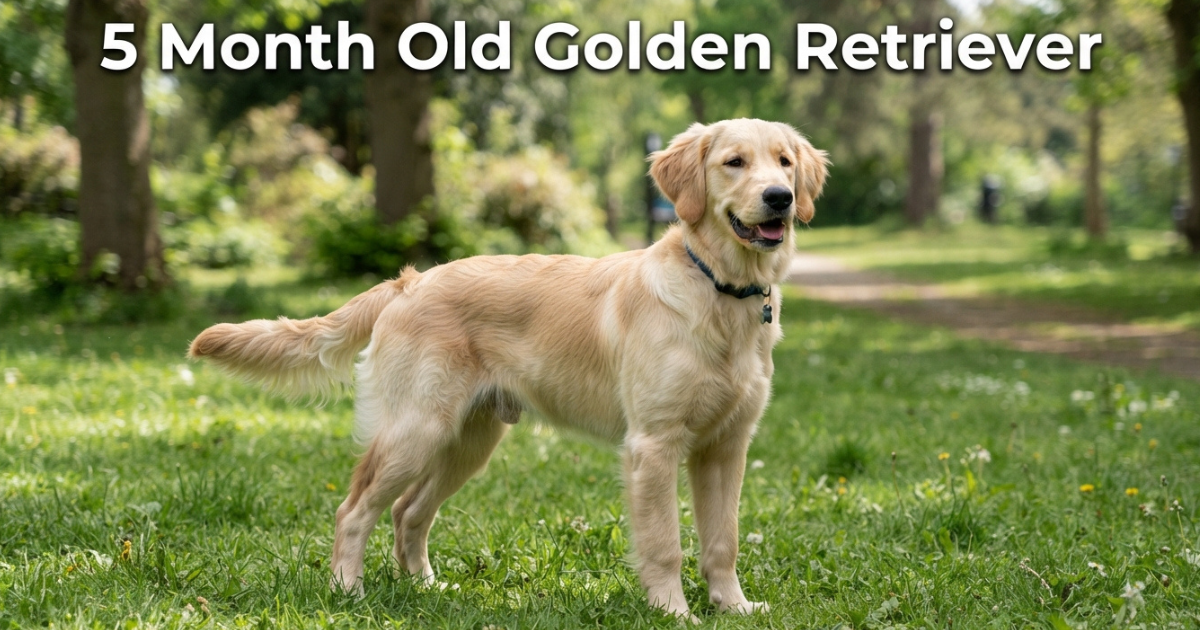
A 6 month old golden retriever weighs around 45 pounds, roughly two-thirds of adult size, with teething ending and adolescence in full swing. Meals can move from three a day to two, but stay on large-breed puppy food for now. Expect selective hearing, high energy, and the first signs of sexual maturity.
Six months is a real milestone. Your Golden is over the worst of teething, into the teenage stage, and starting to look more like the adult it will become, even though there is plenty of growing left.
It is a stage of practical changes, from meal times to exercise to the spay-neuter question. This guide covers what to expect from a 6 month old golden retriever: healthy weight, feeding, exercise, first heat, and timing decisions. For where this fits the full timeline, see our size-by-age growth guide.
What to expect from a six month old golden retriever
Size and appearance
A six month old golden retriever is tall and athletic, around 45 pounds, and finally starting to look less like a puppy. The adult coat and feathering are coming in well, and the frame is broadening beyond the lanky teenage look.
Height is slowing down now, while the body keeps filling out. Many Goldens reach a large share of their adult height by this stage, then spend the next year adding muscle and chest depth. You may notice the puppy fluff has mostly gone, replaced by a smoother, water-repellent adult coat. The face is losing its round baby look too, settling into the classic kind of golden expression.
The teenage phase in full swing
Adolescence is in full swing at 6 months. Expect selective hearing, boundary testing, and a burst of confident independence, all of which are normal for the age. The good news is that a 6 month old golden retriever is more capable than ever, so the same energy that fuels the antics also powers fast learning when you channel it well.
This builds on the changes that started last month, which you can revisit in your Golden at five months. For how this fits the breed, browse our Golden Retriever breed pages and the rest of our Golden Retriever guides.
Golden retriever 6 months: weight and growth
Average weight at 6 months
The typical golden retriever 6 months weight is around 45 pounds, roughly two-thirds of adult size. Males usually run about 40 to 50 pounds and females about 35 to 43 pounds, though some Goldens are heavier and the healthy range is wide.
Do not fixate on the number. A steady upward trend paired with good body condition tells you far more than matching a chart, and males naturally carry more weight and bone than females. English cream goldens can look a little stockier but land in a similar range. Whatever the type, the goal is the same: a lean, steadily growing dog rather than a heavy one racing up the chart.
| Age | Male weight | Female weight | Share of adult |
| 22 weeks | 38 to 46 lb | 32 to 40 lb | ~65% |
| 24 weeks (6 months) | 40 to 50 lb | 35 to 43 lb | ~68% |
| 28 weeks (7 months) | 45 to 55 lb | 40 to 48 lb | ~75% |
| 32 weeks (8 months) | 50 to 60 lb | 42 to 52 lb | ~80% |
Growth is slowing now
Growth has clearly slowed compared with the frantic early months, so weekly weigh-ins can drop to roughly monthly. A 6 month old golden retriever still grows in spurts and plateaus, and both are perfectly normal.
Keep judging the condition with your hands rather than the scale. You should feel the ribs under a thin layer of fat and see a slight waist. For the wider stage map, see our puppy stages overview.
Height is the first thing to finish, usually not long after this stage, while the chest and body keep broadening into the second year. A still slightly lanky 6 month old golden retriever is completely on schedule.
Teething is finally ending
The relief of adult teeth
Here is the good news at 6 months. The adult teeth are almost all in, so the intense, furniture-destroying chewing of the last few months eases off noticeably. Both you and your puppy get some relief. The peak of the chewing, back at the four month mark, is behind you now.
Some Goldens keep a strong urge to carry and mouth things, which is a normal breed trait rather than teething. Channel it into a toy or a job rather than trying to stamp it out.
Keeping up good chew habits
Even as teething ends, keep good chews available. Chewing is a natural stress reliever, and a bored Golden that has nothing appropriate to gnaw will often find something you would rather it left alone.
Rotate a few durable, size-appropriate chews to keep them interesting. This gentle habit carries the good behavior of puppyhood into the calmer months ahead. It also keeps those strong adult teeth clean. A quick brush of the teeth a few times a week, started gently now, sets up a lifetime of good dental habits.

Feeding a 6 month old golden retriever
Moving to two meals a day
Around 6 months, many owners move from three meals a day to two, as growth slows and the stomach grows. Morning and evening meals suit most Goldens well from here.
Watch the behavioral cue, not just the calendar. If your 6 month old golden retriever still does better on three smaller meals for now, that is fine, and your vet can help you decide. Either way, keep to scheduled feeding rather than leaving a bowl down all day. Goldens rarely stop eating when full, so measured meals guard against creeping weight gain.
Stay on large-breed puppy food for now
This is a common mistake worth avoiding. Do not switch to adult food yet. Large breeds like the Golden should stay on large-breed puppy food until around 12 to 15 months, since their growth plates close later than small dogs.
Puppy formula is calorie and calcium controlled for steady growth. Switching too early can leave gaps at a time when the body is still building. When you do switch, around 12 to 15 months, do it gradually over about a week to avoid an upset stomach. Until then, the puppy formula is doing an important job.
A note on bloat
Goldens are a deep-chested breed, so bloat is a real risk to respect. Feed measured meals rather than one huge one, keep the water bowl full, and avoid hard exercise for about an hour before and after eating.
If your dog ever has a swollen belly, unproductive retching, or obvious distress, treat it as an emergency and call your vet at once. It is uncommon, but knowing the signs is one of the most useful things a large-breed owner can carry.

Exercise at 6 months
The 30 minute rule
A widely used, vet-informed guideline is about 5 minutes of structured exercise per month of age, twice a day. For a 6 month old golden retriever, that works out to roughly 30 minutes, twice daily.
Sniffing walks, safe off-leash play, and swimming are all great. Plenty of exercise also prevents a lot of teenage trouble, since a well-worked adolescent has far less energy left for mischief. Split the time into a morning and an evening session rather than one long push, which suits a growing body better and burns energy at both ends of the day.
Protecting growing joints
The growth plates stay open until around 12 to 18 months, so high-impact activity can still harm them. Keep avoiding long runs, repeated jumping, and forced stairs, and hold off on agility or serious distance work.
Swimming remains the standout low-impact option, and most Goldens adore it. Mental games and short training sessions tire a teenager just as effectively as a hard run.

Training your adolescent golden retriever
Selective hearing and boundary testing
The teenage hallmark is selective hearing. Your 6 month old golden retriever still knows its commands, but independence and curiosity now compete hard for attention.
Expect some boundary pushing, like jumping on guests, counter surfing, or ignoring a recall it nailed last month. This is a developmental stage, not defiance, and it passes with patience. Meeting it calmly matters. If you expect the testing, you respond to it steadily instead of taking it personally, which is exactly what your teenager needs from you.
Keep training short and consistent
The owners who sail through this keep sessions short, frequent, and rewarding, rather than pushing harder in long, frustrated ones. Go back to basics with high-value treats and a long line for recall practice.
Stay calm and consistent, and the responsiveness returns as your dog matures. For the behavior map running alongside these weeks, see the puppy development timeline.

Health: first heat, sexual maturity, and spay-neuter timing
Females and the first heat
Females can come into their first heat around 6 months, though it varies and can be earlier or later. Signs include a swollen vulva, spotting, and more interest from male dogs.
An unspayed female in heat needs careful supervision to avoid an accidental litter. If you are unsure whether a heat has started, your vet can confirm it. Some owners choose to wait through the first heat before deciding on spaying, which is a reasonable, vet-guided approach for this breed.
Spay or neuter timing for a large breed
Timing matters for this breed. Research from UC Davis has linked early spay or neuter, before the growth plates close, to higher rates of certain joint disorders and some cancers in Golden Retrievers.
Many vets now suggest waiting until closer to full maturity, often 12 to 18 months, for large breeds. There is no single right answer, so make this a dedicated conversation with your own vet.
From 6 months to adulthood
Your puppy is roughly two-thirds grown now, with the biggest changes ahead being muscle and maturity rather than raw size. The long adolescent stretch continues toward the twelve month stage.
Many owners wonder when their Golden truly counts as grown up, which you can explore when your dog becomes an adult. The routines you hold steady now carry your dog calmly into that adulthood. Six months in, you are already more than halfway to the steady adult Golden you pictured.
Expert Insight
The two things I most often correct at 6 months are owners switching to adult food too early and owners rushing spay or neuter to fix teenage behavior. Neither helps. Keep the puppy food until closer to a year, manage the adolescence with consistent training, and make the surgery a planned decision, not a reaction.
The half-year milestone.
Your puppy is now about 45 pounds and roughly two-thirds grown. Teething is finally ending, meals can drop from three a day to two, and the teenage phase is in full swing. Cap exercise near 30 minutes twice a day, keep training short and consistent, and plan spay or neuter timing with your vet.
How much should a golden retriever 6 months old weigh?
A golden retriever 6 months old usually weighs about 45 pounds, roughly two-thirds of adult size. Males run about 40 to 50 pounds and females 35 to 43, though some are heavier, so trends and body condition beat exact numbers.
Is a 6 month old golden retriever still teething?
Mostly finished. The adult teeth are nearly all in by 6 months, so the intense chewing eases noticeably. Some carrying and mouthing continues as a normal breed trait, so keep good chew toys available even now.
How many times a day should I feed a six month old golden retriever?
Around 6 months, many owners move a six month old golden retriever from three meals a day to two, as growth slows. Watch the behavioral cue, not just the calendar, and ask your vet if unsure.
Should I switch my 6 month old golden retriever to adult food?
Not yet. Large breeds should stay on large-breed puppy food until roughly 12 to 15 months, because their growth plates close later. Switching too early removes nutrition the growing body still needs at this stage.
When do female golden retrievers have their first heat?
Often around 6 months, but it varies and can be earlier or later. Signs include a swollen vulva and spotting. An unspayed female in heat needs close supervision to prevent an accidental litter.
When should I spay or neuter my golden retriever?
Research links early spay or neuter in Goldens to higher joint and some cancer risks, so many vets suggest waiting until 12 to 18 months for this large breed. There is no single answer, so ask your own vet.
How much exercise does a 6 month old golden retriever need?
Use the 5 minute rule, about 5 minutes per month of age, twice a day, so roughly 30 minutes twice daily. Add swimming and gentle play. Avoid long runs, jumping, and stairs to protect growing joints.
Why does my 6 month old golden retriever ignore commands now?
Adolescence is in full swing, bringing selective hearing and boundary testing. Your dog has not forgotten its training, it is testing. Keep sessions short and rewarding, use a long line for recall, and stay consistent.
How big will my 6 month old golden retriever get?
At 6 months your puppy is roughly two-thirds of an adult’s weight, so most Goldens finish around 55 to 75 pounds as adults. Doubling the earlier four-month weight and the size of the parents both give useful clues.
How much sleep does a 6 month old golden retriever need?
Around 14 hours a day, less than in the puppy weeks but still substantial. An overtired teenager is harder to manage, so protected rest genuinely helps behavior during the adolescent stage.
Is my 6 month old golden retriever the right weight?
Judge body condition over the scale. You should feel the ribs under a thin layer of fat and see a slight waist from above. A lighter female is not a sign of underfeeding, since frames differ by sex.
Can I do more advanced training with a six month old golden retriever?
Yes. A six month old golden retriever can handle longer strings of commands and early manners work, as long as sessions stay short and upbeat. This is a great time to build on the basics with consistency.
The bottom line
A 6 month old golden retriever is about 45 pounds, two-thirds grown, past the worst of teething, and squarely in the teenage phase. It is a milestone of practical shifts, from three meals to two, from destructive chewing to calmer habits, and from puppy to adolescent. None of it is a step backward. It is your golden growing up, right on schedule.
Keep growth moderate, cap exercise, and meet the selective hearing with short, consistent training rather than frustration. Stay on large-breed puppy food for now, respect the bloat risk with sensible feeding, and treat spay or neuter timing as a planned conversation with your vet. Hold the routines steady, and the confident adult you are shaping keeps taking shape, month by month.
How is the half-year mark treating you, from the feeding change to the teenage antics? Share your 6 month old golden retriever’s weight and your best tip in the comments for other owners.