A 5 month old golden retriever weighs around 40 pounds, roughly 60 percent of adult size, and is entering adolescence. Expect selective hearing, boundary testing, and heavy chewing as the adult teeth arrive. Growth is slowing but not done. Short, consistent training and steady, moderate growth matter most through this teenage stage.
Five months is when the sweet, biddable puppy quietly becomes a teenager. Commands that were rock solid last week suddenly get a blank stare, and your Golden starts testing what it can get away with.
This is normal, and it is the start of adolescence, not a training failure. This guide covers what to expect from a 5 month old golden retriever, healthy weight, the last of the chewing, exercise, the teenage behavior stage, and spay-neuter timing. For where this fits in the full timeline, see our growth and weight guide.
What to expect from a 5 month old golden retriever
Size and appearance
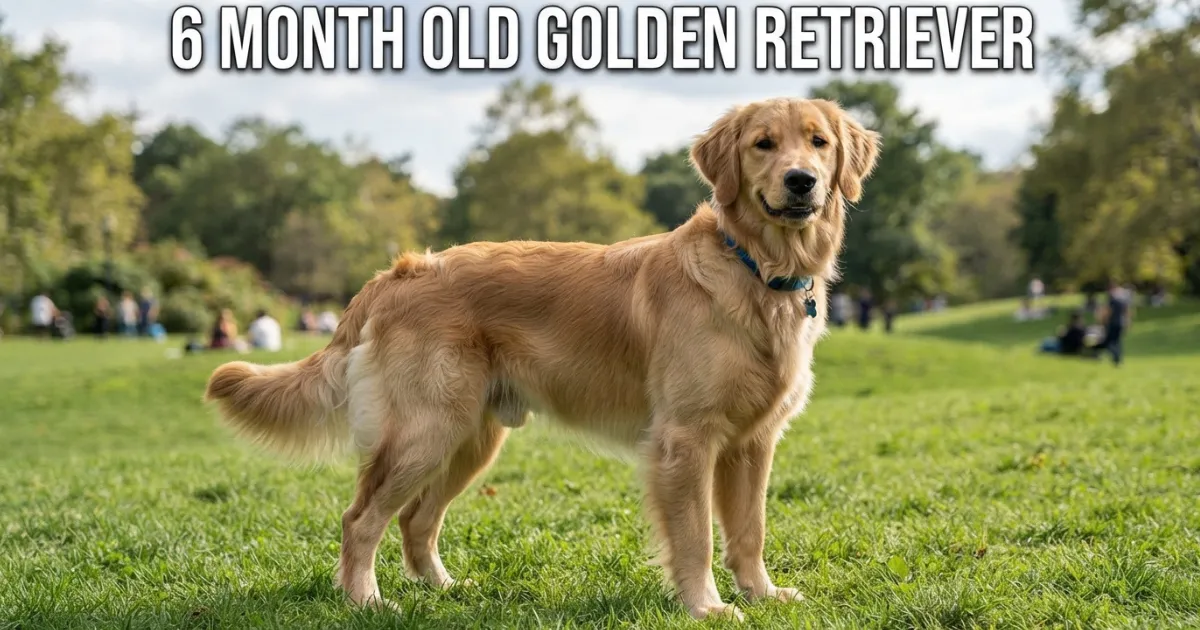
A 5 month old golden retriever is tall, lean, and often gangly, around 40 pounds, with legs that can look too long for the body. The adult coat is coming in, and the feathering on the legs, tail, and chest is filling out.
The difference between males and females is clearer now. Males carry more bone and a broader head, while females look finer, and both are perfectly healthy at their own end of the range. Coat color is close to final now, though the ear tips often hint at the richest adult shade. Underneath the lanky frame, the chest is starting to deepen, the first sign of the sturdy adult to come.
Adolescence begins
Adolescence in Goldens kicks off around 5 months and runs on and off until roughly two years old. The hallmark right now is a puppy that seems to forget its training and pushes at every boundary. The most intense stretch usually lands between 8 and 18 months, so think of 5 months as the opening act. Knowing it is coming makes it far easier to stay patient.
This follows the busy 16-week threshold, which you can revisit in life at four months. For how this fits the breed, browse the Golden Retriever breed hub and everything on Golden Retrievers.
5 month old golden retriever weight and growth
Average weight at 5 months
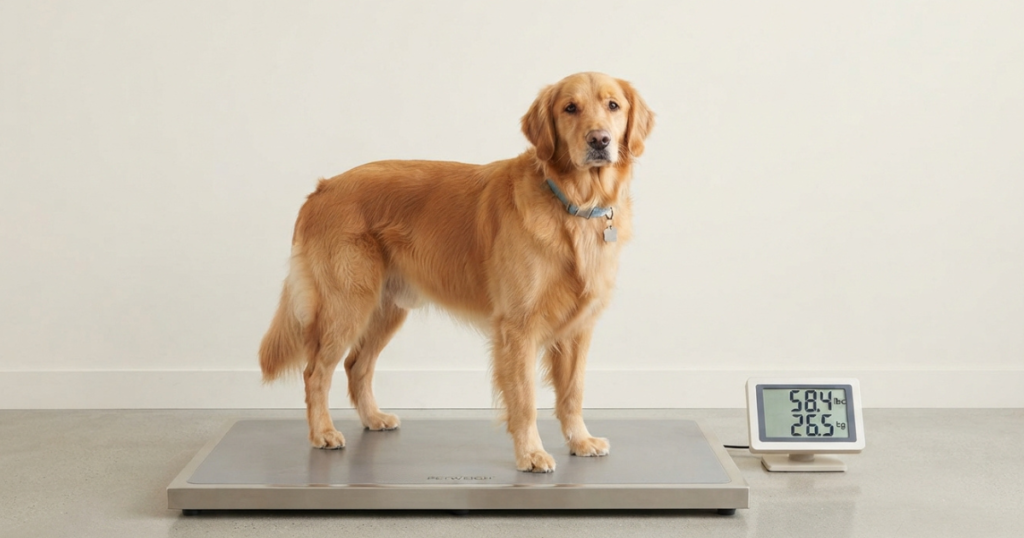
The typical 5 month old golden retriever weighs around 40 pounds, roughly 60 percent of adult size. Males usually run about 35 to 43 pounds and females about 30 to 37 pounds, and the healthy breed range is genuinely wide.
A male at 42 pounds and a female at 33 pounds are both perfectly normal. The frame difference is real, not a sign of under or overfeeding, so judge your own dog by condition rather than by a sibling or a chart. English cream goldens tend to look a touch stockier but land in a similar range. Whatever the type, a steady climb paired with good body condition is the real measure of health.
| Age | Male weight | Female weight | Share of adult |
| 18 weeks | 32 to 40 lb | 28 to 34 lb | ~55% |
| 20 weeks (5 months) | 35 to 43 lb | 30 to 37 lb | ~60% |
| 22 weeks | 38 to 46 lb | 32 to 40 lb | ~65% |
| 24 weeks (6 months) | 40 to 50 lb | 35 to 43 lb | ~68% |
Growth is slowing, condition still counts
Growth is clearly slowing now compared with the frantic early months, though your 5 month old golden retriever still has a fair way to go. Height finishes first, and the body keeps filling out well past the first birthday.
Keep judging the condition with your hands. You should feel the ribs under a thin layer of fat and see a slight waist. For the wider stage map, see the complete puppy stages guide.
Weigh-ins can move to every couple of weeks now, rather than weekly. During this slower phase, a 5 month old golden retriever will surprise you with sudden spurts followed by plateaus, and both are perfectly normal.
Teething and chewing at 5 months
Why chewing still peaks
Adult teeth typically finish arriving between about 4 and a half and 5 months, which is exactly why chewing can feel like it is at its worst right now. Sore gums plus a strong natural urge to chew send a 5 month old golden retriever hunting for anything to gnaw. The chewing has been building since the three month mark, when the land shark phase began.
The good news is that the end is near. Once the adult teeth are fully in, usually by around 6 months, the intense chewing eases off noticeably.
Managing the chewing
Give your puppy plenty of appropriate outlets, since a chewing dog will find something whether you provide it or not. Frozen chew toys and puppy-safe chews soothe sore gums and save your belongings.
Keep valuables out of reach and rotate a few chews to keep them interesting. Skip hard items like antlers and bones, which can crack developing adult teeth. A tired puppy also chews less destructively, so pairing good chews with enough exercise and rest tackles the problem from both ends. This last push of teething is the home stretch.

Feeding your 5 month old golden retriever puppy
How much and how often
Feed a 5 month old golden retriever puppy three meals a day, evenly spaced across the day. Amounts vary a lot by food and by dog, so let your vet set the exact portion rather than relying on the bag alone.
Keep fresh water down at all times. A large-breed puppy formula still matters here, because it is calorie and calcium controlled to keep growth steady and protect the joints. Some owners start thinking about moving to two meals a day around 6 months, but three is still ideal at five.
Keeping growth steady
Appetite can surge during growth spurts, so expect some hungrier weeks. Adjust portions by body condition, aiming for lean rather than round, since fast growth and extra weight raise orthopedic risk in this breed.
If you change foods, mix the new into the old over about a week to avoid a stomach upset. Steady and slightly lean is always the goal.

Exercise at 5 months
The 25 minute rule
A widely used, vet-informed guideline is about 5 minutes of structured exercise per month of age, twice a day. For a 5 month old golden retriever, that works out to roughly 25 minutes, twice daily.
Sniffing walks, gentle play, and safe off-leash time are ideal. Ample exercise also happens to prevent a lot of adolescent misbehavior, since a well-exercised teenager has far less pent-up energy to burn. A good chunk of adolescent trouble is simply an under-exercised, under-stimulated dog looking for something to do.
Protecting growing joints
The growth plates stay open until around 12 to 18 months, so high-impact activity can still harm them. Keep avoiding long runs, repeated jumping, and forced stairs, and hold off on agility or distance work.
Swimming, where it is safe and supervised, is a great low-impact option that many Goldens love. Mental games and short training sessions tire an adolescent just as well as a hard run.

Training through the teenage stage
Selective hearing and boundary testing
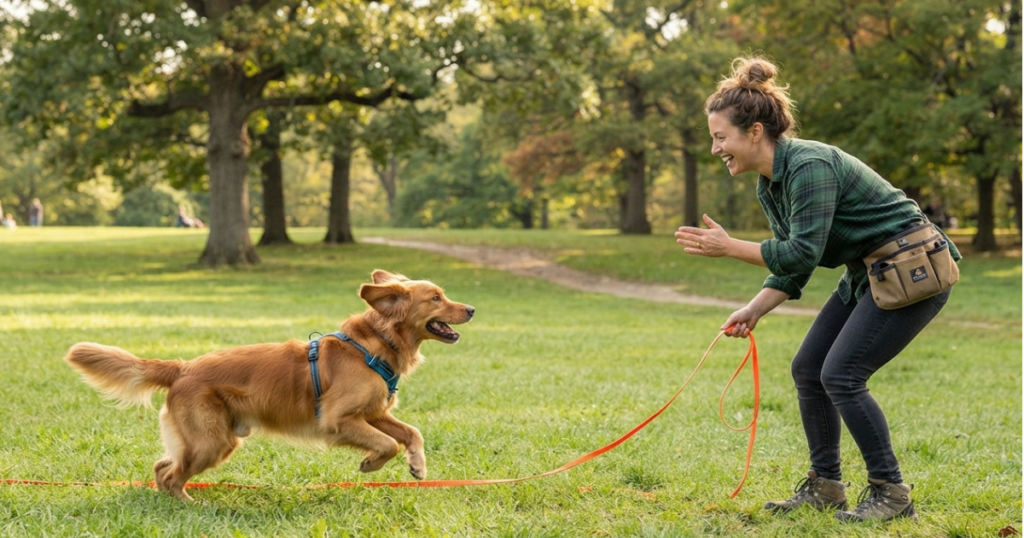
The signature of adolescence is selective hearing. Your 5 month old golden retriever still knows sit and come, but curiosity and independence now feel more interesting than you do.
Expect boundary pushing too, like jumping on guests, counter surfing, and testing rules it respected a month ago. None of it is spite, it is a normal developmental stage. The kindest thing you can do is expect it. If you assume your teenager will test the rules, you meet each test calmly instead of taking it personally, which is exactly what your 5 month old golden retriever needs from you.
How to train an adolescent
The owners who come through this best shorten their training and do it more often, rather than pushing harder in long, frustrated sessions. Go back to basics with high-value treats and a long line for recall practice.
Stay calm and consistent, and reward the behavior you want. For the behavior map running alongside these weeks, see how puppy behavior matures.
Keep socializing
Your puppy is fully vaccinated now, so this is the time to broaden its world safely. Calm, positive experiences with new people, dogs, and places keep an adolescent confident and friendly.
A second, brief fear phase can pop up in adolescence too. If your puppy suddenly spooks at something ordinary, stay calm and let it investigate rather than forcing the issue. A confident five-month-old that meets the world calmly today tends to become an easygoing adult, so these outings are worth the effort even on a busy week.
Health: sexual maturity and spay-neuter timing
Approaching sexual maturity
Hormones are ramping up. Males may start marking or mounting, and females can approach their first heat, often around 6 months but sometimes later. These changes can intensify the adolescent behaviors you are already seeing.
Intact dogs often show stronger teenage behavior because of these hormone surges. That is normal, and consistent training carries you through it. Keeping an intact adolescent on leash around unfamiliar dogs is sensible for now, since hormones can make interactions less predictable than they were a month ago.
When to spay or neuter a large breed
Timing matters for this breed. Research from UC Davis has linked early neutering, before the growth plates close, to higher rates of certain joint disorders and some cancers in Golden Retrievers.
Because of this, many vets now suggest waiting until closer to full maturity, often 12 to 18 months, for large breeds. There is no single right answer, so make this a dedicated conversation with your own vet, based on your dog’s health and lifestyle.
From 5 months to the months ahead
Growth keeps slowing from here. Your puppy moves next through life at six months, reaching roughly two-thirds of adult weight, then through the long adolescent stretch toward the one year old milestone.
The teenage phase is the marathon of puppyhood, not a sprint. Everything you teach now, calmly and consistently, is what carries your Golden into a steady, well-mannered adulthood.
Expert Insight
The single biggest predictor of how adolescence goes is whether the owner keeps training short, frequent, and rewarding or gives up because the puppy suddenly seems to have forgotten everything. The dogs have not forgotten. They are testing, and boring consistency is what wins. This is also the right moment to plan spay or neuter timing, not to rush it.
Welcome to the teen years.
Your puppy is now about 40 pounds, chewing hard as the adult teeth finish coming in, and starting to test boundaries. Keep training short and frequent, cap exercise near 25 minutes twice a day, and start the spay or neuter timing conversation with your vet. Consistency beats correction now.
What is the average 5 month old golden retriever weight?
The average 5 month old golden retriever weighs about 40 pounds, roughly 60 percent of adult size. Males run about 35 to 43 pounds and females 30 to 37, and the healthy breed range is wide, so trends beat exact numbers.
Why does my 5 month old golden retriever suddenly ignore me?
Adolescence has begun, bringing selective hearing and boundary testing. Your puppy still knows its commands but finds independence more interesting. Keep training short, fun, and rewarding, use a long line for recall, and stay consistent.
Is a 5 month old golden retriever still teething?
Usually yes, at the tail end. Adult teeth typically finish arriving around 4 and a half to 5 months, which is why chewing peaks now. It eases noticeably once all the adult teeth are in, around 6 months.
How much should I feed a 5 month old golden retriever puppy?
Feed a 5 month old golden retriever puppy three evenly spaced meals a day of large-breed puppy food. Amounts vary a lot by food and dog, so let your vet set the exact portion. Watch body condition and aim for lean.
How much exercise does a 5 month old golden retriever need?
Use the 5 minute rule, about 5 minutes per month of age, twice a day, so roughly 25 minutes twice daily. Add sniffing walks and gentle play. Avoid long runs, jumping, and stairs to protect growing joints.
When should I spay or neuter my golden retriever?
Research links early spay or neuter in Goldens to higher joint and some cancer risks, so many vets now suggest waiting until 12 to 18 months for this large breed. There is no single answer, so ask your own vet.
Why is my 5 month old golden retriever chewing everything?
Adult teeth are finishing coming in, so the urge to chew peaks. It is normal, not bad behavior. Offer frozen and puppy-safe chews, keep valuables out of reach, and skip hard items that can crack the new adult teeth.
Is my 5 month old golden retriever going through adolescence?
Yes. Adolescence in Goldens starts around 5 months and continues on and off until about two years. The classic signs are selective hearing, boundary testing, and a burst of independence, all of which are completely normal.
How much should a 5 month old golden retriever sleep?
Still a lot, around 14 to 16 hours a day, though less than in the newborn weeks. An overtired adolescent is harder to manage and more likely to push limits, so protected rest genuinely helps behavior.
Can I take my 5 month old golden retriever to the dog park?
Yes, once your puppy is fully vaccinated, which it should be by now. Choose calm, well-run settings, keep an eye on play, and step in before rough play escalates. Positive experiences keep an adolescent confident.
Is my 5 month old golden retriever the right size?
Judge body condition over the scale. You should feel the ribs under a thin layer of fat and see a slight waist. Males and females differ in frame, so a lighter female is not a sign of underfeeding.
Will my 5 month old golden retriever calm down soon?
Not quite yet. The teenage stage runs for many months, often calming noticeably between one and two years. Consistent training, enough exercise, and patience now are what turn this energy into a steady adult.
The bottom line
A 5 month old golden retriever is about 40 pounds, chewing hard, and newly a teenager, which is why the biddable puppy of a few weeks ago suddenly seems to have a mind of its own. It has not regressed. It has simply grown into adolescence. Nothing here is a step backward, even though it can feel like one on a hard day.
Keep growth moderate, cap exercise, and meet the selective hearing with short, frequent, rewarding training rather than frustration. The chewing eases as the adult teeth settle, and the teenage antics settle with consistency over the coming year. Start the spay or neuter timing conversation with your vet now, lean on them for the details, and stay patient, because the steady adult you are shaping is worth every consistent day.
Has your Golden hit the selective hearing stage yet, and what is helping you through it? Share your 5 month old golden retriever’s weight and your best teenage-phase tip in the comments.