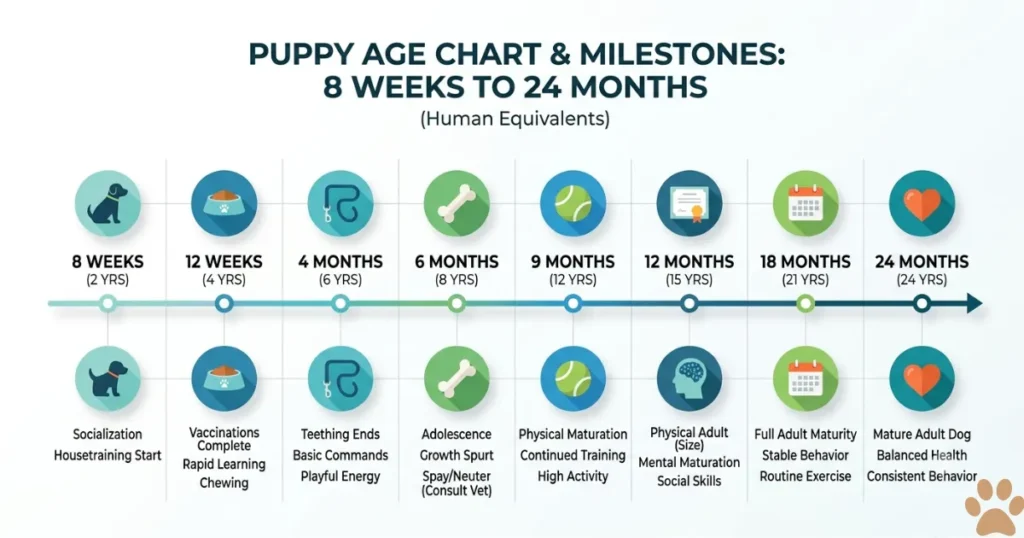
A puppy age chart converts your puppy’s age into human years, and the curve is steep early. By the puppy age chart, an 8 weeks old Golden is like a 9 months old human baby, a 6 months old puppy is roughly a 10 years old child entering puberty, and a 1 year old dog is about 15 human years. So “how old is my puppy” rarely matches the calendar. A Golden is physically grown near 1 year but not fully mature until 18 to 24 months.
“How old is my puppy?” is the first thing most new Golden owners ask, and a puppy age chart answers it better than the calendar does. Puppies race through development. The AKC and UC Davis note a dog’s first year equals about 15 human years, and researchers found the first 8 weeks of a puppy’s life line up with the first 9 months of a human baby’s. Your Golden is doing a lot of growing up fast.
In my practice, the first year is where good habits, or missed windows, set the tone for life. Socialization, joint protection, and nutrition all have deadlines. This puppy age chart and the month by month timeline below are built to help you hit them. For any age past puppyhood, the dog years to human years guide has the full chart and calculator.
How old is my puppy? The puppy age chart
Here’s the puppy age chart for a Golden, matching each stage to a rough human equivalent and what’s happening developmentally. Treat the human ages as approximate, since early development is fast and a little fuzzy.
| Puppy age | Human equivalent (approx.) | What’s happening |
| 8 weeks | ~9 months old baby | Comes home: socialization window open |
| 3 months | preschool child (~3–5 yr) | Peak socialization, basic training, teething |
| 6 months | ~10 years (pre-teen) | Puberty begins, “teenage” phase, ~40–50 lb |
| 9–10 months | ~12–14 years | 85–95% of adult height reached |
| 12 months (1 year) | ~15 years | Near adult size, still adolescent |
| 18–24 months | early 20s | Fully grown and mentally mature |
So when you ask “how old is my puppy,” the honest answer is that your Golden is aging in fast-forward through the first year, then slowing down. The puppy age chart is a planning tool, not a precise birthday converter. To estimate age when you adopted a puppy with no records, our how old is my dog guide covers reading teeth and eyes.
How old is 6 months in dog years?
A 6 months old puppy is roughly a 10 years old human, a child stepping into puberty. That’s why so many owners feel the shift around now. Published puppy charts place 6 months near the start of the 10 to 25 humans year adolescent band, and most dogs hit puberty between 6 and 9 months.
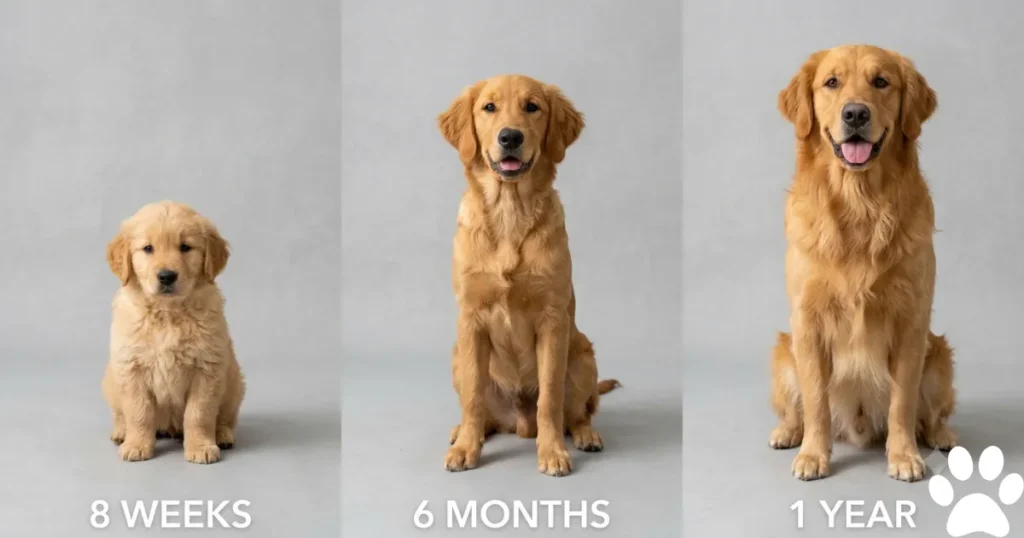
For a Golden, 6 months is the “teenage” turn. Your puppy is around 40 to 50 pounds, bursting with energy, and suddenly testing boundaries and “forgetting” commands it knew at 4 months. That’s normal adolescence, not failed training. Goldens reach about 80% of their growth in this window, so they look big while still being very much a kid inside.
Here’s what I tell owners at 6 months. Keep training short, positive, and consistent, and keep socializing. The work you do now, when your puppy is a pre-teen in human terms, shapes the adult dog. How old is 6 months in dog years matters less than what you do with it. Visit our website for golden retriever health guides.
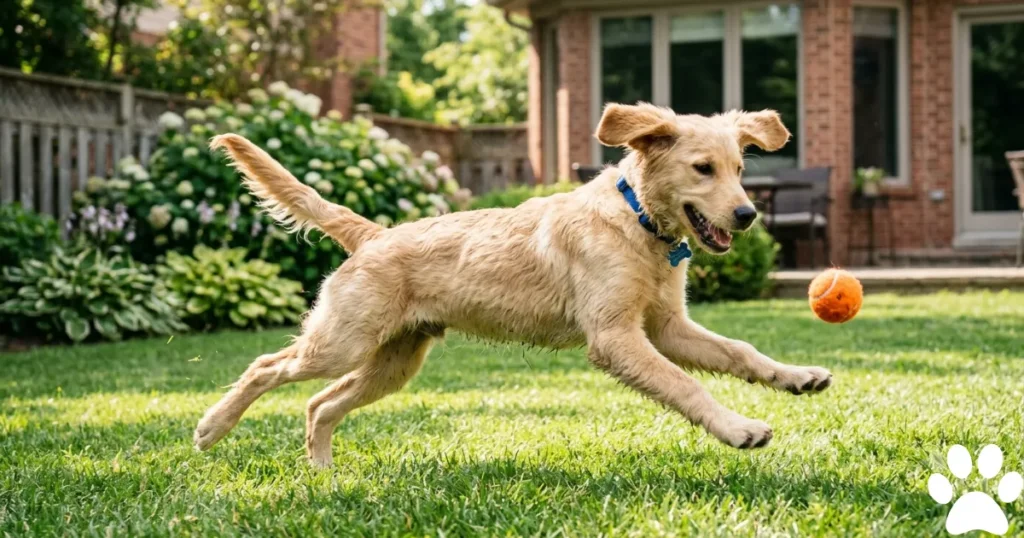
Your Golden puppy’s first year, month by month
This is where a Golden Retriever differs from a generic puppy chart, so here’s the breed-specific timeline.
8 to 16 weeks: the socialization window.
This is the single most important developmental window. The AVSAB notes puppies can start classes as early as 7 to 8 weeks, and the sensitive period for socialization runs roughly 3 weeks to 3 to 4 months. Positive exposure now builds a confident adult Golden. Fear and reactivity often trace back to a window missed here.
3 to 6 months: the fastest growth of their life.
The AKC notes Goldens grow most rapidly between 3 and 6 months, sometimes gaining several pounds a week. Teething peaks, and appetite soars. Large-breed puppy nutrition with controlled calcium matters here to support steady, not explosive, growth.
6 to 12 months: height nearly done, brain still cooking.
Goldens reach about 85 to 95% of their adult height by 9 to 10 months, then fill out more slowly. Behaviorally, this is peak adolescence: independent, mouthy, and distractible.
By the end of this first year, your golden looks like an adult. It isn’t one yet. Full physical and mental maturity arrives at 18 to 24 months, and males may take the full 24 to finish their head and chest, per the AKC. Adult weight settles around 65 to 75 pounds for males and 55 to 65 pounds for females, per UC Davis figures. The ages right after this first year are covered in what 2, 3 and 4 mean in dog years.
What “dog 1 year” really means for a Golden
The “dog 1 year” milestone is a happy fake-out. At 1 year your Golden is close to full size and roughly 15 human years old, but the maturity gap is wide. Think of a 15 years old human: physically near-grown, emotionally still a teenager. That’s your 1 years old Golden.
This mismatch trips up a lot of owners. They see an adult-sized dog at “dog 1 year” and expect adult behavior, then feel let down by the zoomies, the selective hearing, and the chewing. None of that is a problem with your dog. A 1 years old Golden is a large, strong adolescent, and it’ll keep filling out and settling until about 18 to 24 months.
What I tell owners at the 1 year mark: Don’t switch to adult expectations or, in most cases, adult food just yet. Many large-breed Goldens stay on puppy or large-breed formulas until growth finishes closer to 18 to 24 months. Ask your vet to time the transition to your dog’s growth, not the calendar.
Where puppyhood fits in the dog life cycle
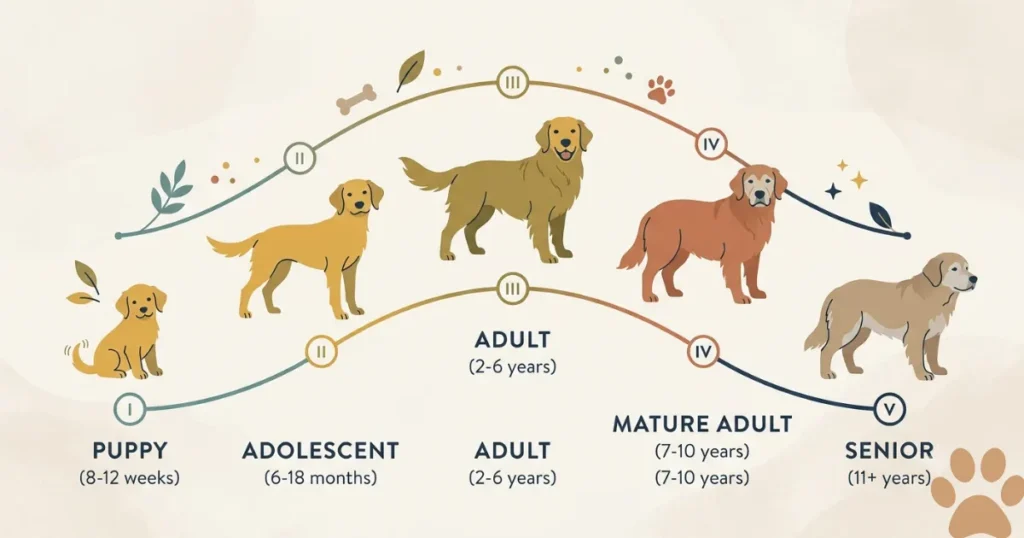
Puppyhood is stage one of a longer dog life cycle, and seeing the whole arc helps you plan. The AAHA Canine Life Stage Guidelines describe five stages: puppy, young adult, mature adult, senior, and end of life. For a Golden, those map roughly to the first 1 to 2 years, then 2 to 6, then 6 to 8, then 8 and up.
Knowing where your dog sits in the dog life cycle changes what care matters. A puppy needs socialization and joint protection. A young adult needs a health baseline. A senior needs cancer-aware screening. Each stage has its own job, and missing the window costs you later.
For a Golden specifically, the early dog life cycle stages move fast, and the senior stage arrives sooner than for small dogs, around 7 to 8. The young-adult and middle stages are covered across our age by number guides, and the far end of the cycle in what a 10 years old Golden’s age signals. For the adult size by size view, see the dog age chart in human years.
What puppy age charts get wrong for large-breed Goldens
Most puppy age charts treat all puppies alike, and for a large breed that’s a real miss. The biggest one is growth plates, the soft cartilage zones at the ends of a puppy’s bones where new bone forms. In Goldens they don’t fully close until around 12 to 18 months, and high-impact exercise before then can cause lasting joint damage.
The most common mistake I see is an owner with an adult-sized 8 months old Golden taking it jogging, doing repetitive fetch on hard ground, or letting it leap off furniture and stairs. Understandable, the dog looks ready. But on open growth plates, that load can contribute to the hip and elbow dysplasia Goldens are already prone to, and the GRCA notes overfeeding and rapid growth raise dysplasia risk.
The fix is to protect the joints through the first 12 to 18 months: free play over forced running, soft surfaces, no big jumps, and lean body weight. Generic charts won’t tell you that, but it’s one of the highest-value things you can do for a large-breed puppy.
The First-Year Golden Check
Here’s the first-year framework I give new Golden owners so the puppy age chart turns into the right action by stage.
The First-Year Golden Check:
8–16 weeks: open the world.
Then prioritize positive socialization and start puppy class. Call your vet promptly for vaccine timing and any lethargy, vomiting, or diarrhea, which puppies tolerate poorly.
3–6 months: fuel growth, not speed.
Then feed large-breed puppy nutrition and keep your puppy lean. Call your vet if growth seems explosive or limping appears.
6–12 months and “dog 1 year”: protect the joints.
Then keep exercise low-impact until growth plates close around 12–18 months, and time the adult-food switch to your vet’s advice. Call your vet for persistent lameness or stiffness.
This check isn’t a diagnosis. It’s how you use your puppy’s real age to do the few high-impact things that set up a healthy adult Golden.

How old is my puppy in human years?
Use the puppy age chart: an 8-week puppy is like a 9 months old baby, a 6-month puppy roughly a 10 years old child, and a 1 years old dog about 15 human years. Early development moves fast.
What is a puppy age chart?
A puppy age chart maps your puppy’s age to a human equivalent and a developmental stage. It’s a planning tool for socialization, nutrition, and joint care, not an exact birthday converter.
How old is 6 months in dog years?
About 10 human years, a pre-teen entering puberty. At 6 months a Golden is roughly 40 to 50 pounds and starting its “teenage” phase.
Is a dog 1 year old still a puppy?
Sort of. At “dog 1 year” a Golden is near adult size and about 15 human years, but behaviorally it’s an adolescent and won’t fully mature until 18 to 24 months.
What are the stages of the dog life cycle?
Five stages per the AAHA: puppy, young adult, mature adult, senior, and end of life. For a Golden, they run roughly 0–2, 2–6, 6–8, and 8+, with seniors arriving earlier than in small dogs.
When is a Golden Retriever fully grown?
Around 18 to 24 months. Goldens reach 85–95% of adult height by 9–10 months, then fill out, with males sometimes finishing at 24 months.
How big should my Golden puppy be at 6 months?
Often around 40 to 50 pounds, though it varies. Many reach roughly two-thirds of adult weight by 6 months, with growth slowing afterward.
When can I start exercising my puppy normally?
After the growth plates close, around 12 to 18 months for a golden. Until then, favor free play and avoid forced running, big jumps, and stairs.
When should puppies be socialized?
During the sensitive window of roughly 3 weeks to 3–4 months. The AVSAB supports starting puppy classes at 7–8 weeks alongside vaccinations.
When do I switch my puppy to adult food?
When growth finishes, often 12 to 24 months for a large breed. Time it to your dog’s growth and your vet’s advice, not just the first birthday.
Why does my golden puppy act out around 6 months to a year?
Adolescence. Hormones surge, independence rises, and trained commands seem to vanish. It’s normal for Goldens and passes by 18 to 24 months with consistent training.
How do I protect my golden puppy’s joints?
Keep exercise low-impact until the growth plates close, feed a large-breed puppy diet, and keep your puppy lean. The GRCA links overfeeding and rapid growth to higher dysplasia risk.
Does my Golden puppy need large-breed puppy food?
Usually yes. Large-breed puppy formulas control calcium and calories to support steady growth, which helps protect a Golden’s developing hips and elbows.
When does a Golden Retriever’s adult temperament settle?
By 18 to 24 months. Whatever steady traits show around then tend to define the adult dog, though Goldens keep a playful streak for life.
When should I call the vet about my puppy?
Call immediately for repeated vomiting or diarrhea, lethargy, or refusing to eat, which puppies handle poorly. Monitor at home for 24 hours for a single mild off moment with normal energy.
The bottom line on the puppy age chart and your Golden’s first year
A puppy age chart shows what the calendar hides: your golden ages in fast-forward early, hitting about a 10 years old human at 6 months and roughly 15 by “dog 1 year,” then slowing toward full maturity at 18 to 24 months.
The one move that matters most this year is to use each stage’s window, socialize early, feed for steady growth, and protect those open growth plates, because the first year sets up the whole dog life cycle. Knowing how old your puppy really is helps you do the right thing at the right time.
How old is your golden puppy right now, and which stage surprised you most, the socialization scramble, the 6-month “teenage” phase, or the 1-year fake adult? Tell me in the comments what’s working, so the next new Golden owner knows what’s coming.