
Soft twitching and leg paddling in sleep are almost always a sign of dreaming. Rigid, violent shaking your dog can’t be woken from is a seizure. A seizure over 5 minutes, or two within 24 hours, means call your vet now.
A dog fitting in sleep is having a seizure while asleep, not dreaming. The difference is usually clear within seconds. A seizing dog has rigid or jerking limbs, can’t be woken when you call its name, and is confused for minutes afterward. A dreaming dog twitches softly, breathes normally, and rouses easily. A fit lasting over 5 minutes is a medical emergency.
If you’ve just watched your golden stiffen, paddle, or cry out in its sleep and you’re not sure what you saw, you’re in the right place. Most sleep movements in dogs are ordinary dreaming, and you can read the gentler end of that spectrum in our breakdown of twitching versus a seizure in sleep.
This page is about the other end, a genuine fit during sleep, why it happens, and what to do. Goldens earn their own guide here because they’re one of the breeds genuinely predisposed to idiopathic epilepsy, so a true sleep seizure in a young adult Golden is worth taking seriously rather than waving off. For the wider context, see the full picture of seizures in dogs.
Dreaming or a Real Fit? The Signs That Separate Them
Here’s the thing owners miss. The single most reliable test isn’t how the movement looks. It’s whether your dog responds to you.
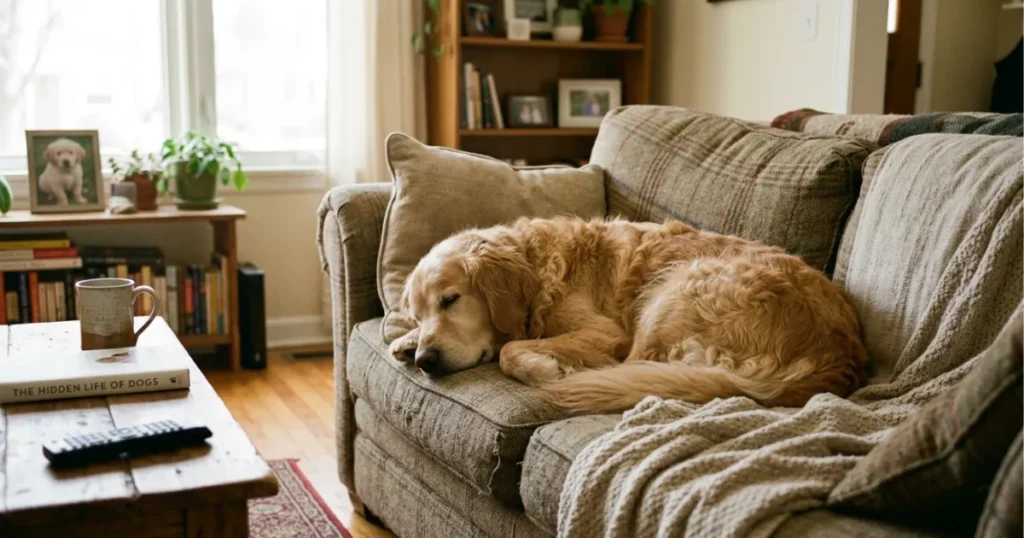
A dreaming dog can be woken. Call its name or make a noise, and a dreamer lifts its head, blinks, and settles. A dog mid-seizure stays locked in no matter what you do, because the brain is firing abnormally. The American Kennel Club makes the same point. Dreaming dogs rouse to their name, while a seizing dog cannot easily be woken and is disoriented afterward.
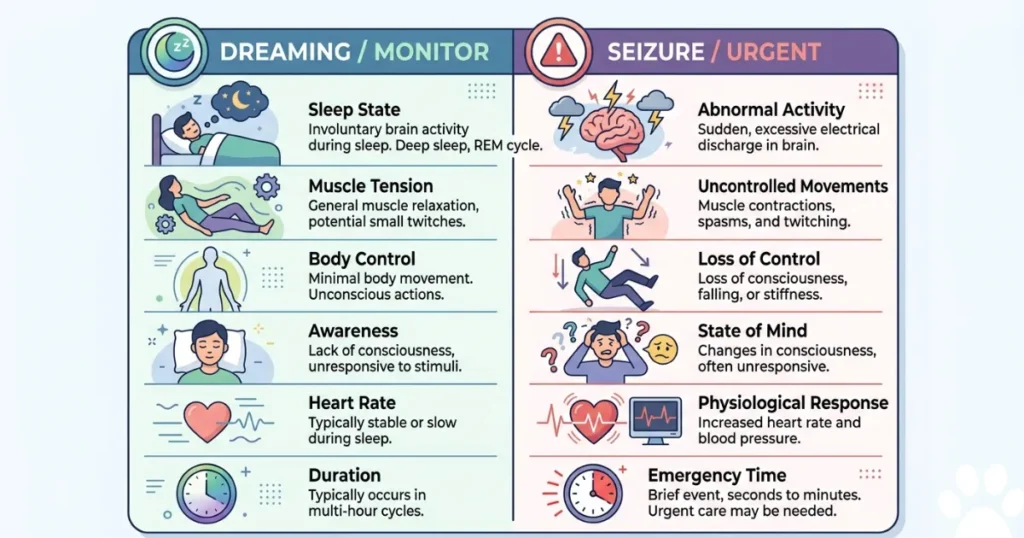
The movements differ, too. Dream twitches are soft and brief, usually under 30 seconds. A fit looks stiffer and more forceful, with rigid limbs, paddling, sometimes a locked jaw, and it runs longer. Many dogs also drool, and some urinate or defecate. Dreaming dogs almost never do.
The aftermath is the giveaway. A dreaming dog wakes calm. A dog coming out of a seizure enters what’s called the post-ictal phase. For minutes to hours, it’s confused, pacing, thirsty, and sometimes briefly blind. If your dog seems “not itself” for a while afterward, that points to a seizure. Compare what you saw against what a dog seizure actually looks like, or follow a structured walkthrough of how to tell if your dog is having a seizure.
6 signs at a glance, Dream (MONITOR) vs Fit (URGENT):
| Sign | Dreaming — MONITOR | Fitting/Seizure — URGENT |
| Response to its name | Wakes, blinks, settles | Cannot be woken |
| Movement quality | Soft twitch, gentle paddle | Rigid, violent, paddling |
| Duration | Brief, under ~30 sec, On and Off | Sustained over 5 min is an emergency |
| Drool/saliva | None to mild | Often heavy drooling |
| Bladder/bowel control | Kept | May urinate or defecate |
| After it ends | Calm and normal at once | Confused, dazed for minutes (post-ictal) |
Why Seizures Strike During Sleep and Just After Waking.
Most canine seizures happen while a dog is resting, asleep, or in the first moments after waking. There’s a reason for that timing. The brain shifts gears as a dog moves between sleep stages and into wakefulness, and in a susceptible dog, those transitions are exactly when unstable neurons can misfire into a fit.
That’s why a fit erupts out of what looked like peaceful sleep. Sleep doesn’t “cause” epilepsy. The changing electrical state of a sleeping or waking brain is simply a common trigger point in a dog that’s already prone.
Not every sleep seizure is the whole-body kind. Some are focal, meaning the abnormal activity stays in one part of the brain and shows up as one-sided twitching, repetitive chewing, or fly-biting at nothing. Those are easy to mistake for a quirky dream, and our guide to focal (partial) seizures covers how they present.
Here’s one sourced fact worth holding onto. A single generalized seizure usually lasts only one to two minutes, according to VCA Animal Hospitals. Anything dragging well past that window changes everything, as the response section below explains.

Why Golden Retrievers Fit the Way They Do.
Golden Retrievers sit on the short list of breeds with a documented genetic tendency toward idiopathic epilepsy, the recurrent-seizure disorder with no other identifiable cause. That’s not folklore. It’s in the veterinary literature, which is why the breed gets its own seizure guidance rather than generic dog advice. Our canine epilepsy signs, causes, and treatment guide covers the condition in full, and our Golden Retriever health guides cover the breed.
The age window is the part owners should know about. In Goldens, the classic genetic study by Srenk and colleagues found that idiopathic epilepsy most often begins in young adulthood, with onset within one to three years of age in about three-quarters of affected dogs and a mean onset around 27.5 months. Males appear somewhat more affected than females. Goldens also tend toward generalized, whole-body seizures rather than subtle focal ones.
Put plainly. If a 1-4 years old Golden has a genuine fit in its sleep, idiopathic epilepsy is a realistic explanation, and it’s worth a veterinary work-up rather than a wait and see.
I’ll be honest about one thing, because it matters more than a breed hook. The signs that separate a dream from a fit are identical in every dog. A Golden’s twitch doesn’t look different from a Labrador’s. What’s breed-specific is the underlying risk, not the appearance. So use the signs above for any dog, and use the Golden risk profile to decide how seriously to chase a diagnosis.
What Causes a Dog to Fit in Sleep by Life Stage?
Age is the most useful clue to why a dog is fitting, and the likely causes shift across three stages. The broader causes of canine seizures go deeper; here’s the age map.
Puppies and dogs under 1 year.
A first seizure this young points away from inherited epilepsy and toward a congenital defect, an infection such as distemper, low blood sugar, or a swallowed toxin. Common household triggers include xylitol, theobromine in chocolate, and ethylene glycol in antifreeze. Our list of household toxins that trigger seizures is worth a read for a young, curious Golden.
Young adults, roughly 1 to 6 years.
This is the idiopathic epilepsy window, where most Goldens that develop epilepsy will start. The pattern is recurrent seizures in a dog that’s normal between episodes. Cornell’s veterinary neurologists place the typical onset between six months and six years, which lines up with the Golden data above.
Senior dogs, 7 and older.
A first-ever fit in an older dog is a different conversation. New-onset seizures in seniors more often trace to a metabolic problem like liver or kidney disease or a structural brain change such as a tumor or stroke. If your older Golden has started having fits, read what causes fits in older dogs and book the vet rather than assuming it’s age.
Across every stage, a fit during sleep deserves the same diagnostic respect as one while awake. The timing doesn’t make it benign.

What Most Articles Get Wrong About Sleep Seizures?
Search this topic, and you’ll be reassured, repeatedly, that your dog is “probably just dreaming.” Most of the time that’s true, and the reassurance is kind. The problem is where it stops.
That framing quietly trains owners to explain away the real thing. When a dog stiffens, can’t be roused, drools, and wakes up dazed, that’s not the gentle paddling those articles describe. Calling it a dream costs time a seizing dog may not have. The failure mode isn’t panicking over a dream. It’s normalizing a genuine fit.
The second gap is the missing risk layer. A generic “all dogs twitch in their sleep” piece never tells the Golden owner that their breed sits in a higher-risk group with a young-adult onset window. That one fact changes how seriously a real episode should be taken.
In a representative case I’ve seen many versions of, an owner films two minutes of “weird dreaming” in their young Golden, calls it harmless, and books a visit only weeks later after a second, longer episode. By then it’s a pattern, and the night-one video turns out to be the first documented seizure.
What to Do When Your Golden Fits in Sleep: The WAKE Response.
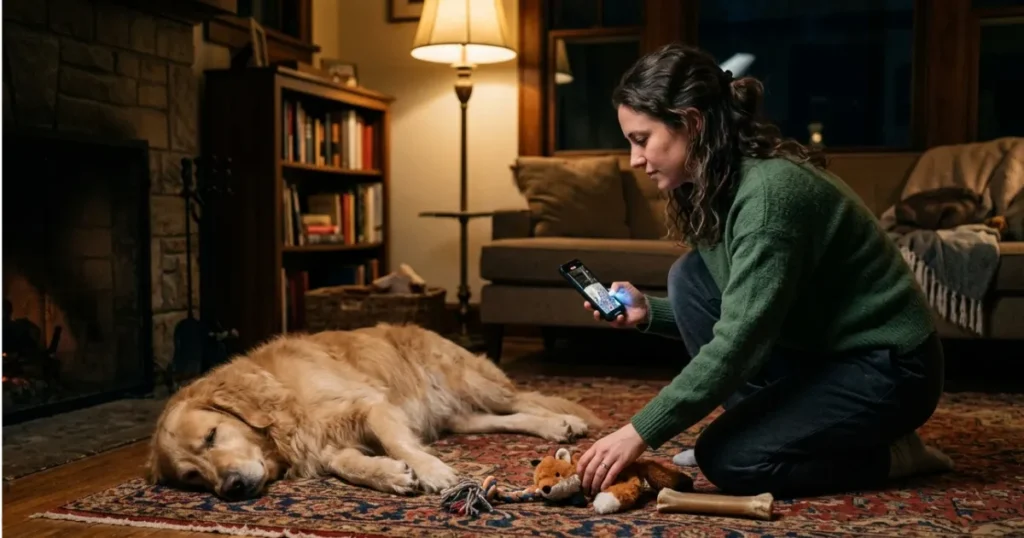
In the moment, you have two jobs. Keep your dog safe and gather the facts your vet needs. Don’t restrain your dog, don’t put your hands near its mouth, and forget the myth about swallowing the tongue. It can’t happen. Clear hard objects away, cushion the head, dim the room, and start timing.
The WAKE check, separate a dream from a fit in seconds.
A quick four-point framework you can run at 3 a.m. without thinking:
W—Will they Wake?
Call the name, clap, and drop something. A dreamer rouses. A seizing dog stays locked in.
A—Awareness.
A dreamer’s movements are soft and responsive. A fit is rigid, mechanical, and unaware of you.
K—Keep time.
Note the start. Under | 30 seconds and intermittent lean dream. Sustained and forceful lean fit. Past 5 minutes is an emergency.
E—Elimination & after-effects.
Drooling, urinating, or minutes of dazed confusion afterward all point to a seizure.
Then act on a binary rule.
Call your vet immediately if a fit lasts more than 5 minutes, or if your dog has two or more fits within 24 hours. A seizure that won’t stop is status epilepticus, which VCA classifies as life-threatening because the body overheats and the brain can be injured. A single, short, first-time fit isn’t an immediate danger, but still call your vet within a day. Film it if you can safely. That clip is the most useful thing you can hand your vet.
If fits become a pattern, your vet may discuss long-term control, which is its own topic in our guide to seizure medication options for dogs. Don’t start, stop, or change any medication on your own.
Expert Insight
“The owners who do best aren’t the calmest in the room. They’re the ones who hit record and start a clock. A 40-second phone video tells me more about your dog’s seizure than an hour of describing it ever will.”
What does it mean when a dog fitting in sleep?
It means your dog is having a seizure while asleep, not dreaming. Expect rigid movement, no response when you call, possible drooling, and confusion afterward. Brief, soft twitching is normal dreaming.
Can Golden Retrievers have seizures in their sleep?
Yes. Golden Retrievers are a breed predisposed to idiopathic epilepsy, and seizures often strike during sleep or just after waking. A genuine sleep fit in a young golden deserves a prompt vet work-up.
What causes a dog to fit while sleeping?
Common causes include idiopathic epilepsy, low blood sugar, ingested toxins, and, in older dogs, organ disease or a brain tumor. Sleep and waking transitions are frequent trigger points in already-prone dogs.
How long do dog sleep seizures usually last?
A single generalized seizure usually lasts one to two minutes. Anything past 5 minutes is a medical emergency called “status epilepticus” and needs a vet immediately. Time every episode from the start.
How to tell a nocturnal seizure from dreaming?
Try to wake your dog. A dreaming dog rouses to its name. A seizing dog can’t be woken, moves rigidly, may drool or lose bladder control, and stays confused afterward. Film it if unsure.
Is it safe to wake a dog twitching in its sleep?
Not by touching it. Startling a dreaming dog can earn an accidental bite. Call its name from a distance instead. If it can’t be roused and moves violently, that’s a seizure, not a dream.
What happens if a dog has a seizure in its sleep?
The dog stiffens or paddles violently, stays unresponsive, and often drools or loses bladder control. Afterward, it’s dazed for minutes. Most single seizures stop within two minutes, but time it carefully.
When should I call the vet about a sleep seizure?
Call immediately if a seizure lasts over 5 minutes or your dog has two or more in 24 hours. For any first, brief seizure, still call your vet within a day.
What should I do during a dog’s seizure?
Stay calm, clear hard objects away, don’t touch the mouth, and don’t restrain your dog. Let the seizure run its course. Call your vet immediately if it passes 5 minutes.
Do Golden Retrievers need medication after one seizure?
Not always. The Merck Veterinary Manual notes that anti-seizure drugs are usually started after a second or third seizure, a cluster, or status epilepticus. Your vet decides based on frequency and cause.
Why do Golden Retrievers seem prone to seizures?
Golden Retrievers carry a documented genetic risk for idiopathic epilepsy. In affected Goldens, seizures most often begin between one and three years of age, tend to be generalized, and appear somewhat more often in males.
At what age do Golden Retrievers start having seizures?
In Goldens with idiopathic epilepsy, onset is typically young adulthood, with a mean of around 27.5 months and most starting within one to three years. A first seizure in a senior Golden usually signals another cause.
Are sleep seizures more dangerous in Golden Retrievers?
A sleep seizure isn’t inherently worse in a golden. But the breed’s higher epilepsy risk means a real fit deserves a prompt veterinary work-up rather than wait and see, especially in a young adult.
Can a Golden Retriever live a normal life with epilepsy?
Yes, many do. With accurate diagnosis and consistent treatment, a large share is well controlled. Roughly a third of dogs are harder to control and need more than one medication, per the Merck Veterinary Manual.
When is a dog seizing in sleep an emergency?
Call your vet immediately if a seizure lasts longer than 5 minutes or if your dog has two or more seizures within 24 hours. Both are emergencies. A single brief seizure still needs a same-day call.
Conclusion.
If your dog is fitting in sleep, the fastest way to know is to try to wake it. A dreamer rouses and settles. A seizing dog can’t be woken, moves rigidly, and wakes up confused. For Goldens, the breed’s real risk of idiopathic epilepsy means a genuine sleep seizure, especially in a young adult, deserves a vet visit rather than a shrug.
The one number to memorize: over 5 minutes, or two fits in 24 hours, is an emergency. Keep a phone nearby, hit record, and start a clock. For more, browse our Golden Retriever health guides.
Have you ever caught your Golden doing something in its sleep that made your stomach drop, unsure if it was a dream or something more? Tell us what you saw and your dog’s age. Your story might help another owner trust the signs at 3 a.m.