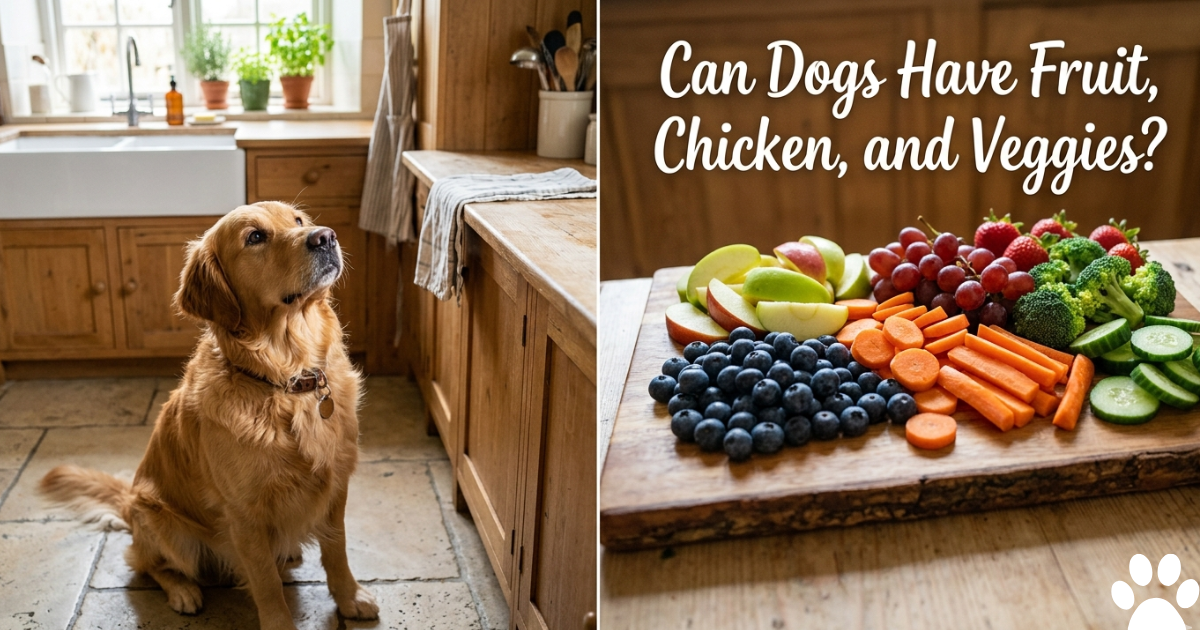
Golden Retriever owners encounter this question from two directions: the dog who just grabbed something off the counter, and the owner actively trying to replace commercial treats with something healthier. Either way, the answer to “can dogs have fruit” isn’t a simple yes or no – it’s species-dependent, preparation-dependent, and for a breed with Golden Retrievers’ specific health profile, more nuanced than most generic lists provide.
Can dogs have fruit? Yes – a meaningful number of fruits are safe, nutritionally valuable, and well-suited to Golden Retrievers as low-calorie treats or training rewards. Several others cause acute kidney failure, cardiovascular toxicity, or GI crisis at doses with no established safe threshold. The difference between these categories is not always obvious by appearance, which is why a breed-specific breakdown matters more than a generic “dogs can eat most fruits” answer.
Golden Retrievers are genetically predisposed to obesity, cancer, and food-seeking behavior through a documented POMC gene deletion that impairs satiety signaling. Fruit choice for this breed intersects directly with weight management, antioxidant intake, and toxicity avoidance – three concerns that don’t have the same answer.
Can Dogs Have Fruit Safely? The Direct Answer
Can dogs have fruit from the safe category without risk? Yes – provided preparation is correct, portions are controlled, and the fruit is a confirmed safe species. The AKC’s fruit safety guidance lists specific dog-safe fruits and explicitly identifies several as toxic. For Golden Retrievers, the safe list delivers genuine nutritional value – antioxidants, fiber, vitamins – at caloric densities low enough to use in daily training without disrupting dietary balance.
The toxic list is not a “use sparingly” category. Grapes, raisins, and certain other fruits cause irreversible organ damage with no established safe dose.
Fruits OK for Dogs: The Complete Safe List for Golden Retrievers
Fruits ok for dogs, specifically Golden Retrievers. They include the following species when properly prepared. Each entry below states what to remove, why it’s beneficial for this breed, and the practical serving size for a 60-70 lb adult Golden.
Blueberries
No preparation needed. Anthocyanins reduce oxidative stress, which is relevant to Golden Retrievers’ documented cancer vulnerability. 10-15 per session.
Strawberries
Remove stem and hull. Vitamin C, fiber, and low caloric density make these one of the best weight-management treats for Goldens. 2-3 medium berries.
Watermelon
Remove rind and all seeds. High water content supports hydration in warm weather. 2-3 small chunks for a 60-70 lb Golden.
Apple slices
Remove seeds and core entirely (seeds contain amygdalin, a cyanogenic compound). Fiber and vitamin A with low sugar. 2-3 thin slices.
Banana
Small pieces only. Higher fructose than in berries – limit frequency for weight-conscious Goldens. 2-3 small slices.
Raspberries
No preparation needed. Anti-inflammatory antioxidants and soluble fiber. Raspberries contain trace xylitol naturally – safe at treat-sized portions, but do not feed in large quantities. 5-10 per session.
Mango
Remove skin and pit. Pit contains cyanogenic compounds. Flesh is high in vitamins A, C, and E. Small portion; higher in sugar – limit frequency for overweight Goldens.
Pineapple
Remove the outer skin and core. Use Fresh fruits, canned pineapple in syrup contains concentrated sugar. Small chunks; high natural sugar, limit to occasional.
Pears
Remove seeds and core: vitamin C and fiber. Prepare identically to apples – seeds contain amygdalin.
Cantaloupe
Remove rind and seeds. High in beta-carotene and vitamin A. Moderate sugar – limit for overweight Goldens. Small cubes.
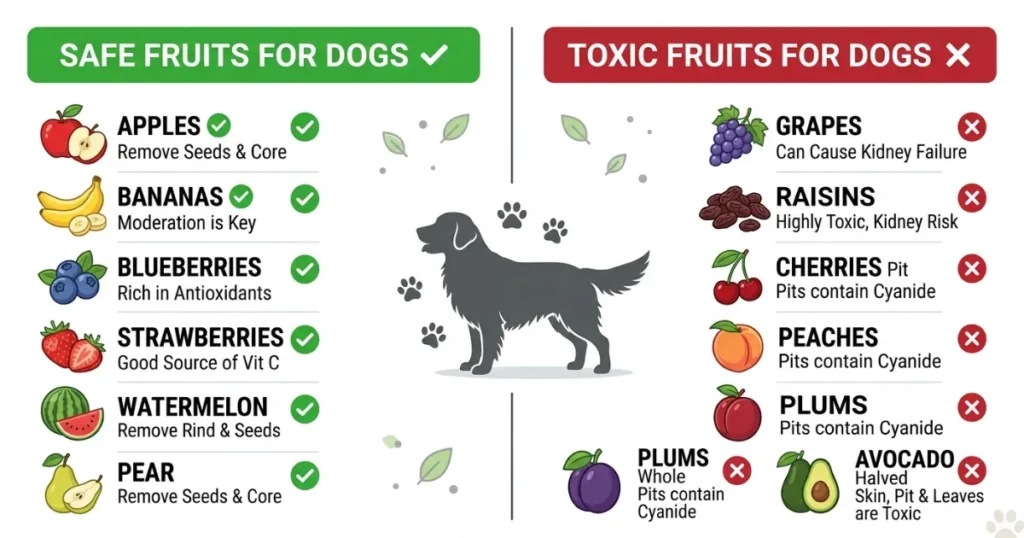
Fruits Bad for Dogs: What Golden Retrievers Must Never Eat
Several fruits are not just inadvisable – they are acutely toxic to Golden Retrievers through documented biochemical mechanisms. Generic articles list names; this section explains why each is dangerous.
Fruits Bad for Dogs
Grapes and Raisins
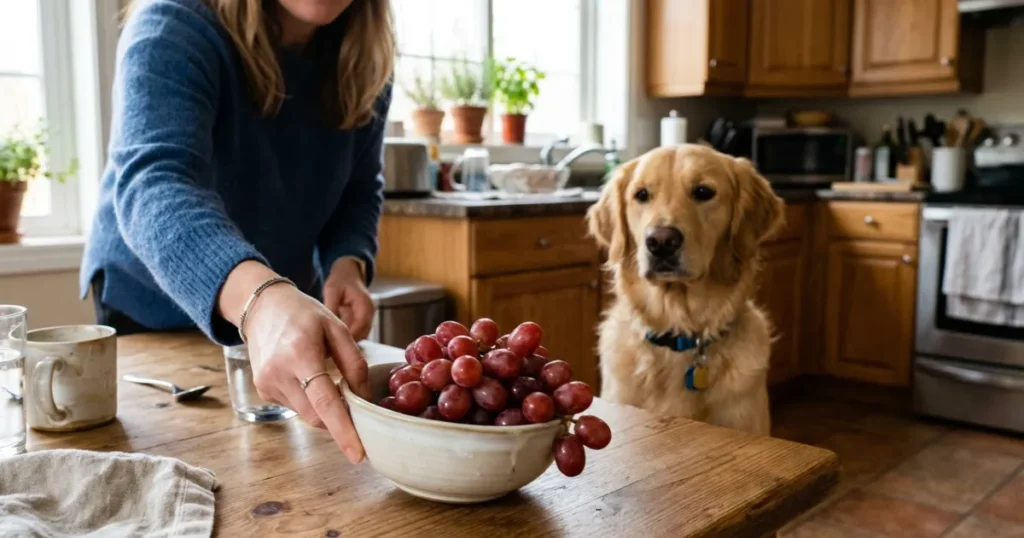
They cause acute tubular necrosis – direct kidney cell death – leading to renal failure. No safe dose has been established. Individual sensitivity is unpredictable. According to VCA Animal Hospitals, raisins are more toxic per gram than fresh grapes due to concentration. Any ingestion warrants an immediate call to ASPCA Poison Control (888-426-4435).
Cherries
The flesh is technically safe in small amounts, but the pit, stem, and leaves contain cyanogenic glycosides that release hydrogen cyanide during digestion. The risk of a Golden Retriever accessing the pit while eating the fruit is high, given the breed’s rapid eating. Treat cherries as unsafe for practical purposes.
Avocado
Avocado contains persin – a fungicidal toxin concentrated in the leaves, skin, and pit, with smaller amounts in the flesh. Persin causes vomiting, diarrhea, and, in significant doses, myocardial damage. ASPCA classifies avocado as toxic to dogs. The Hass variety has a higher persin concentration than other varieties.
Citrus in large amounts
Lemons, limes, and grapefruits contain citric acid and essential oils that can cause GI irritation and central nervous system depression in significant amounts. Small incidental exposure is low risk; intentional feeding is not appropriate.
Tomatoes (unripe and plant parts)
Ripe red tomato flesh is low risk in small amounts, but green tomatoes and all plant parts (stems, leaves) contain solanine and tomatine – glycoalkaloids that disrupt nerve transmission. Golden Retrievers with garden access who chew tomato plants need monitoring.
Fruits OK for Dogs in Moderation – The Middle Category
Some fruits are neither fully safe nor acutely toxic but require context:
Coconut flesh
Small amounts are safe. Medium-chain triglycerides in coconut may cause loose stools in sensitive Goldens. Not a recommended regular treat due to high fat content in a breed prone to pancreatitis.
Peaches and plums (flesh only)
The flesh is non-toxic; pits contain cyanogenic compounds and are a choking hazard. Only appropriate if the pit is entirely removed. Canned versions contain syrup – avoid entirely.
What Competitors Miss: Preparation Errors That Make Safe Fruits Dangerous
Most “can dogs have fruit” articles provide a safe list without addressing the preparation failures that can turn safe fruits into harmful ones. For Golden Retrievers, this gap is breed-relevant because Goldens eat fast, and owners often hand over fruit without thinking through what’s attached.
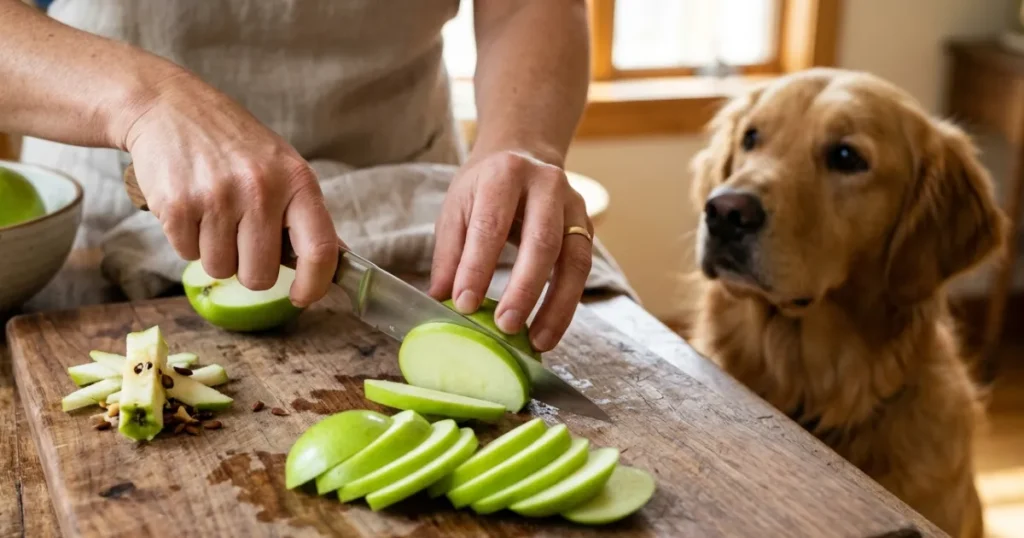
Apple seeds
They contain amygdalin, a cyanogenic glycoside that converts to hydrogen cyanide during intestinal bacterial metabolism. A single apple’s seeds don’t cause an acute crisis in a 65-pound Golden, but chronic exposure to seeds accumulates. Remove every seed, every time.
Mango and peach pits
They contain the same amygdalin mechanism as apple seeds, at a higher concentration. A pit swallowed whole also poses a risk of intestinal obstruction, a surgical emergency in a large-breed dog.
Watermelon rind
It is not toxic but is dense, fibrous, and difficult for Golden Retrievers to digest, a breed already prone to GI sensitivity. Rind ingestion commonly causes vomiting and diarrhea. Remove it completely.
Canned fruit in syrup
Concentrates fructose to levels that spike blood glucose and contribute to weight gain. Any canned fruit – peaches, pineapple, mandarin oranges, is inappropriate for Golden Retrievers unless packed in water with no added sugar, as confirmed on the label.
Can Dogs Have Fruit at Every Life Stage? Golden Retriever-Specific Breakdown
Can dogs have fruit during puppyhood, adulthood, and senior years? Yes! at all stages, but the appropriate species, portion, and frequency differ.
Puppies (Under 12 Months).
Golden Retriever puppies under 6 months should stay on complete growth nutrition without fruit additions. After 6 months, 2-3 pieces of a safe fruit species are appropriate enrichment. Avoid high-fructose fruits like mango and banana during this window – puppies don’t need the sugar load, and their digestive systems are still stabilizing.
Adult Goldens (1-7 Years).
This is the optimal window for fruit as a functional dietary addition. Adults handle fiber well, and the antioxidant load from consistent safe fruit use is most relevant as cancer risk climbs from middle age onward. The 10% daily treat rule applies – fruits ok for dogs in this age group include the full approved list at standard serving sizes.
Senior Goldens (8+ Years).
Seniors benefit from antioxidant-rich fruits but have lower fiber tolerance and potentially reduced kidney and liver function. Stick to low-sugar options, blueberries, strawberries, and apple slices. It keeps portions conservative. Confirm with your vet before introducing any new dog food if your senior is on a prescription diet or cardiac/renal medication.

Decision Framework: Which Fruits Should Your Golden Eat?
- Healthy adult, Golden, normal weight, no conditions → Full approved list at standard portions. Blueberries, strawberries, and apple slices are the highest-value options for a daily diet.
- Overweight Golden on caloric restriction → Blueberries, raspberries, and strawberries only. Skip banana, mango, and pineapple – fructose content adds up for a weight-managed dog.
- Golden with documented GI sensitivity → Introduce one new fruit at a time. Start with 3-5 pieces; observe for 24 hours before increasing. Watermelon and apple are typically well tolerated and good first choices.
- Puppy under 6 months → No fruit. After 6 months: 2-3 pieces of blueberries or apple slices occasionally.
- Senior on no medications → Low-sugar fruits at reduced portions. 5-8 blueberries or 1-2 apple slices per session.
- Senior on cardiac, renal, or anticoagulant medication → Vet confirmation before introducing any fruit regularly.
- Any grape, raisin, or currant exposure → ASPCA Poison Control immediately: 888-426-4435. No wait-and-see.

Warning: Fruit Risk Severity for Golden Retrievers.
Toxic—Vet Now
Grapes, raisins, and currants cause acute kidney failure, no safe dose, and individual sensitivity is unpredictable. Avocado in significant quantities and persin causes GI distress and potential myocardial damage. Apple, cherry, mango, or peach pits swallowed whole – cyanogenic compounds plus obstruction risk. Call ASPCA Poison Control (888-426-4435) or an emergency vet for all of the above.
Problematic—Monitor 24- 48 Hours
Overconsumption of any safe fruit (excessive fiber load causing loose stools, gas, vomiting). Watermelon rind ingestion GI disruption likely. Canned fruit in syrup sugar load causing digestive disruption. Manage at home; call the vet if symptoms persist beyond 24 hours or if vomiting is persistent.
Unsuitable—Avoid, Not Dangerous
Citrus in small amounts, coconut flesh as a regular treat, dried fruit of any kind. Low acute risk at minimal exposure, no upside over fresh alternatives.
When to Call the Vet After Your Golden Eats Fruit.
URGENT – Call Immediately.
| Symptom / Situation | Action |
| Any grape, raisin, or currant ingestion | ASPCA Poison Control 888-426-4435 now |
| Pit swallowed from mango, cherry, or peach | Emergency vet – obstruction and cyanide risk |
| Vomiting with weakness after avocado | Emergency vet – potential persin toxicity |
| Collapse or seizure after any fruit | Emergency vet immediately |
MONITOR AT HOME (24 – 48 Hours).
| Symptom | Action |
| Loose stools after safe fruit session | Bland diet; withhold fruit; resolves in 24h |
| Single vomiting episode | Water only; 4h food withhold; monitor |
| Gas or bloating after large fruit portion | Walk the dog; monitor; reduce serving next time |
| Mild lethargy same day | Monitor; call vet if persists past 24 hours |
Expert Insight
Golden Retrievers need a fruit framework, not just a safety list – because this breed eats first and asks questions never. The antioxidant case for blueberries, raspberries, and strawberries in a cancer-prone breed is real and worth building into the daily routine. The toxic case against grapes and avocado is non-negotiable, regardless of what the dog previously tolerated. The practical middle – banana, mango, pineapple – is fine occasionally but earns no place as a daily treat in a weight-prone breed. Fruit is a useful dietary tool for Goldens when it’s the right fruit, in the right form, at the right portion.
Can dogs have fruit every day?
Yes – when the species is confirmed safe, and portions are controlled. Blueberries, strawberries, and apple slices are appropriate daily options for healthy adult Golden Retrievers within the 10% daily treat guideline. High-sugar fruits like bananas and mangoes are better as occasional treats. The limiting factor for most safe fruits is fiber tolerance, not calories.
Can dogs have fruit from the fridge, or is fresh better?
Both are fine. Fresh and refrigerated fruit is appropriate for Golden Retrievers. Plain frozen fruit – blueberries, raspberries – is equally safe and often preferred in warm weather. Avoid canned fruit in syrup; the concentrated sugar makes it unsuitable for any fruit. Fresh or plain frozen is always the correct default.
What fruits are ok for dogs with Golden Retrievers in mind?
The safest daily fruits for Golden Retrievers are blueberries (10-15 per session), strawberries (2-3 pieces, stems removed), raspberries (5-10 per session), and apple slices (2-3 thin slices, seeds and core removed). Watermelon chunks (rind and seeds out) and pear slices (seeds and core out) are also safe. These deliver antioxidants and fiber at low caloric cost.
What fruits are bad for dogs and should never be given?
Grapes and raisins cause acute kidney failure with no established safe dose – any ingestion is an emergency. Avocado contains persin, which can cause GI symptoms and potential cardiac damage. Cherries, peaches, plums, and mangoes have pits containing cyanogenic compounds – flesh-only is lower risk, but pits must be completely removed. Unripe tomatoes and tomato plant parts contain solanine, a nerve-disrupting glycoalkaloid.
Can dogs have fruit as a list – what’s safe and what’s toxic?
Safe fruits for Golden Retrievers: blueberries, strawberries, raspberries, blackberries, watermelon (no rind/seeds), apple (no seeds/core), banana (small amounts), mango (no pit/skin), pineapple (no skin/core), pear (no seeds/core), cantaloupe (no rind/seeds). Toxic fruits: grapes, raisins, currants (kidney failure), avocado (persin toxicity), any fruit pit (cyanogenic compounds). Large amounts of citrus can cause GI distress. No safe dose for grapes or raisins exists.
Which fruits ok for dogs and are best for Golden Retrievers specifically?
Blueberries top the list for Goldens specifically – anthocyanins address the breed’s documented cancer vulnerability at negligible caloric cost. Strawberries are high in vitamin C and fiber, with low sugar. Apple slices provide dental-adjacent crunch and fiber. For overweight Goldens, berry varieties outperform higher-fructose options like banana and mango because they deliver nutritional value without a meaningful caloric load.
Is it safe to give my Golden Retriever citrus fruit?
Small incidental exposure to orange or mandarin flesh is low risk. Intentional regular feeding of citrus is not appropriate – citric acid and essential oils in lemons, limes, and grapefruit cause GI irritation and potential CNS effects in dogs at higher quantities. A Golden that eats a piece of dropped orange accidentally needs no intervention. Citrus should not be a deliberate treat choice.
Can dogs have fruit juice or dried fruit?
No to both. Fruit juice concentrates fructose while removing the fiber that makes whole fruit beneficial – it delivers a sugar load with no nutritional upside. Dried fruit concentrates sugar and, in the case of dried currants, carries the same kidney-failure risk as raisins. Whole, fresh, or plain-frozen fruit is always the appropriate form for Golden Retrievers.
What happens if my Golden eats grapes or raisins?
Call ASPCA Poison Control at 888-426-4435 immediately – do not wait for symptoms. Grapes and raisins cause acute tubular necrosis that progresses to kidney failure, with clinical signs appearing 24-72 hours after ingestion. Kidney damage begins before visible symptoms. Early treatment – decontamination and IV fluid support – significantly improves outcomes. Individual sensitivity is unpredictable; treat every exposure as urgent regardless of quantity.
How much fruit can a Golden Retriever eat per day?
Treats, including fruit, should not exceed 10% of daily caloric intake, per standard nutritional guidelines. For a 60-70 lb adult Golden at approximately 1,300 kcal daily, that’s a ceiling of 130 kcal from all treats combined. The safest fruits are low in calories, so the practical limit is fiber tolerance, 10-15 blueberries, 2-3 strawberries, or 2-3 apple slices cover the functional benefit without pushing digestive tolerance.
Can dogs have fruit if they are overweight?
Yes – and fruit is one of the better treat categories for weight management in Golden Retrievers. Blueberries, raspberries, and strawberries are particularly suitable due to their high palatability, low caloric density, and genuine antioxidant value. Avoid banana, mango, and pineapple for overweight Goldens – higher fructose content adds up meaningfully on a calorie-restricted diet.
Is watermelon safe for Golden Retrievers?
Yes – watermelon flesh is safe for Golden Retrievers with the rind and seeds removed. The rind is not toxic but causes GI disruption in a breed already prone to digestive sensitivity. Seeds are a minor choking and GI concern. Flesh only, in small chunks, is a particularly useful summer treat given its high water content – roughly 92% by weight – which supports hydration.
Can dogs have fruit with skin on?
Depends on the fruit. Blueberry, raspberry, and strawberry skins are fully safe. Apple skin is safe and contains beneficial quercetin – remove only if your Golden has documented fiber sensitivity. Grape skin is irrelevant – the whole fruit is toxic. Mango and peach skin should be removed – it contains urushiol-adjacent compounds that irritate some dogs’ GI tracts. Watermelon rind should always come off.
What fruits are safe for Golden Retriever puppies?
After 6 months, puppies can have 2-3 pieces of blueberries, apple slices (seeds removed), or watermelon flesh (rind and seeds removed) occasionally. Avoid high-sugar fruits like bananas and mangoes until the digestive system is more established. Under 6 months: no fruit – stay on complete puppy growth nutrition. Grapes and raisins are never appropriate for any puppy, regardless of age or size.
How do I introduce fruit to my Golden Retriever for the first time?
Offer a single species, 3 – 5 pieces, away from mealtimes. Observe for 24 hours for loose stools, vomiting, or behavioral changes. If no reaction, work up to standard serving over the following week. Introduce one fruit at a time – not a mixed fruit bowl – so any reaction can be attributed to a specific species. Golden Retrievers with food sensitivities should start with blueberries or watermelon as the lowest-risk first options.
Conclusion.
Can dogs have fruit safely? Yes – when the fruit is the right species, in the right form, at the right portion for a Golden Retriever’s specific health profile. Blueberries, strawberries, raspberries, and apple slices deliver real nutritional value at caloric densities that support this breed’s weight management needs. Grapes, raisins, and avocado sit in a different category entirely – one where the only appropriate response to any exposure is an immediate call to poison control.
The one habit worth building today: replace one commercial treat session per day with 10- 15 fresh blueberries. For a cancer-prone, weight-prone breed, that single swap adds up across months and years.
Golden Retriever owners – I want to hear from you:
- Which safe fruit does your Golden absolutely lose their mind over, and which one did they sniff and walk away from?
- Have you found a specific way to use fruit – in training sessions, frozen in enrichment toys, or scattered in the grass for a sniff game – that works particularly well for your dog?
If you’ve switched from commercial treats to whole fruit and noticed any changes in weight, coat, or digestion, drop your experience in the comments – other Golden owners will genuinely benefit from what you’ve observed.