
The average life expectancy of a golden retriever is 10 to 12 years, according to the American Kennel Club. With excellent care, many reach 13 to 15. Life expectancy is a population average, not a fixed limit for any one dog, and it actually rises as your Golden survives each year. Weight, genetics, and early screening move it most.
The average life expectancy of a golden retriever is 10 to 12 years. That is the figure from the AKC and the large Morris Animal Foundation study. But the word “expectancy” carries a meaning that most articles skip, and understanding it changes how you should read that number.
This guide gives you the figure, then explains what it really means. You will learn how life expectancy differs from lifespan and average age, why the average life of golden retriever dogs is a starting point rather than a countdown, and how to shift the odds in your dog’s favor. For the full breed lifespan overview, our golden retriever lifespan guide is the canonical source, and this page builds on it.
What Is the Average Life Expectancy of a Golden Retriever?
The average life expectancy of a golden retriever is 10 to 12 years. That range is backed by solid data:
- The American Kennel Club lists 10 to 12 years as the breed standard.
- A 2004 UK Kennel Club survey found a median age at death of just over 12 years.
- The Morris Animal Foundation built its Golden Retriever Lifetime Study around more than 3,000 dogs to study exactly this question.
So the number is trustworthy. What most owners miss is that 10 to 12 is an average across thousands of dogs, not a due date for yours. Plenty of Goldens live to 13, 14, or 15 with good care, and a rare few go well beyond. The average life of golden retriever dogs is best read as the middle of a wide range, and the rest of this guide shows you how to aim for the upper end of it.
Life Expectancy vs Lifespan vs Average Age: What Is the Difference?
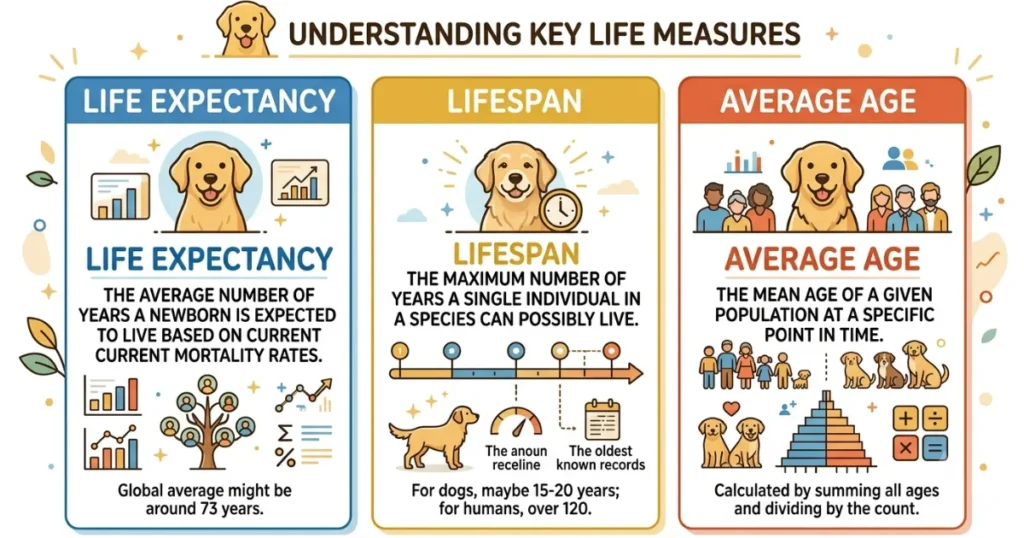
Here is the part almost every article skips, and it clears up a lot of needless worry. People use three terms as if they mean the same thing. They do not.
| Term | What it means | Example |
| Life expectancy | The average age a group is expected to reach | A Golden’s is 10 to 12 years |
| Lifespan | The full possible range, from shortest to longest | Goldens span from under 9 to 20-plus years |
| Average age | The typical age reached, used loosely like expectancy | Often used to mean the same 10 to 12 figure |
In plain English:
- Life expectancy is a statistic about a whole population of dogs.
- Lifespan is the biological range a Golden can fall anywhere within.
- Average age is the everyday phrase people use, usually meaning the same thing as expectancy.
Why does this matter? Because when an owner hears “life expectancy 10 to 12” and their dog turns 11, they panic. But expectancy was never a promise that your dog would stop at 12. It is an average, and your individual dog could easily sit at the high end. If you want the age-by-stage view of where your dog fits, our golden retriever age chart maps every life stage in detail.
A quick example that makes it click
Imagine ten Golden Retrievers born on the same day. Two are lost young, one to an accident and one to an inherited illness. Five live to around 11 or 12. Three, kept lean and screened often, reach 14 or 15.
Add up all ten ages and divide, and you land near the 10 to 12 average. But look closely at the group. Not one dog actually lived “average.” Some fell short, and several beat it by years. The average describes the whole group, yet it fits almost none of them exactly.
That is what life expectancy really is. It is a useful summary of many dogs, not a forecast for the one asleep at your feet. Your job is simply to give your Golden the best chance of landing in that top group of three, and the rest of this guide shows you how.
Why Life Expectancy Rises as Your Golden Ages
This is the most reassuring fact in this whole guide, and hardly anyone explains it. Your Golden’s life expectancy is not fixed at birth. It actually goes up as your dog survives each year.
Here is the simple reason. The 10 to 12 year average includes every Golden, including the ones lost young to accidents, illness, or poor breeding. Once your dog safely passes those early risks, it is no longer part of that unlucky group. Its personal expectancy climbs.
Think of it this way:
- A newborn Golden puppy has an average life expectancy of 10 to 12 years.
- A healthy Golden that reaches 10 has already beaten the risks that claimed others, so its expected remaining time is better than the raw average suggests.
- Every healthy year survived nudges the expectancy a little higher.
This is the same idea that applies to people, where someone who reaches 70 in good health can expect to live well past the birth-based average. So if your Golden is already a healthy senior, do not read the 10 to 12 figure as a countdown. Your dog has earned better odds. Caring well for those years is covered fully in our guide to caring for an old golden retriever.
What this means for you in practice
The practical takeaway is simple and hopeful. Do not treat any single birthday as a cliff edge. A Golden that reaches 10 in good shape is not “living on borrowed time.” It has proven itself a healthy dog, and healthy dogs tend to keep going.
This is also why the care you give in the senior years pays off so well. Every problem you catch early, every extra pound you keep off, and every dental cleaning you keep up with helps your dog stay in the healthy group whose expectancy keeps climbing. The average is not your enemy here. Your dog’s continued good health is quietly rewriting it in your favor.

The Data Behind the Average Life of Golden Retriever Dogs
Where does the 10 to 12 year figure actually come from? It helps to know, because the sources are strong and consistent.
- AKC breed data sets the standard expectancy at 10 to 12 years.
- The UK Kennel Club’s large 2004 health survey found a median age at death of just over 12 years, which lines up well.
- The Morris Animal Foundation Golden Retriever Lifetime Study follows more than 3,000 dogs from youth through their whole lives, tracking exactly what shapes the average life of golden retriever dogs. It is the most ambitious study of its kind in the breed.
One theme runs through all of it. Cancer is the leading cause of death in Golden Retrievers, which is the main reason the breed’s expectancy sits a little below some similar-sized dogs. That single fact is why early screening matters so much in this breed and why the Morris study exists at all. We break down every major condition in our golden retriever health issues guide, and you can explore the full picture in our golden retriever health hub.
It is worth adding that these numbers are not frozen in time. Researchers who study animal aging expect dog life expectancy to keep improving, just as human life expectancy has, as breeding, nutrition, and veterinary medicine advance. The average life of golden retriever dogs today may well be a little higher for the puppies born this year than for those born a decade ago. That is one more reason to read the 10 to 12 figure as a floor to build on rather than a ceiling.

What Raises and Lowers a Golden’s Life Expectancy
Life expectancy is an average, but your choices decide where your own dog lands within it. Here is what moves the needle, in both directions.
| Factor | Effect on expectancy | Why it matters |
| Lean body weight | Raises it | Lean-fed dogs in a major lifetime study lived notably longer than overweight ones |
| Health-tested parents | Raises it | Screened breeding lowers inherited cancer and joint risk |
| Twice-yearly senior exams | Raises it | Early detection is decisive against the breed’s cancer risk |
| Good dental care | Raises it | Mouth infection strains the heart and kidneys over years |
| Excess weight | Lowers it | The single biggest owner-controlled risk to a Golden’s years |
| Skipped screening | Lowers it | Cancers are far more treatable when caught early |
The lean-weight finding deserves a note. In Purina’s 14-year lifetime feeding study, dogs kept lean lived a median of 1.8 years longer than their overfed littermates. That study followed Labradors rather than Goldens, and the effect is about weight, not breed, so it applies just as well here. If you can easily feel your Golden’s ribs under a light touch, you are already doing the most powerful single thing for its life expectancy.

How to Give Your Golden the Best Life Expectancy
Knowing the average life expectancy of a golden retriever only helps if it changes what you do. Here is the short, practical list that pushes your dog toward the high end of the range.
Keep the weight down.
Feel for the ribs with a light touch and look for a visible waist from above. If you cannot find them, cut the portion and measure the meals. This is the number one lever.
Feed with purpose.
Pick a quality food for your dog’s life stage, avoid free-feeding, and keep treats to a small share of daily calories.
Screen early and often.
One full exam a year through adulthood, then every six months from age 8, with bloodwork. Early catches beat late crises every time in this breed.
Care for the mouth.
Brush regularly and follow your vet’s advice on cleanings. Dental health protects far more than the teeth.
Move every day.
Gentle, regular activity keeps muscle, joints, and mind strong. Swimming is ideal, since it builds strength without stressing the joints.
Build a real vet relationship.
This one is easy to overlook. The families of the longest-lived Goldens tend to know their vet well and call early rather than waiting. A vet who knows your dog’s normal can spot a subtle change fast. The owners of Augie, the oldest Golden ever recorded at nearly 21, credited exactly this kind of close, proactive care.
Do these six things well, and you have done nearly everything within your power. None of them are expensive or complicated, and together they are what separate a Golden that meets the average from one that beats it. For a look at how far the high end can stretch, including the oldest Golden ever recorded, see our guide to how long golden retrievers live.

Expert Insight
When an owner asks me about their Golden’s life expectancy, I remind them of one thing. Expectancy is a number about thousands of dogs, not a verdict on them. I have cared for plenty of Goldens who blew past the average because their owners kept them lean and screened them early. The statistic is the starting line, not the finish.
Golden Retriever life expectancy at a glance
| Average life expectancy | 10 to 12 years |
| With excellent care | 13 to 15 years |
| What “expectancy” means | A population average, not a promise |
| Rises as your dog | Survives each year of life |
| Biggest factor you control | A lean body weight |
What is the average life expectancy of a golden retriever?
The average life expectancy of a golden retriever is 10 to 12 years, per the AKC. With lean weight and early screening, many reach 13 to 15 years.
What is the average life of golden retriever dogs?
The average life of golden retriever dogs is 10 to 12 years. This figure is a population average, so individual dogs often live longer with good care and genetics.
Is life expectancy the same as lifespan?
No. Life expectancy is the average age a group of dogs reaches. A lifespan is the full range one dog can fall within, from under 9 to over 20 years.
Does a golden retriever’s life expectancy change as it ages?
Yes. Expectancy rises as your dog survives each year because it has passed the early risks. A healthy senior Golden’s odds are better than the birth-based average suggests.
Why is the life expectancy of a golden retriever lower than some breeds?
Cancer is the leading cause of death in the breed, which pulls the average down slightly compared to some similar-sized dogs. Early screening helps counter this risk.
Can a golden retriever live longer than its life expectancy?
Yes, and many do. Lean weight, health-tested parents, and regular veterinary care commonly push Goldens to 13 to 15 years, well past the 10 to 12 average.
Do male or female golden retrievers have a longer life expectancy?
Females tend to live slightly longer, usually by under a year. The difference is small and easily outweighed by weight, genetics, and veterinary care.
What lowers a golden retriever’s life expectancy the most?
Excess weight is the biggest owner-controlled factor. Overweight dogs face earlier arthritis and disease. Skipped health screening is a close second in this cancer-prone breed.
How can I increase my golden retriever’s life expectancy?
Keep the dog lean, feed measured meals, screen twice a year from age 8, maintain dental care, and choose a health-tested breeder. Weight control matters most of all.
What is the average age a golden retriever lives to?
About 10 to 12 years on average. Well cared for dogs often reach the mid-teens, and the oldest golden retriever on record lived to nearly 21 years old.
Does neutering affect a golden retriever’s life expectancy?
Timing can matter in this breed. Research links very early neutering to more joint problems. Discuss the best age with your vet rather than defaulting to six months.
Is 10 years old considered old for a golden retriever?
A Golden becomes a senior around 8, so 10 is an early senior. Many 10-year-olds are still active and have several good years ahead of them.
Do bigger golden retrievers have a shorter life expectancy?
Within the breed, staying lean matters far more than frame size. Across dog breeds generally, larger dogs tend to have shorter life expectancies than smaller ones.
Does where a golden retriever lives affect its life expectancy?
Often yes. Indoor dogs face fewer accidents and are watched more closely, so problems get caught sooner. Close daily contact supports a longer, healthier life.
When should I worry about my golden retriever’s health as it ages?
Call your vet promptly for any new lump, a sudden drop in energy or appetite, or new trouble standing. For a swollen, tight belly with retching, seek emergency care at once.
The Bottom Line on Golden Retriever Life Expectancy
The average life expectancy of a golden retriever is 10 to 12 years, with well cared for dogs often reaching 13 to 15. But remember what that number is. It is a population average, not a countdown for your dog, and it climbs as your Golden safely passes each year of life.
Keep three ideas in mind. Expectancy describes thousands of dogs, not yours. Your choices, above all, keeping your dog lean and screening early, decide where your golden lands in the range. And a healthy older Golden has better odds than the raw figure suggests. Do the simple things well, and you give your golden retriever its best shot at a long, comfortable life.
How old is your Golden now, and has it already passed the average life expectancy for the breed? If your dog is a healthy senior, tell us the habits you credit most. Your story helps the next owner read that 10 to 12 figure with hope instead of worry.