
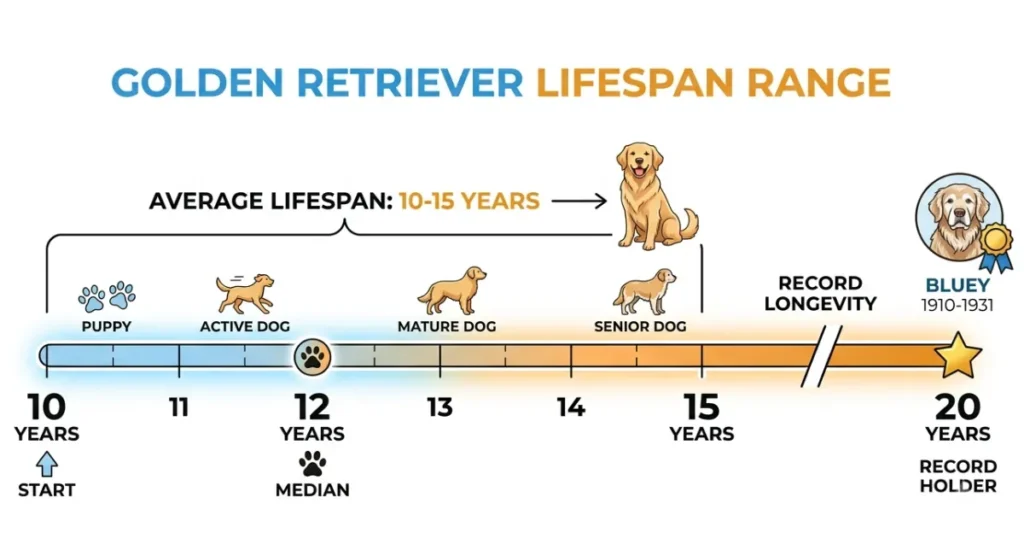
Golden Retrievers live 10 to 12 years on average, according to the American Kennel Club. With excellent care, many reach 13 to 15. The oldest golden retriever on record, a dog named Augie, lived to 20 years and 11 months. How long a golden retriever lives depends most on weight, genetics, and early disease screening.
How long do golden retrievers live? The honest average is 10 to 12 years. But that single number hides a huge range. The gap between a golden that leaves at 9 and one that reaches 15 is mostly decided by care, not luck.
This guide answers the question fully. You will learn how old golden retrievers live on average and why some live far longer. You will also see whether sex or bloodline matters and the record of the oldest Golden ever. For the complete breed lifespan overview, including the history and the science, our golden retriever lifespan guide is the place to go, and this page builds on it.
How Long Do Golden Retrievers Live on Average?
The average is 10 to 12 years. That figure comes from AKC breed data and matches the large Morris Animal Foundation Golden Retriever Lifetime Study, which follows more than 3,000 dogs.
Here is what that range really means:
- Reaching 12 means your Golden met the full breed average. That is a success, not a shortfall.
- Reaching 13 to 15 is common in lean, well cared for dogs with good genes.
- Passing 15 is rare and remarkable, but it does happen.
So when someone asks how long does a golden retriever live, the truthful answer is a range, not a fixed number. Where your dog lands in that range is the interesting part, and the rest of this guide explains what moves it. The deeper history behind this figure, including a common myth that Goldens once lived to 16, is covered fully in our pillar guide.
Why the range is so wide
A five-year gap between one Golden and another is huge in dog terms. It usually comes down to a handful of differences:
- Genetics. A well bred dog from health-tested parents starts with better odds.
- Weight. Lean dogs simply live longer, and the effect is large.
- Veterinary care. Dogs whose owners catch problems early beat those whose problems are found late.
- Living environment. Indoor dogs in close daily contact with their families tend to be watched more closely and kept safer.
None of these is fixed at birth except the first, and even genetics can be improved by choosing a responsible breeder. That is the hopeful message hidden inside the average. Much of how old golden retrievers live is still in your hands.
How Long Does a Golden Retriever Live: Male vs Female?
Many owners ask if sex changes how long a golden retriever lives. The honest answer is that it makes only a small difference.
- Female Golden Retrievers tend to live slightly longer than males, usually by less than a year.
- The gap is real but minor, and it is easily outweighed by weight and care.
- A lean, well screened male will almost always outlive an overweight, unscreened female.
There is one wrinkle worth knowing. Some research on Goldens suggests that the timing of spaying or neutering can affect health more than sex itself. Dogs altered very early have shown higher rates of certain joint problems and cancers in breed-specific studies. This does not mean you should skip the procedure. It means the age at which you do it is a conversation worth having with your vet.
So sex is worth knowing, but it is near the bottom of the list of things that matter. Do not choose or worry about a Golden based on sex alone when it comes to lifespan. The factors later in this guide matter far more, and they are the ones you can actually control.
Do English Cream Golden Retrievers Live Longer?
This is one of the most common lifespan myths, so let me answer it plainly. There is no strong proof that English cream Golden Retrievers live longer than American or Canadian lines.
Some breeders of European lines point to survey data suggesting lower cancer rates. But that evidence is limited, and it is not enough to promise extra years.
Here is what actually decides how old golden retrievers live, regardless of coat color or country of origin:
- The health testing of the parents
- The dog’s lifetime body weight
- Early disease screening and vet care
A pale “English cream” coat is a color, not a health guarantee. A well bred, well cared for American Golden can easily outlive a poorly bred European one. Judge the breeder and the care, not the shade of the coat. For the full list of conditions that shape these odds, see our golden retriever health issues guide.
The Lifespan Factor Ledger: What Adds and Subtracts Years
If you want to change how long your golden retriever lives, this is the section that matters most. Some factors add years. Others quietly take them away. Here they are in one place.
| Factor | Effect on lifespan | Why |
| Lean body weight | Adds years | Overweight dogs develop earlier arthritis and disease. Lean-fed dogs in a major study lived notably longer |
| Health-tested parents | Adds years | Screened breeding lowers inherited cancer and joint risk |
| Twice-yearly senior vet visits | Adds years | Early disease detection, which is decisive in this breed |
| Good dental care | Adds years | Mouth infections strain the heart and kidneys over time |
| Excess weight | Subtracts years | The single biggest owner-controlled risk to longevity |
| Skipped screening | Subtracts years | Cancers like hemangiosarcoma are far more treatable when caught early |
| Very early spay or neuter | May subtract | Research links neutering some Goldens before a year to more joint disease |
The clearest lesson is simple. The biggest lever is weight. If you can easily feel your Golden’s ribs under a light touch, you are already doing the most powerful thing for its lifespan. If you cannot, trimming the waistline is the highest-value change you can make. Managing these factors well is exactly what our golden retriever health hub is built to help with, stage by stage.

The Oldest Golden Retriever Ever: How Long Can They Really Live?
Now for the hopeful part. The oldest golden retriever on record was a dog named August, known as Augie, and her story shows how far the high end can stretch.
Augie lived to 20 years and 11 months, nearly doubling the breed average. Remarkably, she was adopted at 14 years old, an age most people would call the very end. She went on to enjoy almost seven more years of RV trips and pool fetch, passing peacefully in March 2021. That placed her among the oldest dogs of any breed ever recorded.
What can owners learn from an outlier like Augie? Her family credited a few plain habits:
- A very close relationship with her vet, so problems were caught early
- Attentive daily care and supplements suited to her aging body
- Steady, gentle activity well into old age
There is also a bigger lesson in her story. Augie was adopted at 14, an age when many people assume a dog is out of time. Her family gave her nearly seven more years of full, happy life. That is a powerful reminder that senior Goldens are not a lost cause and that adopting an older dog can be deeply rewarding.
Geneticists who study aging were not shocked by Augie either. Researchers have noted that dog lifespans, like human ones, tend to improve over time with better care and medicine. In other words, the high end of how long golden retriever dogs live may slowly climb in the years ahead.
Augie is not proof that every Golden will reach 20. She is proof that good care can stretch the years far past the average and that even a senior dog has a lot of living left. If your Golden is already older, our guide to caring for an old golden retriever walks you through the senior years with the same care Augie’s family gave her.

How Long Do Golden Retriever Dogs Live Compared to Other Breeds?
It helps to see how long golden retriever dogs live next to similar breeds. Size is the big pattern. Larger breeds tend to live shorter lives than small ones.
| Breed | Average lifespan |
| Golden Retriever | 10 to 12 years |
| Labrador Retriever | 11 to 13 years |
| Standard Poodle | 12 to 15 years |
| German Shepherd | 9 to 13 years |
| Border Collie | 12 to 15 years |
| Great Dane | 7 to 10 years |
Goldens sit in a typical range for a large, active breed. They live a little less than some similar dogs, and the main reason is their higher rate of certain cancers, not their size alone. This is why early screening matters so much in this breed. It also explains why a Golden’s long puppy and teenage energy are worth understanding by stage, which our golden retriever age chart breaks down in full. That same big, playful nature is why some owners jokingly call the breed “the worst.” We answer that honestly in our guide to why golden retrievers are called the worst.

How to Push Your Golden toward the High End of the Range
Knowing how long golden retrievers live is only useful if it changes what you do. Here is the short, practical list that gives your dog its best shot at 13, 14, or beyond. None of it is complicated.
Keep the weight down.
This is first for a reason. You should be able to feel your Golden’s ribs with a light touch and see a visible waist from above. If you cannot, cut the daily portion and measure meals instead of guessing. Overweight is the single most common way owners quietly shorten their dog’s life.
Feed with purpose.
Choose a quality food matched to your dog’s life stage. Do not free-feed, and keep treats to a small share of daily calories. Steady, controlled nutrition supports a longer, healthier life.
Screen early and often.
Book a full exam once a year through adulthood, then move to every six months once your Golden turns 8. Ask for bloodwork at senior visits. Because cancer is the breed’s leading threat, catching disease early is the difference maker.
Care for the mouth.
Brush the teeth regularly and follow your vet’s advice on cleanings. Dental infection is not just a mouth problem. Over time it strains the heart and kidneys.
Move every day.
Gentle, regular exercise keeps muscle, joints, and mind healthy at every age. Swimming is ideal, since it builds strength without stressing the joints.
Do these five things well, and you have done nearly everything within your power to help your golden retriever live a long, comfortable life.

Expert Insight
When an owner asks me how long their Golden will live, I never give a single number. I give them a range and then a choice. The range is 10 to 15 years. The choice is whether they will do the few boring things, mainly keeping the dog lean and screening early, that push their dog toward the top of it. Augie’s family made that choice for years.
How long do golden retrievers live?
| Average lifespan | 10 to 12 years |
| Realistic high end with great care | 13 to 15 years |
| Oldest on record | Augie, 20 years and 11 months |
| Biggest factor you control | A lean body weight |
| Do females live longer? | Slightly, usually by under a year |
How long do golden retrievers live?
Golden Retrievers live 10 to 12 years on average, per AKC data. With lean weight and early screening, many reach 13 to 15 years, and a rare few live even longer.
How long does a golden retriever live with great care?
With excellent care, a golden retriever often lives 13 to 15 years. Lean body weight, twice-yearly senior exams, and early disease detection make the high end far more likely.
How old do golden retrievers live at the most?
Most golden retrievers live 10 to 12 years, but the oldest on record, Augie, reached 20 years and 11 months. Reaching the mid-teens is an achievable stretch goal with strong care.
How long do golden retriever dogs live compared to Labradors?
Golden retriever dogs live about 10 to 12 years, while Labradors average 11 to 13. The gap is small and comes mainly from the Golden’s higher cancer rate.
Do female golden retrievers live longer than males?
Slightly. Females tend to live under a year longer on average. Weight, genetics, and veterinary care matter far more than sex when it comes to lifespan.
Do English cream golden retrievers live longer?
There is no strong proof that they do. Coat color is not a health guarantee. Breeding quality, lean weight, and early care decide lifespan far more than a dog’s line.
What is the oldest golden retriever ever recorded?
A golden retriever named Augie holds the record at 20 years and 11 months. Adopted at 14, she lived nearly seven more years, passing peacefully in March 2021.
Can a golden retriever live to 15?
Yes, though it is uncommon. A lean, well bred, and well screened Golden with attentive veterinary care can reach 15. Weight control is the most important factor.
What is the most common cause of death in golden retrievers?
Cancer is the leading cause, affecting a large share of the breed. This is why early screening and vet relationships matter more in Goldens than in many other breeds.
How can I help my golden retriever live longer?
Keep the dog lean, feed measured meals, screen for disease twice a year from age 8, maintain dental care, and choose a health-tested breeder. Weight control matters most.
Does spaying or neutering affect how long a golden retriever lives?
Timing can matter in this breed. Research links very early neutering to more joint problems. Discuss the best age with your vet rather than defaulting to six months.
At what age is a golden retriever considered old?
Around 8 years. That is when a Golden becomes a senior and should switch to twice-yearly vet visits. Senior status is a care label, not a sign of decline.
Why do golden retrievers live shorter lives than small dogs?
Larger breeds generally age faster and face higher cancer rates. Goldens live a typical span for their size, with cancer being the main factor that shortens their years.
Do indoor golden retrievers live longer than outdoor ones?
Often yes. Indoor dogs face fewer accidents, parasites, and extreme weather, and their owners tend to spot health changes sooner. Close daily contact supports a longer life.
When should I worry about my aging golden retriever’s health?
Call your vet promptly for any new lump, a sudden drop in energy or appetite, or new trouble standing. For a swollen tight belly with retching, seek emergency care at once.
The Bottom Line: How Long Do Golden Retrievers Live?
So, how long do golden retrievers live? The honest average is 10 to 12 years, with well cared for dogs often reaching 13 to 15, and one extraordinary Golden named Augie living nearly 21. The number is a range, and you have real influence over where your dog lands in it.
Keep three things in mind. Weight is the biggest lever you control. Early screening catches the diseases that steal years. And even an old Golden, as Augie proved, can have a great deal of life left. Do the simple things well, and you give your golden retriever its best shot at the high end of that range.
How old is your Golden now, and what is the oldest Golden you have ever known? If your dog has passed the average and is still going strong, tell us the habits you credit. Your story helps the next owner aim for the top of the range.