

Golden Retrievers live 10 to 12 years on average, according to the American Kennel Club. Cancer is the breed’s leading cause of death, affecting roughly 60 percent of Goldens. With lean body weight, twice yearly senior screenings, and consistent dental care, many Golden Retrievers reach 13 or 14 years.
The average golden retriever lifespan is 10 to 12 years, and that range holds up across every credible data source I can find, from AKC breed data to the Morris Animal Foundation’s Golden Retriever Lifetime Study. Some Goldens reach 14 or 15. A few don’t see 9. The spread is what this article explains.
In my practice, the lifespan question rarely arrives as a curiosity. It arrives attached to a lump, a slowing gait, or a new puppy contract. So I’ll give you the honest numbers first, then the parts you can actually influence. One sourced fact frames everything that follows: researchers at UC Davis identified a variant of the HER4 gene, and Golden Retrievers carrying certain versions of it lived an average of 13.5 years against 11.6 years for those without. Genetics deals the hand. Care plays it.
Contents
- 1 How Long Do Golden Retrievers Live? The Honest Numbers
- 2 Why Golden Retriever Life Expectancy Trails Similar Breeds
- 3 Golden Retriever Life Span by Life Stage
- 4 Did Golden Retrievers Really Live to 16 in the 1970s?
- 5 What Actually Shortens a Golden Retriever’s Life
- 6 The Lean, Screen, Clean Protocol for a Longer Lived Golden
- 7 Expert Insight
- 7.1 BREED LIFESPAN PANEL
- 7.2 How long do golden retrievers live?
- 7.3 What is the average golden retriever lifespan?
- 7.4 How long can a golden retriever live?
- 7.5 What is the average life expectancy of a golden retriever, male vs female?
- 7.6 How long does a golden retriever live compared to a Labrador?
- 7.7 How old do golden retrievers live in human years?
- 7.8 How many years do small dogs outlive large dogs?
- 7.9 How often should an adult dog see a vet?
- 7.10 Can dogs live longer through weight control?
- 7.11 When should I consider my dog a senior?
- 7.12 Why do Golden Retrievers get cancer so often?
- 7.13 Do English cream Golden Retrievers live longer?
- 7.14 Is it safe to spay or neuter a Golden Retriever before one year?
- 7.15 Do Golden Retrievers need senior bloodwork at age 8?
- 7.16 When should I call the vet immediately about my Golden?
- 8 The Bottom Line on Golden Retriever Lifespan
How Long Do Golden Retrievers Live? The Honest Numbers
Ask five sources how long golden retrievers live and you’ll get answers that sound different but describe the same reality. Here’s the golden retriever lifespan data laid side by side, which no ranking article currently does.
| Data source | What it found |
| American Kennel Club breed data | 10 to 12 years average lifespan |
| UK Kennel Club purebred health survey (2004) | Median age at death just over 12 years |
| Morris Animal Foundation, Golden Retriever Lifetime Study (3,044 dogs enrolled since 2012) | Cancer is the leading cause of death among participants |
| UC Davis HER4 gene research | 13.5 years with the favorable variant, 11.6 without |
Two things stand out to me in that table. First, the floor and ceiling are closer than the owners expect. A golden reaching 12 has met the breed’s full statistical expectation, not fallen short of it. Second, the two year gap in the UC Davis finding is enormous in dog time. Two years is roughly a sixth of a Golden’s whole life, and it traces to a single gene variant.
When a Golden owner calls asking whether their dog is “old at 10,” the first question I ask is what the dog’s body condition and energy look like, because the calendar tells me far less than the dog does. I’ve examined 10 year old Goldens that field-retrieve all morning and 8 year olds already struggling with stairs.
So treat 10 to 12 as the honest expectation for golden retriever life expectancy. Then spend your energy on the levers this article covers next, because the difference between the bottom and top of that range is mostly decided at home, not in my exam room. You’ll find every condition mentioned here covered in depth in our Golden Retriever health hub.
Why Golden Retriever Life Expectancy Trails Similar Breeds
Here’s the uncomfortable part. For a dog of their size, Goldens should do a little better than they do, and the reason is cancer. Roughly 60 percent of Golden Retrievers die of cancer, a figure consistent with Golden Retriever Club of America health survey data and the reason the Morris Animal Foundation chose this breed for its landmark lifetime study. The two big killers are hemangiosarcoma, a cancer of blood vessel walls that often announces itself only when a tumor ruptures, and lymphoma, a cancer of the immune system.
I want to be precise about what that 60 percent means, because owners hear it as a coin flip on early death. It isn’t. Many of those cancers arrive at 11, 12, or 13, at the natural end of a long life. The number describes what Goldens eventually die of, not when.
The mechanism matters too. Goldens descend from a small founding population, and studies estimate their average inbreeding coefficient to be around 8 percent. Research from canine geneticists, including work analyzing Golden Retriever longevity directly, links higher inbreeding with shorter lives. Concentrated genes concentrated cancer risk along with the golden coat and the soft mouth.
The most common mistake I see is fatalism. Understandable, because the statistics sound grim, but in Golden, early detection changes outcomes more than in almost any breed I treat. A hemangiosarcoma found on a routine senior ultrasound and a hemangiosarcoma found during a collapse are different diseases in practice. We break down every major condition, screening test, and warning sign in our guide to Golden Retriever health issues.

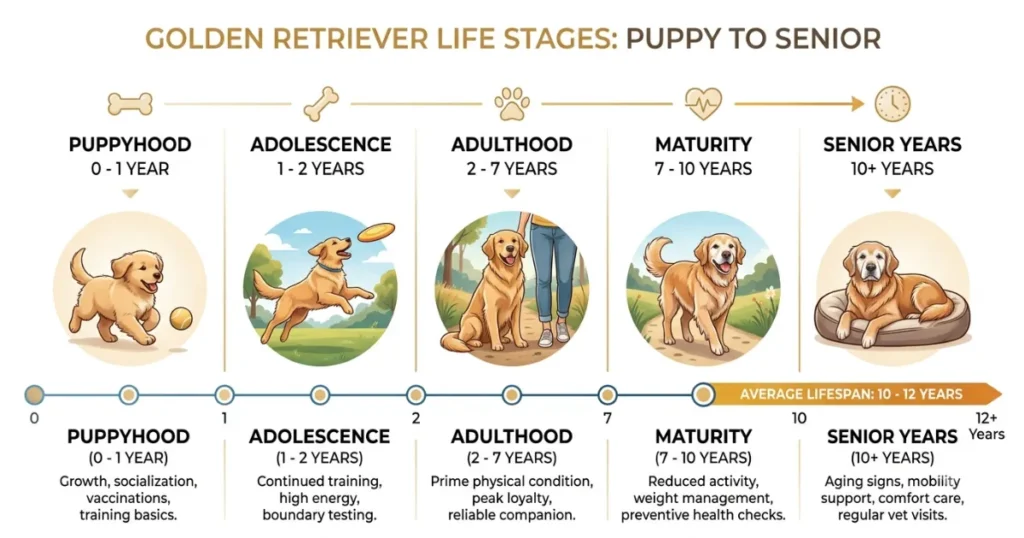
Golden Retriever Life Span by Life Stage
A Golden’s life span reads differently depending on which stage you’re standing in, and the care that extends life changes at each one.
Puppy, 8 weeks to 18 months.
Growth plates in a Golden’s long bones don’t close until 12 to 18 months. Feed a large-breed puppy formula and keep forced running minimal until then, because joints damaged now become arthritis that limits exercise at 9, and exercise capacity late in life is strongly tied to longevity. Adolescent Goldens are also gloriously destructive, which is why so many end up in shelters at this exact age. We wrote honestly about that phase in why Golden Retrievers are “the worst”.
Adult, 2 to 7 years.
The quiet decade. One wellness exam per year, weight held lean, and teeth maintained. This is when lifespan is banked, even though nothing feels urgent.
Senior, 8 years and up.
A Golden becomes senior around 8, and this is where I follow AAHA guidance and move to exams every 6 months with blood work. Six months is a long time in an old Golden. Half the life-extending catches I make happen at these visits, in dogs whose owners saw nothing wrong.
For month by month milestones and what your Golden’s age means in human years, our Golden Retriever age chart breaks down every stage. And once your dog crosses 8, our guide to caring for an old Golden Retriever covers the senior years in detail.

Did Golden Retrievers Really Live to 16 in the 1970s?
You’ll read in most top-ranking articles that Goldens once lived 16 or 17 years and have lost a third of their lifespan. I understand why the claim spreads. It’s dramatic, and it carries an implied villain. The problem is that nobody can produce the dataset behind it.
Canine epidemiologists who study breed longevity have publicly challenged the figure, pointing out that no systematic records of pet dog lifespans exist from that era. There’s no canine census, then or now. The claim survives on memory, and memory is a poor mortality database, because the one Golden who reached 16 is remembered while the many who died at 8 are not.
The historical data we do have points the other way. An analysis published in the American Journal of Veterinary Research in 1982 reviewed dogs treated at a Boston referral hospital between 1962 and 1976. The Golden Retrievers in that population died at an average age of 6.7 years. Referral cases skew sick, so that number runs low, but it’s very hard to reconcile with a breed routinely reaching 16.
Here’s what I tell owners. Not that the breed is in freefall, but that today’s golden retriever lifespan of 10 to 12 years is probably close to what Goldens have always done and that the real story is the opportunity in front of us, because genetics research like the HER4 finding suggests the ceiling can rise. Grieve the myth if you need to. Then put that energy into the factors below, which are real and measurable.
What Actually Shortens a Golden Retriever’s Life
When I look back at the Goldens in my practice who fell short of the average Golden Retriever life span, the same few factors keep appearing, and most were preventable.
Excess weight sits at the top.
The best evidence we have is Purina’s 14 year lifetime feeding study. It followed Labradors rather than Goldens, and I’ll say so plainly because the finding is weight-based, not breed-based: dogs fed to a lean body condition lived a median of 1.8 years longer than their overfed littermates, with arthritis arriving years later. For a food-obsessed breed like ours, this is the single largest lever an owner controls. If you can’t easily feel your Golden’s ribs under light pressure, your dog is carrying years off the back end of its life.
Skipped senior screening comes second.
Hemangiosarcoma and lymphoma are far more treatable if found early, and early means found by a vet, not by a crisis.
Spay and neuter timing matters in this breed specifically.
UC Davis research on Goldens linked neutering before 12 months with higher rates of joint disorders, and timing showed associations with certain cancers. This isn’t an argument against the procedure. It’s an argument for deciding the timing with your vet rather than by default.
Untreated slow burners round out the list.
Hypothyroidism, dental disease, and unmanaged hip dysplasia each erode fitness gradually, and fitness is what carries a Golden through its final years. Our health hub covers each of these, and the full rundown lives in our Golden Retriever health issues guide.
The Lean, Screen, Clean Protocol for a Longer Lived Golden
Owners ask me how long can a golden retriever live if everything is done right, and my honest answer is 13 to 14 years, occasionally more. This is the framework I give them. It has three rules and a set of if/then triggers, so you always know the next action.
| Rule | Do this | If you notice | Then |
| Lean | Hold body condition at 4 to 5 out of 9. Measure meals and cap treats at 10% of calories | You can’t feel ribs easily | Cut portions by 10% and reweigh in 4 weeks |
| Weight gain plus low energy or thinning coat | Book a thyroid panel. Hypothyroidism is common in Goldens | ||
| Screen | Annual exam to age 7, then every 6 months from age 8 with bloodwork | Any new lump | Vet within a week for a needle sample. Never “watch” a lump in a Golden |
| Collapse, pale gums, or a suddenly swollen belly | Call your vet immediately. These can signal internal bleeding from hemangiosarcoma | ||
| Clean | Brush teeth daily or near it. Professional cleanings as your vet advises | Foul breath, dropped food, chewing on one side | Book an oral exam. Dental infection taxes the heart and kidneys |
Two additions earn their place in most Goldens’ plans. Omega-3 fatty acids, specifically EPA and DHA at a dose your vet sets by body weight, support joints and skin. Glucosamine has the most value when started before arthritis is advanced, not after. Neither replaces the table above. In a representative case, a lean 9 year old Golden on this exact schedule had a splenic mass found on routine ultrasound, removed before rupture, and reached 13. That outcome started with a calendar, not a symptom.

Expert Insight
The longest lived Goldens in my practice share one boring trait. Their owners treat the 6 month senior visit like a school pickup, something that simply happens. Not one of those dogs was saved by heroics. They were saved by appointments.
BREED LIFESPAN PANEL
| Golden Retriever lifespan at a glance | |
| Average lifespan | 10 to 12 years (AKC) |
| Senior status begins | Around 8 years |
| Leading cause of death | Cancer, roughly 60% of Goldens |
| Biggest owner-controlled factor | Lean body weight |
| Realistic stretch goal | 13 to 14 years with proactive care |

How long do golden retrievers live?
Golden Retrievers live 10 to 12 years on average, per AKC breed data. Well cared for Goldens regularly reach 13 or 14, while cancer claims some earlier.
What is the average golden retriever lifespan?
The average is 10 to 12 years. A 2004 UK Kennel Club survey found a median age at death just over 12 years.
How long can a golden retriever live?
A Golden can live 14 to 16 years in exceptional cases. Lean weight, biannual senior exams, and early tumor detection make the upper range far more likely.
What is the average life expectancy of a golden retriever, male vs female?
Female Goldens live slightly longer than males on average, usually by less than a year. Weight and preventive care outweigh sex as factors.
How long does a golden retriever live compared to a Labrador?
About the same. Both breeds average 10 to 12 years, though Goldens carry a higher documented cancer rate across their lifetime.
How old do golden retrievers live in human years?
A 10 year old Golden is roughly a 66 to 70 year old human. Large breeds age faster after year two than small breeds do.
How many years do small dogs outlive large dogs?
Small breeds typically outlive large breeds by 2 to 4 years. Faster growth and higher cancer rates shorten big dogs’ lives.
How often should an adult dog see a vet?
Once yearly for healthy adults. From age 8 in large breeds, twice yearly exams with bloodwork catch disease while it’s still treatable.
Can dogs live longer through weight control?
Yes. Purina’s 14 year Labrador study showed lean-fed dogs lived a median of 1.8 years longer than overfed littermates.
When should I consider my dog a senior?
Around age 8 for a Golden-sized dog. Senior status means switching to twice yearly veterinary exams, not slowing your dog’s lifestyle down.
Why do Golden Retrievers get cancer so often?
Roughly 60 percent of Goldens die of cancer, mainly hemangiosarcoma and lymphoma. The Morris Animal Foundation’s Golden Retriever Lifetime Study is investigating the genetic and environmental causes.
Do English cream Golden Retrievers live longer?
Some surveys report lower cancer rates in European lines, but the evidence is limited. Individual genetics and care matter more than coat color or line.
Is it safe to spay or neuter a Golden Retriever before one year?
UC Davis research links neutering Goldens before 12 months to more joint disorders. Discuss timing with your vet rather than defaulting to six months.
Do Golden Retrievers need senior bloodwork at age 8?
Yes. Following AAHA senior care guidance, Goldens 8 and older should have exams and lab work every 6 months to catch disease early.
When should I call the vet immediately about my Golden?
Call your vet immediately for collapse, pale gums, a swollen belly, labored breathing, or bloat signs. For a new lump with a normal dog, book within the week.
The Bottom Line on Golden Retriever Lifespan
The honest golden retriever lifespan is 10 to 12 years, and that number has probably been stable for far longer than the internet suggests. What isn’t fixed is where your dog lands inside and beyond that range. Keep your Golden lean, move to twice yearly exams at 8, act on every lump within a week, and treat dental care as medicine rather than grooming.
Those four habits are the difference I see between Goldens who leave at 9 and Goldens still swimming at 13. Start with the one you’ve been putting off, and use our health hub to go deeper on anything this guide raised.
How old is your Golden right now, and what’s the one habit from the Lean, Screen, Clean protocol you already do or plan to start this month? If you’ve had a golden reach of 13 or beyond, tell us what you think made the difference. Your answer genuinely helps the next worried owner who lands here.

Dr. Nabeel A.
Dr. Nabeel Akram is a Doctor of Veterinary Medicine with more than five years of hands-on experience in animal health, canine nutrition, and preventive care. He is a registered veterinarian with the Pakistan Veterinary Medical Council (PVMC), the statutory body regulating veterinary practice in Pakistan. As the founder of Golden Retriever Insight, Dr. Akram writes and medically reviews every health, nutrition, and grooming guide published on the site. His clinical interests include canine oncology, epilepsy management, and breed-specific nutrition for large breeds — the core topics this site covers. Every article is checked against current veterinary literature and sources such as the Merck Veterinary Manual, AVMA guidance, and peer-reviewed research.
Links will be automatically removed from comments.