
A single seizure with full recovery means calling your vet within a day. Two or more seizures in 24 hours is a cluster, and that’s an emergency; get to the vet now. If a seizure lasts more than 5 minutes or your dog doesn’t wake up between fits, drive to the ER.
Cluster seizures in dogs are two or more separate seizures within a single 24-hour period, with the dog recovering between them. They count as a veterinary emergency because a cluster can build on itself and tip into non-stop seizing that overheats the body and injures the brain. The simple rule is this. One seizure with full recovery can wait for a same-day phone call. A second seizure within 24 hours means your dog needs to be seen right away.
If your dog has just had two seizures in one day, you’re in the right place, and the most useful thing you can do is start a clock and note the time of each event. Most owners don’t know that a second seizure changes the whole picture. Clusters aren’t simply more seizures. They carry worse odds, and research on dogs with idiopathic epilepsy finds cluster seizures in 38 to 77 percent of them.
When a Golden owner calls me about a second seizure in one day, my first question is always the same. What time did the first one start? That timestamp decides everything that follows. For the wider context on seizure types and triggers, see the full overview of seizures in dogs.
What Cluster Seizures Are: Single vs Cluster vs Status Epilepticus
Three words get tangled together, and untangling them tells you how fast to move. A single seizure is one event, after which your dog returns to normal. Cluster seizures are two or more events in 24 hours, with your dog regaining consciousness in between. Status epilepticus is the worst of the three: a seizure lasting more than 5 minutes or seizures stacked so closely that your dog never recovers between them.
The line that matters most is recovery. In a cluster, your dog comes back to itself between seizures, groggy but present. In status epilepticus, that recovery doesn’t happen, and VCA Animal Hospitals classifies that state as immediately life-threatening. A cluster can march into status epilepticus if it isn’t interrupted, which is exactly why a cluster is treated as an emergency rather than a curiosity.
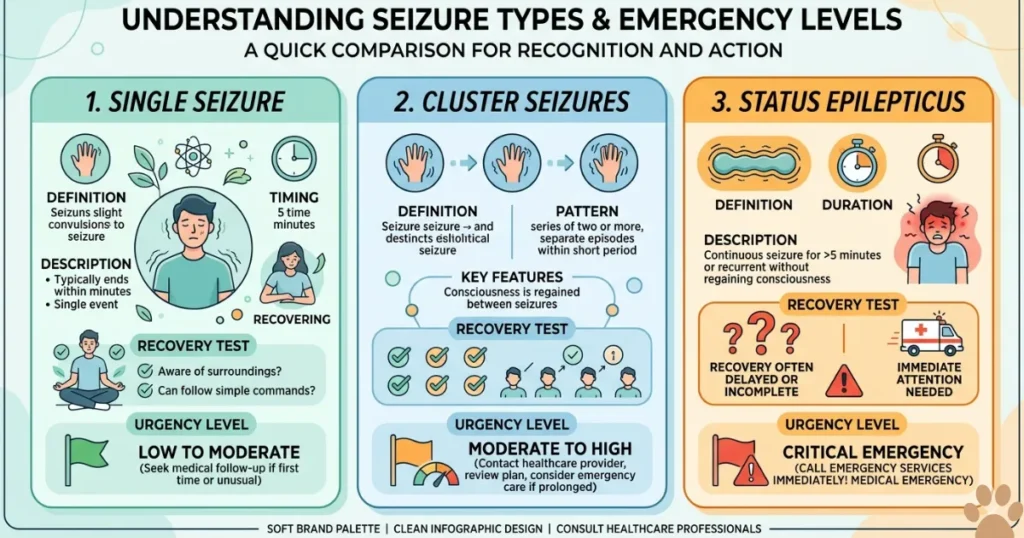
If you’re still deciding whether what you saw was even a seizure, compare it against what a dog seizure looks like and this walkthrough of how to tell if your dog is having a seizure. Some events are subtle. A focal seizure might be a twitching face or frantic fly-biting rather than a full collapse, and focal events can cluster too.
| Single seizure | Cluster seizures | Status epilepticus | |
| What it is | One event, full recovery | 2+ events in 24 hrs | One seizure >5 min, or no recovery between |
| Recovery between | Returns to normal | Recovers between events | Does not recover |
| Urgency | Call the vet within a day | Emergency: Vet now | Life-threatening, ER now |
| Your move | Log it, book a check | Start the rescue plan | Call ahead, drive |
Why Cluster Seizures Are an Emergency
A cluster is dangerous for two reasons, and neither is obvious from watching a single event. The first is escalation. Each seizure can lower the threshold for the next, so a dog that’s already clustered is primed to keep going, which is how clusters slide into life-threatening status epilepticus.
The second reason is the long game. Clusters don’t just frighten owners; they change the prognosis. Dogs with a cluster history are less likely to ever become seizure-free and tend to have shorter survival times than epileptic dogs who don’t cluster. That’s not me catastrophizing. It comes straight from the veterinary literature on canine idiopathic epilepsy.
There’s a sobering datapoint worth knowing. According to Today’s Veterinary Practice, nearly 60 percent of epileptic dogs experience at least one episode of status epilepticus in their lifetime, and up to a quarter of dogs in status epilepticus don’t survive to hospital discharge. Clusters are the on-ramp to that emergency, which is why catching and interrupting them early genuinely matters. None of this means a dog that clusters is doomed. It means the condition earns real respect and a real plan, covered in canine epilepsy signs, causes, and treatment, and browse our Golden Retriever health guides for more.
Cluster Seizures and Golden Retrievers: The Honest Breed Picture
Here’s where I’ll be straight with you, because the internet usually isn’t. Goldens are not the poster breed for cluster seizures. The breeds with the highest documented clustering rates are Border Collies and German Shepherds, not Golden Retrievers. A Border collie study found a striking share affected by clusters, far above the average dog.
What is true for Goldens is upstream of clustering. Golden Retrievers have a documented breed predisposition for idiopathic epilepsy, and since clusters occur in 38 to 77 percent of dogs with idiopathic epilepsy, a Golden that develops epilepsy carries a real cluster risk by extension. The classic Srenk study found that idiopathic epilepsy in Goldens usually begins in young adulthood, with onset within one to three years of age in about three-quarters of affected dogs.
So the honest framing is this. A Golden doesn’t cluster because it’s a Golden. A Golden can cluster because it’s an epileptic dog, and Goldens are a breed that gets epilepsy more than most. That distinction matters because it means the cluster signs and the cluster plan are the same for your Golden as for any dog. There’s no special Golden trick here, just a breed that lands in the higher-risk pool more often.

What Causes Cluster Seizures in Dogs, by Life Stage
The underlying cause of a dog’s seizures shapes whether they cluster, and age is the best first clue. The broader causes of seizures run deeper, but here’s the age map for clusters.
Puppies and dogs under 1 year.
Early clusters point away from inherited epilepsy and toward a congenital problem, an infection such as distemper, low blood sugar, or a toxin. Several household poisons can cause seizures fast, and our list of toxins that trigger seizures is worth a scan if your young dog got into something.
Young adults, roughly 1 to 6 years.
This is the idiopathic epilepsy window, and it’s the group most likely to cluster. Interestingly, the data cuts against intuition here. In one study of epilepsy patients, dogs with a younger age at seizure onset were more likely to suffer clusters, not less. A young adult golden that clusters fits this pattern.
Senior dogs, 7 and older.
A first-ever seizure in an older dog more often signals a metabolic problem or a structural brain change like a tumor or stroke, and these can absolutely cluster. If clusters start late, read what causes fits in older dogs and push for imaging rather than assuming simple epilepsy. Clusters can also strike out of sleep, which we cover in dog fitting in sleep.

What Most Cluster Seizure Articles Get Wrong
Search this topic, and you’ll get a clean definition, a cause list, and “call your vet.” All true, all incomplete. The first gap is the cluster versus status confusion. Plenty of articles use the terms loosely, which leaves owners unsure whether they’re watching an emergency that can wait an hour or one that can’t wait a minute. The recovery test settles it. Recovery between seizures means cluster. No recovery means status epilepticus, and that’s a straight to ER situation.
The second gap is the missing plan. Most pages never mention that dogs with a cluster history can be sent home with a vet-prescribed rescue medication, the thing that actually breaks a cluster before it escalates. Knowing that the option exists changes how an owner prepares.
In a representative case I’ve seen many versions of, an owner watches their dog seize, sees it recover, and feels relieved enough to plan a vet visit for the next day. A few hours later comes a second seizure, then a third. By the time they reach the clinic, the dog is in status epilepticus. The first seizure was the warning. The 24-hour window was the clock they didn’t know was running.

What to Do During a Cluster: The Cluster Clock
When seizures start stacking, you need a plan you can run while your heart is pounding. I teach owners a simple one.
The Cluster Clock:
Start the clock.
Note the exact time your dog’s first seizure begins. That timestamp is the most important number of the night.
Protect and observe.
Clear hard objects away, don’t touch the mouth, don’t restrain your dog, and dim the room. Time each seizure’s length.
Read the clock.
A second seizure before 24 hours is up means a cluster, and that’s your cue to act now, not in the morning.
Know the ER line.
Any single seizure lasting past 5 minutes, or no recovery between seizures, is status epilepticus. Call ahead and drive immediately.
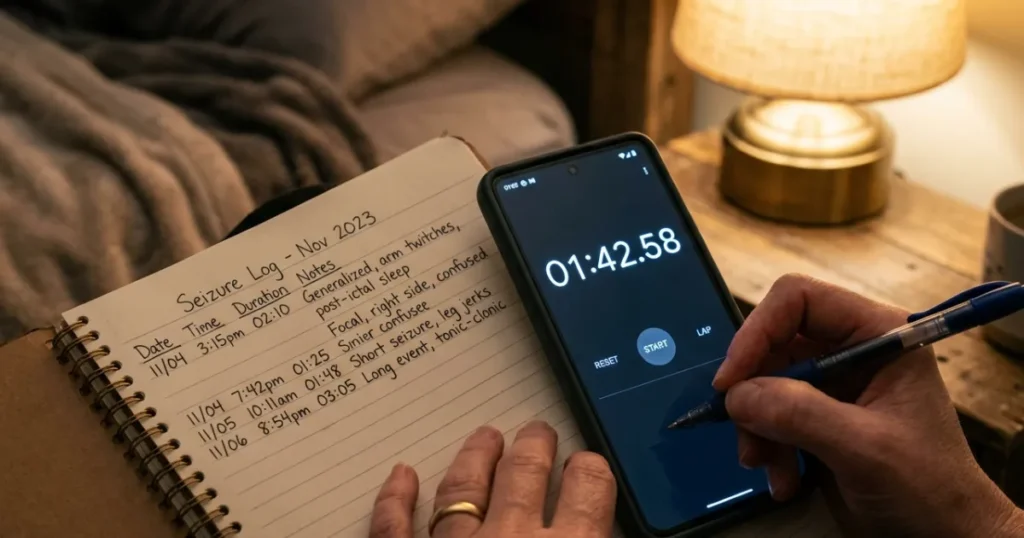
Log every event as you go: the time, the length, and what it looked like. That log is what your vet uses to decide treatment, and it’s far more useful than memory after a frightening night.
For dogs with a cluster history, vets often prescribe an at-home rescue medication so you can interrupt a cluster early. The common ones are rectal diazepam, dosed around 0.5 to 1 mg/kg, and intranasal midazolam, dosed around 0.2 mg/kg, which is roughly 6 mg for a 30-kg (66lb) Golden.
Your vet calculates the exact dose for your dog’s weight, prescribes it, and trains you on timing. Never improvise a dose or reach for leftover medication without that guidance. If clusters keep recurring, your vet may adjust long-term control, which we cover in seizure medication options for dogs.
Expert Insight
“The owners who handle clusters best treat the first seizure as a starting gun, not a finish line. They write down the time, they stay calm, and they call us before the second one turns into a third. That timeline is what saves brains.”
What are cluster seizures in dogs?
Cluster seizures in dogs are two or more separate seizures within 24 hours, with the dog recovering between them. They’re a veterinary emergency because a cluster can escalate into continuous, life-threatening seizures.
How many seizures count as a cluster in dogs?
Two or more seizures within 24 hours count as a cluster. Your dog regains consciousness between them, which separates a cluster from status epilepticus, where the dog never recovers between seizures.
What causes cluster seizures in dogs?
Common causes include idiopathic epilepsy, toxins, low blood sugar, and, in older dogs, brain tumors or metabolic disease. Dogs with idiopathic epilepsy are the most likely to cluster, especially those with a younger onset.
How long can a dog live with cluster seizures?
Many dogs live for years with treatment, but clusters lower the odds of becoming seizure-free and can shorten survival compared with non-clustering epileptic dogs. Early control and a rescue plan improve the outlook.
Is it safe to wait out a cluster seizure at home?
No. A second seizure within 24 hours is an emergency that needs same-day veterinary care. Waiting risks the cluster escalating into status epilepticus, which can cause overheating, brain injury, or death.
What happens if cluster seizures aren’t treated?
Untreated clusters can escalate into status epilepticus, a continuous seizure state VCA calls life-threatening. Repeated seizures also raise the risk of brain injury and reduce the chance of long-term control.
How to stop a dog’s cluster seizures at home?
You can’t stop them barehanded, but vets often prescribe an at-home rescue medication such as rectal diazepam or intranasal midazolam for dogs that cluster. Give it exactly as prescribed, then head to the vet.
When should I take my dog to the emergency vet for seizures?
Go immediately if a seizure lasts over 5 minutes, your dog has two or more seizures in 24 hours, or doesn’t recover between them. When unsure, call your emergency vet and describe the timeline.
Can cluster seizures kill a dog? Yes, indirectly.
A cluster can progress to status epilepticus, and up to a quarter of dogs in status epilepticus don’t survive to hospital discharge, per Today’s Veterinary Practice. Fast treatment greatly improves survival.
Do dogs recover between cluster seizures?
Yes, that’s the defining feature. In a cluster, a dog regains consciousness between seizures, even if groggy. If your dog never recovers between events, that’s status epilepticus, a more severe emergency.
Can Golden Retrievers get cluster seizures?
Yes. Golden Retrievers are predisposed to idiopathic epilepsy, and clusters occur in 38 to 77 percent of dogs with that condition. A Golden that develops epilepsy carries a real risk of clustering and benefits from a rescue plan.
Why do Golden Retrievers have seizures?
Golden Retrievers carry a documented genetic risk for idiopathic epilepsy. In affected Goldens, the Srenk study found seizures usually begin between one and three years of age and tend to be generalized, whole-body events.
Do Golden Retrievers need rescue medication for clusters?
If a Golden has a history of clusters, vets commonly prescribe an at-home rescue drug like rectal diazepam or intranasal midazolam. Whether your dog needs one depends on its seizure pattern, so ask your vet.
Can a Golden Retriever live a normal life with cluster seizures?
Many do, with diagnosis, consistent medication, and a rescue plan. The Merck Veterinary Manual notes roughly a third of epileptic dogs are drug-resistant, so some Goldens need combination therapy to stay controlled.
When are cluster seizures in dogs an emergency?
Always treat a second seizure within 24 hours as an emergency and call your vet immediately. Go straight to the ER if any seizure lasts over 5 minutes or your dog doesn’t recover between seizures.
Conclusion
Cluster seizures in dogs are two or more seizures in 24 hours, and the moment that second seizure hits, monitoring ends and action starts. Start the Cluster Clock at the first event, protect your dog, log every seizure, and get veterinary help that day.
For Goldens, the cluster risk rides on their epilepsy predisposition, not anything unique to the breed, so the plan is the same for every owner. One number to keep in your head. Two in 24 hours is an emergency. Ask your vet whether an at-home rescue medication belongs in your kit.
Has your Golden ever had more than one seizure in a single day? Tell us how you recognized it was a cluster and what your vet recommended. Your timeline could help another owner know when to start driving.