

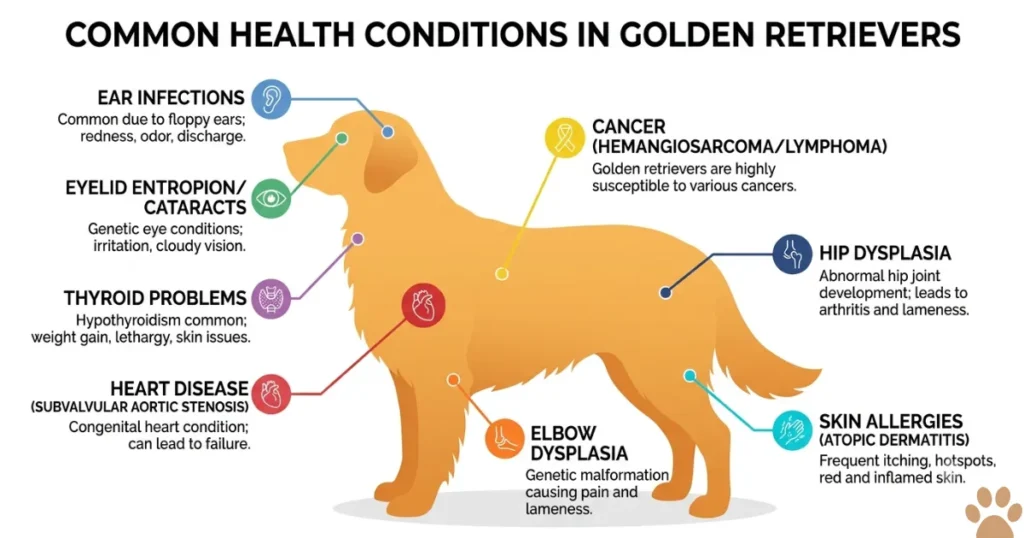
The most common golden retriever health issues are cancer, hip and elbow dysplasia, skin allergies, ear infections, hypothyroidism, heart disease, eye disease, and bloat. Most are manageable when caught early. Roughly 60 percent of Goldens eventually develop cancer, which is why routine screening matters more in this breed than almost any other.
Golden retriever health issues follow a pattern, and once you know the pattern, this breed stops feeling like a medical lottery. Eight conditions account for the vast majority of Golden visits to my exam room, and each has an early window when treatment is easier, cheaper, and more successful.
In my practice, the Goldens who do the worst are rarely the ones with the scariest diagnosis. They’re the ones whose early signs got explained away for months as aging, laziness, or a bad ear week. This guide covers the eight conditions, how to triage a symptom, and the screening map most owners never see. For how these health problems shape the breed’s 10 to 12 year average, start with our pillar guide to golden retriever lifespan, then come back here for the condition detail.
Contents
- 1 The 8 Golden Retriever Health Issues I See Most
- 2 Urgent or Monitor? Triaging Golden Retriever Health Problems
- 3 Why Golden Retrievers Carry More Health Concerns than Most Breeds
- 4 Golden Retriever Health Problems by Life Stage
- 5 The Screening Gap: Tests That Catch These Diseases Early
- 6 The Spot, Log, Book Rule for Any New Symptom
- 7 Expert Insight
- 7.1 What are the most common golden retriever health issues?
- 7.2 Are golden retriever health issues preventable?
- 7.3 What health problems do Golden Retrievers have most as puppies?
- 7.4 When do golden retriever health problems usually start?
- 7.5 Why do Golden Retrievers have so many health concerns?
- 7.6 Is it safe to buy a puppy without health clearances?
- 7.7 How often should dogs get professional dental cleanings?
- 7.8 What happens if hip dysplasia goes untreated?
- 7.9 How long can dogs live with hypothyroidism?
- 7.10 When should I take my dog to an emergency vet?
- 7.11 Do Golden Retrievers need OFA hip and elbow screening?
- 7.12 Can Golden Retrievers get skin problems from swimming?
- 7.13 Why do Golden Retrievers get ear infections so often?
- 7.14 Are Golden Retrievers good candidates for pet insurance?
- 7.15 When should I call the vet immediately about a lump?
- 8 The Bottom Line on Golden Retriever Health Issues
The 8 Golden Retriever Health Issues I See Most
Every list article names roughly these conditions. What those lists skip is when each one tends to arrive, and onset age is exactly what turns a worried owner into an effective one.
| Condition | Typical onset | First sign owners notice |
| Hip dysplasia | Signs from 1 to 2 years, arthritis later | Bunny-hop run, stiffness after rest |
| Elbow dysplasia | Under 1 year | Front-leg limp in a growing puppy |
| Skin allergies (atopic dermatitis) | 2 to 6 years | Paw licking, recurring hot spots |
| Ear infections (otitis externa) | Any age, worse in swimmers | Head shaking, odor, redness |
| Hypothyroidism | Middle age | Weight gain, thinning coat, low energy |
| Heart disease (subvalvular aortic stenosis) | Congenital, found as a murmur | Often nothing. A vet hears it first |
| Eye disease (cataracts, pigmentary uveitis) | Cataracts young or old; uveitis, around 8 | Cloudiness, redness, squinting |
| Cancer (hemangiosarcoma, lymphoma) | Mostly 8 and up | A lump, swollen nodes, or sudden collapse |
Two numbers anchor the cancer row. Morris Animal Foundation data indicates roughly 1 in 5 Golden Retrievers develops hemangiosarcoma and about 1 in 8 develops lymphoma, which is why the foundation built its 3,044-dog Golden Retriever Lifetime Study around this breed. Bloat, or gastric dilatation volvulus, sits outside the table because it isn’t a chronic condition. It’s a sudden emergency that deep-chested breeds like Goldens are built for, and it’s covered in the triage table next.
Urgent or Monitor? Triaging Golden Retriever Health Problems
When a Golden owner calls after hours, the first question I ask is never about the symptom itself. It’s “When did this start, and is your dog acting normal otherwise?” Is it an emergency? A swollen, tight belly with retching, collapse, pale gums, or labored breathing means one thing. Call your vet or an emergency clinic immediately. The answer sorts almost everything into one of two columns.
| URGENT: call the vet now | MONITOR: book within days |
| Swollen, tight belly with unproductive retching (bloat) | Occasional single vomit; dog otherwise normal |
| Collapse, weakness, or pale gums (possible internal bleed) | Stiffness after a long rest that walks off |
| Labored breathing or a blue-tinged tongue | Mild cough for a day in a bright dog |
| Seizure, or can’t stand | New limp that persists past 48 hours |
| Eating something toxic or a foreign object | Recurring ear odor or head shaking |
| Eye that’s suddenly painful, bulging, or blue | Gradual cloudiness in an older eye |
| No urine for 24 hours, or straining with nothing passing | Drinking noticeably more for over a week |
| Any lump that’s bleeding or growing by the day | Any new stable lump: see a vet within one week |
That last row deserves a hard rule. In this breed, no lump is a “keep an eye on it” lump. A needle sample costs little and takes minutes, and with hemangiosarcoma and mast cell tumors in the breed’s deck, waiting is the one move that never helps. The most common mistake I see is owners monitoring a lump for a season because it doesn’t seem to bother the dog. Understandable, because most lumps in most breeds are fatty and harmless, but golden retriever health concerns don’t get graded on the average dog’s curve.

Why Golden Retrievers Carry More Health Concerns than Most Breeds
Goldens aren’t fragile. They’re concentrated. The breed descends from a small founding population, and the same narrow gene pool that fixed the golden coat and the soft temperament also fixed disease risk, with studies estimating the breed’s average inbreeding coefficient around 8 percent. That’s the honest reason golden retriever health problems cluster the way they do, and it’s why two of them barely exist outside this breed.
Pigmentary uveitis
It is the one nobody’s list includes. It’s an inflammatory eye disease essentially unique to Golden Retrievers, typically diagnosed around age 8, and left unchecked, it can progress to glaucoma and blindness. It’s also exactly why annual eye exams shouldn’t stop after puppyhood in this breed. A representative case: a 9 year old Golden in for a routine senior visit, no owner complaints, and mild redness the owner attributed to swimming. The eye exam found early uveitis; treatment started that week, and the dog kept functional vision. Found a year later, that story usually ends differently.
Ichthyosis
It is the second. It’s a genetic skin condition common in Goldens that causes flaky, fish-scale dandruff, usually from puppyhood. It looks alarming and is mostly cosmetic, which cuts both ways. Owners panic over harmless flakes, then relax about itching and hot spots, which are a different problem entirely and usually mean allergy.
None of this makes the breed a bad bet, and plenty of what people call “golden problems” are really temperament myths, which we take apart in “Why Golden Retrievers are the worst.” It does make screening non-optional, which is where the next two sections go.
Golden Retriever Health Problems by Life Stage
Watch for different things at different ages, because each condition keeps its own calendar.
Puppy, 8 weeks to 18 months.
This is joint territory. Elbow dysplasia declares itself with a front-leg limp before the first birthday, and hip laxity shows as a bunny-hop gait or trouble rising. Feed large-breed puppy formula and keep growth lean, because a fat Golden puppy is a down payment on arthritis. Ichthyosis flakes, if present, appear here too.
Adult, 2 to 7 years.
Allergy season, literally. Atopic dermatitis typically starts between 2 and 6 years, showing as paw licking, hot spots, and repeated ear infections. When a Golden has its third ear infection in a year, the ear isn’t the disease. It’s the symptom, and the disease is usually an allergy. Middle age also brings hypothyroidism, which reads as weight gain plus low energy plus a dulling coat, and it’s confirmed with a simple blood panel and managed with an inexpensive daily levothyroxine tablet. Our Golden Retriever age chart maps these windows year by year.
Senior, 8 and up.
Cancer risk rises steeply, arthritis compounds, and pigmentary uveitis enters its diagnostic window. This is when exams move to every 6 months per AAHA senior guidance, and when small changes carry the most information. Everything about managing this stage, from mobility to appetite shifts, lives in our guide to old Golden Retriever care.

The Screening Gap: Tests That Catch These Diseases Early
Here’s what the ranking articles won’t tell you. The Golden Retriever Club of America asks responsible breeders to complete four specific health clearances before breeding, and each one maps to a disease in this guide. If you’re buying a puppy, this table is your checklist. If you already own a Golden, the bottom rows are your dog’s ongoing schedule.
| Screening | Who performs it | What it catches |
| Hip evaluation | OFA radiographs | Hip dysplasia |
| Elbow evaluation | OFA radiographs | Elbow dysplasia |
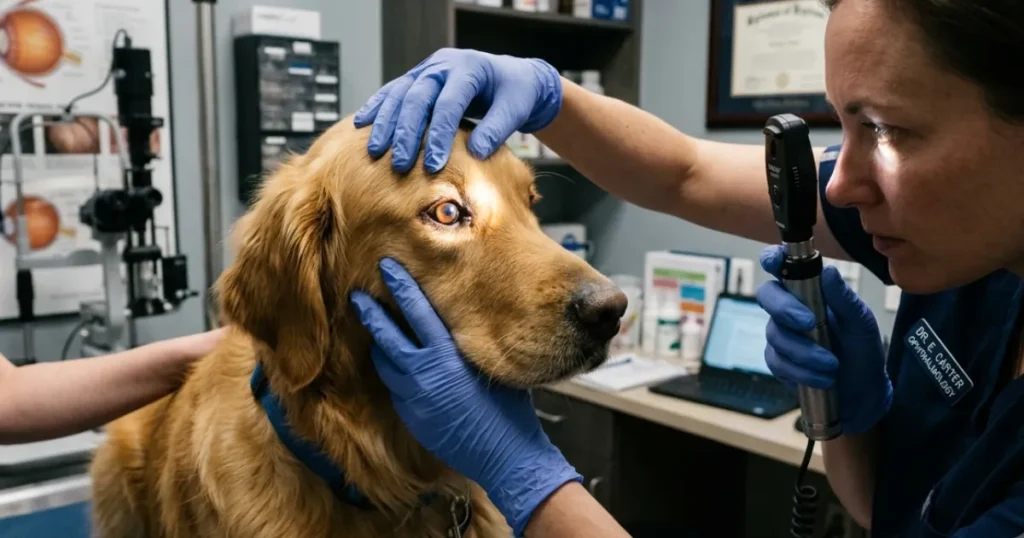
| Eye exam, repeated annually | Veterinary ophthalmologist (ACVO) | Cataracts, retinal disease, pigmentary uveitis |
| Cardiac exam | Veterinary cardiologist | Subvalvular aortic stenosis |
| Annual wellness bloodwork | Your vet | Hypothyroidism, kidney and liver trends |
| Dental checks and daily brushing | You, plus professional cleanings | Periodontal disease, which affects 80% of dogs by age 2 |
Here’s what I tell owners. Not “buy from a good breeder,” which is advice too vague to act on, but ask to see all four GRCA clearances by name, and walk away from any breeder who can’t produce them, because those certificates are the only version of disease prevention that happens before your puppy is even born. For dogs already in your home, the annual eye exam is the one owners skip most and the one this breed can least afford to skip, thanks to pigmentary uveitis. Every condition in this table has a full write-up in our health hub.
The Spot, Log, Book Rule for Any New Symptom
Owners don’t fail their Goldens by missing symptoms. They fail by noticing them and then doing nothing structured about it. This is the three-step rule I give every Golden owner, and it turns worry into a plan.
Spot.
Trust the first observation. If something made you look twice, it counts.
Log.
Write down the date, what you saw, and one photo or video if it’s visible. A limp on video is worth ten minutes of exam-room description, because dogs hide lameness the moment adrenaline hits the clinic floor.
Book.
Apply the timing rules. If the sign is in the urgent column above, then call immediately. If it’s a new lump, then book within one week, no exceptions. If it’s anything else that persists for 48 hours or keeps returning, then book within the week and bring your log. If the same problem recurs three times in a year, then stop treating episodes and ask your vet to hunt the underlying cause, because in Goldens, the third ear infection, the third hot spot, or the third stomach upset is a pattern wearing a costume.
Add omega-3 fatty acids, EPA and DHA dosed by your vet to body weight, for allergic skin and aging joints. That’s the one supplement with enough evidence behind it to earn a default place in this breed.
Expert Insight
Goldens are stoic to a fault, and the breed’s happy default face hides pain better than almost any dog I treat. When a Golden actually shows you something is wrong, it has usually been wrong for a while. Act on the first sign, not the third.
What are the most common golden retriever health issues?
Cancer, hip and elbow dysplasia, skin allergies, ear infections, hypothyroidism, heart disease, eye disease, and bloat. Cancer and joint disease are the two biggest across the breed.
Are golden retriever health issues preventable?
Many are reducible, not fully preventable. Lean weight, GRCA-cleared breeding lines, annual eye exams, and early lump testing prevent or soften most serious outcomes.
What health problems do Golden Retrievers have most as puppies?
Joint problems are common in puppies. Elbow dysplasia limping often appears before 12 months, alongside parasites, eating foreign objects, and ichthyosis flaking in affected lines.
When do golden retriever health problems usually start?
Joint signs can start under a year, allergies between 2 and 6, hypothyroidism in middle age, and cancer risk climbs sharply from age 8.
Why do Golden Retrievers have so many health concerns?
A small founding gene pool concentrated disease risk alongside the breed’s good traits, with an average inbreeding coefficient near 8 percent. Cancer predisposition is the clearest result.
Is it safe to buy a puppy without health clearances?
No. Skipping clearances means gambling on hips, elbows, eyes, and heart. Ask for OFA and eye and cardiac certificates by name before committing.
How often should dogs get professional dental cleanings?
As often as your vet advises, typically every 1 to 2 years. Dental disease affects 80 percent of dogs by age two, and daily brushing stretches the interval.
What happens if hip dysplasia goes untreated?
The joint degenerates into painful arthritis, muscle wasting, and a loss of mobility shrinks. Early management with weight control, omega-3s, and vet-guided treatment slows that slide substantially.
How long can dogs live with hypothyroidism?
A normal lifespan. Treated with daily levothyroxine, hypothyroid dogs typically regain energy and coat quality within weeks and live as long as unaffected dogs.
When should I take my dog to an emergency vet?
Go immediately for a swollen, tight belly with retching, collapse, pale gums, labored breathing, seizures, suspected poisoning, or an eye that’s suddenly painful or bulging.
Do Golden Retrievers need OFA hip and elbow screening?
Breeding Goldens, yes, absolutely. For pet Goldens, OFA films aren’t routine, but any young Golden with a persistent limp deserves radiographs without delay.
Can Golden Retrievers get skin problems from swimming?
Yes. Wet undercoat and damp ears set up hot spots and ear infections. Dry the coat and ears thoroughly after every swim, especially in summer.
Why do Golden Retrievers get ear infections so often?
Floppy ears trap moisture, and underlying allergies inflame the canal. Repeated infections usually signal atopic dermatitis rather than bad luck, so treat the allergy, not just the ear.
Are Golden Retrievers good candidates for pet insurance?
Yes, arguably the best candidates of any breed. With hemangiosarcoma, lymphoma, and joint surgery in the risk profile, insuring a Golden young locks in coverage before conditions appear.
When should I call the vet immediately about a lump?
Call immediately if a lump is bleeding, painful, or growing day to day. For any other new lump on a Golden, book a needle sample within one week.
The Bottom Line on Golden Retriever Health Issues
Golden retriever health issues are predictable, and predictable is beatable. Eight conditions cover most of what this breed faces, each keeps a rough calendar, and each has a screening test or an early sign that buys you options. Sort every symptom with the urgent vs monitor table, apply the Spot, Log, Book Rule to anything new, insist on the four GRCA clearances when buying, and never let a lump wait past a week.
Do those four things, and you’ve addressed the health concerns that actually shorten golden lives. For how all of this adds up to your dog’s years, read golden retriever lifespan, and go deeper on any single condition in the health hub.
Which golden retriever health issues did you deal with, and what was the first sign you noticed, looking back? If your vet caught something early at a routine visit, tell us what the screening was. Your answer helps the next owner recognize their dog’s first sign sooner.

Dr. Nabeel A.
Dr. Nabeel Akram is a Doctor of Veterinary Medicine with more than five years of hands-on experience in animal health, canine nutrition, and preventive care. He is a registered veterinarian with the Pakistan Veterinary Medical Council (PVMC), the statutory body regulating veterinary practice in Pakistan. As the founder of Golden Retriever Insight, Dr. Akram writes and medically reviews every health, nutrition, and grooming guide published on the site. His clinical interests include canine oncology, epilepsy management, and breed-specific nutrition for large breeds — the core topics this site covers. Every article is checked against current veterinary literature and sources such as the Merck Veterinary Manual, AVMA guidance, and peer-reviewed research.
Links will be automatically removed from comments.