
Anti-seizure medication for dogs comes in two forms that owners constantly confuse: a daily maintenance drug that lowers seizure frequency over time and a fast rescue medication you give at home to stop a seizure in progress. Most Goldens on long-term treatment need the first. Dogs with clusters often need both.
Here’s what I see at the exam table. Owners arrive with a daily pill bottle and no rescue plan, then panic during the next cluster because they have nothing to give. That gap is the most dangerous part of managing seizures, and it’s avoidable.
The most common first-choice rescue medications used to manage seizure emergencies at home are benzodiazepines, mainly diazepam and midazolam, which can be given by routes other than IV. Knowing which one your dog needs and how to give it is the heart of any real anti-seizure plan. Our overview of seizure activity in dogs sets the wider context.
What Anti Seizure Medication for Dogs Actually Includes
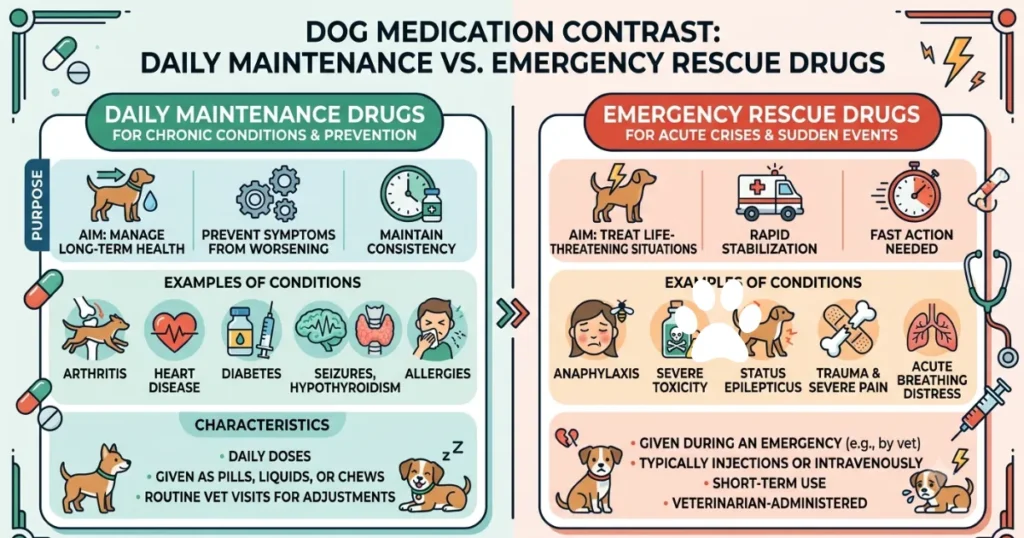
Anti seizure medication for dogs splits cleanly into daily maintenance drugs and emergency rescue drugs, and your Golden may need one or both. The daily drug works in the background. The rescue drug works in the moment.
Daily maintenance medication raises your dog’s seizure threshold so the brain misfires less often. Phenobarbital, dosed at around 2 to 5 mg/kg by mouth every 12 hours, is the first-choice daily option in dogs, according to the Merck Veterinary Manual, with levetiracetam a common, gentler partner. These build steady blood levels over days to weeks.
Rescue medication does the opposite job. It acts in minutes to halt a seizure that’s already happening or to break a cluster before it turns into status epilepticus. That speed is the whole point.
The mechanism is worth understanding plainly. Phenobarbital boosts the brain’s main calming signal, GABA, which dampens the runaway electrical activity that drives a seizure. Benzodiazepines like midazolam push the same GABA brake, but far faster, which is why they work as emergency drugs.
For a deeper breakdown of each daily drug and its monitoring, our guide to dog epilepsy medication goes drug by drug, so this page can focus on the rescue side most articles skip.
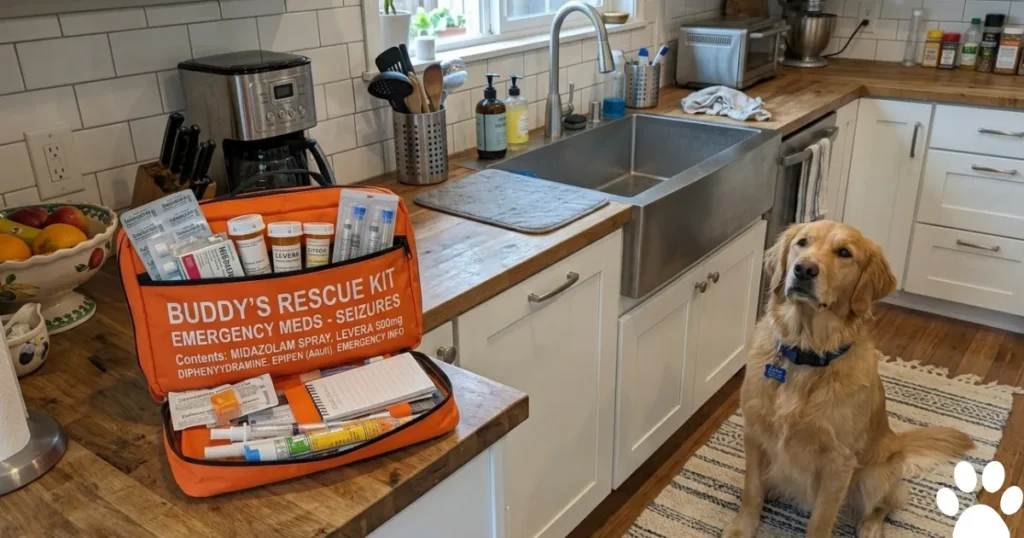
Why Golden Retrievers Often Need Anti Seizure Treatment Sooner
Golden Retrievers tend to surface as seizure patients in early adulthood, which moves anti seizure treatment conversations earlier than owners expect. The breed sits on the predisposed list for a reason.
A genetic study of idiopathic epilepsy in the Golden Retriever found that most affected dogs had generalized grand mal seizures, with onset within one to three years in 75% of cases and a clear predisposition in males. A young adult male golden with full-body convulsions fits that pattern almost exactly.
Clusters are the part that catches Golden owners off guard. A dog can be fine for weeks, then have several seizures in a single day. That clustering is precisely when a home rescue medication earns its place, because waiting out a cluster without one is how dogs end up in the emergency room.
In my practice, the Goldens whose owners cope best aren’t the ones with the rarest seizures. They’re the ones who treated the pattern early and kept a rescue dose on the shelf. You can compare seizure types in our breakdown of focal seizures versus generalized seizures.
Comparing Your Dog’s Anti Seizure Medication Options
For most Goldens, the choice isn’t one drug versus another so much as daily control versus emergency rescue, and how each fits your home. The table scores what owners actually feel.
| Option | Job | Speed | Where it’s given | Owner ease (1–5) |
| Daily phenobarbital | Lowers frequency | Slow build | At home, oral | 3 |
| Daily levetiracetam | Lowers frequency | Faster build | At home, oral | 4 |
| Rectal diazepam | Stops a cluster | Minutes | At home, rectal | 3 |
| Intranasal midazolam | Stops a cluster | Minutes | At home, nasal | 4 |
Research found that intranasal midazolam was a quick, safe, and effective first medication for controlling status epilepticus in dogs and appeared superior to rectal diazepam. That single finding shifts a lot of my rescue prescriptions toward the nasal route.
What I tell owners. Don’t choose your dog’s anti seizure medication off a forum thread. Choose the daily drug and the rescue drug together with your vet, built around your Golden’s seizure frequency and your ability to give each one calmly under pressure.
How to Give Emergency Rescue Medication to Your Dog at Home.
Give the prescribed rescue medication the moment a seizure passes the agreed trigger, usually a single seizure lasting over a few minutes or the second seizure in a cluster. Speed matters more than perfection.
Rectal diazepam, using the injectable solution, is routinely recommended as an at-home emergency treatment for dogs with a history of cluster seizures, and owners can give it up to three times in a 24-hour period. Your vet sets the exact dose and the spacing.
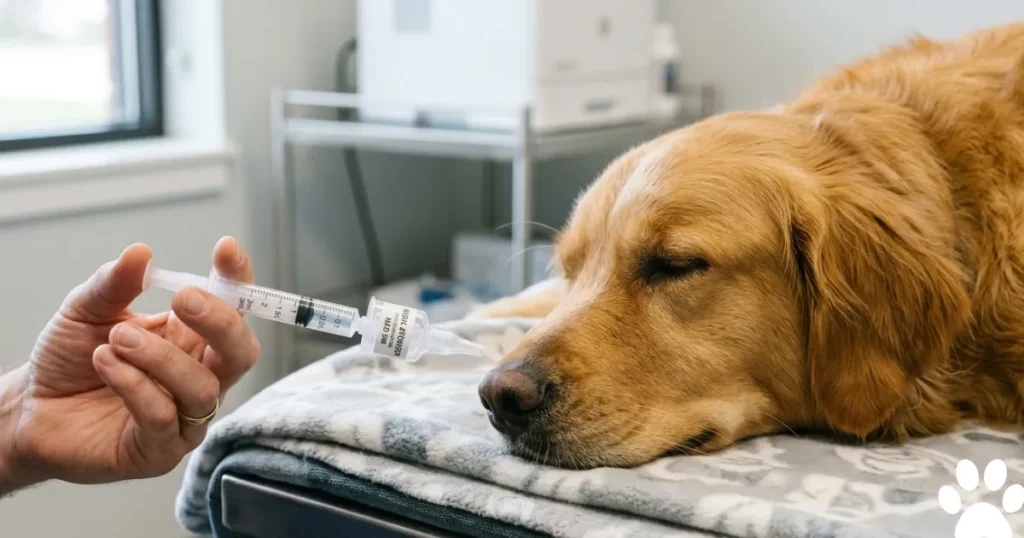
The nasal option often works better in practice. The recommended dose for intranasal midazolam in dogs is 0.2 mg/kg, given with an atomizer attached to a syringe, and it can be repeated up to three times within 24 hours with about two minutes between doses. One route warning matters a lot. Midazolam should not be given rectally, because absorption by that route is poor.
Here’s the owner error I see most. People predraw diazepam into plastic syringes and leave them ready. Diazepam should not be predrawn into plastic syringes because the drug sticks to plastic and degrades in light, which weakens the dose. Draw it fresh every time.
In an owner survey of seizure emergencies, reported success rates were 97% for intranasal midazolam and 63% for rectal diazepam, with higher owner compliance for the nasal route. That’s a meaningful gap when seconds count.
Canine Anti Seizure Care by Age: Puppy, Adult, and Senior Goldens.
Your Golden’s age changes both the likely cause of seizure and the right rescue approach, so canine anti-seizure care isn’t one size fits all. The same convulsion means different things at different stages.
Golden Retriever Puppies (8 Weeks to 18 Months).
In puppies, I rule out poisons, low blood sugar, and infection before labeling anything “epilepsy.” Dogs under one year are more likely to have a congenital defect, an intoxication, or an infectious disease such as canine distemper than primary epilepsy. Rescue dosing for tiny patients needs careful weight-based calculation.
Adult Golden Retrievers (2 to 7 Years).
This is the classic idiopathic window where most rescue prescriptions get written. An adult Golden with recurring clusters is the textbook candidate for a daily drug plus a home rescue dose. Treat the pattern; don’t chase single events.
Senior Golden Retrievers (8 Years and Older).
A first seizure in an older Golden gets a different workup from me. Dogs over six years old at their first seizure are more likely to have a metabolic disorder or a structural brain lesion such as a tumor or stroke. I push for imaging before settling on lifelong treatment, which our canine epilepsy resource explains further.

What Most Dog Anti Seizure Guides Get Wrong.
Most dog anti seizure guides describe daily pills and stop there, leaving out the home rescue plan entirely. For a breed prone to clusters, that omission is the dangerous one.
The breed factor they skip is the cluster pattern itself. A golden mid-cluster needs intervention in minutes, and a daily pill cannot do that. Only a fast-acting rescue drug can, which is exactly the piece most articles never mention.
The correction comes from current emergency guidance. The 2025 ACVIM consensus rates intranasal midazolam as a strongly recommended option for stopping seizures in dogs when IV access isn’t available, including at home. Ask your vet about it directly.
In a representative case, a 4 year old male Golden on daily phenobarbital had three seizures in one evening. His owners had no rescue medication and lost ninety minutes driving to an emergency clinic. The lesson I share: a daily drug is not a rescue plan.
The GRI Rescue Readiness Plan for Your Golden.
Use this named plan so you never freeze during your Golden’s next seizure. It turns a terrifying moment into three clear moves.
Step 1—Time it.
If a seizure starts, then note the time and stay away from the mouth. Call the vet now if it passes five minutes.
Step 2—Treat the cluster.
If a second seizure follows within hours, then give the prescribed rescue medication exactly as instructed and record the time. Repeat only up to your vet’s stated limit.
Step 3—Escalate.
If rescue medication fails to stop a seizure, or your Golden does not wake between events, then go to an emergency clinic immediately.
Tape this to the fridge tonight. In a real seizure, owners go blank, and a named step tells you which move comes next.
EXPERT INSIGHT
The owners who handle clusters best keep their rescue medication fresh and never predrawn and practice the nasal atomizer once while their Golden is calm. The first time you use it should not be the first time you’ve held the device. Verify phrasing with the reviewing vet.
EMERGENCY
If your Golden is seizing nonstop for over 5 minutes or has two or more seizures without fully waking between them, that is status epilepticus. Give the prescribed rescue medication if you have it and get to an emergency vet now.
When Home Anti-Seizure Treatment Is Not Enough.
Call the emergency vet the moment rescue medication fails, a seizure passes five minutes, or your Golden won’t regain consciousness between events. Everything else gets logged and reviewed.
| 🔴 URGENT — Emergency vet now | 🟢 MONITOR — Log and review |
| Seizure lasting 5 minutes or longer | Single brief seizure, full recovery |
| Rescue medication given but seizure continues | Known epilepsy, stable on daily medication |
| Not waking between repeated seizures | One mild seizure in a young adult Golden |
| First seizure in a senior Golden | Brief wobble that clears within an hour |
| Seizure plus high fever or collapse | Mild post-seizure confusion that resolves |
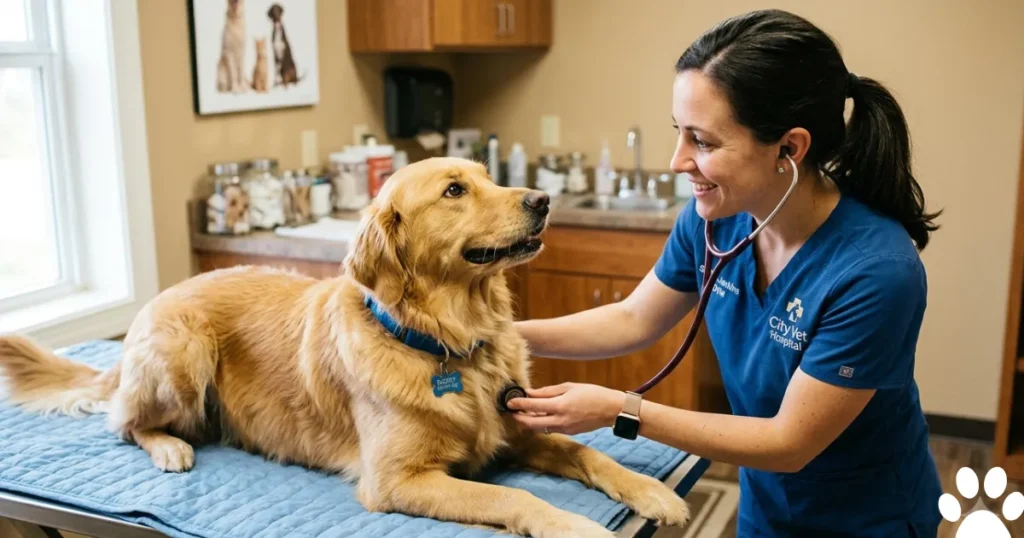
Best anti seizure medication for dogs?
Phenobarbital and levetiracetam are used for daily control. For emergencies, intranasal midazolam or rectal diazepam can stop seizures fast. The best anti seizure medication for dogs depends on seizure frequency and your home setup.
How long does anti seizure medication for dogs take to work?
Daily phenobarbital reaches steady levels in about two weeks; levetiracetam works within days. Rescue medications like midazolam act within minutes, which is exactly why vets prescribe them for clusters.
Is it safe to give a dog anti-seizure rescue medication at home?
Yes, when your vet prescribes and demonstrates it. Benzodiazepines like diazepam and midazolam are designed for home rescue use. Sedation and wobbliness are normal afterward, so never improvise the dose.
Does anti seizure medication have side effects in dogs?
Yes, daily phenobarbital commonly causes early sedation, thirst, and hunger that fade over weeks, plus the need for liver monitoring. Rescue benzodiazepines mainly cause short-term sedation and ataxia.
When should I start canine anti seizure treatment?
Usually after two or more seizures within six months, any cluster, or status epilepticus. Earlier treatment tends to control canine anti seizure cases better, so don’t wait through many uncontrolled episodes.
How often can I repeat anti seizure treatment at home?
Up to three times in 24 hours for most rescue benzodiazepines, spaced as your vet directs. If your dog needs more than that, the anti seizure treatment has failed, and it’s an emergency.
How much does dog seizure medication cost?
Generic phenobarbital is inexpensive monthly, though bloodwork adds cost. Rescue midazolam and diazepam cost more per dose but are used rarely. Budget for both the drug and periodic monitoring.
Can you give a dog seizure medication at home?
Yes, both daily pills and prescribed rescue medication are given at home. Daily drugs are taken by mouth on a fixed schedule. Rescue drugs go nasally or rectally only during a seizure emergency.
What happens if my dog has a seizure on medication?
Breakthrough seizures can still happen on daily medication. Give the prescribed rescue dose if it meets the trigger, log the event, and tell your vet, since the daily dose may need adjusting.
How often can you give a dog rescue medication?
No more than three times in a 24-hour window for most benzodiazepines, with vet-set spacing. Exceeding that limit signals status epilepticus and means an immediate emergency visit.
Do Golden Retrievers need anti seizure medication more than other breeds?
Golden Retrievers sit among the breeds predisposed to idiopathic epilepsy, alongside Labradors and Border Collies, per Cornell. Many need anti seizure medication, especially those with the breed’s cluster seizure tendency.
Why do Golden Retrievers have cluster seizures?
Golden Retrievers carry a genetic predisposition to idiopathic epilepsy, which can present as generalized grand mal clusters in early adulthood. Cluster patterns are why vets often prescribe a home rescue medication for the breed.
Can Golden Retrievers develop seizures from a brain tumor?
Yes, a first seizure in a senior Golden Retriever can signal a brain tumor. Given the Golden Retriever Lifetime Study’s reported 60% cancer rate, vets often image older Goldens before assuming epilepsy.
Do Golden Retrievers need rescue medication for cluster seizures?
Often yes. Golden Retrievers prone to cluster seizures benefit from a prescribed rescue medication like intranasal midazolam, which the 2025 ACVIM consensus rates highly for stopping seizures at home.
When should I take my Golden Retriever to the emergency vet for a seizure?
Go immediately if a seizure lasts over five minutes, rescue medication fails, or your Golden Retriever won’t wake between seizures. A single short seizure with full recovery can wait for a prompt visit.
Conclusion.
The right anti seizure medication for dogs works on two fronts: a daily drug that lowers how often your Golden seizes and a fast rescue medication that stops a cluster before it becomes an emergency. Your one move today: ask your vet whether your dog should have a home rescue dose and learn to give it before you ever need to. Treat the pattern early, keep the rescue drug fresh, and never predraw it into plastic.
If your Golden has a rescue medication on hand, did your vet prescribe rectal diazepam or intranasal midazolam, and how did the first real use go? Share your dog’s age at the first cluster too, since that early pattern is so common in this breed. Your experience could steady another owner facing their first scary night.