
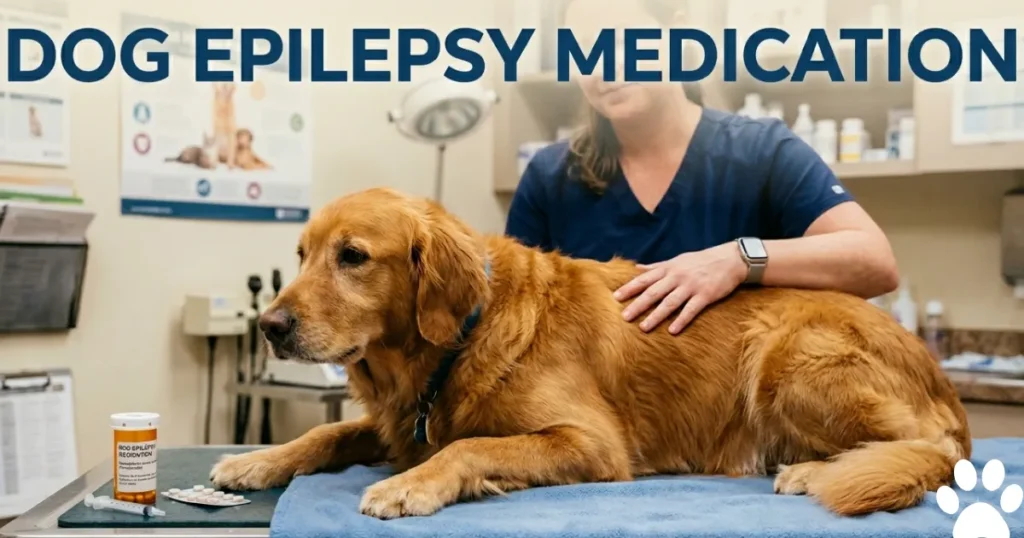
The right dog epilepsy medication won’t cure your Golden Retriever’s seizures, but it will usually cut how often and how hard they hit. For most Goldens diagnosed with idiopathic epilepsy, that means a daily anti-seizure drug, lifelong, with regular blood work. Phenobarbital, dosed at roughly 2 to 5 mg/kg by mouth every 12 hours, is the first medication most vets reach for in dogs, with levetiracetam now a common gentler partner or alternative.
Here’s what I see at the exam table. Owners arrive terrified that the medication itself will hurt their dog more than the seizures do. In Goldens specifically, that fear is usually misplaced. The bigger risk I watch for is an owner waiting too long to start or stopping the drug the moment seizures pause.
Dogs with idiopathic epilepsy typically begin seizing between 6 months and 6 years of age, with a median onset around 2.5 years, according to Cornell University’s Riney Canine Health Center. For a breed whose seizures cluster young, knowing your dog epilepsy medication options before the next episode is what keeps a scary night from becoming a crisis. You’ll find the same calm framework I use in practice further down, and you can read the bigger picture in our overview of seizure activity in dogs.
What Dog Epilepsy Medication Actually Does for Your Golden
Anti-seizure medication raises your Golden’s seizure threshold so the brain misfires less often and less violently. It manages the condition. It does not remove it.
That distinction matters because owners often expect a clean cure and then panic at the first breakthrough seizure. In my practice, the Goldens who do best are the ones whose owners understand the goal from day one. We’re aiming to reduce seizure frequency, shorten each event, and protect quality of life, not to hit zero seizures at any cost.
The ACVIM consensus on seizure management focuses on six antiepileptic drugs for dogs: phenobarbital, potassium bromide, primidone, imepitoin, levetiracetam, and zonisamide. Most Goldens I treat land on phenobarbital, levetiracetam, or a combination. The drug enters the picture once seizures meet a treatment threshold, which I’ll define precisely in a later section.
One honest caveat. Roughly 20% of dogs have refractory epilepsy and need more than one medication to gain control. If your Golden turns out to be in that group, it isn’t a failure on your part. It’s biology, and there are second and third options. For the mechanics of each drug, our guide to seizure medications used in dogs goes deeper than this overview.
Why Golden Retrievers Develop Epilepsy Earlier Than Owners Expect
Golden Retrievers tend to have their first seizure younger than many owners assume, often between one and three years old. That early window is the single most useful breed fact for timing diagnosis and treatment.
A genetic study of idiopathic epilepsy in the Golden Retriever found that most affected dogs showed generalized grand mal seizures, with onset within one to three years in 75% of cases and a significant predisposition in males. Reported mean ages of seizure onset in Goldens sit around 25 to 28 months across studies summarized by the International Veterinary Epilepsy Task Force. So a healthy two years old male Golden having his first full convulsion fits the classic idiopathic pattern almost perfectly.
Here’s the clinical reason this helps you. When a young adult Golden presents with that picture, idiopathic epilepsy moves to the top of my list, and medication conversations start sooner. The diagnostic question I ask first is the dog’s exact age at the first event, because the answer reshapes everything. You can compare seizure types in our breakdown of focal seizures versus generalized seizures.
It’s worth keeping the breed’s health context in view: the Golden Retriever Lifetime Study estimates that about 60% of Golden Retrievers die from cancer. That statistic becomes very relevant for older Goldens, which is why age changes the whole approach.
Dog Epilepsy Medication Options Compared
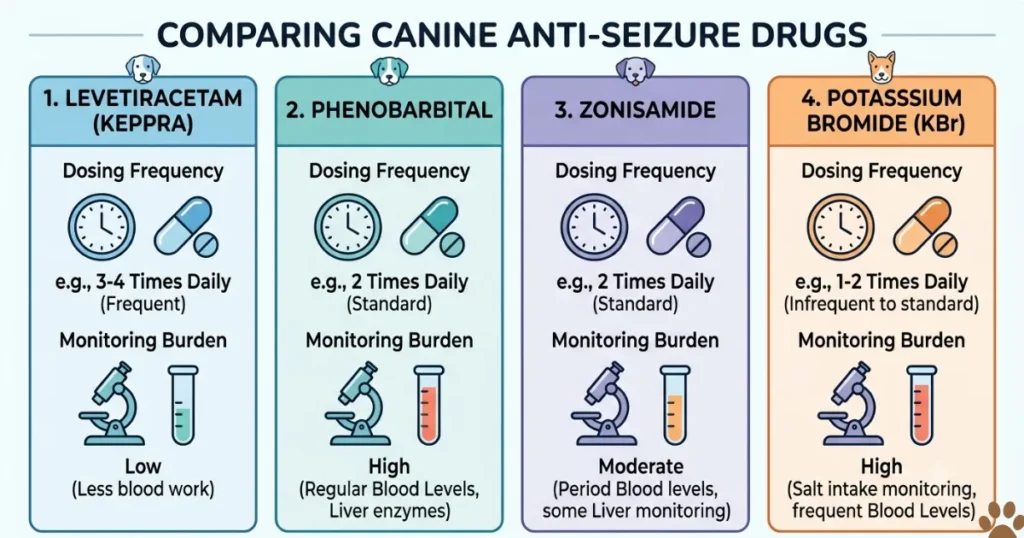
For most Goldens, the practical choice comes down to phenobarbital, levetiracetam, potassium bromide, or imepitoin. They differ most in monitoring burden and side effect profile, not in whether they “work.”
The table below scores each factor on the factors that owners actually feel day to day. I use a simple 1-5 weight, where higher means easier on you and your dog.
| Medication | Typical role | Bloodwork burden | Sedation early on | Owner ease (1–5) |
| Phenobarbital | First-line, daily | High (liver + drug levels) | Common, fades | 3 |
| Levetiracetam (Keppra) | First-line or add-on | Low | Mild | 4 |
| Potassium bromide | Add-on or alternative | Moderate (drug levels) | Common | 3 |
| Imepitoin (Pexion) | Idiopathic, milder cases | Low | Mild | 4 |
Monitoring is generally not required for imepitoin and levetiracetam, while phenobarbital and bromide need periodic serum level checks. That single fact drives a lot of my Golden owners toward levetiracetam first when finances or pill-timing stress are the limiting factor. The trade-off is dosing frequency, since levetiracetam is often given three times daily.
What I tell owners. Don’t pick a drug off a forum thread. Pick it with your vet around your Golden’s seizure frequency, your schedule, and your budget, because the “best” drug is the one you’ll actually give on time every day.
When to Start Epilepsy Medication: The Threshold Vets Use.
You generally start anti-seizure medication when your Golden has two or more seizures within six months, has cluster seizures, or has a single seizure tied to a known brain lesion. A lone, isolated seizure in a young golden often gets watched, not medicated.
The ACVIM defines acute repetitive seizure emergencies as an event lasting 5 minutes or longer, or 3 or more seizures within 24 hours. That pattern always triggers treatment and often an emergency visit. Below that line, the decision weighs frequency, severity, and your dog’s recovery between events.
Timing genuinely matters. Research summarized by the International Veterinary Epilepsy Task Force found that treatment response was better the earlier antiepileptic treatment began and the lower the pre-treatment seizure frequency. Waiting through many uncontrolled seizures can make the condition harder to manage later.
Before starting any dog epilepsy medication, I run baseline bloodwork. That gives me a liver and kidney snapshot to compare against, which protects your golden over the years of dosing. If you want the underlying triggers explained, see our piece on what causes dogs to have seizures.
Canine Epilepsy by Age: Puppy, Adult, and Senior Golden Retrievers.
Age changes what’s most likely causing the seizure, and that changes the plan. The same convulsion means different things in a 9 months old puppy, a 3 years old adult, and a 9 years old senior.
Golden Retriever Puppies (8 Weeks to 18 Months).
In puppies, I’m cautious about labeling seizures as epilepsy too fast. Dogs under one year are more likely to have a congenital defect, an intoxication, or an infectious disease such as canine distemper than primary epilepsy. Toxins and low blood sugar get ruled out first. Medication waits until those are excluded.
Adult Golden Retrievers (2 to 6 Years).
This is the textbook idiopathic epilepsy window for the breed and where most of my medication conversations happen. A structurally normal adult Golden with recurrent generalized seizures is the classic candidate for lifelong phenobarbital or levetiracetam. Treat early, log every event, and recheck levels.
Senior Golden Retrievers (7 Years and Older).
A first seizure in an older Golden is a different animal. Dogs over six years old at their first seizure are more likely to have a metabolic disorder or a structural brain lesion such as a tumor or stroke. Given the breed’s high cancer rate, I push harder for imaging in seniors before settling on a lifelong drug. You can read more on this pattern in our canine epilepsy resource.

What Most Dog Epilepsy Guides Get Wrong About Golden Retrievers?
Most guides treat every seizing dog the same and quietly assume the cause is idiopathic. For senior Goldens, that assumption is the dangerous one.
The breed-specific factor they skip is cancer risk. The Golden Retriever Lifetime Study, run by the Morris Animal Foundation since 2012 with more than 3,000 enrolled dogs, has documented the breed’s heavy cancer burden, with hemangiosarcoma and lymphoma among the most common. A new seizure in an eight years old Golden can be the first visible sign of a brain tumor, not garden-variety epilepsy.
The correction is simple. In a senior Golden, push for advanced imaging before committing to a lifelong daily drug because the medication you choose and the prognosis you give depend entirely on whether the brain is structurally normal. Starting phenobarbital and walking away would mask a treatable or time-sensitive problem.
In a representative case, a 9 years old female Golden presented after two seizures in one week. The owner assumed late-onset epilepsy and wanted to start phenobarbital that day. Imaging revealed a forebrain mass instead. The lesson I share with owners: in an older golden, the rush to medicate can hide the real diagnosis.
The GRI 3-Tier Seizure Response Framework.
Use this named framework to decide your Golden’s next step the moment a seizure ends. It sorts the chaos into three clear tiers.
Tier 1—Monitor.
If your Golden has one brief seizure, recovers fully within an hour, and is acting normally, then log the date, time, and length, and book a routine vet visit. Call sooner if a second seizure follows within the month.
Tier 2—Schedule.
If your Golden has two or more seizures in six months, then book a diagnostic workup and discuss starting dog epilepsy medication. Call the vet if events grow longer or more frequent before the appointment.
Tier 3—Emergency.
If a seizure lasts 5 minutes or longer, or your Golden has 3 or more in 24 hours, then go to an emergency clinic immediately. This is status epilepticus territory, and it’s life-threatening.
Print this and stick it on the fridge. In a real seizure, owners freeze, and a named tier tells you exactly which call to make.

When to Call the Vet about Your Golden’s Seizures.
Call your vet immediately for any seizure lasting over 5 minutes or any cluster. Anything else gets logged and monitored, then reviewed at your next visit.
| 🔴 URGENT—Call vet now | 🟢 MONITOR—Log and review |
| Seizure lasting 5 minutes or longer | Single seizure under 2 minutes, full recovery |
| 3 or more seizures in 24 hours | First mild seizure in a young adult Golden |
| Not regaining consciousness between events | Brief disorientation that clears within an hour |
| First seizure in a senior Golden | Known epilepsy, normal frequency, stable on meds |
| Seizure plus high fever or collapse | Mild post-seizure wobble that resolves |
EXPERT INSIGHT
The owners who manage epilepsy best aren’t the ones chasing zero seizures. They’re the ones who keep a precise seizure log and never stop the medication on their own. In Goldens, abrupt withdrawal of phenobarbital can trigger worse seizures than the dog ever had untreated.
EMERGENCY
If your Golden is seizing continuously for more than 5 minutes or has 3 or more seizures in 24 hours, call your vet or an emergency clinic now. That pattern is a medical emergency, not a wait and see situation.
Best dog epilepsy medication for a Golden Retriever?
Phenobarbital and levetiracetam are the usual first choices. Phenobarbital is most studied; levetiracetam needs no routine bloodwork. The best one fits your Golden’s seizure frequency, your schedule, and your budget.
How long does dog epilepsy medication take to work?
Phenobarbital reaches steady levels in about two weeks. Levetiracetam works within days. Your vet rechecks drug levels and seizure logs before judging whether the dose controls your Golden’s epilepsy.
Can dog epilepsy be cured?
No, idiopathic dog epilepsy is managed, not cured. Daily medication reduces seizure frequency and severity. Most dogs live full lives on treatment, though about 20% need more than one drug for control.
Does epilepsy medication have side effects in dogs?
Yes, early sedation, increased thirst, and appetite are common with phenobarbital and fade over weeks. Long-term use needs liver monitoring. Levetiracetam and imepitoin carry lighter side effect profiles.
At what age does canine epilepsy usually start?
Usually between 6 months and 6 years, with a median near 2.5 years. Onset outside that window raises suspicion of toxins in puppies or structural causes in seniors, per Cornell’s canine health center.
How often should seizure medication be given to dogs?
On a fixed daily schedule, never skipped. Phenobarbital is typically given every 12 hours; levetiracetam is often given every 8 hours. Consistent timing keeps blood levels steady and prevents breakthrough seizures.
How much does dog seizure medication cost?
Generic phenobarbital is inexpensive monthly, but bloodwork adds cost. Levetiracetam costs more per dose. Budget for both medication and the periodic monitoring your vet schedules across the year.
Can a dog live a normal life on seizure medication?
Yes, most dogs on well-managed anti-seizure medication play, train, and age normally. The goal is fewer, milder seizures and a good quality of life, not a perfectly seizure-free record.
How long can a dog stay on epilepsy medication?
For life, in most idiopathic cases. The medication is taken indefinitely and adjusted by your vet based on seizure logs and drug levels. Stopping suddenly can trigger severe rebound seizures.
Can you stop dog epilepsy medication suddenly?
No, never stop dog epilepsy medication abruptly. Sudden withdrawal of phenobarbital can cause status epilepticus. Any change must be a slow, vet-supervised taper, even if your dog has been seizure-free.
Do Golden Retrievers have a higher risk of epilepsy than other breeds?
Yes, Golden Retrievers are listed among breeds predisposed to idiopathic epilepsy by Cornell and the International Veterinary Epilepsy Task Force, alongside Labradors and Border Collies, with a noted predisposition in males.
Why do Golden Retrievers develop epilepsy so young?
Golden Retrievers show a genetic predisposition, with onset within one to three years in about 75% of affected dogs. Most present with generalized grand mal seizures during early adulthood rather than later in life.
Why do Golden Retrievers need bloodwork on epilepsy medication?
Because phenobarbital is processed by the liver and can affect liver enzymes over time. Periodic bloodwork lets your vet protect your Golden Retriever’s liver and confirm the drug sits in the effective range.
Can Golden Retrievers develop seizures from cancer?
Yes, a first seizure in a senior Golden Retriever can signal a brain tumor. Given the Golden Retriever Lifetime Study’s reported 60% cancer rate, vets often image older Goldens before diagnosing idiopathic epilepsy.
When should I call the vet if my golden retriever has a seizure?
Call immediately if a seizure lasts over 5 minutes or your Golden Retriever has 3 or more seizures in 24 hours. For a single short seizure, log it and book a prompt visit.
Conclusion.
The right dog epilepsy medication gives most Golden Retrievers a normal, happy life by cutting seizure frequency and severity, even though it won’t erase the condition. Your one actionable move today: start a seizure log with date, time, and length, because that record drives every dosing decision your vet makes. Treat early, never stop abruptly, and imagine any senior Golden’s first seizure before assuming it’s simple epilepsy.
If your Golden is on seizure medication and epilepsy medication, which drug did your vet start with, and how long did it take before you saw fewer episodes? Tell us your dog’s age at the first seizure, too, since the early-onset pattern is so common in this breed. Your story helps another worried owner reading this at 2 a.m. after their dog’s first scary night.

Dr. Nabeel A.
Dr. Nabeel Akram is a Doctor of Veterinary Medicine with more than five years of hands-on experience in animal health, canine nutrition, and preventive care. He is a registered veterinarian with the Pakistan Veterinary Medical Council (PVMC), the statutory body regulating veterinary practice in Pakistan. As the founder of Golden Retriever Insight, Dr. Akram writes and medically reviews every health, nutrition, and grooming guide published on the site. His clinical interests include canine oncology, epilepsy management, and breed-specific nutrition for large breeds — the core topics this site covers. Every article is checked against current veterinary literature and sources such as the Merck Veterinary Manual, AVMA guidance, and peer-reviewed research.