

What Causes Dogs to Have Seizures? Dogs have seizures when abnormal electrical activity fires through the brain in an uncontrolled burst. The trigger can be inside the brain, as in idiopathic epilepsy, or outside it, from toxins, organ failure, or metabolic collapse. For Golden Retrievers specifically, the cause distribution looks different from what most general guides describe, and missing that difference changes how fast you move.
In my practice, Goldens that present with a first seizure fall into two clear groups: dogs under 5 years, where idiopathic epilepsy is the overwhelming likelihood, and dogs over 7, where an underlying structural or metabolic cause demands faster investigation. Most online resources treat those groups identically. I don’t.
According to the Morris Animal Foundation’s Golden Retriever Lifetime Study, more than 60% of Golden Retrievers will be diagnosed with cancer in their lifetime. That makes intracranial neoplasia a cause of seizures; no golden retriever owner or vet should place it last on the differential list for older dogs.
Why Dogs Have Seizures: The Four Cause Categories
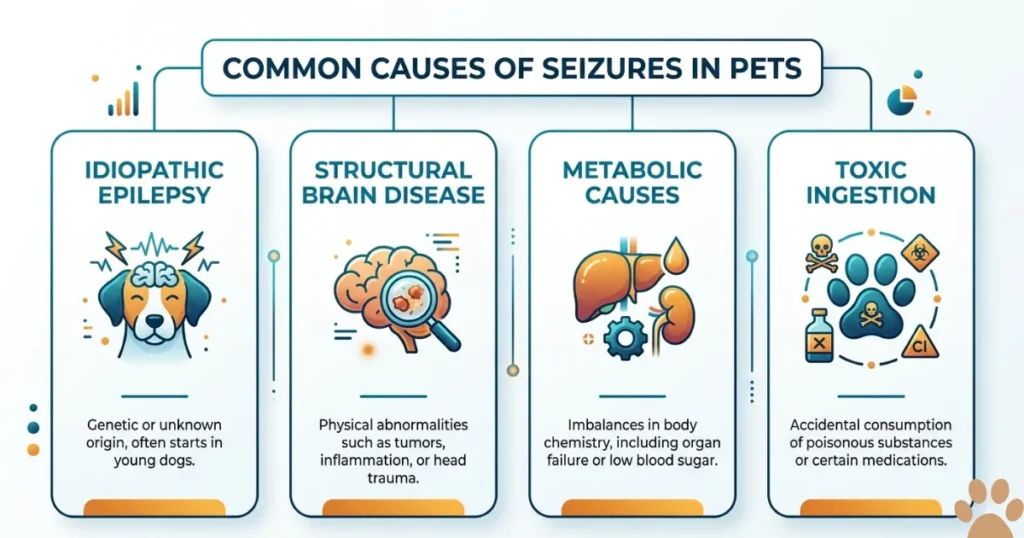
Dogs have seizures from four broad cause categories: idiopathic epilepsy, structural brain disease, metabolic and systemic disease, and toxic ingestion. Understanding which category applies to your dog determines how urgently you act and what tests your vet will run.
Idiopathic epilepsy is the most common cause of recurrent seizures in dogs and means the seizures originate from abnormal brain electrical activity with no identifiable underlying lesion. The AVMA and the American College of Veterinary Internal Medicine both define it as a diagnosis of exclusion, meaning your vet rules out all other causes first. In Goldens, idiopathic epilepsy most commonly surfaces between 1 and 5 years of age. I’ve seen owners of 8 years old Goldens told over the phone, “It’s probably epilepsy,” without bloodwork. That assumption is not safe in this breed past age 5.
Structural brain disease includes brain tumors (intracranial neoplasia), inflammatory brain disease (meningoencephalitis), and stroke. These cause seizures because the structural abnormality directly irritates or compresses brain tissue. In the general dog population, structural causes account for roughly 25% of seizure cases. In Golden Retrievers, given their documented cancer predisposition per the GRLS, that proportion rises. That’s why MRI is not optional when a Golden over 7 presents with a first seizure.
Metabolic and systemic disease causes seizures by disrupting the chemical environment the brain depends on. Hepatic encephalopathy, brain dysfunction caused by liver failure, is one of the most common metabolic seizure triggers I see. Other causes include hypoglycemia (blood sugar crash, more relevant in puppies and diabetic dogs), hypothyroidism, kidney disease with uremic toxins, and electrolyte imbalances. Seizures from metabolic causes almost always come with other signs: GI upset, lethargy, and increased drinking or urination. The brain is the last resort alarm, not the first sign of trouble.
Toxic ingestion produces some of the most severe and fastest-escalating seizures I manage. Xylitol, a sugar substitute found in peanut butter, gum, and sugar-free baked goods, causes acute hypoglycemia and liver failure in dogs by triggering a massive insulin release within 30 minutes of ingestion. Lead, mycotoxins from moldy food, and certain mushrooms also cause seizures. Permethrin-based flea and tick products labeled for cats are frequent because I see in multi-pet households where an owner applies a cat product to a dog by mistake.
For the full overview of how seizures present and how they’re classified, the seizures in dogs pillar guide covers the clinical picture in depth.
What Causes Seizures in Golden Retriever Puppies, Adults, and Seniors
The cause of a seizure in a 10 weeks old Golden is rarely the same as the cause in a 9 years old Golden. Treating these identically delays the right answer.
Golden Retriever Puppies (8 Weeks to 18 Months).
In puppies, hypoglycemia is my first concern. Golden puppies under 12 weeks have limited glycogen reserves and can crash blood sugar rapidly if they miss meals, are stressed, or have intestinal parasites sapping their nutrition. A 10-pound golden puppy needs to eat every 4-6 hours. A seizure in a puppy that skipped a meal is a hypoglycemic emergency until proven otherwise.
Portosystemic shunts, abnormal blood vessel connections that bypass the liver, are a congenital cause of seizures in young Goldens. The liver fails to filter toxins, and hepatic encephalopathy results. These puppies often have stunted growth and show neurological signs after eating. If your golden puppy seems to “zone out” or stumble after meals before 6 months of age, that history is clinically significant and needs a full liver panel, not a wait and see approach.
Adult Golden Retrievers (2-7 years).
This is the idiopathic epilepsy window. For a 3 years old, well-vaccinated, otherwise healthy Golden with a normal physical exam, the most statistically likely cause of a first tonic-clonic seizure is idiopathic epilepsy. Bloodwork and urinalysis should still confirm it. This age group doesn’t go straight to MRI on a first presentation if the basic workup is clean.
The most common mistake I see with adult Goldens is the owner attributing a first seizure to “stress” or “overheating” without any workup. It’s understandable because the dog recovers and seems fine. In Goldens specifically, skipping that first workup means missing the 3-6 month window where early idiopathic epilepsy is easiest to manage with phenobarbital or potassium bromide before seizure frequency climbs.
Toxic ingestion is also an adult-stage concern. Goldens are enthusiastic scavengers. Xylitol in a peanut butter treat, moldy compost, or a permethrin-based lawn treatment can trigger seizures within hours of exposure.
Senior Golden Retrievers (8 Years and Older).
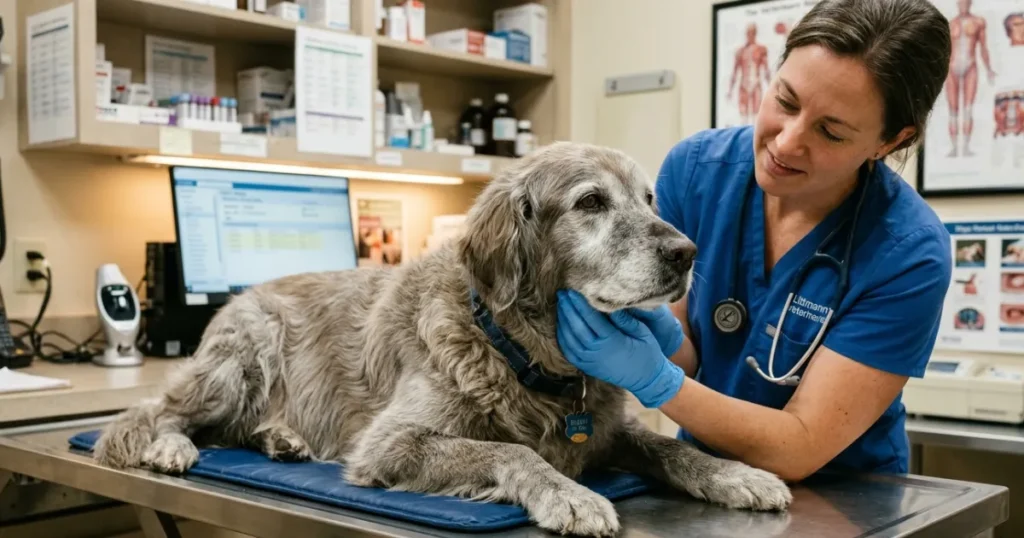
A first seizure in a Golden over 7 years old is a structural or metabolic cause until proven otherwise. I say it directly because the workup must match that assumption. Idiopathic epilepsy diagnosed for the first time after age 7 is rare. Intracranial neoplasia, hepatic encephalopathy from chronic liver disease, and hypertension-related brain injury are the causes I prioritize in this age group.
In March 2024, a 9 years old male golden named Biscuit presented with his first tonic-clonic seizure. The owner had initially attributed it to a thunderstorm the night before. Bloodwork revealed elevated liver enzymes. Abdominal ultrasound showed a hepatic mass.
Outcome: surgical consultation and dietary management. The owner’s observation that he’d been “a little slower” for two months, which she hadn’t mentioned because she thought it was aging, turned out to be the early clinical picture of hepatic encephalopathy. That’s the lesson. Don’t normalize subtle changes in a senior Golden.
What Most Seizure Guides Get Wrong About Golden Retrievers.
Most dog seizure guides list causes the same way: epilepsy first, then toxins, then “other.” For the average mixed-breed dog, that order is defensible. For Golden Retrievers, it leads owners and general practitioners to underweight the structural cause category in dogs over 6.
Here’s the gap: the Golden Retriever Lifetime Study, run by the Morris Animal Foundation, has established that Golden Retrievers develop cancer at more than twice the rate of most other breeds. Hemangiosarcoma, lymphoma, mast cell tumors, and osteosarcoma account for the majority of Golden deaths. Intracranial masses, primary brain tumors, or metastatic disease directly cause seizures by compressing or invading brain tissue.
Most online guides list “brain tumor” generically as a rare cause. In Golden’s over 7 years, it is not rare. It’s one of the primary differentials.
The clinical workup for a senior Golden with a first seizure should include a CBC and chemistry panel, a thorough physical exam for lymph node enlargement, a chest X-ray to screen for pulmonary metastases, and, in most cases, an MRI when basic imaging doesn’t explain the cause. According to the AVMA’s guidelines on intracranial disease, MRI is the gold standard for evaluating structural brain changes. In a breed with this cancer profile, that imaging should not wait until a dog has had five seizures.
I’ve seen two Golden Retriever cases in the past three years where a general-practice vet diagnosed idiopathic epilepsy in a dog over 7 and started phenobarbital before any advanced imaging. Both dogs later had mass lesions identified. That’s not a failure of intention. It’s a failure of breed-specific risk weighting.

What I tell owners: not “Let’s wait and see if it happens again,” but “Let’s rule out structural disease now, because in your breed, the stakes of missing it are higher than in a Labrador at the same age.” For more on how focal seizures present differently from generalized ones, see this guide on focal seizures in dogs.
The GRI Seizure Response Protocol: What to Do When Your Golden Has a Seizure.
Most guides say “stay calm and time the seizure.” That’s a start, but it leaves too much unanswered for the next 24 hours. The GRI Seizure Response Protocol gives you a named, step by step framework for the full event, from the first muscle twitch through the post-ictal recovery period, built specifically around the 60-75 lb Golden Retriever.
Step 1. Observe, don’t restrain.
Dogs cannot swallow their tongues during seizures. Putting your hands near a seizing golden’s mouth risks a serious bite from involuntary jaw movement. Clear the area of furniture and sharp objects. If your dog is near stairs, block access. Do not hold the dog down.
Step 2. Start the clock.
A seizure lasting 5 minutes or longer in a dog of any size is status epilepticus, a life-threatening emergency requiring immediate IV anticonvulsant therapy. Call your emergency vet the moment you start timing. Don’t wait to see if it stops.
Step 3. Reduce stimulation.
Dim the lights and lower the noise in the room. Post-ictal sensitivity to light and sound is common in Goldens. A dark, quiet space shortens recovery time in my experience.
Step 4. Post-ictal monitoring checklist.
In the 30 minutes after the seizure stops, note:
- Is your Golden able to stand without falling?
- Can they recognize you and make eye contact?
- Are they drinking water?
- Have they urinated or defecated involuntarily during or after the seizure?
Write these observations down with timestamps. Your vet needs this information. It’s often more diagnostically useful than a description of the seizure itself. For ongoing management, including what medications are used and when they’re started, this article on seizure medications for dogs walks through the decision framework.
When to go directly to the emergency vet (call immediately):
| Urgent — Call Vet Now 🔴 | Monitor at Home 🟡 |
| Seizure lasting more than 5 minutes | Single seizure under 2 minutes |
| Two or more seizures within 24 hours | Full recovery within 30 minutes |
| Dog not conscious or responsive after 30 minutes | Normal food/water interest within 2 hours |
| Suspected toxic ingestion (xylitol, permethrin, lead) | No history of toxin exposure |
| Dog under 6 months or over 8 years | Adult dog, ages 2–7, first occurrence |
| Known or suspected liver disease | Previously normal bloodwork |

Expert Insight
In my practice, the Goldens that recover most smoothly aren’t necessarily the ones with the mildest seizures. They’re the ones whose owners timed accurately and brought written notes to the appointment. A 90-second focal seizure witnessed clearly is more useful clinical information than “a few minutes, maybe?” of a generalized one. I’ve adjusted treatment plans based on owner-reported timing dozens of times. That detail changes the drug, the dose, and the urgency.
URGENT! Medical Review.
If your Golden had one brief seizure and is now alert, monitor at home and call your vet within 24 hours. Call your vet immediately if the seizure lasted longer than 5 minutes, if two or more seizures occurred within 24 hours, or if your dog has not recovered consciousness.

What causes dogs to have seizures?
Seizures in dogs come from four categories: idiopathic epilepsy; structural brain disease, including tumors; metabolic disorders like liver failure or hypoglycemia; and toxic ingestion, such as xylitol or lead. The cause determines urgency and treatment path.
What are the most common causes of seizures in dogs?
Idiopathic epilepsy is most common in dogs aged 1-5 years. Metabolic disease from liver or kidney failure is more common in older dogs. Toxic ingestion is the most common acute cause when exposure history is known.
What is idiopathic epilepsy in dogs?
Idiopathic epilepsy means recurrent seizures with no identifiable structural or metabolic cause. The AVMA defines it as a diagnosis of exclusion. It’s managed with anticonvulsants, including phenobarbital or potassium bromide.
Can a brain tumor cause seizures in dogs?
Yes. Intracranial neoplasia compresses or invades brain tissue and triggers abnormal electrical activity. In Golden Retrievers, the breed’s documented cancer predisposition makes this a priority differential for any dog over 7 with a first seizure.
What toxins cause seizures in dogs?
Xylitol causes acute hypoglycemia and liver failure within 30-60 minutes of ingestion. Lead causes neurological toxicity. Permethrin-based cat flea products applied to dogs and mycotoxins from moldy food also trigger seizures in clinical practice.
What does a focal seizure in dogs look like?
Focal seizures affect one body part, such as facial twitching, jaw snapping, or rhythmic limb movement on one side, while the dog stays conscious. In Goldens, focal seizures often precede a generalized tonic-clonic episode and should be timed and reported.
Can a dog die from a single seizure?
A single seizure under 5 minutes rarely causes death. Status epilepticus, seizures exceeding 5 minutes or cluster events without recovery between them, can cause brain damage and is life-threatening without immediate IV anticonvulsant treatment.
How long does a dog seizure usually last?
Most generalized tonic-clonic seizures last 1-3 minutes. Beyond 5 minutes is a veterinary emergency. The post-ictal period, confusion, disorientation, and hunger typically last 15-60 minutes after the seizure ends.
Should I take my dog to the vet after a first seizure?
Yes. A first seizure warrants a vet visit within 24 hours, even if recovery looks complete. A CBC and chemistry panel are the minimum workup needed to rule out metabolic and toxic causes before assuming idiopathic epilepsy.
Can dogs have seizures while sleeping?
Yes, and they’re distinct from normal REM twitching. Sleep seizures: the dog doesn’t respond to touch, the episode exceeds 30 seconds, and there is a post-ictal disorientation period. Normal REM dreaming resolves immediately when the dog wakes.
Do Golden Retrievers have a higher risk of seizures than other breeds?
Yes. Golden Retrievers have elevated risk from two directions: idiopathic epilepsy occurs at higher rates than in mixed-breed dogs, and the Morris Animal Foundation’s Golden Retriever Lifetime Study confirms a cancer predisposition that raises structural seizure risk after age 7.
How does idiopathic epilepsy affect Golden Retrievers differently from Labradors?
Goldens have a narrower epilepsy onset window (1-5 years) and higher lifetime cancer risk than Labradors. After age 5, diagnostic workup for a seizing Golden should be more aggressive because neoplastic causes are a more realistic differential than in a Labrador of equal age.
At what age do Golden Retrievers typically develop seizures from idiopathic epilepsy?
Golden Retrievers with idiopathic epilepsy typically have their first seizure between the ages of 1 and 5. Onset after age 6 should prompt structural and metabolic investigation first rather than a default epilepsy diagnosis.
What does the Golden Retriever Lifetime Study show about cancer and seizures?
The Morris Animal Foundation’s Golden Retriever Lifetime Study found that over 60% of Goldens develop cancer during their lifetime. Intracranial neoplasia from primary or metastatic disease directly causes seizures, making this a primary differential in senior Goldens with new-onset seizures.
My dog is having a seizure right now. What do I do?
Clear the area, don’t restrain the dog, and start timing. Call your emergency vet immediately if it reaches 5 minutes. That’s status epilepticus. If it stops within 2 minutes and your dog recovers, call your regular vet within 24 hours with the duration and recovery notes.
Conclusion: What This Means for Your Golden.
Seizures in dogs are caused by abnormal brain electrical activity triggered by idiopathic epilepsy, structural brain disease, metabolic disorders, or toxic ingestion. For Golden Retrievers, the cause distribution shifts meaningfully with age: epilepsy is the dominant cause under 5, while structural and metabolic causes, including intracranial neoplasia, which this breed develops at an outsized rate, take priority in dogs over 7. A first seizure always needs a vet call and basic bloodwork. A first seizure in a senior Golden needs an urgent workup with advanced imaging on the table.
If your Golden has had a seizure, write down the time, duration, what the body did, and what the recovery looked like. Bring that note to your vet. It changes the conversation.
Have you seen a first-time seizure in your Golden Retriever? How old were they, and did bloodwork reveal anything unexpected? Share what your vet found; it helps other Golden owners know what to watch for.

Dr. Nabeel A.
Dr. Nabeel Akram is a Doctor of Veterinary Medicine with more than five years of hands-on experience in animal health, canine nutrition, and preventive care. He is a registered veterinarian with the Pakistan Veterinary Medical Council (PVMC), the statutory body regulating veterinary practice in Pakistan. As the founder of Golden Retriever Insight, Dr. Akram writes and medically reviews every health, nutrition, and grooming guide published on the site. His clinical interests include canine oncology, epilepsy management, and breed-specific nutrition for large breeds — the core topics this site covers. Every article is checked against current veterinary literature and sources such as the Merck Veterinary Manual, AVMA guidance, and peer-reviewed research.