Thyroid medication for dogs means levothyroxine sodium in nearly every case, a synthetic thyroxine (T4) that replaces what the underactive thyroid no longer produces. For Golden Retrievers, the standard starting dose is 0.02 mg/kg twice daily; the medication is lifelong, and dose adjustments depend on T4 bloodwork at 6 weeks after starting or after any change.
In my practice, owners who manage this well understand three things from day one: the dose is a starting point, not a fixed number; the 6-week recheck is non-negotiable; and what their Golden eats in the hour surrounding the pill matters more than most guides acknowledge.
Levothyroxine sodium is FDA-approved for dogs under the trade name Soloxine, among others. According to the Merck Veterinary Manual, the standard canine starting dose is 0.01-0.02 mg/kg twice daily, adjusted based on serum T4 measured 4-6 hours post-dose. Golden Retrievers, with their weight range of 60-75 lbs and autoimmune-driven diseases, typically start at 0.02 mg/kg BID, the upper end of this range.
How Thyroid Medication Works Differently in Golden Retrievers
Levothyroxine replaces the T4 that the damaged thyroid no longer produces. In healthy thyroid function, T4 is released continuously and converted peripherally to the more active T3. When the gland fails from autoimmune thyroiditis, the dominant mechanism in Golden Retrievers is that the continuous supply stops. Oral levothyroxine restores it.
Here’s what most general guides don’t address specifically for Goldens.
Why Twice-Daily Dosing Is the GR Standard
Many hypothyroid dogs in other breeds are managed on once-daily dosing. Golden Retrievers with autoimmune thyroiditis show greater inter-dose T4 variability than dogs with idiopathic thyroid atrophy. The immune-driven mechanism doesn’t produce a flat baseline; residual thyroid function fluctuates episodically. Splitting the dose evens out the serum T4 curve over 24 hours more effectively.
In my practice, Goldens on once-daily dosing showed more variable T4 readings and inconsistent energy levels at their 6-week rechecks compared to dogs on BID protocols. The goal is a stable T4, not just an adequate peak once per day.
Brand vs Generic: The Formulation Consistency Question
Thyroid medication for dogs comes in brand-name Soloxine and generic levothyroxine formulations. Generic is clinically effective and widely prescribed. The practical concern isn’t generic itself; it’s switching between formulations. Different manufacturers produce tablets with slightly different absorption profiles. A golden stabilized on Soloxine at a set dose may need re-monitoring if switched to a generic, and vice versa.
What I tell owners:
Pick one formulation and stay on it. If cost drives a switch, schedule a 6-week T4 recheck as if it were a new prescription. The Merck Veterinary Manual notes that absorption differences between levothyroxine products can be clinically significant in some dogs.
Thyroid Meds for Dogs by Life Stage: Dosing Goldens from Adult to Senior
Levothyroxine dosing isn’t static across a Golden’s life. Weight, metabolic rate, and concurrent conditions all shift what the right dose looks like.
Golden Retriever Puppies (Under 18 Months): Rare but Precise
Congenital hypothyroidism in Golden Retriever puppies is uncommon, but dosing is more exacting than in adults. Standard starting dose: 22 µg/kg/day divided into two doses. Puppies require T4 rechecks at 4 weeks, not 6 weeks, because growth velocity changes faster. Underdosing risks impaired bone development and cognitive delay.
Adult Golden Retrievers (2-7 Years): Calculating the Starting Dose
For a 65-lb (29.5 kg) adult Golden, 0.02 mg/kg BID equals approximately 0.59 mg per dose. Most practices round to the nearest available tablet size, typically 0.5 mg or 0.7 mg BID, and confirm at the 6-week recheck. Post-treatment T4 target for adult Goldens: 2.0-3.5 µg/dL measured 4-6 hours after the morning dose. Values consistently above 4.0 µg/dL indicate overdose risk. Values below 1.5 µg/dL at 6 weeks indicate under-treatment; increase the dose by 25%.
Senior Golden Retrievers (8 Years and Older): Dose Reductions Are Common
Senior Goldens frequently need lower doses as body mass decreases and concurrent conditions alter drug metabolism. I review the dose of every hypothyroid Golden at age 8 regardless of apparent stability. A Golden maintained on the same dose prescribed at age 5 is frequently running higher T4 levels than intended by age 9, producing subclinical hyperthyroid effects that owners often attribute to anxiety or aging.

What Most Canine Thyroid Medication Guides Get Wrong for Golden Retrievers
Three consistent gaps appear in the top-ranking resources on thyroid medication for dogs. All three are directly relevant to Golden Retriever owners.
The Food Interaction No Guide Mentions
Soy isoflavones reduce levothyroxine absorption in dogs. Golden Retrievers are frequently fed grain-free diets that substitute legumes, including soy protein concentrate, for grain-based carbohydrates. Several popular large-breed grain-free formulas contain enough soy-derived ingredients that a Golden eating breakfast within 30 minutes of a levothyroxine dose may absorb 20-30% less medication than intended, per veterinary pharmacokinetic data.
Calcium carbonate supplements have a similar, lesser effect. If your Golden is on a joint supplement containing calcium, commonly given due to the breed’s hip dysplasia predisposition, give levothyroxine at least one hour before that supplement.
What I tell owners:
Give the pill at least 30 minutes before the first meal, ideally one hour. If the diet is grain-free with legume protein, flag it explicitly at every recheck. It may explain a persistent under-response to an apparently adequate dose.
The Blood Draw Timing Problem
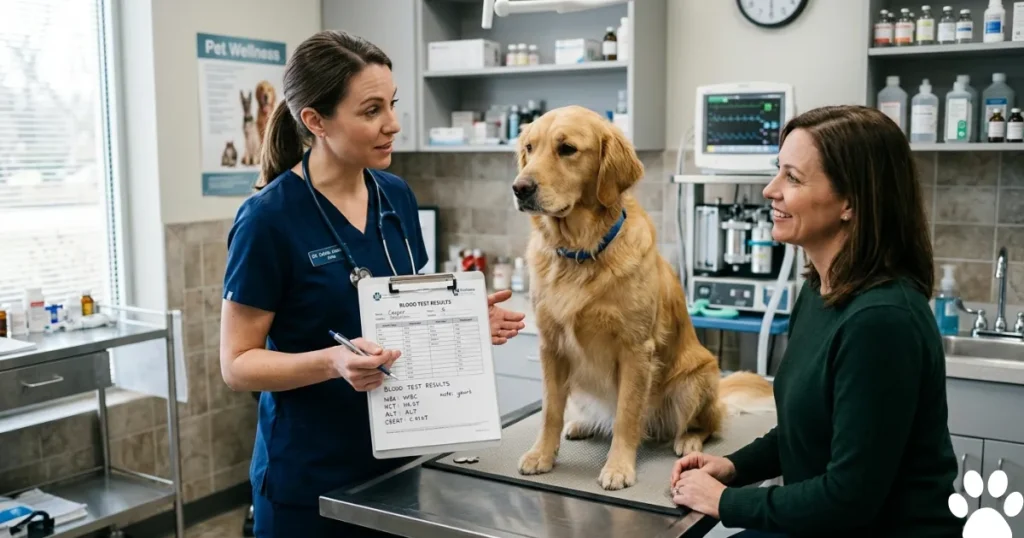
Most guides mention a 4-8 week monitoring recheck. None specifies when during that day to draw blood, and the timing can significantly affect the result. T4 peaks 4-6 hours after an oral levothyroxine dose. A draw at 8-9 hours post-dose shows a materially lower value.
In November 2022, a 5 years old female Golden, 31 kg, had a recheck at a covering clinic. Blood was drawn approximately 9 hours post-dose. T4 returned at 1.1 µg/dL; the covering vet increased the dose. At her next visit, blood drawn at 5 hours showed T4 at 3.2 µg/dL. She’d been overdosing for 6 weeks. Signs: mild restlessness and slightly elevated resting heart rate, which the owner attributed to anxiety. Dose was reduced; signs resolved in two weeks. The timing of the blood draw was as consequential as the value itself.
The Overdose Risk Golden Retriever Owners Need to Know
Levothyroxine overdose produces iatrogenic hyperthyroidism: rapid heart rate, increased appetite, excessive panting, hyperactivity, and weight loss. In Golden Retrievers specifically, a breed with an elevated risk of dilated cardiomyopathy and subaortic stenosis per AKC breed health data, a sustained overdose places cardiac stress that’s clinically more significant than in lower-risk breeds. A resting heart rate consistently above 140 bpm in an overdosed Golden warrants same-day vet contact, not monitoring.
The GRI Dose-Check Protocol: Monitoring Thyroid Meds in Your Golden
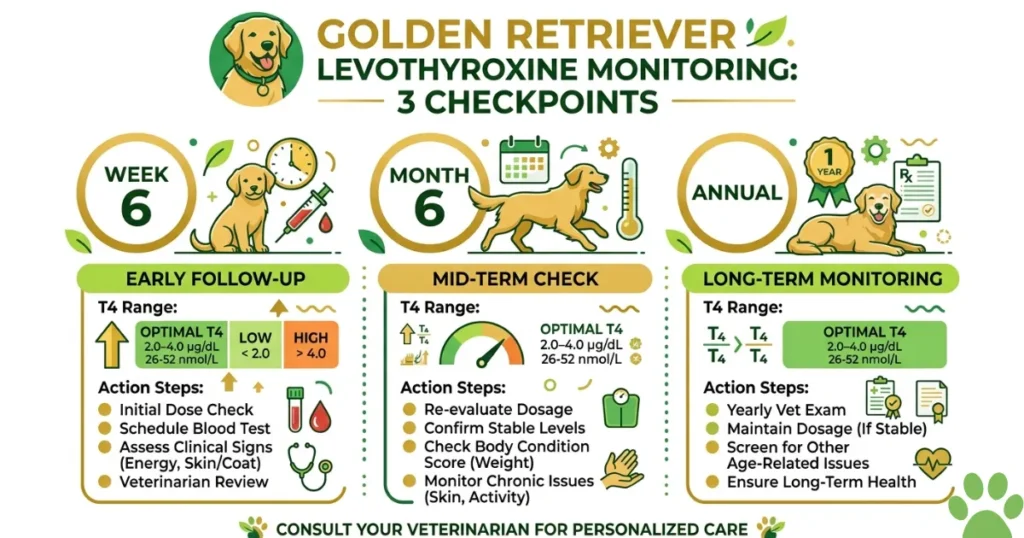
The GRI Dose-Check Protocol is the three-checkpoint monitoring schedule I use for Goldens on thyroid medication for dogs. It’s designed to catch under-treatment, overdose, and food-interaction effects at the intervals that matter clinically.
Checkpoint 1—Week 6 after starting or after any dose change:
Blood draw 4-6 hours after morning dose. T4 target: 2.0-3.5 µg/dL. Below 1.5 µg/dL: increase dose by 25%, repeat in 6 weeks. Above 4.0 µg/dL: reduce dose by 20%, repeat in 6 weeks. Between 1.5 and 2.0 µg/dL with persistent symptoms: review diet for soy and calcium, confirm dosing timing, and re-evaluate before changing dose.
Checkpoint 2—Month 6 on stable dose:
Blood draw 4-6 hours after morning dose. Add a full chemistry panel, including cholesterol. Elevated cholesterol despite normal T4 suggests an absorption issue. If Golden is 7 or older, recalculate dose against current weight.
Checkpoint 3—Annual (ongoing):
Full thyroid panel with TSH. Review the weight trend. Review diet for soy and calcium changes. For Goldens aged 8 and older: recalculate dose by current body weight regardless of apparent stability.
Call your vet the same day if your Golden shows a resting heart rate above 140 bpm, sudden weight loss exceeding 5% of body weight over 4 weeks, or severe restlessness or panting at rest.
| Checkpoint | Timing | T4 Target | Action if Out of Range |
| 1 | Week 6 | 2.0–3.5 µg/dL | Adjust ±20–25% |
| 2 | Month 6 | 2.0–3.5 µg/dL | Chemistry panel + diet review |
| 3 | Annual | 2.0–3.5 µg/dL | Recalculate dose by current weight |
| Overdose signs | Any time | — | Same-day vet contact |
Expert Insights
“The owners who manage thyroid medication best in their Goldens aren’t the ones who ask me what the right dose is. They’re the ones who track the timing of every blood draw and list everything their dog eats. I’ve had Goldens whose T4 looked subtherapeutic on a grain-free soy diet with the pill given 10 minutes before breakfast. Same dose, switch to 30 minutes pre-meal on a non-soy formula, and the next T4 is perfect. The medication hadn’t changed. The absorption had.”
What thyroid medication for dogs is most commonly prescribed?
Levothyroxine sodium is the standard thyroid medication for dogs with hypothyroidism. Available as brand-name Soloxine and in generic forms, both are effective. Consistency within one formulation matters more than which product is chosen.
How is this medication given each day correctly?
Give levothyroxine orally as a tablet, twice daily, for Golden Retrievers. Administer at least 30 minutes before the first meal and 1 hour before any calcium supplement to maximize absorption.
Are thyroid meds for dogs available without a prescription?
No effective thyroid meds for dogs are available without a prescription. Levothyroxine requires a veterinary prescription and dose confirmation by bloodwork. Over-the-counter thyroid supplements lack clinical efficacy evidence.
How does levothyroxine, as canine thyroid medication, restore metabolism?
Levothyroxine restores thyroxine levels in the bloodstream, restarting metabolic processes, heat production, weight regulation, cardiac rate, and skin cell turnover that T4 deficiency had slowed. Clinical improvement begins within 4-8 weeks.
How long do dogs stay on thyroid medication?
Dogs with hypothyroidism stay on thyroid medication for life. Autoimmune thyroiditis in Golden Retrievers permanently destroys thyroid tissue. Stopping levothyroxine causes T4 to drop and symptoms to return within 4-8 weeks.
What happens if a dog misses a dose of thyroid medication?
Give the missed dose if within 4 hours of the scheduled time. Beyond 4 hours, skip it and continue the regular schedule. Don’t double the next dose. One missed dose won’t cause a clinical relapse.
Can a dog overdose on thyroid medication?
Yes. Levothyroxine overdose produces iatrogenic hyperthyroidism: rapid heart rate, restlessness, excessive panting, increased appetite, and weight loss. Call your vet the same day if your dog shows these signs.
What foods interfere with thyroid medication in dogs?
Soy isoflavones and calcium carbonate both reduce levothyroxine absorption. Grain-free diets with legume protein and calcium joint supplements are the most common sources for golden retrievers. Give thyroid medication at least 30 minutes before any meal or supplement.
How much does thyroid medication cost for dogs per month?
Generic levothyroxine for a 65-lb golden typically costs $20–$45 monthly. Brand-name Soloxine runs $40–$80. Twice-yearly monitoring panels add $80–$160 per visit.
How long before thyroid medication starts working in dogs?
Most dogs show improved energy within 2-4 weeks. Weight loss and coat recovery take 2-4 months. A T4 recheck at 6 weeks confirms whether the dose is therapeutic before assuming the medication isn’t working.
What is the correct levothyroxine dose for a Golden Retriever?
The starting dose for a Golden Retriever is 0.02 mg/kg twice daily. For a 65-lb (29.5 kg) Golden, that’s approximately 0.6 mg BID, confirmed at a 6-week recheck targeting T4 of 2.0-3.5 µg/dL measured 4-6 hours post-dose.
How often should a Golden Retriever on thyroid medication have a blood test?
T4 recheck at 6 weeks after starting any dose change, then at 6 months on a stable dose, then annually. Senior Goldens aged 8 and older should have their dose recalculated by their current body weight at every annual check.
Do Golden Retrievers absorb thyroid medication differently than other breeds?
The difference comes from diet, not breed biology. Goldens are frequently fed grain-free kibble with soy protein, which reduces levothyroxine absorption by up to 30%. A diet review is a necessary part of every thyroid medication recheck in this breed.
What are the signs of too much thyroid medication in a Golden Retriever?
Signs include resting heart rate above 140 bpm, restlessness, excessive panting, sudden weight loss, and increased appetite. Given the Golden Retriever’s elevated cardiac disease risk per AKC breed health data, sustained overdose warrants same-day vet contact.
My Golden Retriever has been on thyroid medication for 6 weeks. How do I know it’s working?
Schedule a T4 blood draw now, at 4-6 hours after the morning dose. Target: 2.0-3.5 µg/dL. Improved energy, stable or declining weight, and better coat texture alongside an in-range T4 confirm the dose is working. An out of range T4 means adjustment is needed.
Conclusion | Managing Thyroid Medication for Dogs: What the First Year Requires.
Thyroid medication for dogs is well-tolerated and genuinely transformative for most Golden Retrievers, but only if the monitoring is done right. The dose that starts treatment is rarely the dose that stays. The 6-week recheck, the blood draw timing, and the diet review are what separate a well-managed hypothyroid Golden from one that’s been adequately medicated on paper while remaining under- or over-treated in practice.
Follow the GRI Dose-Check Protocol checkpoints, watch for food interactions with soy and calcium, and recalculate dose by current weight at every annual check for Goldens over 8. For the full diagnostic process and the GRI Thyroid Check Protocol, see our hypothyroidism in dogs overview. For symptom staging before and during treatment, the hypothyroidism symptoms in dogs guide covers what to watch for.
If your Golden has been on thyroid medication for three months or more, what did you notice changing first, and how long did it take? Owner timelines in the comments help other families know what to expect in those early weeks.