
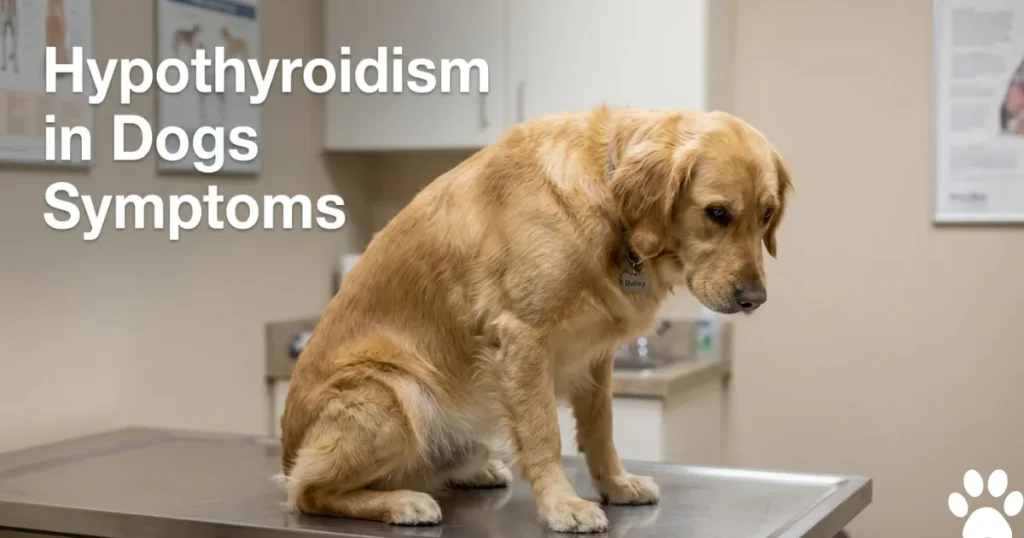
The hypothyroidism in dogs symptoms that Golden Retriever owners notice first are not the ones most guides list first. Weight gain on an unchanged diet, cold intolerance, and reduced activity appear months before visible coat changes, and in Goldens, the alopecia that most checklists lead with typically shows up 6 to 18 months after the metabolic signs.
I’ll be honest: the standard symptom list, hair loss, weightgain, and, lethargy, is accurate but ordered wrong for this breed. A golden’s dense double coat hides early follicular changes. What owners actually catch first are metabolic and behavioral shifts. Acting on those earlier signs is the difference between diagnosis at 4 years versus 6, after the condition has been silently progressing for two years.
According to the Orthopedic Foundation for Animals (OFA), Golden Retrievers are a high-risk breed for autoimmune thyroiditis. The Golden Retriever Lifetime Study, managed by the Morris Animal Foundation, tracks endocrine conditions in its 3,000+ dog cohort, with data supporting thyroid screening at age 4, not at the first visible coat change.
Why Golden Retrievers Show Hypothyroidism Symptoms Differently Than Other Breeds
The hypothyroidism symptoms in dogs of this breed follow a sequence that differs from short-coated breeds. Two factors specific to Golden Retrievers explain why.
The Double Coat That Delays Visual Detection
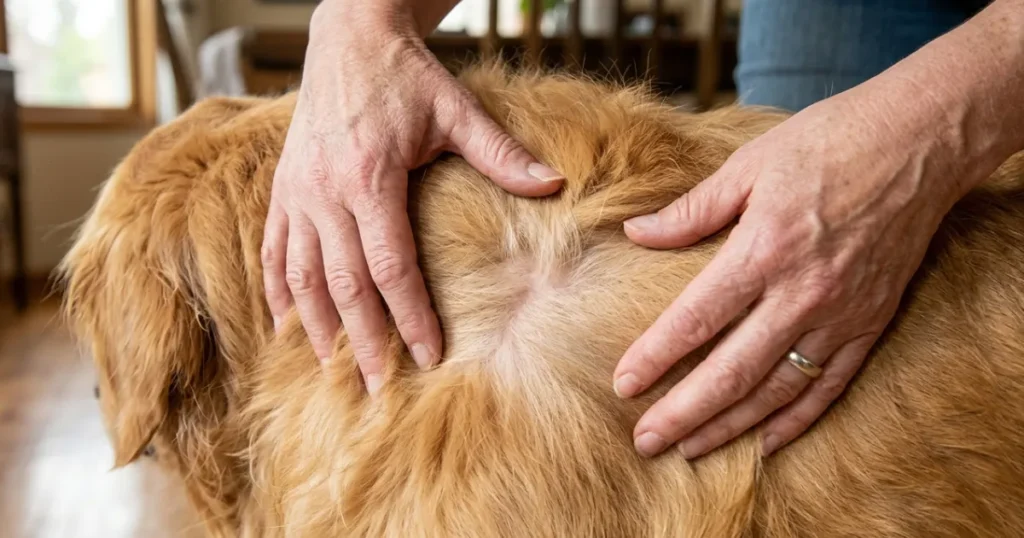
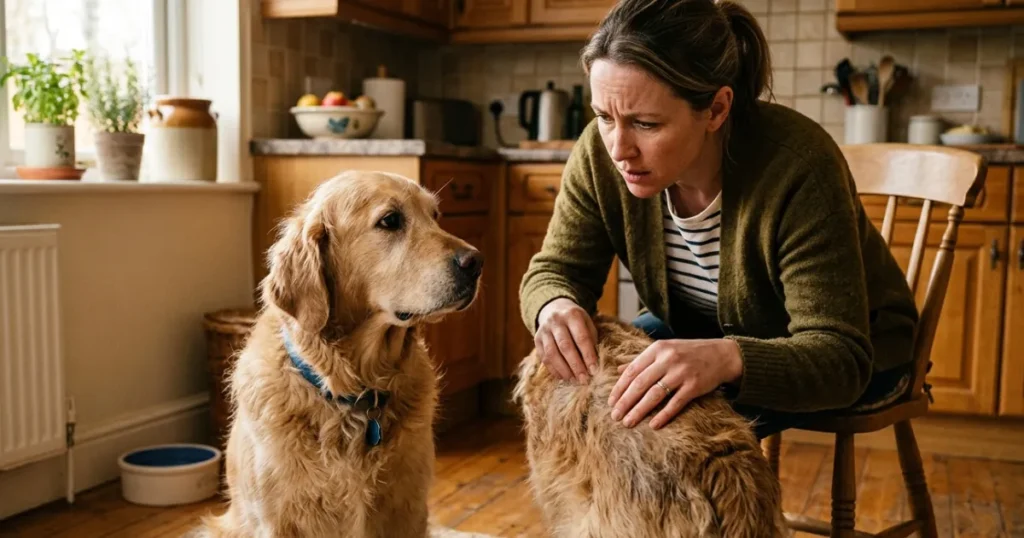
A Golden’s undercoat can be thin enough that you can part the fur and read print through it, while the outer coat still looks full to the owner. In short-coated breeds like Dachshunds, bilateral flank alopecia becomes visible when 20-30% of follicles stop cycling. In Goldens, the same degree of follicular disruption remains invisible for months longer. By the time coat changes are obvious to an untrained eye, the condition has usually been present for over a year.
This changes the clinical rule for Goldens: don’t wait for hair loss. The coat is a lagging indicator.
The Autoimmune Fluctuation Problem
Autoimmune thyroiditis in Golden Retrievers causes episodic immune-mediated tissue destruction rather than a steady linear decline. This creates an inconsistent symptom picture; some weeks the dog seems more energetic, the next week less so. In my practice, Goldens with autoimmune thyroiditis sometimes appear to improve transiently, which leads owners and even some vets to wait and re-evaluate. The T4 value doesn’t recover between episodes. Only bloodwork establishes whether the dog is genuinely stabilizing or plateauing before the next wave.
What I tell owners: if your Golden seems “on and off” for months, some weeks normal, some weeks sluggish, that fluctuation is itself a sign worth investigating, not dismissing.
The 7 Hypothyroidism in Dogs Symptoms Ranked by When They Appear in Goldens
These symptoms are ordered by when they actually appear in golden retrievers, earliest first. That’s the ordering no competing guide provides.
Stage 1: Metabolic Signs (Months 1-6).
These are the hypothyroidism in dogs symptoms that appear earliest and the ones most often missed because owners attribute them to diet or aging.
1. Unexplained weight gain.
A 65-lb golden gaining 5 lbs over 3-4 months on an unchanged diet is showing a metabolic red flag. T4 deficiency slows caloric processing regardless of food intake.
2. Cold intolerance.
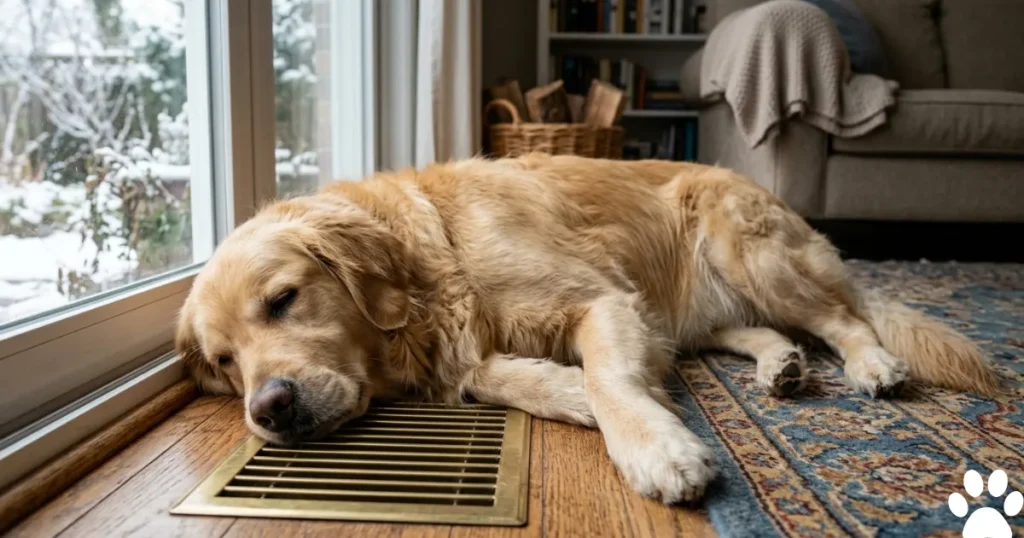
Thyroid hormone drives thermogenesis. When T4 drops, the dog loses metabolic heat production before any physical sign appears. A golden seeking warm floors, avoiding cool outdoor air, or pressing against radiators is showing thermal dysregulation, not a preference change.
3. Reduced exercise tolerance.
T4 deficiency reduces mitochondrial efficiency across all muscle tissue, including cardiac muscle. A Golden who lags on walks they previously led, or recovers unusually slowly after moderate activity, is showing a Stage 1 cardiovascular-metabolic sign.
Stage 2: Dermatological Signs (Months 6-18).
4. Coat texture changes before hair loss.
The outer coat loses luster and becomes dry and brittle. The undercoat thins while the outer coat still looks relatively normal. Owners describe it as the coat “not growing back right.”
5. Bilateral symmetrical alopecia.
When alopecia does appear in Goldens, it starts at the flanks and tail base. The symmetry is diagnostically useful; a one-sided loss points toward mange or ringworm. Bilateral loss in a middle-aged golden warrants a T4 panel immediately.
6. Skin thickening-myxedema.
Glycosaminoglycan accumulation in skin produces facial puffiness, folded forehead skin, and the classic “tragic face” expression. This is a late confirmatory sign, not an early one.
Stage 3: Neurological Signs (Often Missed Entirely).
7. Peripheral neuropathy.
T4 deficiency can cause demyelination of peripheral nerves, producing knuckling, an unsteady gait, or facial nerve palsy. These signs appear in approximately 2-5% of hypothyroid dogs per clinical literature, but they’re routinely excluded from popular symptom guides. In Golden Retrievers, who are prone to hip dysplasia and elbow disease, misattributing neurological signs to orthopedics costs months of diagnosis time.
| Symptom | Urgency | Typical Stage in Goldens | Action |
| Weight gain >8% on unchanged diet | Schedule a vet. | Stage 1 (months 1–6) | T4 + TSH panel |
| Cold intolerance, seeks warmth | Schedule a vet. | Stage 1 (months 1–6) | T4 + TSH panel |
| Reduced exercise tolerance | Schedule a vet. | Stage 1 (months 1–6) | T4 + TSH panel |
| Coat texture change, brittle fur | Vet within 4 weeks | Stage 2 (months 6–18) | T4 + TSH panel |
| Bilateral symmetrical alopecia | Vet this week | Stage 2 (months 6–18) | Full thyroid panel |
| Facial thickening, myxedema | Vet this week | Stage 2 (late) | Full thyroid panel |
| Knuckling, ataxia, facial palsy | Same-day call | Stage 3 (advanced) | Urgent neuro + thyroid panel |
| Temp < 37.5°C + lethargy + swelling | Call vet immediately | Any stage | Emergency |
Hypothyroidism Symptoms in Golden Retrievers by Age: Puppy, Adult, and Senior.
Hypothyroidism in dogs symptoms shift in character and severity across life stages. The dominant signs differ enough that a staged approach is the only clinically accurate one.
Golden Retriever Puppies (Under 18 Months): Developmental Lag, Not Weight Gain.
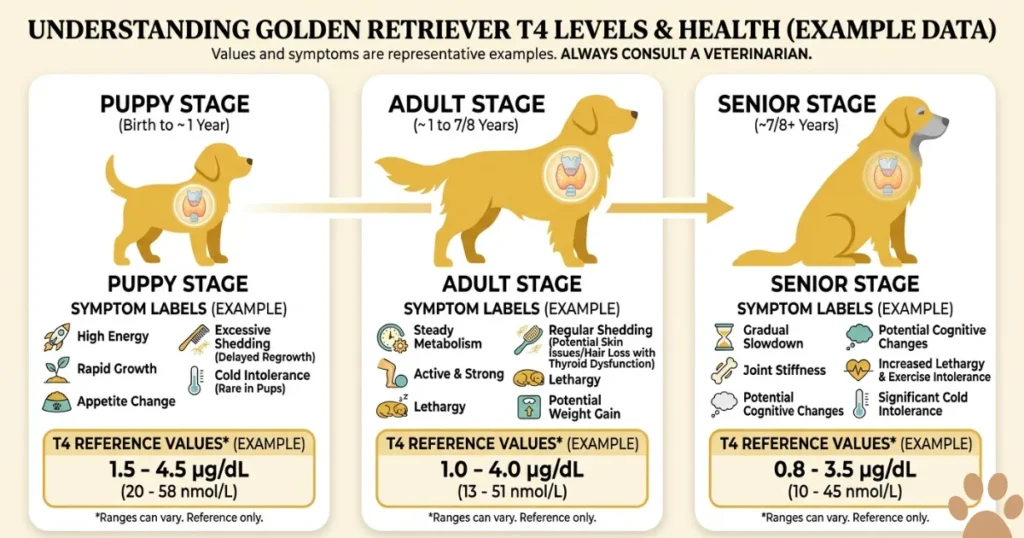
Congenital hypothyroidism presents differently from adult-onset disease. Signs include disproportionate body size relative to littermates, delayed bone growth, slow permanent tooth eruption, and profound lethargy that isn’t explained by normal puppy patterns. These pups don’t gain abnormal weight; they fail to grow normally. The T4 reference range for puppies under 6 months is 1.5-3.5 µg/dL. Values below 1.0 µg/dL with developmental lag require immediate evaluation.
Adult Golden Retrievers (2-7 Years): Metabolic-First Presentation.
The vast majority of hypothyroidism in this breed presents in this window. The adult T4 reference range is 1.0-4.0 µg/dL. A practical clinical threshold: a T4 below 1.0 µg/dL in an adult Golden with any two hypothyroidism in dogs symptoms from Stage 1 supports a treatment trial; waiting for three confirmatory panels in a symptomatic dog delays relief. The full diagnostic process is covered in our hypothyroidism in dogs overview.
Senior Golden Retrievers (8 Years and Older): Rate of Change Is the Differentiator.
This is where symptoms of thyroid problems in a dog most often get dismissed as normal aging. Weight gain, reduced activity, and cognitive slowing occur in both hypothyroidism and healthy aging. The differentiator is pace. A healthy aging Golden declines over the years. Thyroid-driven decline accelerates over months. A Golden aged 8 or older deteriorating noticeably over a 3-6 month window warrants a panel, not a “let’s monitor” response. T4 below 0.5 µg/dL in a senior Golden almost always reflects disease.
What Most Symptom Lists for Dogs with Underactive Thyroid Get Wrong.
Every mainstream symptom guide opens with coat and hair changes. For short-coated breeds, that’s defensible. For Golden Retrievers, this approach to hypothyroidism in dogs symptoms creates a diagnostic delay of over a year.
Three Signs Most Guides Omit Completely.
First: behavioral changes.
Thyroid hormone deficiency alters neurotransmitter balance. Some hypothyroid dogs develop uncharacteristic irritability, anxiety, or rarely, aggression. The Merck Veterinary Manual lists behavioral changes as a recognized manifestation of canine hypothyroidism. In September 2023, a 6 years old male Golden, 34 kg, presented with a gait change, described by the owner as “tripping over his own feet.” He’d been gaining weight for eight months, attributed to treats. T4 came back at 0.2 µg/dL. We started levothyroxine at 0.02 mg/kg twice daily. At his 10-week recheck, the gait had normalized, and weight was down 3.5 kg.
Owner takeaway: the gait was the sign she couldn’t ignore, but the weight gain had been the warning she could have acted on eight months earlier.
Second: peripheral neuropathy signs.
The knuckling, ataxia, and facial nerve palsy described in Stage 3 appear in roughly 2-5% of hypothyroid dogs. They’re absent from most owner-facing resources. In Golden’s, misattributing these to orthopedic disease costs months.
Third: reproductive changes.
Intact female Goldens may show irregular or absent oestrus cycles as a symptom of thyroid disorder in dogs. Intact males may show reduced libido or testicular atrophy. Less common, but diagnostically significant in breeding dogs.
The GRI Symptom Staging Scale.
This A-C framework structures the urgent decision for Golden Retriever owners who’ve identified hypothyroidism in dogs symptoms but aren’t sure when to act.
Grade A—Act within 2 weeks:
One stage 1 metabolic sign with no coat changes. Request T4 + TSH at next available appointment.
Grade B—Act within 1 week:
Two or more Stage 1 signs, OR any Stage 2 dermatological sign. Request a full thyroid panel, including free T4 by equilibrium dialysis.
Grade C—Call same day:
Any Stage 3 neurological sign (knuckling, ataxia, or facial nerve change) or a resting heart rate below 55 bpm in a resting non-athletic adult Golden.
Expert Insight
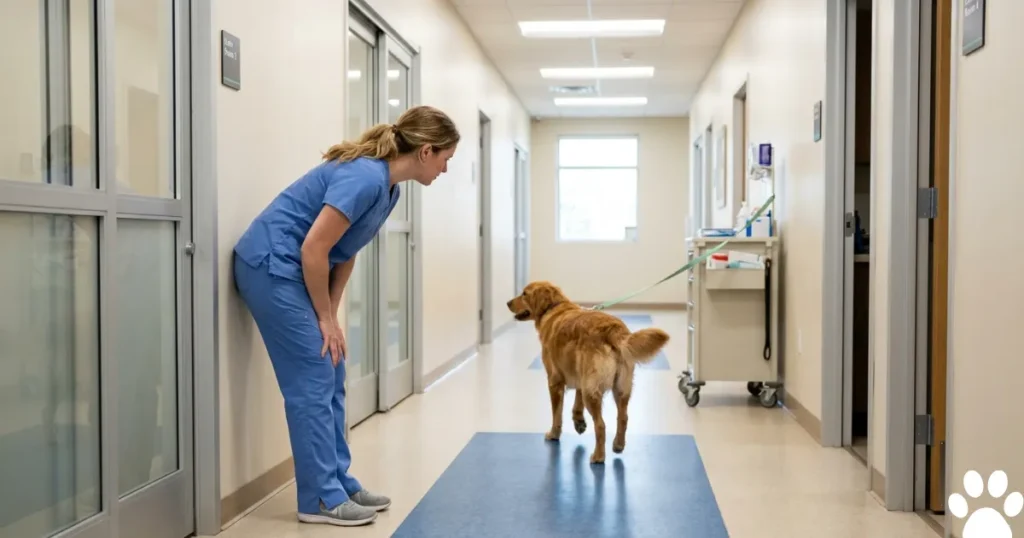
“I’ve reviewed cases where a Golden came in for a coat issue, dry fur, patchy shedding, and the thyroid panel confirmed what the weight chart had been showing for over a year. The coat is a lagging indicator. In Goldens specifically, I pay more attention to the scale trend and the owner’s description of the dog’s enthusiasm than to the physical exam findings. A Golden who ‘just doesn’t seem like himself’ is telling you something the coat hasn’t shown yet.”
What are the symptoms of hypothyroidism in dogs?
The main symptoms of hypothyroidism in dogs are unexplained weight gain, lethargy, cold intolerance, coat changes, and reduced exercise tolerance. In Golden Retrievers, metabolic signs appear months before any coat changes.
What are the first hypothyroidism in dogs symptoms to watch for?
The first hypothyroidism in dogs symptoms are weight gain on an unchanged diet, cold intolerance, and reduced activity. In Golden Retrievers, these precede visible coat changes by 6-18 months and are the signs most owners see first.
What are the symptoms of thyroid problems in a dog?
Symptoms of thyroid problems in a dog include weight gain, lethargy, coat thinning, skin thickening, cold intolerance, and sometimes personality change or neurological signs. A T4 + TSH blood panel confirms the diagnosis.
What do symptoms of thyroid disorder in dogs look like day to day?
Day to day, symptoms of thyroid disorder in dogs look like a dog that tires faster, seeks warmth, gains weight despite eating normally, and has a coat that looks duller than usual. Changes are subtle and accumulate over months.
How do dogs with underactive thyroid behave differently?
Dogs with an underactive thyroid often become quieter, less playful, and more reluctant to exercise. Some show mild irritability or anxiety. The AVMA and Merck Veterinary Manual both recognize behavioral changes as a feature of canine hypothyroidism.
What behavioral symptoms does a dog with thyroid issues show?
A dog with thyroid issues may show uncharacteristic lethargy, reduced social engagement, or mild anxiety. These behavioral shifts often predate physical signs and are frequently dismissed as normal aging or a personality change.
Can hypothyroidism cause aggression in dogs?
Yes. Thyroid hormone deficiency can alter neurotransmitter pathways, producing uncharacteristic irritability or aggression in some hypothyroid dogs. The Merck Veterinary Manual lists this as a recognized behavioral manifestation of the condition.
What does a hypothyroid dog’s coat feel like?
A hypothyroid dog’s coat feels dry and brittle, with a thinned undercoat and a dull outer coat. In Golden Retrievers, the fur loses its characteristic sheen and feels coarse before any patchy hair loss becomes visible.
How quickly do hypothyroid symptoms appear in dogs?
Hypothyroid symptoms in dogs develop gradually over months to years. In Golden Retrievers, the first metabolic signs appear between ages 4 and 6 years, with the full symptom picture developing over 12-24 months if untreated.
Can a dog have hypothyroidism symptoms without weight gain?
Yes. Some hypothyroid dogs present primarily with coat changes, cold intolerance, or neurological signs without significant weight gain, particularly if caloric intake has been reduced in response to reduced activity.
Do Golden Retrievers show neurological symptoms of hypothyroidism?
Yes. Golden Retrievers can develop peripheral neuropathy from hypothyroidism, showing knuckling, an unsteady gait, or facial nerve palsy. These signs affect approximately 2-5% of hypothyroid dogs and are commonly misattributed to the breed’s predisposition to hip dysplasia.
How does a hypothyroid Golden Retriever’s coat differ from a healthy one?
A hypothyroid Golden Retriever’s coat loses its natural luster and becomes dry and brittle. The undercoat thins significantly before the outer coat shows visible changes, which is why coat changes are frequently missed in this breed until the condition is advanced.
What does the Golden Retriever Lifetime Study show about thyroid symptom onset?
The Golden Retriever Lifetime Study (Morris Animal Foundation) tracks endocrine diseases in its 3,000+ cohort. Clinical data from the study support that thyroid disease in Golden Retrievers most commonly manifests between ages 4 and 6, earlier than general canine guidelines suggest.
Why do Golden Retrievers show cold intolerance before coat changes appear?
Cold intolerance appears first because thyroxine directly drives thermogenesis. When T4 drops, heat production decreases before follicle cycling is disrupted enough to produce visible hair changes. Cold intolerance is metabolic; alopecia is structural and follows later.
My Golden Retriever is lethargic and gaining weight. Could it be thyroid symptoms?
Yes, these are the two most common early hypothyroidism symptoms in dogs and the ones Golden Retriever owners typically see first. Schedule a vet appointment and ask specifically for a T4 and TSH panel. Not an emergency, but don’t wait until the annual exam.
Conclusion: Recognizing Hypothyroidism in Dogs Symptoms Before the Coat Shows It.
The hypothyroidism in dogs symptoms that give you the earliest diagnostic window are metabolic: weight gain, cold intolerance, and reduced activity. The coat changes come later; they confirm what those signs predicted months before.
If your Golden is between 4 and 7 years old and showing any two Stage 1 symptoms from the GRI Symptom Staging Scale, request a T4 and TSH panel. You don’t need to wait for alopecia. The metabolic shift is the signal, not the coat. For the full condition overview, including the GRI Thyroid Check Protocol, see our hypothyroidism in dogs guide.
Which hypothyroidism symptom did you notice first in your Golden: the weight gain, the cold intolerance, the coat change, or something else entirely? Real owner timelines help others recognize these signs before they become obvious.

Dr. Nabeel A.
Dr. Nabeel Akram is a Doctor of Veterinary Medicine with more than five years of hands-on experience in animal health, canine nutrition, and preventive care. He is a registered veterinarian with the Pakistan Veterinary Medical Council (PVMC), the statutory body regulating veterinary practice in Pakistan. As the founder of Golden Retriever Insight, Dr. Akram writes and medically reviews every health, nutrition, and grooming guide published on the site. His clinical interests include canine oncology, epilepsy management, and breed-specific nutrition for large breeds — the core topics this site covers. Every article is checked against current veterinary literature and sources such as the Merck Veterinary Manual, AVMA guidance, and peer-reviewed research.