
You can prevent hip dysplasia in dogs from reaching clinical severity, but only if you act in the right window, with the right interventions for Golden Retrievers specifically. Genetics sets the predisposition. Growth rate, body weight, exercise surface, and joint nutrition determine whether that predisposition becomes a diagnosis.
In my practice, the Golden Retriever owners who prevent hip problems into middle age aren’t doing anything exotic. They’re controlling growth velocity in puppyhood, maintaining a body condition score of 4-5 out of 9 through adulthood, and addressing canine joint pain signals early rather than attributing them to aging. The owners who struggle are the ones who followed standard large-breed advice without understanding why Golden Retrievers need a tighter protocol.
According to the Golden Retriever Lifetime Study, conducted by Morris Animal Foundation, Golden Retrievers diagnosed with canine hip dysplasia show significantly higher disease progression rates when body weight exceeds ideal BCS during the first three years of life. Maintaining a healthy weight from puppyhood onward is identified as the single most modifiable prevention factor. For a full breakdown of how canine hip dysplasia develops in Golden Retrievers, see our complete Golden Retriever hip dysplasia guide.
Why Golden Retrievers Need a Different Hip Dysplasia Prevention Plan Than Other Large Breeds
Standard large-breed prevention advice, switching to large-breed puppy food, avoiding jumping, and not over-exercising cover the basics but miss the specific mechanism that makes Golden Retrievers disproportionately vulnerable.
The issue isn’t just size. Its growth velocity is combined with joint laxity inheritance. The OFA reports canine hip dysplasia prevalence of approximately 20% in evaluated Goldens, higher than in Labrador Retrievers, Bernese Mountain dogs, and most other large breeds at comparable evaluation ages. The reason sits in how Golden Retriever puppies grow: they gain mass rapidly between 4 and 8 months while their acetabular depth, the hip socket, develops more slowly than in comparable retriever lines.
During this window, excess caloric intake accelerates skeletal growth faster than periarticular soft tissue can stabilize the developing joint. The result is coxofemoral subluxation: the femoral head loosening in a socket that hasn’t deepened to accommodate it. This is the structural origin of canine hip dysplasia in Golden Retrievers, and it begins months before any owner sees a symptom.
What the Golden Retriever Lifetime Study Shows about Prevention
The Golden Retriever Lifetime Study, run by Morris Animal Foundation with over 3,000 enrolled Golden Retrievers, identifies early-life body condition as a stronger predictor of adult musculoskeletal disease than breed lineage alone. Goldens maintained at lean body condition through 18 months show measurably reduced rates of hip-related mobility decline in middle age.
What most guides don’t tell you is that a bag of food labeled “large breed formula” doesn’t automatically prevent excessive growth velocity. Fed at the upper end of the manufacturer’s recommended range, even appropriate puppy foods can push a golden through the 4-8-month window too quickly. What I monitor is the weekly weight gain rate, not just the food brand. For Golden puppies at this stage, a gain of more than 2.5-3 lbs per week warrants a feeding amount reduction, regardless of what the food bag recommends.
Preventing Canine Hip Dysplasia in Golden Retrievers by Life Stage
Hip dysplasia prevention looks different at every stage. The interventions that matter most at 5 months are not the same ones that matter most at 4 years. Golden Retriever owners need stage-specific targets, not a single generic prevention checklist.
Golden Retriever Puppies (4-18 Months): The Growth Rate Window
This is the highest-leverage prevention period. Cartilage is still developing, and joint laxity hasn’t yet translated to irreversible structural damage.
Feed a large-breed puppy food with a calcium to phosphorus ratio of 1.2:1 to 1.4:1, confirmed on the AAFCO nutrient profile on the food label. Avoid adult maintenance foods and high-calorie performance formulas, both of which accelerate growth rate in Golden puppies. Feed to a body condition score of 4/9, not 5/9, puppies should show a visible waist when viewed from above, with ribs palpable but not protruding.
Exercise on grass and soft surfaces only during this window. Concrete and tile increase impact loading on developing hip joints. Limit off-lead running to under 20 minutes per session for puppies under 6 months. Avoid repetitive stair use and jumping onto furniture until 12 months. Swimming is the single best exercise for this age group: full-body muscle development with zero compressive joint load.
Adult Golden Retrievers (2-7 Years): Maintenance and Monitoring
Dog joint pain signs in adult Goldens most commonly signal that adolescent joint laxity has progressed to early cartilage erosion. Prevention at this stage means slowing that progression.
Target BCS 4-5/9. Every extra pound on a 65-lb golden adds approximately 4 lb of force per stride to the hip joints. A Golden at 72 lbs instead of 65 lbs carries that differential load on every step every day. Start EPA/DHA supplementation at 40 mg per kg of body weight daily; for a 65-lb Golden, that’s approximately 1,200 mg of combined EPA/DHA. Introduce glucosamine at 500 mg and chondroitin sulfate at 400 mg daily. Evidence from AAHA pain management guidelines supports combined glucosamine and chondroitin sulfate for slowing articular cartilage degeneration in large-breed dogs.
Senior Golden Retrievers (8 Years and Older): Protecting What Remains
At this stage, prevention means protecting residual joint function and controlling canine joint pain rather than reversing established pathology.
Maintain EPA/DHA at 40-50 mg/kg daily. Transition to orthopedic bedding and ramp access for all elevated surfaces; exits from beds and vehicles generate significant hip extension force in dogs with established joint damage. Consider scheduled hydrotherapy or underwater treadmill sessions twice monthly to preserve hindquarter muscle mass without compressive loading. Discuss with your vet whether low-dose NSAID therapy on an as-needed basis is appropriate before joint pain reaches daily severity.

What Most Dog Joint Pain Prevention Guides Get Wrong About Golden Retrievers
Most prevention guides list “moderate exercise” as protective against hip dysplasia. For Golden Retriever owners, this guidance is both correct and dangerously incomplete.
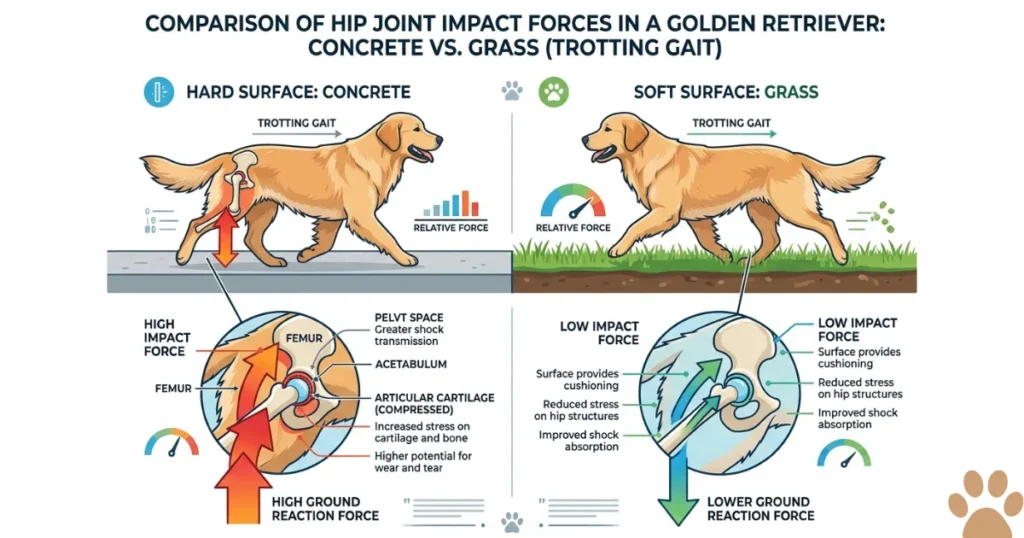
The missing detail is surface type and impact mode. A 20-minute ball-fetching session on concrete loads a Golden puppy’s developing hip joint far more destructively than a 40-minute walk on grass. The compressive force differential between hard and soft surfaces at a running gait is significant, and for a Golden in the 4-8 month growth window, repeated hard-surface impact is one of the fastest ways to accelerate the coxofemoral subluxation that drives canine hip dysplasia development.
In November 2025, a 10 months old female Golden presented with a bilateral bunny-hop gait and a PennHIP distraction index of 0.74. Her owner had been diligently exercising her daily, 30 minutes of ball fetch on a concrete driveway, five days per week. The owner had read that exercise prevented hip problems. The exercise was appropriate in duration. The surface was wrong for this breed at this age. We shifted to leash walks on grass and twice-weekly swimming. At her 14-month recheck, muscle development had improved, and gait had normalized at a trot. The joint laxity remained, but progression had slowed measurably.
The correction
According to AVMA guidelines on large-breed orthopedic development, low-impact activity on compliant surfaces is specifically recommended during the rapid growth phase for at-risk breeds. For Golden Retrievers, “appropriate exercise” means soft-surface, low-repetition, muscle-building activity, not duration alone.
The most common mistake I see is owners praising themselves for exercising their golden puppy daily while doing it on pavement. It’s understandable; most exercise advice focuses on time, not surface. But in Golden Retriever puppies specifically, 15 minutes on grass outperforms 30 minutes on concrete for joint health every time.
The GRI Prevention Window System: Matching Canine Joint Pain Interventions to the Right Stage
The GRI Prevention Window System assigns specific, measurable prevention actions to three distinct life-stage windows for Golden Retrievers. Each window has a primary lever, a threshold, and an escalation trigger.
Window 1—Puppy Growth Phase (4-18 Months)
Primary lever: growth rate control
Target: BCS 4/9, weekly weight gain below 2.5 lbs after 4 months
Action: large-breed puppy food at BCS-targeted serving; soft-surface exercise only; swimming preferred; no repetitive jumping or stair use
If → Then reduce daily feeding by 10-15% → Call vet if
Window 2—Adult Maintenance Phase (2-7 Years)
Primary lever: body weight and supplement support
Target: BCS 4-5/9; EPA/DHA at 40 mg/kg daily; glucosamine 500 mg + chondroitin sulfate 400 mg daily
Action: structured low-impact exercise; quarterly BCS assessment; OFA radiograph at 24 months if not already completed
If → Then → Call vet immediately if
Window 3—Progressive Management Phase (diagnosed mild dysplasia or age 7+)
Primary lever: load reduction and canine joint pain control
Target: BCS 4/9 strictly; EPA/DHA at 40-50 mg/kg; orthopedic environment modifications in place
Action: ramp access, orthopedic bedding, hydrotherapy twice monthly, NSAIDs as prescribed during flare periods, and biannual vet reviews
If → Then → Call vet if complete rear-leg non-weight-bearing

Expert Insight
“The Golden owners I respect most aren’t the ones who spent the most on supplements; they’re the ones who kept their puppy lean through the first 18 months and walked on grass instead of pavement. Those two decisions alone change the trajectory of a genetically predisposed Golden more than anything else I can prescribe at age 4.”

How to prevent hip dysplasia in dogs?
How to prevent hip dysplasia in dogs involves controlling growth rate between 4 and 18 months with a calorie-appropriate large-breed puppy food, maintaining BCS 4-5/9 through adulthood, limiting high-impact exercise on hard surfaces during puppyhood, and adding EPA/DHA and glucosamine supplementation from 12 months onward for at-risk breeds like Golden Retrievers.
Can you fully prevent hip dysplasia in dogs if caught early?
You can’t eliminate genetic predisposition to hip dysplasia in dogs, but you can prevent mild laxity from progressing to clinical canine hip dysplasia. Goldens whose growth rate, body weight, and exercise surfaces are managed from 4 months onward show significantly lower rates of symptomatic hip disease in adulthood, per the Golden Retriever Lifetime Study.
What causes dog joint pain in Golden Retrievers?
Dog joint pain in Golden Retrievers most commonly stems from canine hip dysplasia and secondary osteoarthritis. Cartilage erosion from juvenile joint laxity generates chronic inflammation in the coxofemoral joint. Excess body weight, hard-surface exercise during growth, and inadequate EPA/DHA intake all accelerate the cartilage degeneration driving that pain.
How do I reduce canine joint pain without medication?
Reduce canine joint pain without medication by reaching and maintaining ideal body weight, starting EPA/DHA supplementation at 40 mg/kg daily, and replacing high-impact activities with swimming or leash walks on grass. For a 65-lb Golden, a 5-lb weight reduction alone meaningfully reduces hip joint load per stride.
What supplements reduce canine joint pain in large breeds?
EPA/DHA fish oil at 40 mg/kg daily and combined glucosamine (500 mg) with chondroitin sulfate (400 mg) are the most evidence-supported supplements for canine joint pain in large breeds. AAHA pain management guidelines recommend both for slowing articular cartilage degeneration in dogs with established hip dysplasia.
How long does canine joint pain treatment take to show results?
Canine joint pain improvements from weight loss typically become visible in gait within 6-10 weeks of consistent caloric reduction. EPA/DHA supplementation for canine joint pain shows a measurable anti-inflammatory effect within 4-6 weeks at therapeutic doses. Glucosamine and chondroitin sulfate effects are slower; allow 8-12 weeks before assessing benefit.
Can exercise prevent hip dysplasia in dogs?
Yes, the right exercise prevents hip dysplasia in dogs from worsening, but surface and mode matter more than duration. Muscle-building low-impact activity on soft surfaces, such as grass walking and swimming, stabilizes the hip joint. Repetitive hard-surface running during puppyhood increases compressive load on developing joint cartilage and accelerates laxity-driven damage.
Does diet affect hip dysplasia risk in dogs?
Yes. Feeding a large-breed puppy food with a calcium-to-phosphorus ratio of 1.2:1 to 1.4:1 and controlling caloric intake to maintain lean body condition reduces growth velocity in the highest-risk window. Overfeeding any puppy food, including large-breed formulas, accelerates skeletal growth faster than joint-stabilizing soft tissue can develop.
At what age should I start hip dysplasia prevention for my dog?
Start hip dysplasia prevention from the day you bring your Golden Retriever puppy home, typically 8 weeks. The 4-8 month window is the highest-leverage period for growth rate management. Prevention strategies for adult and senior Goldens differ in focus but remain valuable at any age for slowing disease progression.
Does weight management prevent dog joint pain from worsening?
Yes. Weight management is the single most modifiable factor in preventing dog joint pain from worsening, per the Golden Retriever Lifetime Study. A Golden Retriever at ideal BCS 4-5/9 places measurably less compressive force per stride on hip joints than the same dog at even 10% above ideal weight, directly slowing the cartilage erosion rate.
Do Golden Retrievers need hip dysplasia prevention supplements from puppyhood?
Golden Retrievers don’t need glucosamine supplementation before 12 months; puppy joint cartilage develops best through growth-rate management and nutrition, not supplements. EPA/DHA fish oil at puppy-appropriate doses (20 mg/kg daily under 12 months) supports joint membrane health during the growth phase without interfering with normal skeletal development.
How does rapid growth in Golden Retriever puppies cause canine hip dysplasia?
Rapid growth in Golden Retriever puppies causes canine hip dysplasia by accelerating femoral head development faster than acetabular socket deepening. This mismatch creates coxofemoral joint laxity, and the femoral head sits loosely, generating abnormal cartilage contact pressure. Repeated loading of this unstable joint during puppyhood initiates the cartilage erosion cascade that becomes clinical hip dysplasia.
What does the Golden Retriever Lifetime Study say about preventing canine hip dysplasia?
The Golden Retriever Lifetime Study, conducted by Morris Animal Foundation, identifies early-life body condition as a stronger predictor of adult musculoskeletal disease than lineage alone. Golden Retrievers maintained at lean body condition through 18 months show reduced rates of hip-related mobility decline. Consistent weight management from puppyhood is the most supported preventive intervention identified by the study.
How much EPA/DHA does a 65-pound Golden Retriever need daily to support joint health?
A 65-pound Golden Retriever needs approximately 1,200 mg of combined EPA and DHA daily for joint health support, calculated at 40 mg/kg of body weight. Use a fish oil product listing EPA and DHA separately on the label. Krill oil provides lower total EPA/DHA per serving at equivalent cost and is not an appropriate substitute at this dosing target.
My Golden Retriever puppy is growing fast, and I’m worried about its hips. What should I do right now?
Reduce daily food to the lower end of the feeding guide and confirm you’re using a large-breed puppy formula. Weigh your puppy weekly. Gains over 2.5 lbs per week after 4 months signal excessive growth velocity. Switch all exercise to grass surfaces immediately. Call your vet if a bunny-hop gait or wide-based rear stance develops at any weight.
Conclusion
Knowing how to prevent hip dysplasia in dogs, specifically in Golden Retrievers, means acting earlier than most owners expect on factors most guides don’t specify. Keep your Golden puppy lean through the first 18 months. Walk on the grass. Start EPA/DHA supplementation by 12 months. Monitor weekly weight gain rate, not just food brand. These aren’t complicated steps. They’re the ones that keep a genetically predisposed Golden off the surgical consultation list.
For owners already seeing canine joint pain signs in their dog, prevention has shifted to progression management, and that starts with a vet-confirmed body condition score and a radiograph, not a supplement. I want to hear what prevention steps you’re already taking and which ones you wish someone had told you sooner.
Did you manage your Golden’s growth rate through puppyhood, or did the rapid-growth warning come too late? What age was your dog when you made the connection between their weight or exercise routine and their joint health? Leave your dog’s age, what you changed, and whether it made a difference. Real owner timelines help other Golden families know where to start.