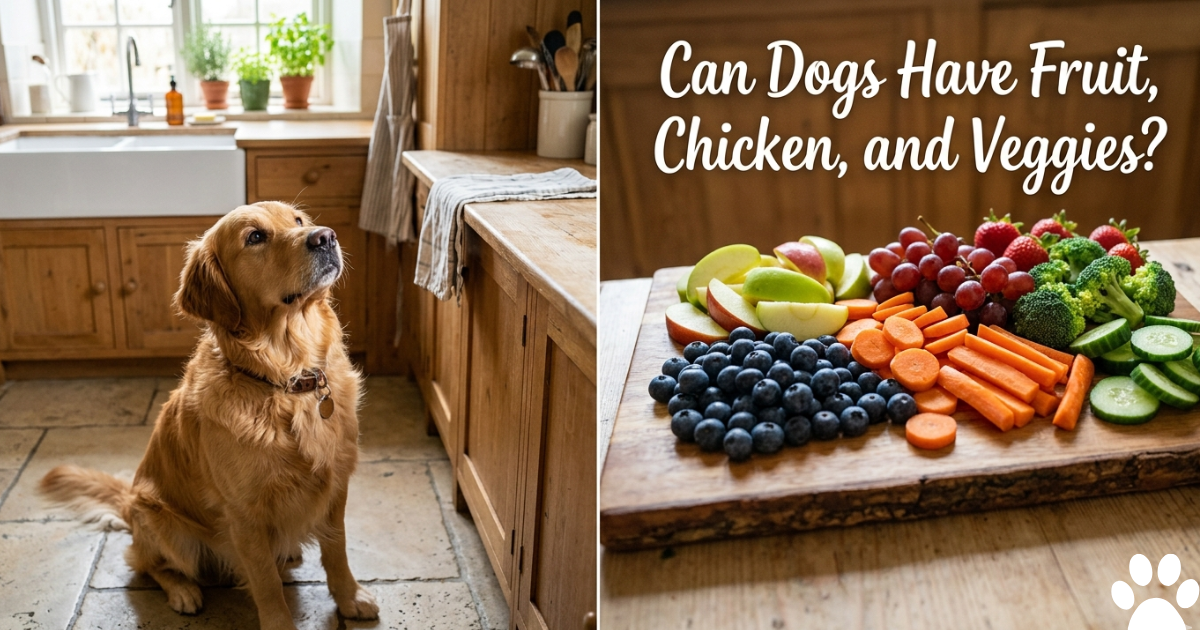
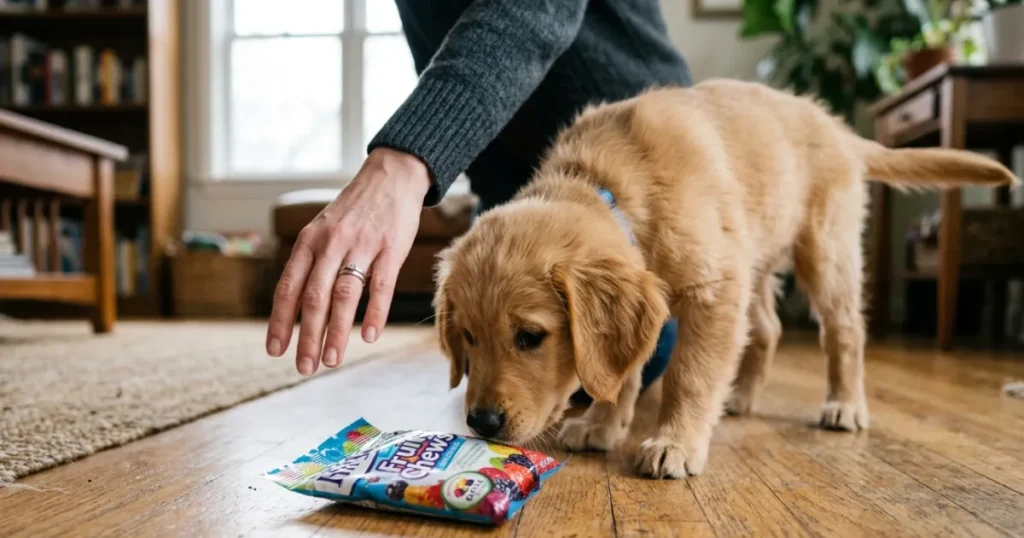
Your Golden just snagged a Welch’s fruit snack off the coffee table before you could react. Or your child handed one over without thinking. Either way, you’re now asking: can dogs eat fruit snacks, or do you need to make a call?
The direct answer: No, dogs should not eat commercial fruit snacks. These products, like Welch’s, Motts, and generic gummy fruit snacks, are human-formulated confections containing concentrated sugar, artificial dyes, corn syrup, and, in “no sugar added” or “diet” varieties, potentially xylitol. None of these ingredients belongs in a Golden Retriever’s diet, and one of them is acutely lethal.
Can dogs eat fruit snacks without immediate consequences? Often, Yes! A single standard gummy fruit snack rarely causes a crisis in a dog the size of a Golden Retriever. But “no immediate crisis” is not the same as “safe,” and the ingredient risk in sugar-free versions is serious enough to treat every exposure as urgent until the label is confirmed. What looks like a harmless fruit-flavoured treat is a processed product with no nutritional value and a real toxicity risk if formulated incorrectly.
Can Dogs Eat Fruit Snacks? What’s Actually Inside Them
Can dogs eat fruit snacks safely? That depends entirely on the ingredient list – and most owners don’t check it until after the fact.
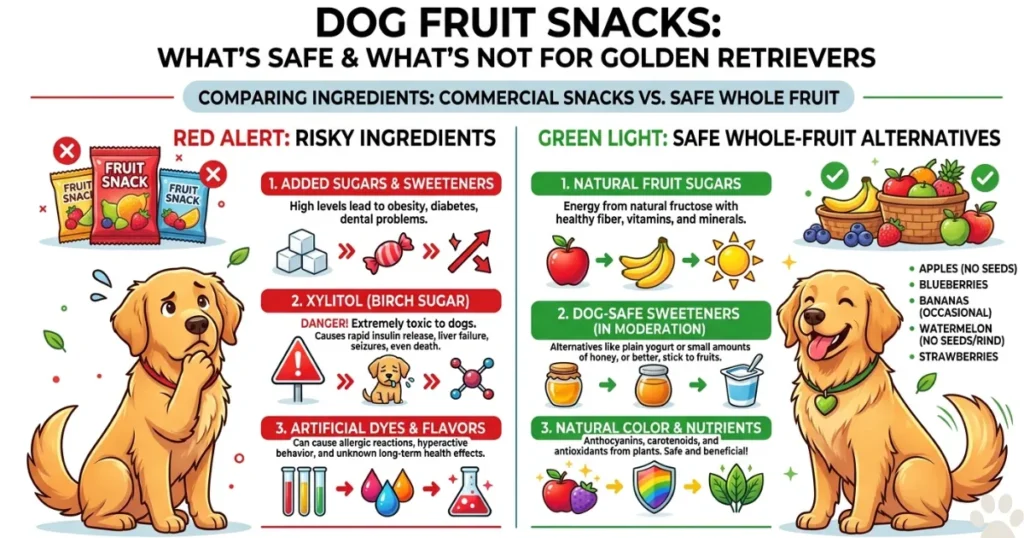
Standard commercial fruit snacks like the gummy, chewy, brightly colored varieties marketed to children contain concentrated fruit juice or puree, corn syrup, sugar, modified cornstarch, citric acid, and artificial or natural food dyes. None of these is acutely toxic to a Golden Retriever in a single-serve quantity. The cumulative sugar load is the primary concern at normal serving sizes: a single pouch of Welch’s fruit snacks contains roughly 11 grams of sugar – nearly as much as two teaspoons – and provides zero nutritional value while contributing unnecessary calories to a breed already predisposed to weight gain.
The Xylitol Variable – Why Label-Checking Is Non-Negotiable
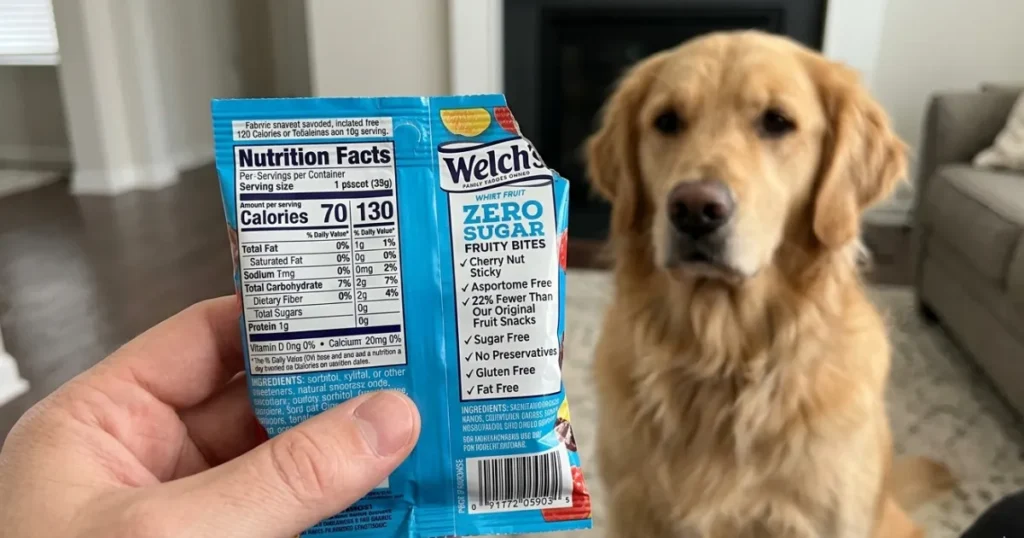
The ingredient that changes this from “inadvisable” to “emergency” is xylitol. Sugar-free and reduced-sugar fruit snack varieties, including some organic and “natural” branded options, use xylitol as a sweetener. According to PetMD’s xylitol toxicity guidance, xylitol triggers a rapid insulin release in dogs, causing blood glucose to crash – the onset of hypoglycemia occurs within 30 minutes of ingestion. In larger doses, xylitol causes acute liver failure. The amount required to trigger toxicity is small: as little as 0.1 g per kilogram of body weight causes hypoglycemia. A single sugar-free fruit snack pouch may contain enough to harm a dog.
Artificial Dyes and Additives – The Secondary Concern
Standard fruit snacks also contain Red 40, Yellow 5, Blue 1, and similar petroleum-derived artificial dyes. While acute toxicity from food dyes in dogs is not documented at typical fruit snack quantities, Golden Retrievers with known food sensitivities or atopic dermatitis – a condition this breed develops at elevated rates – can react to artificial additives with increased itching, digestive disruption, or behavioral changes. This is a secondary concern, but breed-relevant.
Can Dogs Have Fruit Snacks if It’s Just One Piece?
Can dogs have fruit snacks in a minimal amount without harm? For a standard-formula product without xylitol, a single piece is unlikely to cause acute illness in a 60-70 lb Golden Retriever. The sugar load from one gummy is insufficient to cause hypoglycemia in a non-diabetic dog. GI upset, loose stools, and mild gas are the most probable outcomes if any reaction occurs at all.
The calculation changes entirely for sugar-free formulas. A single sugar-free fruit snack pouch can contain 0.5 – 1g of xylitol – a dose that approaches the toxic threshold for a Golden Retriever. This is not a wait-and-see situation.
The practical approach: if your Golden ate one standard fruit snack and you’ve confirmed no xylitol on the label, monitor at home. If the label says “sugar-free,” “no sugar added,” “reduced sugar,” or lists xylitol, sorbitol, or erythritol as ingredients – call your vet or ASPCA Poison Control (888-426-4435) immediately.
What Competitors Miss: The “Natural” and “Organic” Fruit Snack Trap
Generic articles answering “can dogs eat fruit snacks” focus on standard Welch’s- type products and confirm that one isn’t an emergency. What they miss – and what creates real danger for Golden Retriever owners – is the premium natural and organic fruit snack category.
Products marketed as “no artificial sweeteners,” “made with real fruit,” or “organic” sound safer than conventional gummy snacks. Some are. But a significant portion of the organic and natural fruit snack category uses xylitol, erythritol, or monk fruit concentrate to reduce sugar content while maintaining sweetness. These products carry the same xylitol toxicity risk as overtly labeled “sugar-free” snacks, without the obvious warning.
Golden Retrievers are food-motivated to an unusual degree due to a documented POMC gene deletion in the breed, which impairs satiety signalling. A Golden that locates a bag of fruit snacks will eat the entire pouch, not one piece. An entire pouch of a xylitol-sweetened “natural” fruit snack product is a veterinary emergency regardless of breed size.
Safe Whole-Fruit Alternatives That Actually Deliver Value
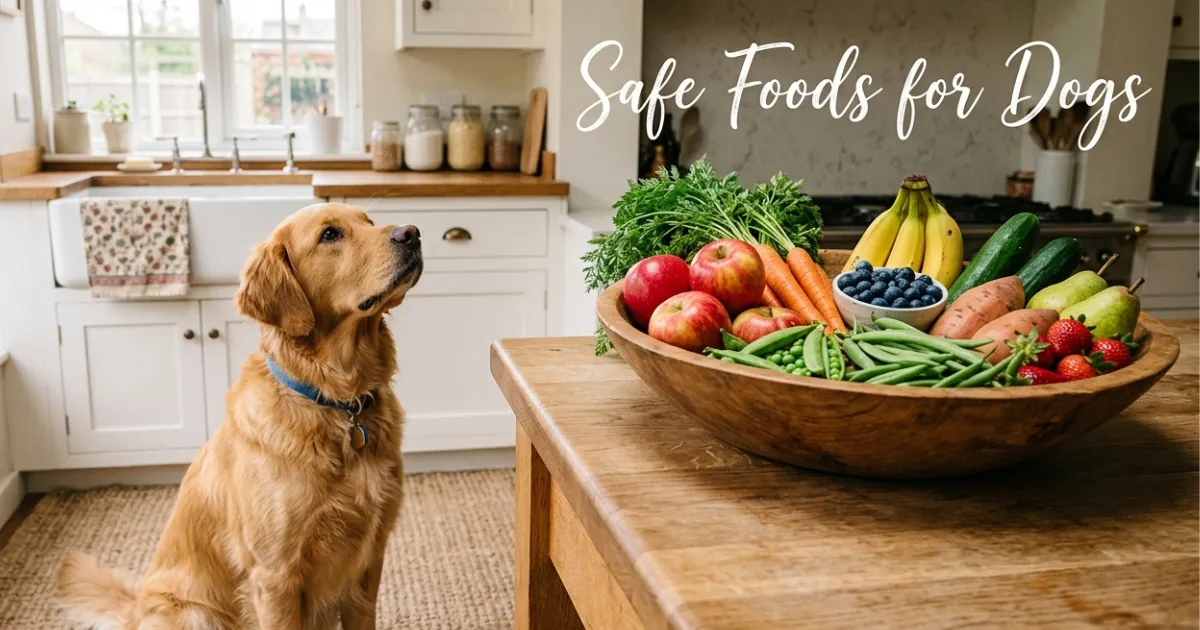
Can dogs have fruit snacks made from real, whole fruit? Yes, and these are the only forms worth offering to Golden Retrievers. The best fruits and vegetables for dogs guide covers the full safe list, but for a direct swap:
- Fresh blueberries – 10-15 per session, | 1 kcal each, high antioxidant value
- Strawberry slices – 2-3 medium berries, stem removed
- Watermelon chunks – rind and seeds removed, high water content
- Apple slices – flesh only, seeds and core removed
- Banana pieces – small amounts; higher sugar than berries, so limit frequency
Each of these delivers genuine nutritional value that commercial fruit snacks do not. None contains artificial additives, concentrated sugar, or xylitol risk.

Why Fruit Snacks Are Especially Problematic for Golden Retrievers
Commercial fruit snacks pose specific risks for Golden Retrievers beyond those for the general dog population, and this is what most content ignores entirely.
Golden Retrievers are genetically predisposed to obesity through impaired satiety signaling. A diet where treat calories consist of high-sugar, zero-nutrition products like fruit snacks accelerates weight gain in a breed already carrying elevated health risk from excess body weight – including increased joint stress, shortened lifespan, and higher cancer incidence. According to data from the Morris Animal Foundation’s Golden Retriever Lifetime Study, obesity is among the modifiable risk factors most consistently associated with reduced health outcomes in the breed.
Dental Health Consequences for Goldens
Golden Retrievers are at significant risk of developing periodontal disease. The concentrated sugar in commercial fruit snacks, including the fructose from “real fruit juice” formulations, feeds oral bacteria that accelerate plaque formation and gum disease progression. This isn’t a dramatic acute risk, but for a breed already predisposed to dental problems, regularly consuming high-sugar treats compounds a known vulnerability.
Decision Framework: Your Golden Ate Fruit Snacks – What Now?
- Your Golden ate 1 – 2 pieces of a standard fruit snack (Welch’s, Motts, regular formula) → Check label for xylitol. If none confirmed: monitor at home for 24 hours. Watch for loose stools or vomiting. No veterinary visit needed unless symptoms develop.
- Your Golden ate a full pouch of standard fruit snacks → Monitor for 24 – 48 hours. Expect potential loose stools or gas from the sugar load. No xylitol = no emergency. Ensure access to fresh water.
- Any product labeled “sugar-free,” “no sugar added,” or “reduced sugar” → Call ASPCA Poison Control (888-426-4435) or emergency vet immediately. Do not wait for symptoms. Xylitol hypoglycemia onset is 30 minutes.
- “Natural” or “organic” fruit snack with an unfamiliar sweetener listed → Treat as xylitol risk until confirmed otherwise. Call the vet.
- Your Golden is a puppy under 12 months → Lower body weight means lower toxic threshold. Any exposure to a sugar-free product in a puppy requires immediate vet contact.
- From now on → Keep all human fruit snack products out of Golden reach entirely. Replace with fresh whole fruit at appropriate portions.
Warning: Severity Ladder for Fruit Snack Risks in Golden Retrievers
Toxic—Vet Now
Xylitol ingestion from sugar-free or reduced-sugar fruit snack products. Mechanism: Xylitol triggers disproportionate insulin release, crashing blood glucose within 30 minutes. Signs include weakness, vomiting, disorientation, seizure, and collapse. At higher doses, xylitol causes acute liver failure independent of blood glucose effects. Call ASPCA Poison Control (888-426-4435) or an emergency vet immediately – do not wait for symptoms to appear.
Problematic—Monitor 24 – 48 Hours
A full pouch or multiple servings of standard sugar-containing fruit snacks. The sugar load from several pouches can cause digestive disruption – loose stools, gas, vomiting – in a Golden Retriever within 6-12 hours. Monitor at home. Withhold food for 4-6 hours, offer fresh water, and return to a bland diet. Call the vet if vomiting is severe or persists beyond 24 hours.
Unsuitable—Avoid, Not Dangerous
One or two pieces of a standard fruit snack were confirmed free of xylitol. No acute crisis. Not a safe or appropriate treat for Golden Retrievers, no nutritional value, unnecessary sugar exposure – but not an emergency.
When to Call the Vet after Your Golden Eats Fruit Snacks
URGENT – Call Immediately
| Symptom | Likely Cause |
| Weakness or sudden collapse | Xylitol-induced hypoglycemia |
| Vomiting with disorientation | Acute blood glucose crash |
| Seizure activity | Advanced xylitol toxicity |
| Jaundice or abdominal pain (hours later) | Xylitol-induced liver failure |
| Any sugar-free product confirmed eaten | Preemptive call – don’t wait for symptoms |
MONITOR AT HOME (24 – 48 Hours).
| Symptom | Action |
| Loose stools after standard fruit snack | Bland diet; withold food 4–6h; monitor |
| Single vomiting episode | Water only; monitor; no food 4h |
| Excessive thirst after sugar load | Offer fresh water; monitor stool output |
| Mild lethargy same day | Monitor; call vet if persists past 24 hours |

Expert Insight
Golden Retrievers are among the breeds least suited to human confectionery products – not because one fruit snack causes a crisis, but because this breed’s food-seeking behavior and weight predisposition make “just one” an unrealistic ceiling in practice. A Golden that locates a bag of fruit snacks eats the bag. The xylitol risk in sugar-free formulations compounds this: what looks like a minor counter-surfing incident can become an emergency depending entirely on the label. The smarter default is to keep all human snack products out of reach and replace fruit-flavoured treat requests with fresh whole fruit, where the nutrition is real, and the risk variables are gone.
Can dogs eat fruit snacks from brands like Welch’s or Motts?
No! these products are not appropriate for Golden Retrievers. Standard fruit snacks contain concentrated sugar, corn syrup, and artificial dyes with zero nutritional value for dogs. A single piece of a regular-formula fruit snack is unlikely to cause acute harm in a Golden. Still, the products offer no benefit and expose consumers to unnecessary sugar and additives.
Can dogs eat fruit snacks that are sugar-free?
No! sugar-free fruit snacks are a genuine emergency risk. Sugar-free varieties frequently contain xylitol, which triggers rapid insulin release in dogs, causing life-threatening hypoglycemia within 30 minutes. If your Golden ate a sugar-free fruit snack and you cannot confirm that the label is xylitol-free, call ASPCA Poison Control (888-426-4435) or your emergency vet immediately.
Can dogs have fruit snacks made with real fruit juice?
No! “Made with real fruit juice” describes the flavoring source, not the safety profile. These products still contain concentrated fructose, corn syrup, citric acid, and artificial dyes. Real fruit juice in a gummy snack delivers sugar without fiber – the opposite of what makes whole fruit a reasonable treat option for Golden Retrievers.
What happens if my Golden eats a whole bag of fruit snacks?
Check the label for xylitol first. If xylitol-free: expect loose stools, gas, and possible vomiting within 6-12 hours from sugar overload. Monitor at home, withhold food for 4-6 hours, and offer fresh water. If the product is sugar-free or you cannot confirm the ingredient list, call your vet immediately – don’t wait for symptoms.
Is it safe to give my Golden one a fruit snack as a treat?
One piece of a confirmed standard-formula fruit snack (no xylitol) is unlikely to cause acute harm in a 60-70 lb Golden Retriever. It is not appropriate as a treat – no nutritional value, unnecessary sugar – but it is not an emergency. Confirm the label, monitor for 24 hours, and replace with a whole-fruit alternative going forward.
Are organic or natural fruit snacks safer for dogs?
Not necessarily. Natural and organic fruit snacks frequently contain xylitol, erythritol, or monk fruit concentrate to reduce sugar while maintaining sweetness. These sweeteners carry the same xylitol-class toxicity risk as conventional sugar-free products. “Natural” on the label does not mean safe for Golden Retrievers – read every ingredient before making that assessment.
Can dogs have fruit snacks if they’re made for kids?
Children’s fruit snacks are formulated for human consumption, not canine nutrition. Kid-targeted products contain excessive amounts of sugar, artificial dyes, and modified starches, which are inappropriate for dogs. The kid-safe designation provides no information about canine safety. Standard children’s fruit snacks are unsuitable for Goldens; sugar-free children’s fruit snacks are potentially dangerous.
What should I give my Golden instead of fruit snacks?
Fresh whole fruit is the correct swap. Blueberries (10-15 per session), sliced strawberries (2-3 pieces, stems removed), watermelon chunks (rind and seeds removed), and apple slices (no seeds or core) provide real antioxidants and fibre at a low caloric cost. These options deliver genuine nutritional value that commercial fruit snacks do not.
How much sugar in fruit snacks is dangerous for Golden Retrievers?
No safe sugar threshold applies to commercial fruit snacks – the products are unsuitable, not dose-managed. The sugar in a single standard pouch (approximately 11g) won’t cause an acute crisis in a 60-70 lb Golden. Still, it provides no benefit and contributes to weight gain in a breed predisposed to obesity. The concern is xylitol, not sugar volume, from a toxicity standpoint.
Are fruit snacks bad for Golden Retriever puppies?
Yes! more so than for adults. Puppies have lower body weight, so toxic thresholds for xylitol are reached at lower doses. A sugar-free fruit snack that causes manageable symptoms in an adult Golden can be a serious emergency in a 15-25 pound puppy. Keep all human fruit snack products out of puppy reach entirely and contact your vet immediately for any exposure.
Can fruit snacks cause long-term harm to Golden Retrievers?
Regular fruit snack consumption – even standard, non-xylitol formulas contributes to a cumulative sugar load that accelerates weight gain, promotes dental disease progression, and displaces calorie space better used by nutritionally complete food. Golden Retrievers are already at elevated risk for obesity-related health consequences. Commercial fruit snacks, as a recurring treat choice, compound known breed vulnerabilities without delivering any offsetting nutritional benefit.
What are the signs my Golden is having a reaction to fruit snacks?
For standard products: loose stools, gas or vomiting within 6-12 hours – monitor at home. For xylitol-containing products: weakness, vomiting, disorientation, seizure, or collapse within 30 minutes – call vet immediately. The timeline and severity differ dramatically between these two scenarios, which is why confirming the ingredient list is the first action after any fruit snack exposure.
Are fruit roll-ups safe for Golden Retrievers?
No. Fruit roll-ups are structurally similar to gummy fruit snacks – concentrated sugar, artificial dyes, and corn syrup – with an added risk: the adhesive, chewy texture can stick to a Golden’s teeth and gums, extending sugar contact with oral surfaces. Sugar-free fruit roll-up variants carry the same risk of xylitol as other sugar-free products. Neither format is appropriate for Golden Retrievers.
Can dogs eat fruit snacks if they need extra calories?
No. Empty-calorie sugar products are not an appropriate tool for weight gain in Golden Retrievers, regardless of the clinical situation. If your Golden needs additional calories – post-surgery recovery, underweight condition – caloric supplementation should be directed by your vet using complete, nutrient-dense food, not confectionery products with no nutritional value.
My Golden ate fruit snacks and seems fine – should I still call the vet?
If the product was a standard formula with no xylitol listed on the label, and your Golden ate a small amount, monitor at home; no call is necessary if no symptoms develop. If the product was sugar-free, reduced-sugar, or you cannot confirm the label, call ASPCA Poison Control (888-426-4435) now, regardless of how your Golden appears. Xylitol hypoglycemia onset precedes visible symptoms.
Conclusion.
Can dogs eat fruit snacks? No – and the reason isn’t alarmism. Standard fruit snacks offer Golden Retrievers concentrated sugar, artificial additives, and zero nutritional value. Sugar-free variants introduce xylitol, which is acutely lethal at small doses. Neither category belongs in a Golden’s treat rotation under any circumstances.
The practical swap is simple: replace fruit-flavored commercial treats with fresh whole fruit. Blueberries, apple slices, strawberries, and watermelon chunks deliver real fiber, antioxidants, and palatability at a fraction of the caloric cost – with none of the ingredient risk.
Keep all human fruit snack products out of reach. Golden Retrievers don’t stop at one piece.
Golden Retriever owners – I want to hear from you:
- Has your Golden ever counter-surfed a bag of fruit snacks or grabbed one from a child before you could intervene?
- What happened, and how did you handle it?
If you’ve successfully switched your Golden from commercial treats to fresh whole fruit and noticed changes in weight, digestion, or coat condition – drop your experience in the comments. And if you have a Golden who flat-out refuses fresh fruit no matter how you offer it, that’s worth sharing too.