
Most Golden Retriever owners already suspect blueberries are fine – the question is whether they’re actually worth offering or just a harmless novelty. The answer lands firmly on “worth it,” but the reasoning is breed-specific and more grounded than the generic “antioxidants are good” framing most content stops at.
Dogs and blueberries are a genuinely useful pairing for Goldens. Blueberries deliver anthocyanins, vitamin C, vitamin K, and soluble fiber at roughly 1 calorie per berry – a nutritional package that aligns directly with Golden Retrievers’ documented health vulnerabilities. This breed develops cancer at rates approaching 60% over a lifetime, according to the Morris Animal Foundation’s Golden Retriever Lifetime Study. Anthocyanins reduce oxidative cellular stress, a contributing factor in cancer development. That connection is documented, not speculative.
The practical case is equally strong. Blueberries require zero preparation, fit any training session without disrupting caloric balance, and are accepted enthusiastically by most Goldens. Getting the portion, frequency, and form right is simple – and that’s what this article covers.
Dogs and Blueberries: The Direct Safety Answer
What are the safe fruits for dogs? Dogs and blueberries are a safe combination – the AKC confirms blueberries as non-toxic and nutritionally beneficial for dogs. No component of a whole fresh blueberry – skin, flesh, or seeds – presents a toxicity risk. For Golden Retrievers, this means no preparation is required beyond rinsing: serve whole, fresh, or plain frozen, and the berry is ready.
The risk in the dogs-and-blueberries conversation comes exclusively from what the berry is processed into. Whole berry: safe. Blueberry yogurt, baked goods, or “no sugar added” products: potential xylitol exposure, which is acutely dangerous.
Why Dogs Eating Blueberries Makes Particular Sense for Goldens
When dogs eat blueberries, they receive anthocyanins that neutralize reactive oxygen species – unstable molecules that damage DNA and cell membranes at a rate that accumulates across a lifespan. For Golden Retrievers, where that lifespan intersects with one of the highest cancer incidence rates of any purebred dog, consistent dietary antioxidant intake is a practical and evidence-adjacent strategy owners can implement without cost or pharmaceutical risk.
Nutritional Components and Their GR-Specific Relevance
Vitamin K in blueberries supports bone metabolism – relevant for a breed that carries high rates of hip dysplasia and joint degeneration. Manganese contributes to cartilage formation and mitochondrial function. Soluble fiber (pectin) feeds beneficial gut bacteria and supports stool consistency in a breed prone to dietary sensitivity and loose stools. These aren’t incidental benefits – they address known Golden Retriever health patterns directly, and they can be used as a dog food.
Caloric Profile for a Weight-Prone Breed
One blueberry contains approximately 1 calorie. A 65-pound Golden Retriever with a daily requirement of around 1,300 kcal can eat 15 blueberries and consume roughly 1% of their daily intake. This caloric profile means dogs eating blueberries as training rewards won’t accumulate treat calories that displace nutritional balance – a meaningful advantage for a breed genetically predisposed to weight gain through impaired satiety signaling.
Safe Serving Sizes: Dogs and Blueberries by Golden Retriever Weight
Dogs and blueberries follow the same 10% treat rule that governs all snacks, per AKC nutritional guidance. For blueberries, the caloric math is permissive – but fiber tolerance, not calories, is the actual practical ceiling.
| Golden Retriever Weight | Daily Calories (approx.) | Practical Blueberry Ceiling | Frequency |
| 45–55 lbs (lean female) | 900–1,100 kcal | 10–12 berries per session | Up to daily |
| 60–70 lbs (average adult) | 1,200–1,400 kcal | 12–15 berries per session | Up to daily |
| 75–85 lbs (large male) | 1,400–1,700 kcal | 15–18 berries per session | Up to daily |
More than 20 blueberries in a single session typically causes loose stools in Golden Retrievers regardless of weight – fiber overload, not toxicity. The ceiling above is fiber-based, not caloric.
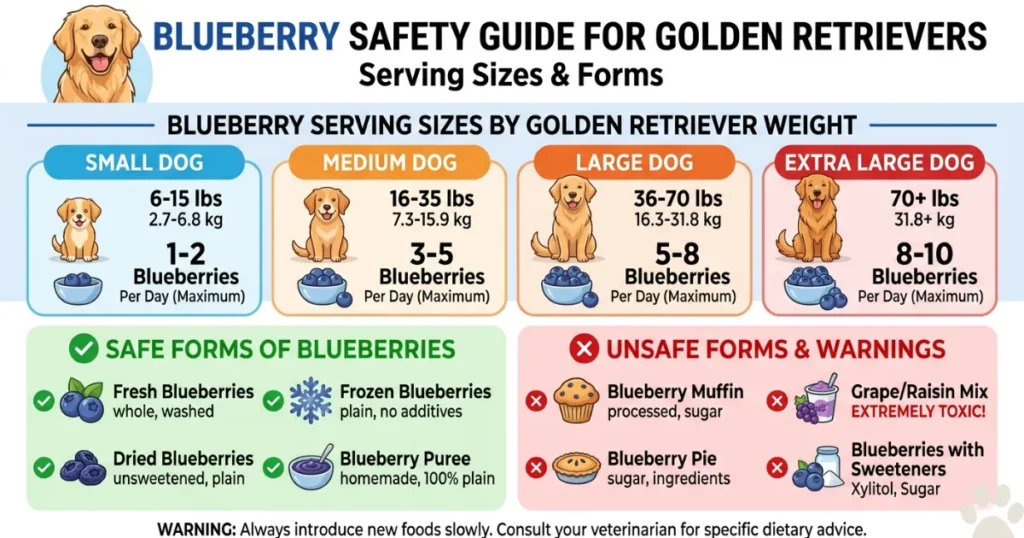
Dogs Eating Blueberries: Safe Forms vs. What to Skip
Dogs eating blueberries get the full benefit only from whole, plain forms. Processing changes everything – and this is where most generic content fails Golden Retriever owners by not being specific enough.
Fresh whole blueberries
Ideal. No preparation, full nutritional profile, appropriate texture.
Plain frozen blueberries
Equally safe. Preferred by many Goldens in warm weather. Offer one at a time to fast-eating Goldens to prevent swallowing multiple frozen berries whole, which can cause mild GI discomfort from cold temperature and undigested skins.
Dried blueberries
Unsuitable as a regular treat. Sugar is concentrated, fiber benefit is reduced, and caloric density increases significantly compared to fresh. One or two dried berries won’t cause harm, but dried forms provide no advantage over fresh and create an unnecessary sugar load for a weight-prone breed.
Blueberry yogurt
Avoid. Commercial varieties contain added sugar and artificial flavoring; “no sugar added” and “light” versions frequently use xylitol. According to PetMD’s xylitol toxicity guidance, xylitol triggers insulin release, causing life-threatening hypoglycemia within 30 minutes. Read every label before feeding any blueberry product that isn’t a whole berry.
Blueberry baked goods and muffins
Avoid. Added sugar, butter, and potential xylitol disqualify them regardless of blueberry content.
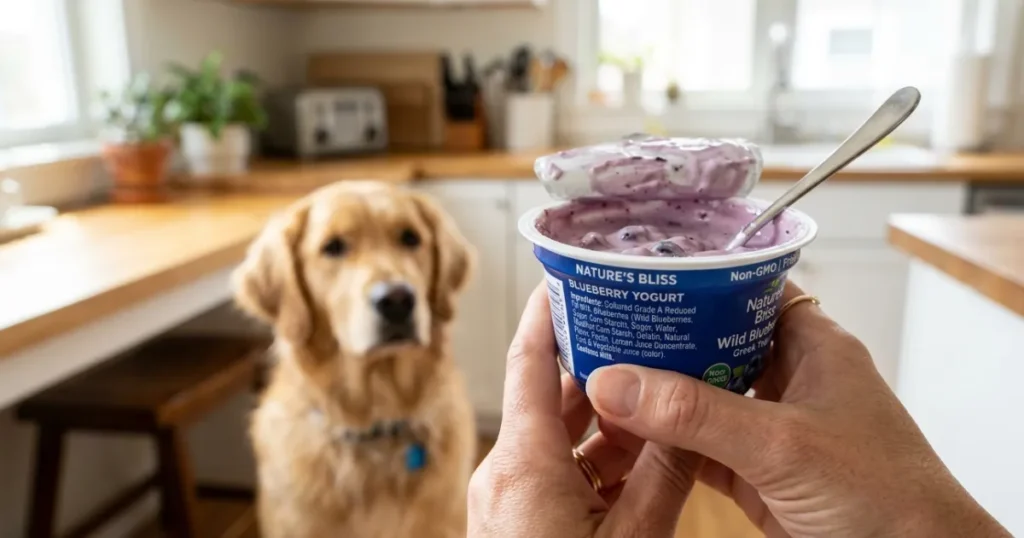
What Competitors Miss – The Processed Form Risk
Top-ranking articles on dogs and blueberries confirm the berry is safe and mention antioxidants. None adequately addresses the processed-form risk that creates real danger for Golden Retrievers in typical households. The berry in a blueberry muffin provides none of the nutritional benefits and introduces multiple risk vectors. The dogs-and-blueberries safety conversation is only complete when it includes what surrounds the berry in commercial products.
Dogs and Blueberries across Golden Retriever Life Stages
Puppies (Under 12 Months).
Puppies under 6 months should stay on vet-approved growth nutrition without fruit additions. After 6 months, 2 – 3 blueberries as occasional enrichment is appropriate – not nutritionally necessary, but harmless and useful for palette variety. Monitor for soft stools on first introduction; puppy digestive systems respond more sensitively than adults to new fiber sources.
Adult Goldens (1 – 7 Years).
This is the optimal window for dogs eating blueberries as a functional dietary addition. Established gut microbiomes handle pectin well, training sessions benefit from the low-calorie reward, and the breed enters the cancer-risk window where consistent antioxidant intake is most relevant. Up to 15 blueberries per session, daily if desired, fits comfortably within treat guidelines for a typical adult Golden.
Senior Goldens (8+ Years) – Modified Protocol.
Senior Golden Retrievers benefit from blueberry antioxidants and anti-inflammatory compounds, but slower digestive motility means lower fiber tolerance. Cap portions at 5 – 8 berries per session. If your senior is on anticoagulant medication, confirm with your vet before regular blueberry feeding – vitamin K in blueberries interacts with blood-thinning drugs.

Decision Framework: Should Your Golden Retriever Eat Blueberries?
- Healthy adult (1 – 7 years), normal weight, no diagnosed conditions → Yes. 12 – 15 fresh or plain frozen blueberries per session. Suitable as a daily treat or training reward.
- Overweight Golden on caloric restriction → Yes – among the best treat substitutes available. Count against daily treat allocation; at 1 kcal per berry, the ceiling is generous.
- Puppy 6 – 12 months → Yes, occasionally. 2 – 3 berries as enrichment only. No nutritional requirement beyond the growth formula.
- Senior on no medications → Yes. 5 – 8 berries per session; monitor for soft stools.
- Senior on anticoagulant drugs → Vet confirmation required before regular feeding.
- Golden with active diarrhea or GI upset → No. Adding fiber during active digestive disruption extends recovery. Resume after 48 hours of normal stools.
- Blueberry yogurt, muffins, or processed products → Check every ingredient before offering. If “no sugar added” appears anywhere on the label, assume xylitol risk until confirmed otherwise.

Warning: Blueberry-Related Risks Specific to Golden Retrievers.
Toxic – Vet Now
Xylitol is ingested via blueberry-flavored processed products. Not the berry – the packaging. The onset of hypoglycemia occurs within 30 minutes; signs include weakness, vomiting, collapse, and seizures. This is the only genuine toxicity risk in the dogs-and-blueberries category, and it lives entirely in commercial products, not the fruit itself.
Problematic
Monitor 24 – 48 Hours Overconsumption of fresh or frozen blueberries (20+ in one session). Fiber overload causes gas, bloating, and loose stools within 6- 12 hours. Not toxic – manageable at home. Withhold food 4 – 6 hours, offer water, resume bland diet. Fast-eating Goldens swallowing multiple frozen berries whole can experience mild GI discomfort from undigested cold skins; thaw slightly for these dogs.
Unsuitable
Avoid, Not Dangerous. Dried blueberries as a regular treat, blueberry juice, and blueberry-flavored commercial treats with unverified ingredient lists. No crisis at minimal exposure, but no benefit over whole fresh berries.
When to Call the Vet After Your Golden Eats Blueberries.
URGENT – Call Immediately.
| Symptom | Likely Cause |
| Vomiting with weakness or disorientation | Xylitol ingestion from blueberry product |
| Collapse or sudden lethargy | Hypoglycemia from xylitol toxicity |
| Seizure activity | Acute xylitol poisoning |
| Severe abdominal bloating with distress | Rule out GDV if large volume consumed rapidly |
MONITOR AT HOME (24- 48 Hours).
| Symptom | Action |
| Soft stools or gas after blueberry session | Withhold berries; bland diet; resolves in 24h |
| Single vomiting episode | Water only; monitor; no more blueberries today |
| Blue-tinged stool | Normal anthocyanin pigment — not a concern |
| Reduced appetite for one meal | Expected mild GI response; monitor for worsening |
Expert Insight.
Golden Retrievers are one of the few breeds where the case for blueberries goes beyond snack convenience. Their cancer vulnerability is documented and disproportionate – and while no single dietary intervention prevents cancer, reducing cumulative oxidative load through consistent anthocyanin intake is a low-effort, zero-risk lever owners can pull daily. The ceiling isn’t caloric for this breed – it’s fiber. Twelve to fifteen berries hit the antioxidant target without pushing digestive tolerance. What undermines the benefit entirely is sourcing blueberry intake from processed products instead of whole fruit.
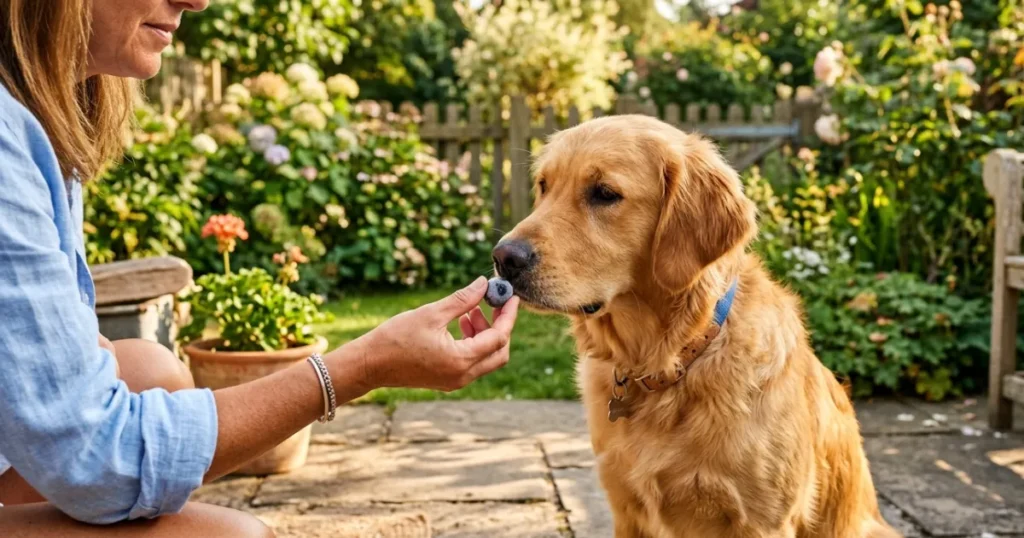
Are dogs and blueberries a safe combination?
Yes. Whole fresh or plain frozen blueberries are non-toxic to dogs and nutritionally beneficial for Golden Retrievers. No component of the raw berry poses a risk. The danger zone is processed blueberry products – yogurt, baked goods, and flavored treats – which may contain xylitol, a compound acutely toxic to dogs.
How many blueberries can dogs eat in one sitting?
For a 60- 70 lb adult Golden Retriever, 12- 15 blueberries per session is the practical ceiling – determined by fiber tolerance, not calories. More than 20 berries typically causes loose stools within 6 – 12 hours. Puppies should receive 2 – 3 maximum; seniors 5 – 8.
Can dogs eat blueberries every day?
Yes, at appropriate portions. Healthy adult Golden Retrievers can have 12 – 15 fresh blueberries daily without disrupting nutritional balance. The caloric load is negligible at roughly 1 kcal per berry. Daily feeding is nutritionally supportable provided the rest of the diet remains complete and portions stay within the 10% treat guideline.
Is it safe to give dogs frozen blueberries?
Yes. Plain frozen blueberries are safe and often preferred by Goldens in warm weather. Offer one at a time for fast eaters – swallowing multiple frozen berries whole can cause minor GI discomfort from cold temperature and undigested skins passing through. Partial thawing resolves this.
What happens if my dog eats a whole container of blueberries?
A Golden that eats 50 – 100 blueberries will experience significant fiber overload – expect gas, bloating, and loose stools within 6 – 12 hours. This is not toxicity. Withhold food for 4 – 6 hours, offer fresh water, and resume a bland diet. Call your vet if vomiting is severe or symptoms worsen past 24 hours.
Dogs and blueberries – does the antioxidant benefit actually apply to Golden Retrievers?
Yes, in a breed-specific way. Anthocyanins in blueberries reduce oxidative cellular stress – a documented contributing factor in cancer development. Golden Retrievers develop cancer at rates significantly higher than most purebred dogs. Consistent dietary antioxidant intake from blueberries is a practical, evidence-based measure. It is not a cancer treatment, but it is a defensible dietary choice for this breed.
How should I introduce blueberries to my Golden for the first time?
Offer 3 – 5 fresh blueberries as a standalone treat, away from mealtimes. Observe for 24 hours for loose stools, vomiting, or behavior changes. If no reaction occurs, increase to a standard serving over the following week. No preparation beyond rinsing is needed – serve whole.
Is it safe to give dogs blueberry yogurt as a treat?
No. Commercial blueberry yogurt contains added sugar, artificial flavoring, and, in “no sugar added” or “light” varieties, frequently xylitol. Xylitol causes life-threatening hypoglycemia within 30 minutes of ingestion. Plain unsweetened yogurt in small amounts is a separate conversation – but no blueberry-flavored commercial yogurt should be fed to Golden Retrievers.
Can Golden Retriever puppies eat blueberries?
Yes, after 6 months. Offer 2 – 3 fresh blueberries as occasional enrichment – not a nutritional supplement. Puppy growth formulas are complete; berries at this stage serve variety and palatability purposes only. Monitor for soft stools after introduction, as puppy digestive systems respond more sensitively to new fiber sources than adult Goldens.
Are dogs eating blueberries beneficial for joint health in Goldens?
The anti-inflammatory properties of anthocyanins provide modest supportive benefit alongside veterinary joint management. For Golden Retrievers with hip dysplasia or osteoarthritis – both common in the breed – consistent blueberry intake complements omega-3 supplementation and weight control. It is not a replacement for prescribed care but a sensible dietary complement.
Can senior Golden Retrievers eat blueberries?
Yes, with reduced portions. Senior Goldens benefit from blueberry antioxidants but have slower digestive motility and lower fiber tolerance than adults. Cap portions at 5 – 8 berries per session. If your senior is on anticoagulant medication, consult your vet – vitamin K in blueberries can interact with blood-thinning drugs and may need dietary accounting.
Do dogs eating blueberries get cognitive benefits as they age?
Preliminary research in aging dogs associates consistent anthocyanin intake with reduced cognitive decline by limiting oxidative damage in neural tissue. Golden Retrievers are susceptible to canine cognitive dysfunction syndrome from age 8 onward. Blueberries are not a clinical treatment, but their inclusion in a senior Golden’s diet represents a low-risk, evidence-adjacent supportive measure.
Can dogs eat blueberries picked from a garden?
Yes, if no pesticides, herbicides, or fungicides have been applied to the plant. Rinse thoroughly before serving. Wild-foraged blueberries carry risk from wildlife contact, fungal contamination, and proximity to toxic look-alike plants – grocery store berries remove all of that uncertainty.
What’s the best way to use blueberries for a Golden in training?
Fresh blueberries work well as mid-session training rewards – low calorie, high palatability, quick to deliver, and easy to carry in a small container. Frozen blueberries thawed slightly provide the same convenience with a different texture that Goldens often prefer. Prepare a batch in advance; refrigerated fresh blueberries stay viable for 4- 5 days.
Are dogs and blueberries a good match for Goldens managing their weight?
Yes – blueberries are among the best treat options for overweight Golden Retrievers. At approximately 1 kcal per berry, they replace higher-calorie commercial treats without reducing palatability or training effectiveness. For a breed with genetically impaired satiety signaling, swapping commercial treats for blueberries during weight management programs adds up meaningfully over weeks.
Conclusion.
Dogs and blueberries are a well-matched pairing – particularly for Golden Retrievers, where the combination of low caloric density, high antioxidant load, and zero preparation requirement makes blueberries one of the most practical functional treats available. Twelve to fifteen fresh or plain frozen blueberries, offered daily to a healthy adult retriever, delivers real nutritional value without disrupting dietary balance.
The one rule that doesn’t move: whole berry only. Any processed blueberry product gets a label check for xylitol before it reaches your Golden’s bowl. The berry itself is safe. What surrounds it in commercial packaging sometimes isn’t.
Start with a small handful today – and count against your Golden’s daily treat allocation.
Golden Retriever owners – I want to hear from you:
- Does your Golden go wild for blueberries, or are they suspicious of anything that small?
- Have you found a specific way to use blueberries – frozen on a lick mat, mixed into their meal, used in a sniff-and-find game – that works particularly well?
If your Golden is a senior and you’ve added blueberries to their routine for health reasons, I’d especially love to know whether you’ve noticed any changes in coat, energy, or digestion. Drop your experience in the comments below.