Apples are one of the most searched dog food questions on the internet – 90,000 people a month ask whether dogs can eat apples, which tells you something about how often an owner is standing in their kitchen holding an apple slice and second-guessing the impulse to share it.
The answer is yes. Dogs can eat apples, and for Golden Retrievers specifically, apples are one of the better fruit choices available – low in fat, moderate in natural sugar, genuinely high in dietary fiber and vitamin C, and available year-round in consistent quality. The preparation requirement is not optional: seeds and core must be fully removed before any apple is offered to a dog, without exception.
Dogs can eat apples as a regular part of their treat rotation when prepared correctly, and the serving size is matched to the dog’s weight and health status. For Golden Retrievers – a breed prone to weight gain and with documented cancer and pancreatitis susceptibility – the fiber and antioxidant content make apples a more nutritionally justified treat choice than most commercial options. The ceiling is the natural sugar content, which requires portion discipline rather than outright avoidance.
This guide covers the preparation requirements in full, the breed-specific serving framework, why apples are good for dogs in the right portion, and the complete puppy introduction protocol. For the complete picture of how apples fit alongside other safe fruits and vegetables for Golden Retrievers, our guide on the best fruits and vegetables for dogs covers the full list with breed-specific portions and preparation notes.
Can Dogs Eat Apples Safely – What the Preparation Gets Wrong
Are apples safe for dogs?
Yes – and dogs can eat apples safely when the preparation follows one non-negotiable rule: every seed and the entire core must be removed before the apple reaches the dog. This is not a precaution that can be relaxed based on how few seeds are visible or how quickly the dog eats.
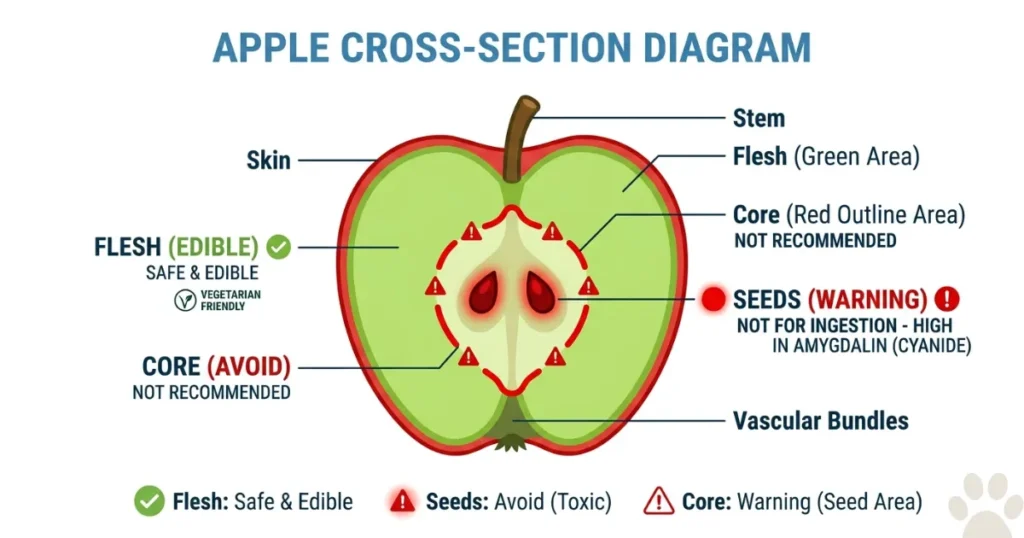
Apple seeds contain amygdalin, a cyanogenic glycoside that metabolizes into hydrogen cyanide when chewed or digested. The quantity of cyanide released from one or two seeds is unlikely to cause acute poisoning in a Golden Retriever-sized dog – the threshold for acute cyanide toxicity in dogs is considerably higher than what a few seeds provide. The risk is cumulative. A Golden Retriever who regularly receives apple pieces with seeds included is accumulating low-level cyanide exposure that builds over time, with effects that manifest gradually rather than dramatically. This is precisely why it gets overlooked – there is no obvious single-incident consequence that signals the problem.
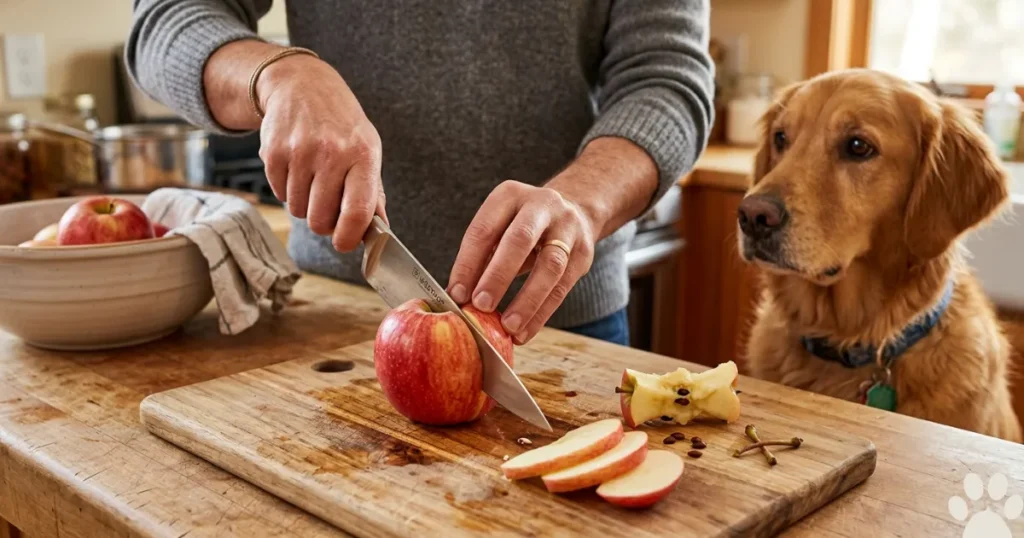
The core presents a secondary, more immediate concern:
Choking and GI obstruction. Apple cores are firm, awkwardly shaped, and difficult for dogs to break down into pieces small enough to pass safely. In a Golden Retriever, which tends to eat quickly and swallow without adequate chewing, a whole or partial core is a genuine obstruction risk. The ASPCA Animal Poison Control Center classifies apple seeds as toxic to dogs; the flesh, when prepared correctly, is listed as non-toxic.
The preparation protocol that eliminates both risks:
Slice the apple, remove the core completely, check each slice for seeds, and offer the flesh only. Skin-on is fine – apple skin provides additional dietary fiber and does not present a digestive concern for Golden Retrievers with normal GI function.
Are Apples Good for Dogs – The Nutritional Case for This Fruit
Are apples good for dogs? is a question with a genuine yes at the right serving size – not a hedged “it depends” that avoids committing to an answer.
Per 100g of raw apple flesh, the profile relevant to dogs includes: approximately 52 kcal, 14g carbohydrate, 10g natural sugar, 2.4 g dietary fiber, 4.6 mg vitamin C, and meaningful amounts of quercetin and catechin – flavonoid antioxidants that support immune function. For a Golden Retriever, that antioxidant content is specifically relevant: this breed carries one of the highest cancer rates of any dog breed, and dietary antioxidants contribute to the cellular environment that either supports or works against carcinogenesis.
The dietary fiber content is the second meaningful benefit. Golden Retrievers experience episodic GI disruption more commonly than many owners expect – loose stools following dietary changes, stress, boarding, or antibiotic courses are a recurring pattern. The soluble pectin fiber in apple flesh acts as a mild prebiotic and helps regulate stool consistency in both directions: firming loose stools and softening constipated ones. This makes apple a functionally useful addition to the diet, not just a palatable one.
The natural sugar content – 10g per 100g – is the variable that determines frequency and portion. For a healthy adult Golden Retriever at an ideal weight, this is not a disqualifying figure; it is a moderating one. Apples are appropriate several times per week at the serving sizes below. For overweight Golden Retrievers, or those managing diabetes or hypothyroidism, the frequency drops and the portion shrinks.
Apple Seeds and Core – The Risk Mechanism Every Owner Must Understand
The seed risk in apple feeding is the most commonly misunderstood element of this topic, and the misunderstanding cuts in both directions. Some owners treat it as catastrophic (a single seed will poison the dog), and others dismiss it entirely (my dog has eaten apple seeds for years without any obvious effect). Both positions are incorrect.
Amygdalin, the compound in apple seeds, is a cyanogenic glycoside. When metabolized – specifically when the seed coating is broken by chewing or gastric acid – amygdalin releases hydrogen cyanide. The clinical threshold for cyanide toxicity in dogs is approximately 2mg of cyanide per kilogram of body weight. A single apple seed contains roughly 0.06 – 0.24 mg of amygdalin, of which only a fraction converts to active cyanide. For a 30kg Golden Retriever, acute toxicity from apple seeds would require consuming many dozens of seeds in a single sitting.
The actual risk for a dog receiving apple pieces with seeds still present is chronic low-level accumulation – not acute poisoning. The relevance increases for smaller dogs and for dogs with compromised liver function (the liver is the primary detoxification route for low-level cyanide). For Golden Retrievers, who are not small and who typically have normal liver function, the seeds-in-apple scenario is more a consistent preparation failure than an acute medical emergency.
The correct position:
Remove seeds every time, as a non-negotiable habit, because the cumulative exposure has no safe floor and because establishing the habit of careful preparation protects against the rare scenario where a larger quantity of seeds is consumed.
The most common preparation error in apple feeding is not malicious – it is the “I just gave them a slice” assumption that the slice is seed-free because the seeds aren’t visible on the cut surface. Apple flesh adjacent to the core often contains seed remnants that are partially embedded and not obvious at a glance. Cutting apple slices from the outside of the fruit toward the center, then discarding the core section entirely rather than working around it, eliminates this risk reliably.
Can Puppies Eat Apples – Age-Specific Guidance for Golden Retrievers
Can puppies eat apples as a normal dog food is a question with a more favorable answer than the equivalent banana question – apple flesh is lower in fermentable carbohydrates than banana, and the GI disruption risk from apple’s fiber profile is lower in young puppies.

Under 8 weeks:
Apple is not appropriate. At this stage, the diet should consist entirely of the mother’s milk or a complete puppy formula. No fruit additions of any kind.
8 to 12 weeks:
One to two small pieces of peeled apple flesh – roughly half a teaspoon of material – can be offered alongside a regular meal. Peeling the apple at this stage removes the additional fiber from the skin, which makes the introduction gentler on a still-maturing GI tract. Remove all seeds and core before peeling. Observe for 24 hours.
12 weeks to 6 months:
Skin-on apple slices are now appropriate in small amounts. One to two thin slices (approximately 15 – 20g) once or twice per week is the target serving. At this stage, apple can be offered as a standalone treat rather than requiring meal accompaniment. Continue seed-and-core removal as the absolute standard.
6 to 12 months:
Up to two to three thin slices, two to three times per week. The growing puppy’s caloric needs are high during this phase, but so is the risk of establishing excess-weight patterns that persist into adulthood. Apple at these portions contributes meaningfully to the treat budget without pushing it.
One critical difference from adult feeding:
Can puppies eat apples with the peel? Yes, from 12 weeks onward, the fiber is beneficial, and the peel presents no toxicity concern. The only adjustment needed from adult preparation is that pieces should be smaller to account for the puppy’s smaller mouth and tendency to eat quickly. Thin half-slices rather than full slices reduce the choking risk in puppies who have not yet learned to slow down with unfamiliar textures.
Can Dogs Have Apples by Life Stage – The Serving Framework
Can dogs have apples at different life stages requires a calibrated answer rather than a single serving size, because a Golden Retriever’s caloric requirements, metabolic rate, and health vulnerabilities change substantially from puppyhood through senior age.
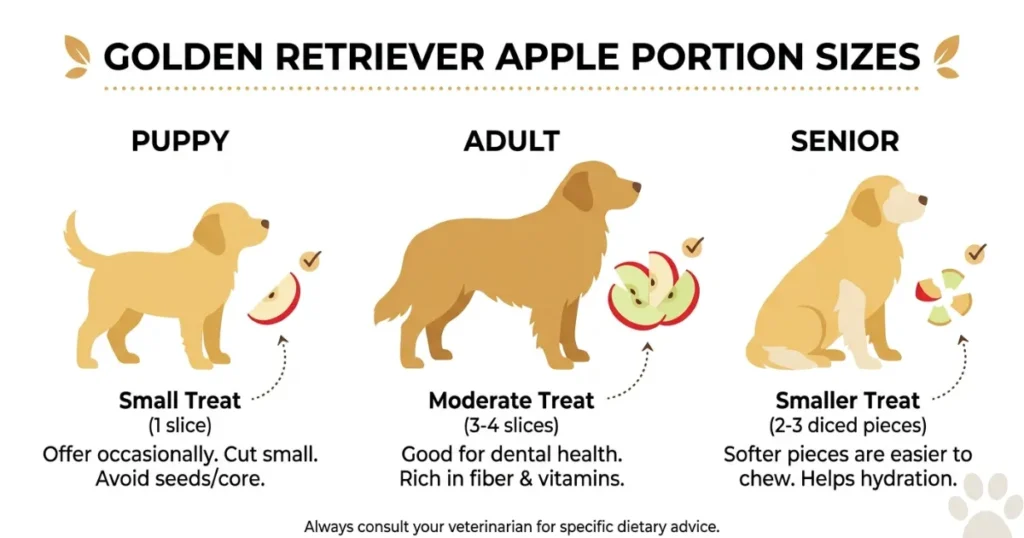
Healthy adult Golden Retriever (25 – 34kg, ideal weight):
Two to three thin slices (approximately 30 – 45g of flesh) per serving, three to four times per week. At this serving size, apple contributes approximately 15 – 23 kcal per session – a modest addition to the treat budget that leaves room for other low-calorie treats on the same day. Skin on, seeds and core removed.
Overweight Golden Retriever:
One to two thin slices, twice per week. Apple is one of the better treat options for weight management because its fiber content creates satiety relative to its caloric density – more filling per calorie than commercial treats. However, the sugar content still counts. On apple days, reduce or eliminate other treat additions.
Golden Retriever with diabetes:
Apple is not suitable for diabetic Golden Retrievers. The natural sugar content produces a glycemic response that conflicts with glucose management, regardless of the relatively low glycemic index of whole apples compared to processed foods. Substitute with a cucumber or a raw carrot.
Senior Golden Retriever (8+ years, normal organ function):
Two to three thin slices, two to three times per week. The antioxidant content – quercetin and vitamin C specifically – has particular relevance at this life stage, given the breed’s cancer trajectory. Ensure pieces are small enough for the dog’s dental condition; softened or grated apple is appropriate for dogs with significant tooth loss.
Golden Retriever with kidney disease:
Apple flesh is generally low in phosphorus and potassium relative to other fruits, making it one of the more renal-compatible treat options. Confirm with the treating vet before adding any new food to a dog managing kidney disease. Still, apples are less likely to conflict with a renal diet than bananas or other higher-potassium fruits.
- Suppose your Golden Retriever is healthy at an ideal weight → two to three slices, three to four times per week, seeds and core removed.
- If your Golden Retriever is overweight → one to two slices, twice weekly, replacing, not supplementing, other treats.
- If your Golden Retriever has diabetes → remove the apple; substitute a cucumber or a carrot.
- If your Golden Retriever is a puppy under 12 weeks → no apple; introduce from 8 weeks with peeled tiny pieces.
- If your Golden Retriever has any diagnosed health condition → clear with a vet before adding apple to the diet.
What to Watch For and When to Call the Vet
Apple feeding problems in Golden Retrievers fall into two categories: seed-related and portion-related. The signs and urgency differ significantly between them.
Seed and core related – when to act immediately:
| Situation | Urgency | Action |
| Dog ate a large quantity of apple seeds (more than 15–20 seeds at once) | Same day | Call vet — discuss induced vomiting within 2 hours if ingestion was recent |
| Dog swallowed the apple core whole or in large piece | Same day | Obstruction risk; call vet if the dog shows reluctance to eat, gagging, or abdominal discomfort |
| Puppy under 4 months swallowed seeds | Same day | Lower body weight increases relative cyanide exposure; contact vet |
| Signs of cyanide distress: rapid breathing, bright red gums, dilated pupils, collapse | Emergency | Go to the emergency vet immediately — this is rare but requires immediate treatment |
Portion-related – monitor at home:
| Situation | Urgency | Action |
| Loose stools 12–24 hours after the first apple introduction | Monitor | Reduce portion; try again in one week with a smaller amount |
| Vomiting once after eating apple | Monitor | Remove apple from diet temporarily; reintroduce at a smaller portion |
| Loose stools persisting for more than 48 hours | Call vet | Rule out other causes; may indicate apple sensitivity |
| Diabetic dog ate an apple accidentally | Call the vet the same day | Discuss glucose monitoring adjustment |

Can dogs eat apples with the skin on?
Yes – dogs can eat apples with the skin on without any safety concern. Apple skin provides additional dietary fiber and does not present a digestive problem for Golden Retrievers with normal GI function. The only preparation adjustment needed is ensuring no seeds are present near the skin edge, and that pieces are an appropriate size for the dog’s age and dental condition.
Can dogs eat apples every day?
Dogs can eat apples daily if they are healthy, at an ideal weight, and the portion stays within the treat budget – roughly two thin slices per day for a 30kg adult Golden Retriever. Daily feeding is not harmful at this portion, but it consumes a meaningful portion of the daily treat calorie allocation. Two to four times per week is a more sustainable routine for most Golden Retriever owners managing a varied treat rotation.
Can dogs have apples if they are on a diet?
Yes, can dogs have apples during active weight management is a question with a practical yes. Apple is one of the better treat choices during a weight reduction plan because the fiber content creates satiety relative to its caloric cost. One to two thin slices replacing commercial treats reduces the treat caloric load meaningfully while maintaining the behavioral reward function. Count the apple calories in the daily total.
Can dogs have apples that are cooked or processed?
Can dogs have apples in cooked form depends on what was added during cooking. Plain baked apple with no sugar, sweetener, or spice added is safe. Applesauce is safe if it is unsweetened, additive-free, and xylitol-free – check the ingredient label carefully. Apple juice, commercially sweetened applesauce, and any product containing xylitol are not appropriate. Xylitol causes severe hypoglycemia and liver failure in dogs at very small doses.
Are apples safe for dogs with sensitive stomachs?
Are apples safe for dogs with mild or episodic GI sensitivity? Yes – the soluble pectin fiber in apple flesh actually helps regulate stool consistency in dogs with mild loose stools. For Golden Retrievers with diagnosed IBD, chronic colitis, or food allergies, introduce apple cautiously in small amounts and observe for 48 hours before establishing it in the regular rotation.
Are apples safe for dogs who are pregnant or nursing dogs?
Are apples safe for dogs during pregnancy and nursing? Yes, in moderate amounts. The vitamin C and fiber content are appropriate for pregnant and nursing Golden Retrievers. Two to three thin slices two to three times per week is a conservative, appropriate frequency. Total caloric intake increases significantly during late pregnancy and lactation, so apples integrate comfortably within the expanded daily caloric budget.
Can puppies eat apples at 8 weeks old?
Yes, in very small, carefully prepared amounts. One to two tiny pieces of peeled apple flesh – approximately half a teaspoon – offered alongside a regular meal is appropriate from 8 weeks. Peel the apple at this stage to reduce the fiber load on an immature GI tract. Remove all seeds and core before peeling. Do not offer apple as a standalone treat until 12 weeks.
Can puppies eat apples at 8 weeks?
Yes, in very small, carefully prepared amounts. One to two tiny pieces of peeled apple flesh – approximately half a teaspoon – offered alongside a regular meal is appropriate from 8 weeks. Peel the apple at this stage to reduce the fiber load on an immature GI tract. Remove all seeds and core before peeling. Do not offer apple as a standalone treat until 12 weeks.
Can puppies eat apples with seeds?
No, can puppies eat apples with seeds? is an unambiguous no at any age. Apple seeds contain amygdalin, which metabolizes into hydrogen cyanide. For puppies, whose lower body weight means a smaller absolute threshold for toxic exposure, this risk is proportionally higher than for adult dogs. Seed removal is mandatory for puppies regardless of how few seeds appear to be present.
Are apples good for dogs as training treats?
Are apples good for dogs as training treats depends on the session format. Small pieces of apple – approximately a centimeter square – work well for calm, repetition-based training where the dog is not in a high-excitement state. For fast-paced, high-frequency reward training with Golden Retrievers, smaller and drier treats are more practical. Apple pieces are better suited to reward contexts than to rapid-fire training sequences.
What happens if my dog eats an apple core?
If a Golden Retriever eats an apple core, monitor for reluctance to eat, gagging, retching, or abdominal discomfort over the next 12- 24 hours. A core contains both seeds (cumulative cyanide risk) and a firm fibrous structure (obstruction risk). Contact a vet the same day if the dog shows any GI distress, changes in stool, or appears uncomfortable. A core swallowed without chewing poses a higher obstruction risk than one that was partially chewed.
How many apple slices can a Golden Retriever eat?
For a 30kg adult Golden Retriever at ideal weight, two to three thin slices (approximately 30 – 45g of flesh) per serving is appropriate, up to three to four times per week. For overweight Golden Retrievers, reduce to one to two slices twice weekly. For puppies 12 weeks to 6 months, one to two thin slices once or twice per week. Always remove seeds and core before any serving.
Are apples good for dogs with joint problems?
Are apples good for dogs with joint inflammation? The quercetin in apple flesh has documented anti-inflammatory properties in laboratory studies, and it contributes to the overall dietary antioxidant load that supports cellular health. Apple is not a joint supplement and should not be positioned as one – fish oil, glucosamine, and veterinary-directed joint support remain the primary interventions. Apple is a complementary dietary addition, not a treatment.
Can dogs eat green apples as well as red apples?
Dogs can eat green apples and red apples with equal safety – the preparation requirements and seed risks are identical regardless of variety. Green apples (typically Granny Smith varieties) are slightly more tart and lower in sugar than red varieties, which makes them marginally more appropriate for overweight Golden Retrievers or those managing blood sugar. The nutritional profile is sufficiently similar that variety selection is a minor variable compared to preparation and portion.
What should I do if my dog ate apple seeds by accident?
If a Golden Retriever ate a small number of apple seeds accidentally – fewer than ten seeds for a 30kg dog – monitor for the next 24 hours without immediate intervention. Seeds must be chewed or crushed to release amygdalin; seeds swallowed whole pass through largely intact. If your dog ate a larger quantity of seeds, crushed them while eating, or shows any signs of respiratory distress, bright red gums, or unusual lethargy, contact a vet or ASPCA Poison Control (888-426-4435) immediately.
Conclusion
Dogs can eat apples – this is a straightforward yes that holds across nearly every health scenario in Golden Retrievers, with a small number of specific exceptions. The preparation requirement (seeds removed, core removed, flesh only) is the non-negotiable step that turns an apple from a potential cumulative risk into one of the more genuinely useful fruit additions in the treat rotation.
Are apples good for dogs in the right portion? Yes – the fiber content supports GI regularity, the antioxidants are relevant to a breed with elevated cancer risk, and the caloric profile is favorable compared to most commercial treats. The natural sugar content means portion discipline applies, and the frequency adjusts downward for overweight, diabetic, or metabolically compromised dogs.
Golden Retriever owners who have made apple a regular treat often have strong opinions about which preparation method their dog responds to best – fresh slices, dehydrated pieces, frozen chunks, or grated over food. If you’ve found an approach that works consistently for your dog, or run into a reaction that made you rethink the frequency, share the details below.
Apple is one of those foods where Golden Retriever owners tend to settle into a reliable routine – a few slices a few times a week, seeds and core always removed – and then occasionally hear from someone who has been doing it differently for years with no apparent issues.
- The seed question in particular generates strong opinions. How do you prepare apples for your Golden Retriever?
- Have you found a specific variety, cut size, or serving method that your dog responds to best?
And if you’ve ever had a reaction – digestive or otherwise – that changed how you approach it, that detail is useful for other owners to hear.