
I often see Golden Retriever owners arrive after an arthritis diagnosis, asking the same question: Can food actually make a difference? The answer is yes – not as a cure, but as a meaningful daily intervention that slows progression, reduces inflammation, and directly influences the two most controllable drivers of joint damage: systemic inflammation and body weight.
Golden Retrievers are predisposed to osteoarthritis, hip dysplasia, and elbow dysplasia at rates that make joint-supportive nutrition a breed priority – not an optional upgrade. The inflammatory processes degrading articular cartilage, the mechanical load, excess weight placed on damaged joints, and the availability of cartilage-building compounds are all directly influenced by what your dog eats every day.
The best dog food for arthritis addresses all three simultaneously: delivering anti-inflammatory omega-3 fatty acids at therapeutic concentrations, providing glucosamine and chondroitin for cartilage support, and managing caloric density to maintain healthy body weight. Generic maintenance food – regardless of quality – does not accomplish this.
This guide covers the nutrients that matter most for dog joints, how to evaluate dog food for arthritis without being misled by label claims, which commercial options consistently perform well, and the feeding mistakes that silently accelerate joint damage in this breed.
Why Dog Joints Are a Nutritional Priority in Golden Retrievers.
Golden Retrievers rank among the top breeds for osteoarthritis prevalence. Genetics, size, and activity level create compounding joint stress that makes dietary intervention both urgent and impactful.
Two arthritis drivers are directly modifiable through diet:
Systemic inflammation
It accelerates cartilage breakdown. EPA and DHA from marine omega-3 sources reduce pro-inflammatory cytokine production in joint tissue, producing measurable reductions in canine lameness scores in peer-reviewed veterinary studies.
Body weight
It is the most powerful mechanical driver of progression. Every excess kilogram adds three to five kilograms of force per joint per stride. A Golden Retriever carrying five kilograms of excess weight accumulates thousands of additional pounds of joint load daily. A landmark 14-year Purina study confirmed that dogs maintained at lean body condition developed osteoarthritis an average of two years later than heavier dogs and required significantly less pain medication across their lifetimes.
In Golden Retrievers, the two most impactful dietary interventions for arthritis are maintaining lean body weight and delivering therapeutic EPA and DHA from marine omega-3 sources – both achievable through targeted dog food for arthritis selection.
The 5 Nutrients That Matter Most in Dog Food for Arthritis.
1. EPA and DHA (Marine Omega-3s)
The active anti-inflammatory omega-3s. Therapeutic dose for a 30kg Golden: 2,250 – 3,000 mg EPA+DHA daily. No commercial food delivers this at standard portions – fish oil supplementation is always warranted alongside dog food for arthritis.
2. Glucosamine Hydrochloride
Precursor to cartilage and synovial fluid components. Slows articular cartilage degradation and reduces joint discomfort in moderate disease. Glucosamine hydrochloride has higher bioavailability in dogs than glucosamine sulfate – look for this specific form on labels.
3. Chondroitin Sulfate
Works synergistically with glucosamine. Inhibits cartilage-degrading metalloproteinases and maintains water retention within cartilage for sustained shock absorption. Foods listing both glucosamine and chondroitin deliver more complete dog joint support than either alone.
4. Green-Lipped Mussel (Perna canaliculus)
The only dietary source of eicosatetraenoic acid (ETA) – a fatty acid that blocks both COX and LOX inflammatory pathways that standard fish oil cannot reach. Multiple peer-reviewed studies show statistically significant pain score reductions in arthritic dogs supplemented with green-lipped mussel extract. When listed in dog food for arthritis, it must appear prominently – listed as ingredient 20 delivers negligible benefit.
5. Antioxidants (Vitamin E, Selenium)
Oxidative stress in inflamed joint tissue accelerates cartilage damage. Vitamin E and selenium work synergistically to neutralize reactive oxygen species generated by the inflammatory process. Both should appear in the guaranteed analysis of any joint-health formula.
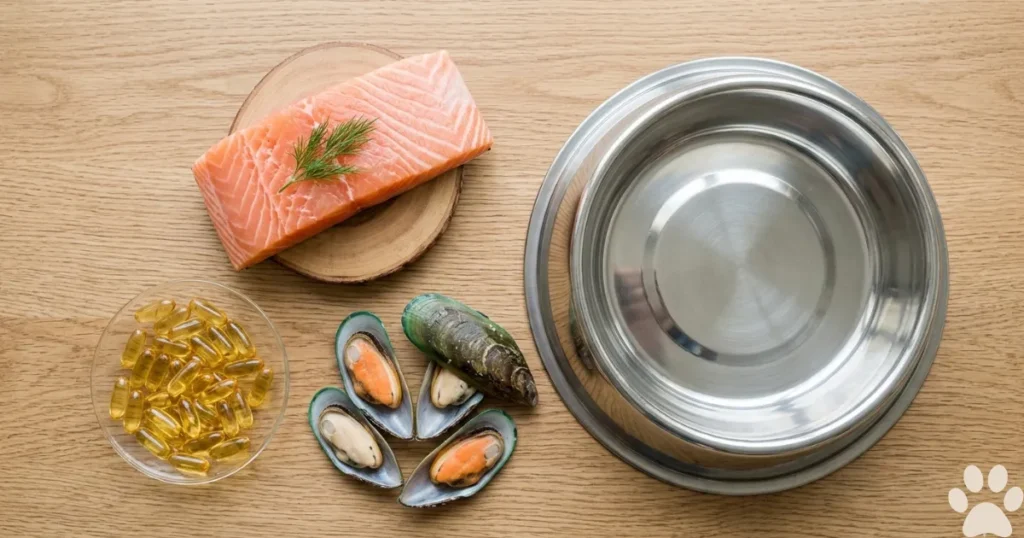
Green-lipped mussel is the only dietary source of ETA fatty acids, which inhibit inflammatory pathways in arthritic dog joints that omega-3 supplementation alone cannot address – making it uniquely valuable in dog food for arthritis.
Best Dog Food for Arthritis in Golden Retrievers: Vet-Reviewed Comparison Table.
| Food Name | Key Joint Ingredients | Life Stage | Best For |
| Hill’s Prescription Diet j/d | High-dose EPA/DHA, glucosamine, chondroitin, Vitamin E | Adult + Senior | Clinically diagnosed arthritis; the strongest published evidence base |
| Purina Pro Plan Veterinary JM | EPA/DHA, glucosamine, chondroitin | Adult + Senior | Vet-managed moderate to severe cases; requires authorization |
| Royal Canin Veterinary Mobility | EPA/DHA, glucosamine, chondroitin, green-lipped mussel | Adult + Senior | One of the few commercial foods containing green-lipped mussel |
| Hill’s Prescription Diet Metabolic + Mobility | EPA/DHA, glucosamine, L-carnitine | Overweight Adult | Simultaneous weight loss and joint management |
| Purina Pro Plan Joint Health Salmon | EPA/DHA (salmon), glucosamine | Adult | Early joint stiffness; strong protein profile alongside joint support |
| Royal Canin Golden Retriever Adult | Glucosamine, chondroitin, EPA/DHA | Adult (breed-specific) | Breed-engineered maintenance joint support |
| Orijen Senior | Whole fish EPA/DHA, natural glucosamine | Senior 7+ | High protein alongside joint compounds for muscle preservation |
| Acana Senior’s Recipe | Whole fish, glucosamine from chicken meal | Senior | Non-prescription; whole-food ingredient sourcing |
| Hill’s Science Diet Large Breed Adult | Glucosamine, chondroitin, omega-6 | Adult | Prevention baseline for healthy adults before diagnosis |
| Merrick Grain-Free Salmon | Salmon EPA/DHA, glucosamine, chondroitin | Adult | Non-prescription whole-food option for mild joint support |
Vet’s Tip: Hill’s Prescription Diet j/d is the only commercial dog food for arthritis with published clinical trial data showing statistically significant mobility improvement – but monitor portions carefully, as its high palatability frequently leads to overfeeding, directly undermining the weight management component that makes it effective.

6 Signs Your Golden Retriever’s Dog Joints Need Nutritional Support.
- Hesitation before jumping – pre-loading behavior before impact; one of the earliest detectable signs of joint discomfort in retrievers.
- Morning stiffness lasting over ten minutes – resolves with movement; a textbook early osteoarthritis presentation in dogs.
- Slowing on walks without obvious cause – subconscious reduction in weight-bearing activity driven by low-grade joint pain.
- Hindquarter or shoulder muscle asymmetry – unequal muscle development indicates chronic weight-shifting away from a painful joint.
- Licking or chewing at elbows, hips, or carpals – localized self-directed behavior directly signaling joint discomfort.
- Altered sitting posture – dogs with hip discomfort increasingly sit with one or both legs extended laterally rather than tucked normally.
If your Golden Retriever shows three or more of these signs consistently, a veterinary orthopedic assessment and immediate dietary review are both warranted.
Over the years, I’ve noticed that Golden Retrievers whose owners started joint-supportive nutrition before formal diagnosis consistently present with slower disease progression, better muscle condition around affected joints, and lower pain scores at the same age as dogs whose dietary management began only after lameness became obvious. Starting early changes the trajectory in ways that catch-up nutrition cannot fully replicate.
7 Feeding Mistakes That Worsen Arthritis in Golden Retrievers.
1. Treating glucosamine as the only joint metric
EPA/DHA concentration matters equally for active inflammation control. High glucosamine with negligible omega-3s delivers incomplete dog joint support.
2. Not supplementing fish oil.
No commercial dog food for arthritis reaches therapeutic EPA/DHA at standard portions for a 25- 35kg Golden. Daily fish oil at 2,000 – 3,000 mg EPA+DHA is necessary alongside even the best joint formula.
3. Overfeeding joint-support foods.
Joint formulas are highly palatable. Generous portioning causes weight gain that directly worsens arthritis, negating the food’s primary benefit. Follow caloric targets, not volume guidelines.
4. Reducing protein for senior arthritic dogs.
Arthritic dogs need adequate protein to maintain muscle mass around affected joints. Muscle atrophy increases mechanical joint stress significantly. Maintain 25 – 28% dry matter protein unless kidney disease is confirmed.
5. Relying on food alone
Even the best dog food for arthritis cannot deliver therapeutic doses of all joint compounds simultaneously at practical portions. A veterinary-grade joint supplement alongside food provides more complete coverage.
6. Ignoring meal timing
Arthritic dogs are stiffest after rest. Feeding the larger meal in the evening and encouraging light movement afterwards reduces morning stiffness – a simple adjustment most owners overlook.
7. Staying on the same food throughout disease progression
Arthritis advances. A food appropriate for early diagnosis may be insufficient for moderate disease. Reassess dietary strategy at every veterinary arthritis review rather than maintaining the original choice indefinitely.

9 Vet-Backed Tips for Supporting Dog Joints through Nutrition Long-Term.
- Start EPA/DHA supplementation and glucosamine-containing food from age two to three in Golden Retrievers – before arthritis develops, not after.
- Calculate daily caloric need: RER = 70 × (kg) ^ 0.75, multiplied by 1.4 for sedentary adults. Adjust monthly based on body condition score, not scale weight alone.
- Supplement fish oil at 75 – 100mg EPA+DHA per kilogram of body weight daily – this matches therapeutic doses used in peer-reviewed canine arthritis studies.
- Use a veterinary-grade glucosamine and chondroitin supplement alongside food – label-listed amounts in commercial food rarely reach clinically effective daily doses at standard portions.
- Target body condition score 4 – 5 out of 9. Reducing BCS by even one unit in an overweight arthritic Golden produces measurable mobility improvement within weeks.
- Choose foods explicitly listing marine omega-3 sources – salmon, sardines, menhaden, fish oil – rather than relying on generic “omega-3 fatty acids” claims that may include low-efficiency plant-sourced ALA.
- For overweight arthritic Goldens, target weight loss of 1 – 2% of body weight weekly – faster risks muscle depletion; slower delays the joint load relief, driving improvement.
- Run annual bloodwork in dogs over seven before increasing protein or changing joint formulas – kidney and liver values directly influence appropriate dietary targets in aging dogs.
- Reassess nutritional strategy every twelve months with your veterinarian. Arthritis progresses, and dietary management should advance alongside it, not remain static after initial diagnosis.

Dog food for arthritis produces the strongest outcomes when it simultaneously reduces systemic inflammation through marine omega-3s, supports cartilage integrity through glucosamine and chondroitin, and manages caloric density for lean body weight maintenance – no single nutrient achieves what the combination delivers.
FAQs: Best Dog Food for Arthritis and Dog Joint Health.
What is the best dog food for arthritis in Golden Retrievers?
Hill’s Prescription Diet j/d has the strongest published clinical evidence. For non-prescription options, Royal Canin Veterinary Mobility and Purina Pro Plan Joint Health Salmon consistently support dog joints in Golden Retrievers.
What ingredients matter most in dog food for arthritis?
EPA and DHA from marine sources, glucosamine hydrochloride, chondroitin sulfate, and green-lipped mussel. All should appear explicitly in the ingredient list – not only in marketing claims on packaging.
Can diet alone manage arthritis in dogs?
Diet significantly influences progression and comfort, but rarely manages arthritis completely without veterinary support. Best outcomes combine appropriate dog food for arthritis with weight control, pain management, and controlled exercise.
How much EPA and DHA does an arthritic Golden Retriever need daily?
Approximately 75- 100mg combined EPA+DHA per kilogram of body weight. A 30kg Golden needs 2,250 – 3,000 mg daily, levels requiring fish oil supplementation alongside any commercial food.
Does body weight affect arthritis severity in dogs?
Directly and significantly. Every excess kilogram adds three to five kilograms of force per joint per stride. Weight reduction produces measurable mobility improvement within weeks and is the single most impactful dietary intervention available.
Is grain-free food better for arthritic dogs?
No evidence supports grain-free diets specifically for arthritis. Unless grain sensitivity is confirmed, whole grains are appropriate. Grain-free formulas with heavy legume bases carry an unresolved potential link to cardiac disease in dogs.
What is a green-lipped mussel, and why does it help dog joints?
A New Zealand shellfish delivering ETA fatty acids, glycosaminoglycans, and omega-3s. It inhibits inflammatory pathways – both COX and LOX – that standard fish oil cannot, making it uniquely valuable in dog food for arthritis.
How long before dietary changes improve arthritis symptoms?
Omega-3 anti-inflammatory effects appear within 4- 6 weeks. Body weight reduction benefits joint comfort within 2- 4 weeks of meaningful loss. Glucosamine effects on cartilage repair develop over 8- 12 weeks of consistent intake.
Should arthritic Golden Retrievers eat senior dog food?
Only if protein is maintained at 25 – 28% dry matter or higher. Many senior formulas reduce protein unnecessarily, which accelerates muscle loss around arthritic joints. Confirm protein levels before transitioning.
Can I add human glucosamine supplements to my dog’s food?
Yes, with veterinary guidance. Target approximately 20mg of glucosamine per kilogram of body weight daily. Confirm the supplement contains no xylitol or artificial sweeteners before use.
Is omega-3 from flaxseed effective for dog joint health?
Minimally. Dogs convert plant-sourced ALA to EPA and DHA at only 5 – 15% efficiency. Marine-sourced EPA and DHA are required for a meaningful anti-inflammatory effect on dog joints.
Do I need a prescription food for arthritis management?
Not always. For mild to moderate arthritis, quality non-prescription joint formulas with supplementation often suffice. Prescription options like Hill’s j/d or Purina JM deliver higher therapeutic doses with clinical data for confirmed moderate to severe cases.
How does muscle condition relate to arthritis in Golden Retrievers?
Muscle mass around affected joints stabilizes articular surfaces and reduces mechanical stress. Preserving lean muscle through adequate dietary protein is essential – protein restriction directly worsens joint instability in arthritic dogs.
When should I switch to a veterinary arthritis diet?
When lameness affects daily quality of life, when standard food plus supplementation produces no improvement after 8- 12 weeks, or when veterinary assessment confirms moderate to severe osteoarthritis requiring clinically dosed nutritional therapy.
How often should I reassess my arthritic dog’s diet?
Annually, at a minimum, or at every veterinary arthritis review. Disease progression changes nutritional requirements – dietary strategy should advance alongside the condition, not remain fixed at initial diagnosis.
Conclusion.
Managing arthritis in a Golden Retriever through nutrition requires more than picking a bag with “joint health” on the label. The best dog food for arthritis delivers marine-sourced EPA and DHA at concentrations that reduce active inflammation, provides glucosamine and chondroitin at clinically relevant levels, and supports the lean body weight that reduces mechanical joint load every single day.
No food reverses arthritis in a predisposed breed. But consistent, targeted nutrition – started early and adjusted as the condition evolves – measurably slows progression, reduces pain medication requirements, and preserves the mobility and quality of life that matter most in a Golden Retriever’s senior years.
Work with your veterinarian to assess body condition, confirm appropriate dietary targets, and supplement where food falls short. The combination of the right dog food for arthritis, therapeutic fish oil, and lean weight management is the most evidence-supported nutritional strategy available for protecting dog joints in this breed over a lifetime. Arthritis management is deeply personal – every Golden Retriever responds differently to dietary changes, supplements, and feeding adjustments.
Have you switched to a joint-specific food or added fish oil and noticed a real difference in your dog’s mobility or comfort levels? Share what worked – and what didn’t – in the comments below. Your firsthand experience helps other Golden Retriever owners make better decisions sooner.