
“What can I feed my dog?” is one of the questions I hear most often – and the answer matters far more when the dog in question is a Golden Retriever puppy. Puppies are smaller, their detoxification systems are immature, and their digestive tracts are still developing. Something a healthy adult dog processes without issue can cause serious harm in a 10-week-old puppy.
I often see owners approach puppy diet basics with confidence they haven’t quite earned yet. They’ve looked up a list of safe foods for puppies, given their Golden a piece of fruit or a bite of chicken, and assumed that any human food they’ve read about is fine. The gap between “generally safe” and “safe for this specific puppy at this specific age, in this amount” is where problems begin.
What you can feed your dog depends on species, breed, age, size, and health status. For Golden Retriever puppies specifically, breed predispositions to skin sensitivity, GI reactivity, and food-related allergies make the question of safe foods for puppies even more important to get right.
This guide gives you a complete, breed-aware answer – covering puppy diet basics, a full safe foods reference, the complete toxicity list, and the Golden Retriever-specific nuances that most general guides miss entirely.
Contents
- 1 Puppy Diet Basics: What Every Golden Retriever Owner Needs to Understand First
- 2 What Can I Feed My Dog? Safe Foods for Golden Retriever Puppies
- 3 What Can I NOT Feed My Dog? Toxic and Dangerous Foods for Golden Retrievers
- 4 Golden Retriever-Specific Puppy Diet Basics: What the Breed Changes
- 5 8 Puppy Diet Basics: Rules for What You Can Feed a Golden Retriever
- 5.1 1. Verify “dog safe” claims against breed-specific context.
- 5.2 2. Never introduce more than one new food per week.
- 5.3 3. Remove all pits, seeds, cores, and rinds before offering fruit.
- 5.4 4. Plain means plain. Cooked chicken is safe for puppies.
- 5.5 5. Peanut butter requires a label check every time.
- 5.6 6. Cooked bones are more dangerous than raw bones.
- 5.7 7. The 10% ceiling applies to all extras combined – not per item.
- 5.8 8. Safe foods for puppies are dose-dependent.
- 6 What Can I Feed My Dog as a Healthy Treat? Practical Options for Golden Retriever Puppies
- 7 Vet Definitive Statements
- 7.1 What can I feed my dog as a safe snack?
- 7.2 What are the basics of a puppy diet?
- 7.3 What human foods are safe for puppies?
- 7.4 What foods are toxic to Golden Retrievers?
- 7.5 Can I feed my dog cooked chicken every day?
- 7.6 Is peanut butter safe for Golden Retriever puppies?
- 7.7 Can puppies eat carrots?
- 7.8 What vegetables can I feed my dog?
- 7.9 Can I feed my Golden Retriever puppy fruit?
- 7.10 What should I never feed my dog?
- 7.11 Can dogs eat eggs?
- 7.12 Is rice a safe food for puppies?
- 7.13 Can Golden Retriever puppies eat salmon?
- 7.14 Why does my Golden Retriever puppy react to some foods?
- 7.15 How do I know if a human food is safe for my puppy?
- 8 Conclusion
Puppy Diet Basics: What Every Golden Retriever Owner Needs to Understand First
Before addressing specific foods, understanding puppy diet basics lays the foundation for every feeding decision that follows.
Primary nutrition must come from a complete and balanced puppy food
What can you feed your dog as the core of their diet? For Golden Retriever puppies, the answer is unambiguous: a commercially formulated large-breed puppy food that meets AAFCO (Association of American Feed Control Officials) nutritional standards for growth and reproduction.
Human foods, raw additions, and supplements are not substitutes for a complete diet – they are additions to one. Puppy diet basics begin with this hierarchy: structured puppy food first, everything else in strict moderation.
What “complete and balanced” means in practice:
- The food meets established nutrient profiles for growing dogs
- Protein, fat, calcium, phosphorus, and essential vitamins are present in appropriate ratios
- The formula is specifically designed for large-breed puppies – not generic puppy food, which is often too calorie-dense and mineral-rich for fast-growing large breeds
Puppy diet basics: the 90/10 rule
In canine nutrition, the 90/10 rule is the practical application of puppy diet basics for supplemental feeding:
- 90% of daily calories come from the complete and balanced puppy food
- 10% of daily calories maximum come from treats, toppers, and human food additions
For a Golden Retriever puppy needing 900 kcal/day, that 10% ceiling is just 90 kcal – roughly equivalent to 2 tablespoons of cooked chicken breast or one small carrot. The ceiling is lower than most owners expect.
What Can I Feed My Dog? Safe Foods for Golden Retriever Puppies
The following foods are generally considered safe for Golden Retrievers, including puppies, when offered in appropriate amounts as part of a balanced diet. All portions should stay within the 10% daily calorie ceiling.
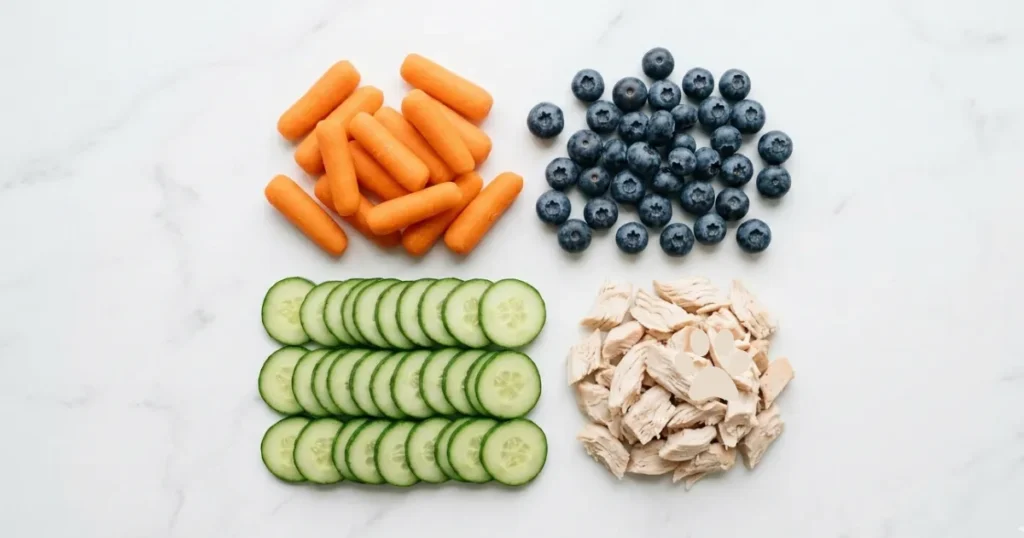
Safe Proteins
| Food | Safe for Puppies | Notes |
| Plain cooked chicken (boneless) | ✅ Yes | No seasoning, skin, or bones |
| Plain cooked turkey (boneless) | ✅ Yes | No onion, garlic, or seasoning |
| Plain cooked salmon | ✅ Yes | Fully cooked only — raw salmon carries Neorickettsia helminthoeca risk |
| Plain cooked eggs | ✅ Yes | Scrambled or hard-boiled; no butter or salt |
| Plain cooked lean beef | ✅ Yes | Unseasoned, no onion or garlic |
| Plain cooked cod or whitefish | ✅ Yes | Boneless, unseasoned |
What NOT to do:
Do not feed raw salmon or raw trout to Golden Retriever puppies. Salmon Poisoning Disease – caused by a parasite carrying Neorickettsia helminthoeca – is fatal in dogs if untreated and is more dangerous in immunologically immature puppies. This is one of the most underknown food safety risks in canine nutrition, and it is particularly relevant for owners in Pacific Northwest regions or those purchasing raw fish.
Safe Vegetables
| Vegetable | Safe for Puppies | Notes |
| Carrots (raw or cooked) | ✅ Yes | Low calorie; good for chewing |
| Broccoli (small amounts) | ✅ Yes | Over 10% of diet can cause GI irritation |
| Green beans (plain) | ✅ Yes | Fresh, frozen, or cooked — no canned with salt |
| Cucumber (plain) | ✅ Yes | Hydrating, very low calorie |
| Cooked sweet potato | ✅ Yes | Plain only — no butter, sugar, or spices |
| Cooked pumpkin (plain) | ✅ Yes | Excellent for GI support in puppies |
| Peas (fresh or frozen) | ✅ Yes | In moderation — avoid in dogs with kidney issues |
| Cooked zucchini | ✅ Yes | Plain; good low-calorie option |
Safe Fruits
| Fruit | Safe for Puppies | Notes |
| Apple (no seeds or core) | ✅ Yes | Seeds contain amygdalin — remove completely |
| Blueberries | ✅ Yes | Antioxidant-rich; feed as occasional treat |
| Watermelon (no rind or seeds) | ✅ Yes | Hydrating; rind can cause GI upset |
| Banana | ✅ Yes | High sugar — limit to small pieces |
| Mango (no pit or skin) | ✅ Yes | Pit contains cyanogenic compounds |
| Strawberries | ✅ Yes | Natural sugars — small amounts only |
| Pineapple (fresh, no core) | ✅ Yes | Occasional only due to sugar content |
Vet’s Tip: When introducing any new safe food, offer a very small amount – no larger than your thumbnail – and wait 24 hours before offering again. Golden Retriever puppies are prone to food sensitivities, and introducing multiple new foods simultaneously makes it impossible to identify which one triggered any reaction. One new food at a time is the safest puppy diet basics rule for this breed.
What Can I NOT Feed My Dog? Toxic and Dangerous Foods for Golden Retrievers
Puppy diet basics include an equally important list of what to keep entirely out of reach. The following foods are toxic to dogs – some acutely, some cumulatively.
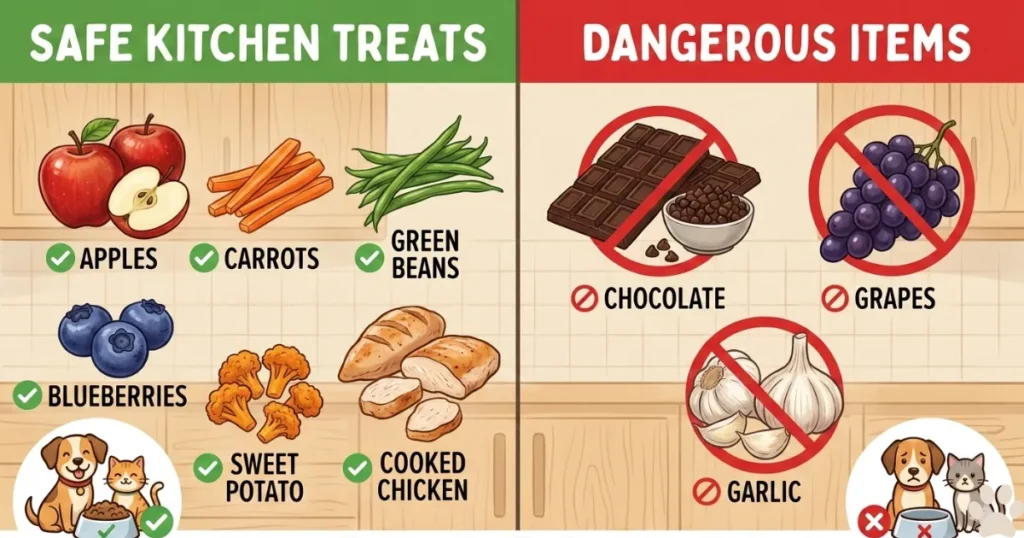
Critical Toxicity Reference – Foods to Never Feed a Golden Retriever
| Food | Toxicity Level | Primary Risk |
| Grapes and raisins | 🔴 Severe | Acute kidney failure — no safe dose established |
| Xylitol (artificial sweetener) | 🔴 Severe | Hypoglycaemia, liver failure; found in gum, peanut butter, baked goods |
| Onions and garlic (all forms) | 🔴 Severe | Haemolytic anaemia — raw, cooked, and powdered all toxic |
| Chocolate | 🔴 Severe | Theobromine toxicity — darker chocolate is more toxic |
| Macadamia nuts | 🔴 Severe | Tremors, hyperthermia, weakness |
| Alcohol | 🔴 Severe | CNS depression, hypoglycaemia, death |
| Cooked bones (all types) | 🔴 Severe | Splintering risk — intestinal perforation |
| Raw dough (yeast-containing) | 🔴 Severe | Ethanol production in stomach, life-threatening bloating |
| Avocado | 🟠 Moderate | Persin causes vomiting and diarrhoea; toxic in large amounts |
| Caffeine (coffee, tea, energy drinks) | 🔴 Severe | Cardiac arrhythmia, seizures |
| Nutmeg | 🟠 Moderate | Myristicin toxicity — tremors and CNS effects |
| Cherries (pits, leaves, stems) | 🟠 Moderate | Cyanogenic compounds in non-flesh parts |
| Salt (large quantities) | 🟠 Moderate | Sodium ion toxicosis — especially dangerous in puppies |
| Milk and dairy (large amounts) | 🟡 Low-moderate | Lactase deficiency common in dogs — GI upset |
If your Golden Retriever puppy has consumed any item from the severe toxicity list:
Contact your veterinarian or the ASPCA Animal Poison Control Center (1-888-426-4435) immediately. Do not wait for symptoms to appear – the treatment window for grape toxicity and xylitol ingestion is narrow.
Golden Retriever-Specific Puppy Diet Basics: What the Breed Changes
What can you feed your dog in general terms is one question. What can you feed a Golden Retriever puppy specifically involves additional breed-aware considerations.
Skin and Food Sensitivity
Golden Retrievers are predisposed to food-related skin conditions – more commonly triggered by protein sources than by grains. In canine dermatology, Golden Retrievers show a higher incidence of reactions to beef, dairy, and chicken than many other breeds. This doesn’t mean these foods are universally problematic. Still, it does mean that when introducing safe foods for puppies that include these proteins, monitoring for skin changes (itching, red ears, paw licking) is warranted.
Decision Checkpoint: If your Golden Retriever puppy begins showing consistent paw licking, ear scratching, or recurrent skin redness within 4- 6 weeks of introducing a new protein source, discuss a dietary elimination trial with your vet before assuming it is environmental.
GI Reactivity
Golden Retriever puppies tend to have more reactive digestive tracts than many other large breeds. What can you feed your dog as an occasional treat without issue may cause loose stools in a Golden puppy in the same amount.
Puppy diet basics for this breed include maintaining higher dietary consistency – fewer new foods introduced simultaneously, smaller portions of any new addition, and longer observation windows before concluding a food is well-tolerated.
Weight Predisposition
Golden Retrievers are predisposed to weight gain, and safe foods for puppies – even healthy ones – contribute to total daily caloric intake. A banana, a tablespoon of peanut butter, and a few pieces of chicken added to a puppy’s day can represent 150- 200 extra kcal – pushing a puppy fed a correctly calculated kibble amount significantly over its daily target.
Over the years, I’ve noticed that well-informed Golden Retriever owners who know their puppy diet basics and carefully avoid toxic foods are still inadvertently overfeeding by treating safe foods as calorie-free additions. They are not. Every addition counts against the daily 10% ceiling.

8 Puppy Diet Basics: Rules for What You Can Feed a Golden Retriever
1. Verify “dog safe” claims against breed-specific context.
A food listed as safe for dogs may cause reactions in Golden Retrievers with protein sensitivities. General lists are a starting point – not a guarantee.
2. Never introduce more than one new food per week.
With safe foods for puppies, the one-at-a-time rule makes it possible to identify the source of any adverse reaction. Introducing three new foods in a weekend makes this impossible.
3. Remove all pits, seeds, cores, and rinds before offering fruit.
The flesh of many fruits is safe; the seeds, cores, and pits of apples, mangoes, peaches, and cherries contain cyanogenic compounds that are toxic in concentrated doses.
4. Plain means plain. Cooked chicken is safe for puppies.
Cooked chicken with garlic, onion powder, or seasoning is not. What can you feed your dog safely from your own cooking depends entirely on whether those specific ingredients are included.
5. Peanut butter requires a label check every time.
Xylitol – a sweetener that causes acute hypoglycaemia and liver failure in dogs – is found in an increasing number of reduced-sugar peanut butter brands. Check every new jar before offering.
6. Cooked bones are more dangerous than raw bones.
Cooking makes bones brittle. Brittle bones splinter into sharp shards that can perforate the oesophagus, stomach, or intestines. Cooked bones of any type – chicken, pork, and beef – should never be given to any dog.
7. The 10% ceiling applies to all extras combined – not per item.
A carrot, two blueberries, and a piece of chicken breast together may represent 150 kcal. For a puppy with a 90 kcal daily extras ceiling, that’s already 67% over the limit before any treats are added.
8. Safe foods for puppies are dose-dependent.
Broccoli is safe in small amounts and problematic in large amounts. Green onion is toxic at any dose. Safe means safe within a defined portion – not unconditionally safe in any quantity.
What Can I Feed My Dog as a Healthy Treat? Practical Options for Golden Retriever Puppies
For owners who want to incorporate real-food additions while maintaining puppy diet basics, these are the most practical, low-risk options:
Low-calorie, high-value options for Golden Retriever puppies:
| Food | Approx. Calories | Why It Works |
| Baby carrot (1 piece) | ~4 kcal | Crunchy; good for teething puppies |
| Blueberries (5–6 berries) | ~10 kcal | Antioxidant value: small size = easy portion control |
| Plain cooked chicken breast (1 tbsp) | ~17 kcal | High-value training reward |
| Cucumber slice (1 thin slice) | ~2 kcal | Hydrating; nearly zero caloric impact |
| Plain cooked pumpkin (1 tsp) | ~3 kcal | Supports GI health; easily mixed into kibble |
| Watermelon cube (1 inch, seedless) | ~5 kcal | Hydrating: a popular warm-weather treat |
These options allow meaningful enrichment and training rewards while staying well within puppy diet basics caloric limits.

Vet Definitive Statements
In canine nutrition, safe foods for puppies must be evaluated against the 90/10 rule – 90% of a puppy’s daily calories should come from a complete and balanced puppy formula, with all human food additions remaining below 10% of daily caloric intake.
Raw salmon is not a safe food for puppies in any breed – it carries a risk of Salmon Poisoning Disease caused by Neorickettsia helminthoeca, a bacterial infection transmitted by a parasite in raw Pacific salmon that is uniformly fatal in dogs without treatment.
Golden Retrievers are predisposed to food-related skin reactions more often triggered by protein sources – particularly beef, dairy, and chicken – than by grains; new protein additions should be introduced one at a time and monitored for dermatological response over 4- 6 weeks.
Xylitol – an artificial sweetener found in increasing numbers of peanut butter, baked goods, and dental products – causes acute hypoglycaemia and liver failure in dogs; its presence must be verified on every product label before any human food is shared with a dog.
Cooked bones of any type – chicken, beef, or pork – are not safe foods for puppies; cooking makes bones brittle and prone to splintering into sharp fragments that can cause intestinal perforation.
What can I feed my dog as a safe snack?
Baby carrots, plain cooked chicken, blueberries, cucumber slices, and cooked plain sweet potato are among the safest, lowest-risk snacks for Golden Retrievers. All should stay within the 10% daily caloric ceiling.
What are the basics of a puppy diet?
Puppy diet basics centre on a complete and balanced large-breed puppy formula as the primary food source (90%+ of daily calories), with strictly limited additions of safe foods within a 10% daily caloric ceiling. No supplements unless vet-directed.
What human foods are safe for puppies?
Plain cooked chicken, eggs, salmon (fully cooked), carrots, green beans, blueberries, apple (no seeds), cooked sweet potato, and plain pumpkin are commonly safe for Golden Retriever puppies in small amounts as part of a balanced diet.
What foods are toxic to Golden Retrievers?
Grapes, raisins, xylitol, onions, garlic, chocolate, macadamia nuts, alcohol, yeast dough, avocado, and caffeine are all toxic. Grapes, xylitol, onions, and chocolate are the most acutely dangerous for Golden Retriever puppies.
Can I feed my dog cooked chicken every day?
Small amounts of plain cooked chicken are safe daily for most Golden Retrievers. However, it must be counted against the 10% daily extras ceiling and should not replace any portion of the complete puppy formula.
Is peanut butter safe for Golden Retriever puppies?
Only if it contains no xylitol. Check the label every time you purchase a new jar, as formulations change. If xylitol-free, plain peanut butter in very small amounts (1/2 tsp) is safe as an occasional treat.
Can puppies eat carrots?
Yes. Raw or cooked plain carrots are one of the safest, most practical safe foods for puppies – low calorie, beneficial for chewing during teething, and very unlikely to trigger sensitivities in Golden Retrievers.
What vegetables can I feed my dog?
Plain carrots, green beans, cooked sweet potato, cooked pumpkin, cucumber, broccoli (small amounts), peas, and cooked zucchini are generally safe for Golden Retrievers. Avoid onions, garlic, leeks, and chives in any form.
Can I feed my Golden Retriever puppy fruit?
Yes, in small quantities. Safe fruits for puppies include blueberries, apples (seeds and core removed), watermelon (rind and seeds removed), bananas (small pieces), and strawberries. Avoid grapes, raisins, and cherries (pit, stem, leaves).
What should I never feed my dog?
Never feed grapes, raisins, xylitol-containing products, onions, garlic (any form), chocolate, macadamia nuts, cooked bones, alcohol, raw yeast dough, avocado flesh in large amounts, or anything containing caffeine.
Can dogs eat eggs?
Yes. Plain cooked eggs – scrambled or hard-boiled without butter, salt, or seasoning – are safe for Golden Retriever puppies and a good protein source. Raw eggs carry Salmonella risk and contain avidin, which interferes with biotin absorption.
Is rice a safe food for puppies?
Plain cooked white rice is safe and commonly used to support GI recovery in puppies with loose stools. It is not nutritionally complete, so it should only be used as a short-term supplement or GI support food – not a dietary staple.
Can Golden Retriever puppies eat salmon?
Fully cooked, boneless salmon is safe and nutritionally beneficial. Raw salmon is never safe for any dog due to the risk of Salmon Poisoning Disease – a bacterial infection transmitted by a parasite present in raw Pacific salmon that is fatal without treatment.
Why does my Golden Retriever puppy react to some foods?
Golden Retrievers are predisposed to food sensitivities, most commonly to protein sources. Paw licking, ear redness, and recurring skin irritation after introducing a new food are common early signs. One-at-a-time food introduction makes the trigger identifiable.
How do I know if a human food is safe for my puppy?
Verify against a trusted breed-specific or veterinary source – not just a general “dog safe” list. Check for xylitol in any processed product. Introduce one new food at a time. Keep all additions within the 10% daily caloric ceiling and monitor for GI or skin reactions over 24- 48 hours.
Conclusion
What can you feed your dog safely comes down to three layers of knowledge working together: the foundation of complete and balanced puppy food, a clear understanding of safe foods for puppies within the 10% caloric ceiling, and a precise awareness of what must never enter the bowl.
For Golden Retriever puppies specifically, puppy diet basics carry breed-level nuances that general lists miss. The protein sensitivity pattern, the GI reactivity, and the weight predisposition all shape what “safe in moderation” actually means for this breed in practice.
The safest approach is one new food at a time, in thumbnail-sized portions, tracked against daily caloric intake, and monitored for 24- 48 hours before becoming routine. Most Golden Retriever puppies will enjoy a range of whole foods without incident. But the ones that do react will react in ways that are easy to miss – and impossible to pinpoint – if multiple new foods have been introduced at once.
When in doubt about whether a specific food is safe for your puppy, a quick call to your vet is always faster and more reliable than a general internet search.
What safe foods have you added to your Golden Retriever puppy’s diet – and how did they react?
Every puppy responds differently, and real owner experiences with specific foods – what worked, what caused a reaction, what became a firm favourite – help the next owner make smarter, safer choices. Share your puppy diet discoveries below. Toxic food close calls are especially valuable for the community to hear.

Dr. Nabeel A.
Hi, I’m Dr. Nabeel Akram – a farm management professional by trade and a passionate Golden Retriever enthusiast at heart. With years of experience in animal science and livestock care, I’ve built a career around understanding animals—how they live, thrive, and bring value to our lives. This blog is a personal project born from that same passion, focusing on one of the most loyal and lovable breeds out there: the Golden Retriever. Whether I’m managing farm operations or sharing insights on canine health, behavior, and care, it all ties back to one core belief—animals deserve thoughtful, informed, and compassionate attention. Welcome to a space where professional expertise meets genuine love for dogs.
Facebook |
Links will be automatically removed from comments.