

A consistent puppy feeding schedule is the foundation of a healthy first year – and one of the things I see most inconsistently applied by new Golden Retriever owners. It’s not that owners don’t try. It’s that the puppy food schedule they’re given is rarely specific enough to be useful, and the transition points between stages are rarely explained.
I often see puppies come in at 5 or 6 months still being fed four times a day on an 8-week puppy feeding schedule, or switched abruptly to twice-daily feeding at 4 months before their digestion was ready. Both create problems that are easy to prevent with a clear, age-graded plan.
A well-designed puppy feeding schedule by age does more than keep a puppy satisfied. It primes digestive enzymes, supports blood glucose stability, aids housetraining, reduces mealtime anxiety, and creates the structured routine that food-motivated breeds like Golden Retrievers genuinely thrive on.
This guide gives you a complete, breed-specific puppy feeding schedule from 8 weeks through 12 months – with exact daily timing plans, transition checkpoints, and puppy food schedule adjustments for every key growth stage.
Contents
- 1 Why a Structured Puppy Feeding Schedule Matters for Golden Retrievers
- 2 Puppy Feeding Schedule by Age: The Complete Golden Retriever Plan
- 3 The Complete Puppy Feeding Schedule Reference Chart.
- 4 Building a Puppy Food Schedule Around Your Daily Routine.
- 5 Puppy Feeding Schedule and Housetraining: The Timing Connection.
- 6 7 Puppy Feeding Schedule Mistakes That Affect Golden Retriever Health.
- 6.1 1. Transitioning too early to twice daily.
- 6.2 2. Keeping the 8-week schedule past 12 weeks.
- 6.3 3. Letting the midday meal drift on busy days.
- 6.4 4. Feeding immediately before crating or confinement.
- 6.5 5. Moving meal times more than 30 minutes off schedule on weekends.
- 6.6 6. Not adjusting meal size when reducing meal frequency.
- 6.7 7. Using the same puppy food schedule for 9 months without a single adjustment.
- 7 Vet Experiences.
- 7.1 What is the right puppy feeding schedule by age?
- 7.2 What is a good puppy food schedule for an 8-week Golden Retriever?
- 7.3 When should I move from 3 meals to 2 meals on the puppy feeding schedule?
- 7.4 What is the best puppy food schedule for a 3-month Golden Retriever?
- 7.5 Should my puppy eating schedule be the same every day?
- 7.6 Can I adjust the puppy feeding schedule on weekends?
- 7.7 How does the puppy feeding schedule help with housetraining?
- 7.8 How long should I wait to take my puppy outside after eating?
- 7.9 What is the puppy feeding schedule by age for a 6-month Golden Retriever?
- 7.10 Should I wake up at night to feed my puppy?
- 7.11 What if my puppy isn’t hungry at scheduled meal times?
- 7.12 How do I handle the puppy feeding schedule if I work full time?
- 7.13 Should I use an automatic feeder for my puppy’s food schedule?
- 7.14 What puppy feeding schedule is best for a Golden Retriever with loose stools?
- 7.15 When does the puppy feeding schedule become the adult schedule?
- 8 Conclusion.
Why a Structured Puppy Feeding Schedule Matters for Golden Retrievers
A puppy food schedule is not just about preventing hunger. In Golden Retrievers, it creates three overlapping benefits that directly affect health, behaviour, and development.
1. Digestive Enzyme Priming
The canine digestive system releases gastric enzymes in anticipation of meals when feeding happens on a consistent schedule. A reliable puppy feeding schedule by age means the stomach is biologically ready to process food efficiently at mealtimes – reducing GI upset, incomplete digestion, and the loose stools that many owners attribute to food sensitivity when the real issue is irregular timing.
2. Housetraining Synchronisation
A Golden Retriever puppy typically needs to eliminate within 15 – 30 minutes of eating. A consistent puppy food schedule allows owners to predict and manage bathroom timing – turning what feels like constant accident monitoring into a manageable, predictable routine. Irregular feeding times remove this predictability entirely.
3. Behavioural Regulation
Dog Food-motivated breeds like Golden Retrievers are more prone to mealtime anxiety, food-guarding, and persistent food-soliciting when meals are unpredictable. A structured puppy feeding schedule by age creates clarity – the puppy learns when food arrives, which reduces the low-level food anxiety that drives frantic eating and between-meal begging.
Puppy Feeding Schedule by Age: The Complete Golden Retriever Plan
Stage 1: 8 to 12 Weeks – 4 Meals Per Day
The puppy food schedule at 8 weeks is built around one constraint: stomach size. A Golden Retriever puppy at 8 weeks has a stomach capacity equivalent to roughly a cupped handful – enough for a small, frequent meal, not a large one.
Four meals per day at this stage prevents hypoglycaemia between feeds, avoids GI overload, and establishes the puppy’s earliest relationship with structured mealtimes.
Daily puppy feeding schedule – 8 to 12 weeks:
| Meal | Time | Portion (approx.) | Notes |
| Meal 1 | 7:00 AM | ⅓–½ cup | After morning toilet break |
| Meal 2 | 12:00 PM | ⅓–½ cup | Midday; 20-min rest after |
| Meal 3 | 5:00 PM | ⅓–½ cup | Late afternoon |
| Meal 4 | 9:00 PM | ⅓–½ cup | 45 min before sleep |
| Daily Total | 1.3–2 cups | Large-breed puppy formula | |
What NOT to do at this stage:
- Do not skip the fourth meal to simplify the day – the overnight gap is already at the upper limit for a very young puppy.
- Do not top up bowls based on how fast the puppy eats – speed reflects temperament, not portion inadequacy.
- Do not allow free access to food between structured meals.
Housetraining alignment:
Take the puppy outside 15 – 20 minutes after every meal. At four meals daily, this creates four predictable bathroom windows – far easier to manage than waiting for accidents.

Stage 2: 3 to 6 Months – 3 Meals Per Day.
The transition from four meals to three is the first major shift in the puppy feeding schedule by age. It should happen gradually at approximately 12 weeks – not suddenly – by eliminating one meal over 5- 7 days and redistributing its portion across the remaining three.
Why three meals at this stage:
By 3 months, stomach capacity has grown enough to handle a larger per-meal volume. GI motility has matured enough to manage slightly longer gaps between feeds. Four meals are no longer necessary – but two meals are still premature for most puppies at this age.
Daily puppy food schedule – 3 to 6 months:
| Meal | Time | Portion (approx.) | Notes |
| Meal 1 | 7:00 AM | ⅔–1 cup | Before morning activity |
| Meal 2 | 1:00 PM | ⅔–1 cup | Midday; quiet rest after |
| Meal 3 | 6:00 PM | ⅔–1 cup | Evening; toilet break 20 min later |
| Daily Total | 2.0–3.0 cups | Increase every 3–4 weeks with weight | |
Over the years, I’ve noticed that the 3- 6 month window is where Golden Retriever owners most commonly let the puppy food schedule slip from structured to approximate. One meal shifts by two hours, then three. The midday meal starts being skipped on busy days. Within a month, the puppy is on an irregular two-meal schedule – and the digestive enzyme rhythm the structured plan established starts to break down. The result is often morning nausea, erratic appetite, and loose stools that get blamed on the food rather than the schedule.
Housetraining alignment:
By 3 – 4 months, the post-meal bathroom window extends slightly to 20 – 30 minutes. Three meals still give three reliable elimination windows per day.
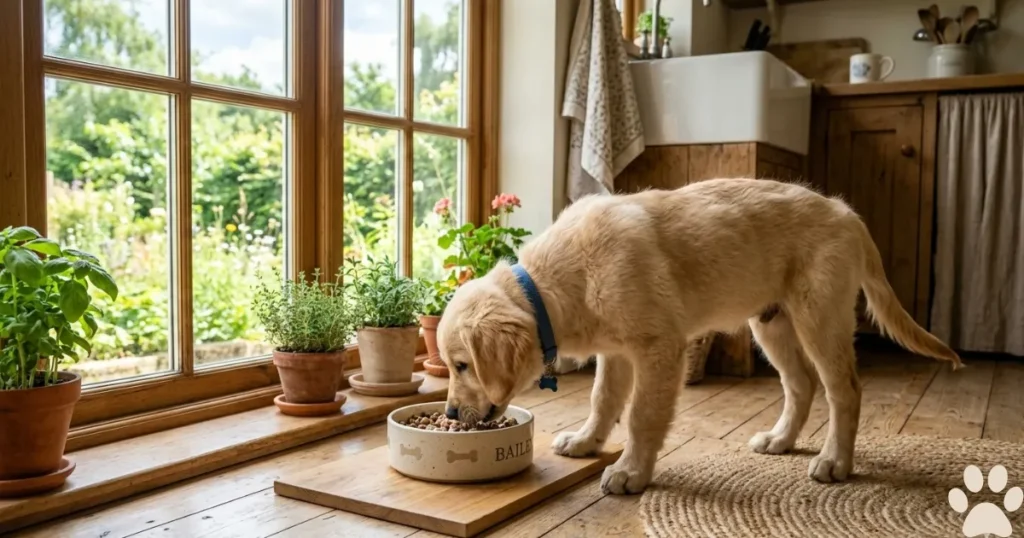
Stage 3: 6 to 12 Months – Transitioning to 2 Meals Per Day.
The puppy feeding schedule by age transitions to twice daily, somewhere between 6 and 12 months. The exact timing is individual – not every puppy is ready at 6 months, and holding at three meals until 8 or 9 months is completely appropriate if the puppy’s digestion signals it.
Transition readiness checklist:
| Indicator | Ready to Move to 2 Meals | Hold at 3 Meals |
| Morning bile vomiting | Absent | Present |
| Eating pace | Calm, steady | Gulping, rushing |
| Energy between meals | Stable | Restless, food-seeking |
| Age | 6+ months | Under 6 months |
| GI stability | Consistent firm stools | Loose stools, variable |
Transition method – 3 meals to 2 meals:
Do not drop the midday meal overnight. Instead, over 7- 10 days, progressively reduce the midday portion while increasing morning and evening meals by equal amounts. The daily total does not change – only the distribution.
Daily puppy food schedule – 6 to 12 months (2 meals):
| Meal | Time | Portion (approx.) | Notes |
| Meal 1 | 7:00 AM | 1.5–2 cups | Before morning exercise |
| Meal 2 | 6:00 PM | 1.5–2 cups | 2 hrs after afternoon exercise |
| Daily Total | 3.0–4.0 cups | Verify against current weight + kcal/cup | |
Decision checkpoint: If your puppy shows yellow-foam vomiting before the morning meal within two weeks of switching to two meals, the overnight gap is too long. Either return to three meals temporarily or add a small late-evening snack (1/4 cup) to bridge the gap without restoring a full third meal.
The Complete Puppy Feeding Schedule Reference Chart.
A consolidated reference for the full first year – all stages in one place.
| Age | Weight Range | Meals/Day | Daily Total | Per Meal | Key Transition |
| 8–12 weeks | 3–7 kg | 4 | 1.3–2.0 cups | ⅓–½ cup | |
| 3–4 months | 7–13 kg | 3 | 2.0–2.7 cups | ⅔–1 cup | Drop meal 4 gradually |
| 5–6 months | 13–21 kg | 3 | 2.6–3.4 cups | ⅞–1.1 cups | Begin 2-meal readiness check |
| 6–8 months | 17–25 kg | 2–3 | 2.9–3.7 cups | 1.0–1.9 cups | Transition to 2 meals if ready |
| 9–12 months | 23–30 kg | 2 | 3.4–4.2 cups | 1.7–2.1 cups | Maintain 2 meals through year 1 |
Based on large-breed puppy formula at | 375 kcal/cup. Recalculate every 3 – 4 weeks using actual body weight.
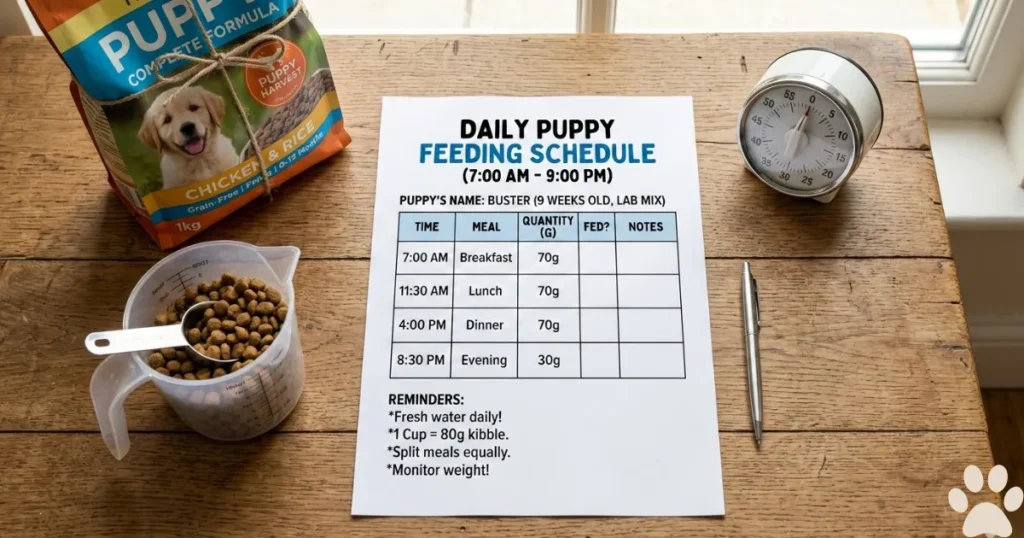
Building a Puppy Food Schedule Around Your Daily Routine.
The most nutritionally precise puppy feeding schedule fails if it isn’t sustainable for the household. These principles make the schedule work in real life:
Anchor meals to fixed household events:
- Morning meal tied to wake time – the most consistent anchor point.
- Evening meal tied to dinner or end of workday.
- Midday meal (where applicable) tied to lunch break or a designated midday check-in.
Build the exercise buffer in first:
Map walks and active play sessions before setting meal times. For Golden Retriever puppies, the rule is: no vigorous exercise within 30 minutes before a meal, and 20- 30 minutes rest after a meal before any energetic activity.
Assign feeding responsibility explicitly:
In multi-person households, double-feeding is the most common source of unintentional overfeeding. Designate a specific person for each meal on the puppy food schedule, or use a simple tracking note (a whiteboard, a shared note on a phone) to confirm meals have been given.
Match the schedule to daylight:
Puppies under 3 months generally tolerate the overnight gap better when the last meal is given as late as reasonably possible – 9:00 PM rather than 7:00 PM. This shortens the overnight fast without disrupting the morning meal timing.
Puppy Feeding Schedule and Housetraining: The Timing Connection.
One of the most underused benefits of a consistent puppy food schedule is the housetraining leverage it provides. The gastrocolic reflex – a physiological response where eating stimulates colonic movement – is reliable in puppies. It means a puppy fed on a fixed schedule will need to eliminate at predictable intervals after each meal.
Post-meal bathroom timing guide:
| Age | Typical Time to Elimination After Meal |
| 8–12 weeks | 10–20 minutes |
| 3–4 months | 15–25 minutes |
| 5–6 months | 20–30 minutes |
| 6–9 months | 20–35 minutes |
| 9–12 months | 25–40 minutes |
A puppy food schedule that keeps meal times consistent keeps these windows predictable. Owners who shift meal times by 1 – 2 hours daily lose this predictability entirely – and find housetraining far harder to manage than owners on fixed schedules.
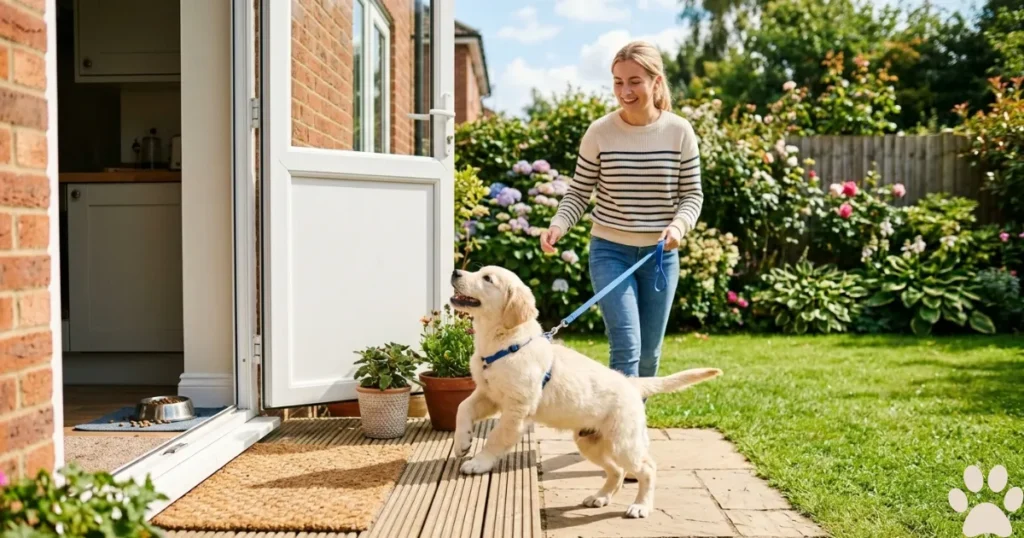
Vet’s Tip: The post-meal bathroom window is narrowest at 8- 10 weeks and widens gradually as the puppy matures. If your puppy is having accidents inside despite being taken out, check whether the trip outside is happening before or after the window – most owners wait too long, not too little.
7 Puppy Feeding Schedule Mistakes That Affect Golden Retriever Health.
1. Transitioning too early to twice daily.
Moving a 3 – 4 month puppy directly to two meals skips the GI maturation window. The result is often bile vomiting, restlessness between meals, and gulping behaviour that establishes a fast-eating habit that can persist into adulthood.
2. Keeping the 8-week schedule past 12 weeks.
Four meals past 3 months is not harmful, but it keeps portion sizes artificially small relative to a growing puppy’s caloric needs. The per-meal amounts need to increase as the schedule reduces – missing this leads to a puppy that is correctly scheduled but underfed.
3. Letting the midday meal drift on busy days.
Skipping the midday meal once or twice a week turns a three-meal puppy food schedule into a de facto two-meal schedule before the puppy is physiologically ready. Consistency is the point.
4. Feeding immediately before crating or confinement.
A puppy crated immediately after eating – before the post-meal bathroom window closes – will almost certainly eliminate in the crate. Factor 20 – 30 minutes of post-meal outdoor time before any confinement.
5. Moving meal times more than 30 minutes off schedule on weekends.
A puppy feeding schedule by age works because the digestive system anticipates timing. Weekend lie-ins that delay the morning meal by 90 minutes disrupt the enzyme rhythm built by the weekday schedule – causing morning nausea in some puppies.
6. Not adjusting meal size when reducing meal frequency.
The daily food total stays constant across schedule transitions – only the distribution changes. Owners who reduce from four to three meals without increasing per-meal portions are inadvertently reducing total daily intake.
7. Using the same puppy food schedule for 9 months without a single adjustment.
A Golden Retriever puppy at 3 months and the same puppy at 9 months have dramatically different body weights, caloric needs, and GI capacities. A puppy feeding schedule by age is a moving framework – not a permanent setup.
Vet Experiences.
A Golden Retriever puppy feeding schedule by age follows four clear stages: four meals daily from 8- 12 weeks, three meals from 3- 6 months, a gradual transition to two meals from 6- 12 months, and a consistent twice-daily adult schedule from 12 months onward.
In canine physiology, a consistent puppy food schedule primes digestive enzyme release in anticipation of mealtimes – irregular feeding disrupts this rhythm. It commonly causes GI upset, loose stools, and morning nausea in young puppies.
The gastrocolic reflex makes a structured puppy feeding schedule one of the most effective housetraining tools available – puppies fed on fixed schedules eliminate at predictable post-meal intervals that owners can reliably anticipate.
Transitioning a Golden Retriever puppy from three meals to two meals should occur gradually over 7- 10 days; an abrupt schedule change frequently causes bile vomiting before the morning meal, indicating the overnight fasting gap is longer than the puppy’s digestion is ready to handle.
A puppy food schedule that is consistent within 30-minute daily windows – including on weekends – produces more stable digestion, more predictable housetraining, and calmer mealtime behaviour than a schedule that varies by household routine.
What is the right puppy feeding schedule by age?
8 – 12 weeks: 4 meals daily. 3 – 6 months: 3 meals daily. 6 – 12 months: transition to 2 meals daily based on readiness. From 12 months onward: twice daily as the standard adult schedule. Exact timing within each stage should stay consistent within 30-minute windows.
What is a good puppy food schedule for an 8-week Golden Retriever?
Four meals at approximately 7:00 AM, 12:00 PM, 5:00 PM, and 9:00 PM – roughly every 4- 5 hours. Total daily amount: 1.3 – 2 cups of large-breed puppy formula, divided evenly across all four meals.
When should I move from 3 meals to 2 meals on the puppy feeding schedule?
Most Golden Retriever puppies are ready to transition to twice daily between 6 and 9 months. Readiness indicators include stable energy between meals, a calm eating pace, and no early morning bile vomiting. Transition gradually over 7- 10 days – not overnight.
What is the best puppy food schedule for a 3-month Golden Retriever?
Three meals daily at approximately 7:00 AM, 1:00 PM, and 6:00 PM. Total daily amount: 2.0 – 2.7 cups, divided evenly. Increase per-meal portions every 3 – 4 weeks as body weight increases.
Should my puppy eating schedule be the same every day?
Yes – consistency within 30-minute windows daily is a core function of the puppy feeding schedule. The digestive system primes itself around anticipated meal times; irregular scheduling disrupts this rhythm and commonly causes GI upset.
Can I adjust the puppy feeding schedule on weekends?
Small adjustments of 15 – 30 minutes are manageable. Shifts of 60 – 90 minutes – common when owners sleep in on weekends – are enough to disrupt the digestive rhythm and occasionally cause early morning nausea in puppies accustomed to a fixed puppy food schedule.
How does the puppy feeding schedule help with housetraining?
A fixed puppy food schedule creates predictable post-meal elimination windows through the gastrocolic reflex. Puppies fed at consistent times will reliably need to go outside 15 – 30 minutes after eating – making accidents far easier to prevent than with irregular feeding.
How long should I wait to take my puppy outside after eating?
Take a puppy outside 15 – 20 minutes after each meal at 8 – 12 weeks. This window extends to 20- 35 minutes by 6- 9 months as the gastrocolic reflex slows slightly with maturation. Do not wait longer than the window – most accidents happen when owners delay the trip outside.
What is the puppy feeding schedule by age for a 6-month Golden Retriever?
At 6 months, most puppies are transitioning toward twice daily. If still on three meals: 7:00 AM, 1:00 PM, 6:00 PM. If ready for two meals: 7:00 AM and 6:00 PM. Daily total: 2.9 – 3.4 cups depending on current weight.
Should I wake up at night to feed my puppy?
Not necessary for most Golden Retriever puppies after the first week or two at home. By 8 weeks, most puppies can handle the overnight gap on a four-meal schedule ending at 9:00 PM. Waking for night feeds beyond this window disrupts sleep training without nutritional benefit.
What if my puppy isn’t hungry at scheduled meal times?
Occasional disinterest at one meal is normal. If a Golden Retriever puppy skips two or more consecutive meals without explanation, the cause is more likely illness, dental discomfort, or a previous meal that was too large – not a problem with the puppy food schedule itself.
How do I handle the puppy feeding schedule if I work full time?
Align the morning meal with your wake time and the evening meal with your return home. For puppies under 6 months needing a midday meal, a dog sitter, neighbour, or doggy daycare midday check-in is the practical solution. Skipping the midday meal entirely for 6 months is not a recommended alternative.
Should I use an automatic feeder for my puppy’s food schedule?
Automatic feeders can support a consistent puppy food schedule for the midday meal in working households. Choose portion-controlled models and confirm the amount dispensed matches the target portion – not all auto feeders measure accurately.
What puppy feeding schedule is best for a Golden Retriever with loose stools?
Maintain the current meal frequency but temporarily reduce per-meal portions by 10 – 15%. If loose stools persist beyond 3 – 5 days despite a consistent puppy food schedule, consult a vet – the cause may be parasitic, viral, or related to food, not timing.
When does the puppy feeding schedule become the adult schedule?
At 12 months for most Golden Retrievers – when the switch to adult food also occurs. The twice-daily schedule established in the second half of puppyhood continues into adulthood. Total daily caloric needs decrease slightly as growth stops, so portions should be recalculated at the transition point.
Conclusion.
A well-designed puppy feeding schedule is one of the most practical tools available to a new Golden Retriever owner – and one of the least complicated to implement once the age-by-age framework is clear. The puppy food schedule doesn’t need to be perfect. It needs to be consistent.
Four meals at 8 weeks. Three meals for 3 months. A gradual, readiness-based transition to two meals between 6 and 12 months. That sequence, maintained within predictable daily time windows, gives a Golden Retriever puppy stable digestion, reliable housetraining cues, and calm mealtime behaviour from the start.
The puppy feeding schedule by age outlined here is a framework – not a rigid script. Individual puppies vary in their readiness for each transition, and there’s no penalty for holding at three meals a little longer if your puppy’s digestion hasn’t signaled readiness. What matters is that transitions happen gradually, that daily timing stays consistent, and that the schedule is revisited at each growth stage rather than set once and left unchanged.
If your puppy’s digestion, weight, or appetite don’t align with what the schedule predicts, a routine wellness check will give you the breed-specific, dog-specific answer you need.
What did your Golden Retriever puppy’s feeding schedule actually look like in the first year?
Did you stick to four meals longer than expected, hit the two-meal transition early, or find a midday solution that worked around your work schedule? The real-world details of how owners manage a puppy food schedule are exactly what the first-time Golden Retriever owner needs to read. Share your experience below.

Dr. Nabeel A.
Hi, I’m Dr. Nabeel Akram – a farm management professional by trade and a passionate Golden Retriever enthusiast at heart. With years of experience in animal science and livestock care, I’ve built a career around understanding animals—how they live, thrive, and bring value to our lives. This blog is a personal project born from that same passion, focusing on one of the most loyal and lovable breeds out there: the Golden Retriever. Whether I’m managing farm operations or sharing insights on canine health, behavior, and care, it all ties back to one core belief—animals deserve thoughtful, informed, and compassionate attention. Welcome to a space where professional expertise meets genuine love for dogs.
Facebook |
Links will be automatically removed from comments.