Levothyroxine sodium is used to treat hypothyroidism in dogs medication, and it’s the only FDA-approved oral thyroid hormone replacement for canine use. For a Golden Retriever, the standard starting dose is 0.02 mg/kg given twice daily, but that number alone tells only part of the story. In obese Goldens, dosing must be calculated on estimated lean body weight, not actual weight, or you’ll overdose from day one.
Golden Retrievers are among the most commonly diagnosed breeds for canine hypothyroidism, and they tend to develop it earlier than most. According to data compiled by the University Federation for Animal Welfare, lymphocytic thyroiditis, the immune-mediated destruction of the thyroid gland, is diagnosed in Goldens at a younger age than in the general dog population. The Golden Retriever Club of America reports that 69% of Goldens have elevated thyroglobulin autoantibody (TgAA) levels, significantly higher than most other breeds. This immune burden shapes how we approach both diagnosis and long-term medication management.
Why Golden Retrievers Develop Canine Hypothyroidism Earlier Than Most Breeds
Most guides describe hypothyroidism as a middle-aged dog’s disease, typically presenting between ages 4 and 10. That’s accurate for dogs generally. For Golden Retrievers, I see the pattern skew younger sometimes as early as age 3.
The reason traces to lymphocytic thyroiditis, the immune-mediated form of canine hypothyroidism that accounts for approximately 50% of cases in dogs, according to the Merck Veterinary Manual. In Goldens specifically, the predisposition is well-established. According to research cited by the Golden Retriever Club of America, the breed shows a strong association between immune system gene variants and thyroid gland vulnerability, though the exact genetic mechanism in Goldens differs from what’s been identified in Doberman Pinschers, where a specific MHC class II variant is the known driver.
Here’s what that means in practice: a 4 years old Golden presenting with lethargy and coat changes is a much more suspicious picture than the same dog at age 2. I don’t wait for a full thyroid panel to come back flagrantly abnormal before I take the owner’s concern seriously.
There’s also a diagnostic wrinkle in Goldens that most medication guides skip entirely. TgAA, thyroglobulin autoantibodies present in so many Goldens, can cross-react with T4 assays and produce a falsely elevated T4 reading. A Golden with early-stage lymphocytic thyroiditis may appear to have a normal total T4 on standard blood work, even while the thyroid gland is actively being destroyed. This is why I pair total T4 with TSH and, in younger Goldens with clinical signs, always request TgAA as part of the initial panel. Missing that early-stage window delays medication by months. According to MSU Veterinary Diagnostic Laboratory data, TgAA can become detectable up to two years before overt clinical hypothyroidism appears, earlier than any other currently available marker.
In my practice, Goldens present with this diagnostic challenge more than any other retriever breed. I once had a 4.5 years old male Golden referred to me after two rounds of “normal” thyroid panels at another clinic. His T4 was borderline low but technically within range. His TgAA came back strongly positive. Six months later, his T4 had dropped well below range, and he was unequivocally hypothyroid. Starting the TgAA conversation earlier would have prepared that owner and may have enabled an earlier treatment start.
What Hypothyroidism in Dogs Medication Actually Does and Why the Dose Is Not One Size Fits All
Levothyroxine sodium replaces the thyroxine (T4) that a hypothyroid dog’s thyroid gland can no longer produce in sufficient quantity. In peripheral tissues, the liver and kidneys convert that supplemental T4 into the metabolically active triiodothyronine (T3), so the oral pill essentially restores the entire thyroid axis from a single compound.
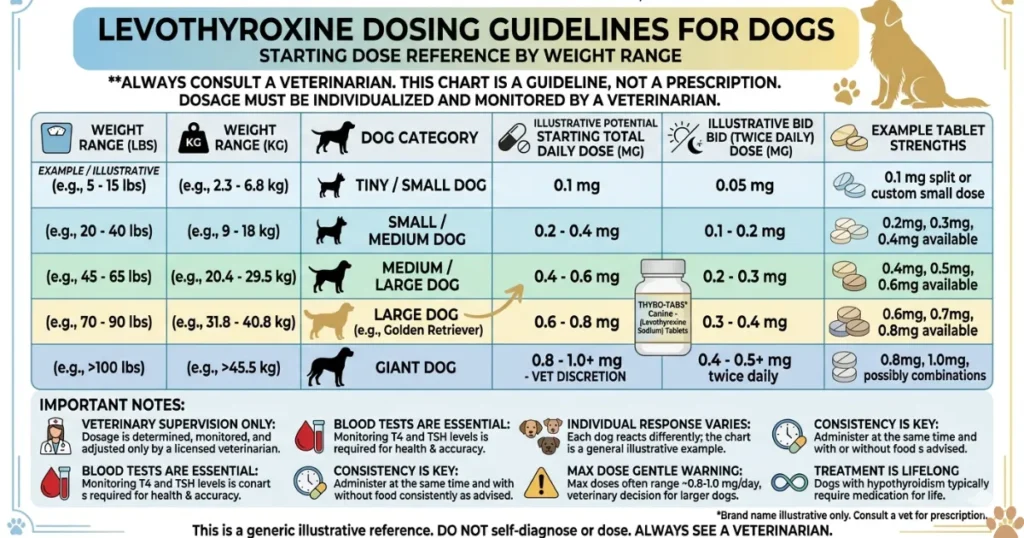
The standard starting dose is 0.02 mg/kg twice daily, per AAHA’s 2023 Selected Endocrinopathies Guidelines. That converts to approximately 0.10 mg per 10 lbs of body weight. For a typical 65-lb adult Golden Retriever, that’s roughly 0.29-0.30 mg twice daily as a starting point.
Two critical adjustments apply to Goldens specifically:
Lean body weight in obese dogs.
Many Goldens presenting with hypothyroidism are already significantly overweight; weight gain is one of the disease’s most reliable early signs. AAHA’s guidelines explicitly state that obese patients must have dose calculations based on estimated lean body weight. Dosing by actual weight in a 78-lb Golden who should weigh 62 lbs means giving 26% more medication than intended from the first pill. I’ve seen this produce signs of thyrotoxicosis, restlessness, panting, and excessive thirst within three weeks of starting treatment, leading owners to believe the medication itself is the problem.
Concurrent cardiac conditions.
Goldens carry a meaningful risk of dilated cardiomyopathy. In a golden with confirmed or suspected cardiac disease, the AAHA guidelines recommend starting at 25-50% of the routine dose and increasing gradually. Levothyroxine raises myocardial oxygen demand; in a compromised heart, standard starting doses can precipitate cardiac decompensation. I always get a cardiology consult or, at a minimum, a thorough cardiac auscultation before starting full-dose levothyroxine in any Golden over 7 years old.
FDA-approved products include Thyro-Tabs Canine (levothyroxine sodium tablets) and ThyroKare (levothyroxine sodium tablets). Both are available by veterinary prescription only. Human-grade levothyroxine (Synthroid) is not recommended; the formulation isn’t bioequivalent in dogs, and absorption differs enough to make consistent dosing unreliable. Visit our website for general dog health blogs by a vet.
Hypothyroidism in Dogs Medication by Age: Puppies, Adult Goldens, and Seniors
Golden Retriever Puppies and Young Dogs (Under 2 Years).
Congenital hypothyroidism in Golden Retriever puppies is rare. What I do see occasionally is a young Golden, under 2 years, referred with suspected early thyroiditis identified through TgAA screening. Overt hypothyroidism requiring levothyroxine at this age is uncommon, but it happens.
If a puppy under 12 months is started on levothyroxine, dosing requires more frequent rechecks than in adults, every 4 weeks initially rather than every 4-8 weeks, because growing dogs metabolize thyroid hormone differently as their body composition changes. I‘d also note that reproductive considerations matter: levothyroxine has not been evaluated in pregnant or nursing females, and caution is warranted in intact bitches of breeding age.
Adult Golden Retrievers (2-7 Years).
This is the primary window in which I diagnose and start treatment. For a 60-70 lb adult Golden, the core of the breed’s healthy weight range, the starting dose of 0.02 mg/kg twice daily translates to 0.27-0.32 mg BID. The first recheck bloodwork happens at 4-6 weeks, timed specifically to the post-pill window (more on that below).
Most adult Goldens respond well and stabilize within 2-3 months. In this age group, I expect energy and appetite to improve within 2 weeks. Coat improvement takes longer, 2-3 months is typical, and some chronic skin infections require 4 months to fully resolve alongside appropriate antimicrobial treatment.
Senior Golden Retrievers (8 Years and Older).
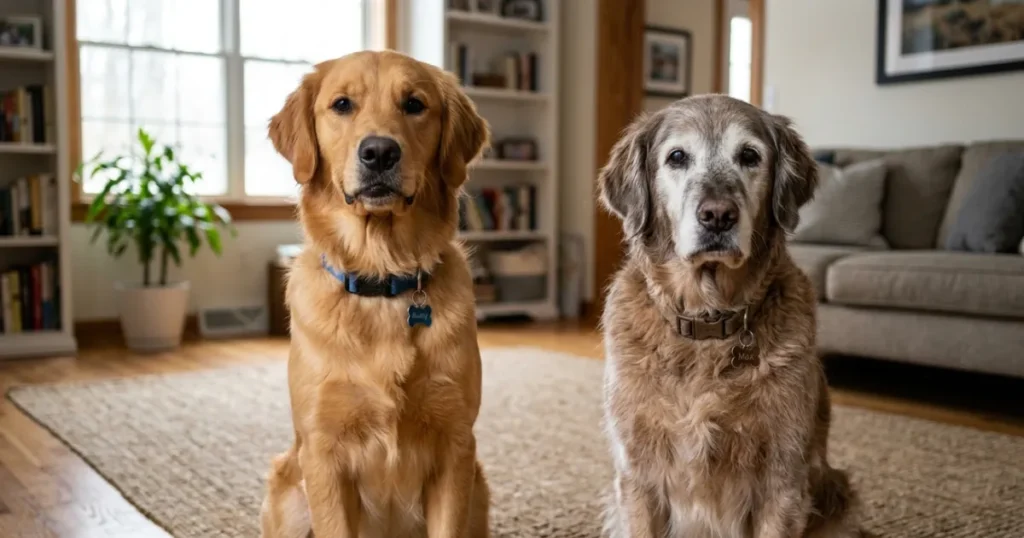
Senior Goldens get the most cautious start. In addition to the cardiac concern above, older dogs also absorb levothyroxine less consistently, and concurrent diseases, such as arthritis, chronic kidney disease, and dental disease, can affect baseline T4 through what’s called the non-thyroidal illness (NTI) effect. An old golden’s “low T4” may be partly real hypothyroidism and partly NTI suppression. I start at 0.01 mg/kg twice daily in senior Goldens and titrate up based on the 4-week post-pill panel, rather than jumping to the full calculated dose.
The GRI Thyroid Timing Protocol: Dosing, Food, and Blood Draw Sequence.
This is where most owners and, honestly, some referring clinicians, get tripped up. Getting the blood draw timing wrong produces a misleading result that either underdoses a dog who needs more medication or panics an owner with a falsely high reading.
The GRI Thyroid Timing Protocol works as follows:
Step 1—Administer medication consistently.
Give levothyroxine at the same time each day, ideally on an empty stomach (30 minutes before food). Absorption drops when given with food, particularly high-fiber meals. If your schedule requires giving it with food, always give it with food; consistency matters more than the ideal. Critically: if you give it with food at home, blood must also be drawn after a fed administration. Comparing a fed-state dose to a fasted-state draw invalidates the result.
Step 2—Draw blood 4-6 hours post-pill.
Per AAHA guidelines, the monitoring blood draw for total T4 should happen 4-6 hours after the morning pill, not while fasting, and not first thing in the morning before the dose. This captures the peak serum concentration. The target is a post-pill total T4 in the upper half or just slightly above the laboratory’s reference range. A result pulled first thing in the morning before the pill, a common scheduling mistake, gives a pre-pill trough value that looks like the dose isn’t working even when it is.
Step 3—Interpret TSH alongside T4.
An elevated TSH at recheck means the dose is still too low. A suppressed TSH with a very high T4 means the dose is too high; reduce it by 25% and recheck in 4-6 weeks. A normal TSH with post-pill T4 in range = euthyroid. That’s the goal.
Step 4—Once stable, move to twice-yearly monitoring.
After an effective dose is confirmed, AAHA recommends T4 checks every 6-12 months. Don’t skip these. Required levothyroxine levels change over time as a dog’s lean body mass, concurrent diseases, and absorption patterns shift. A Golden who was well-controlled at 62 lbs may need a dose adjustment after reaching ideal weight loss.
The most common owner error I see is administering the pill, then rushing to the vet first thing that morning, before the 4-hour window has passed. I explain this to every new hypothyroid Golden owner at the diagnosis appointment; it saves a wasted blood draw and an unnecessary dose adjustment.
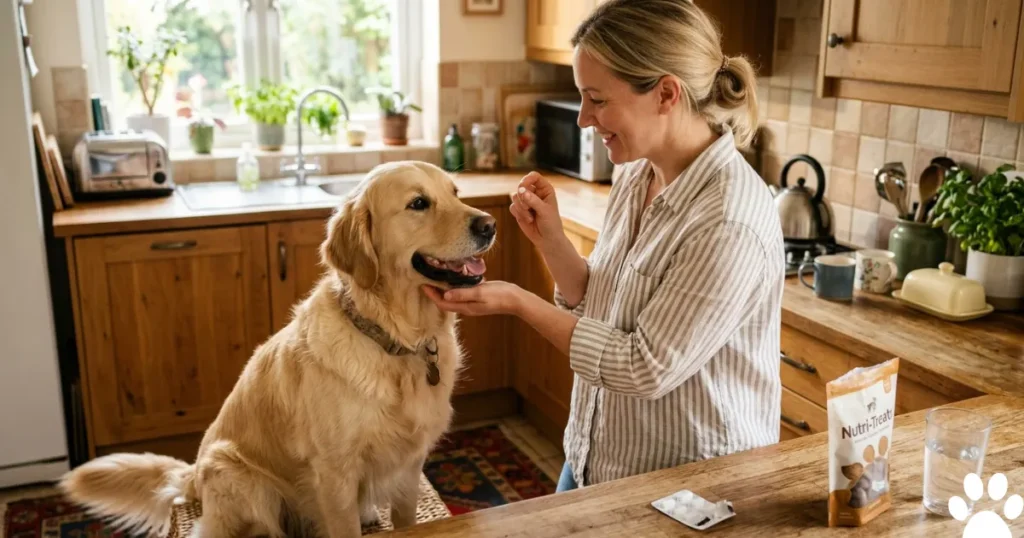
What Most Hypothyroidism Medication Guides Get Wrong About Golden Retrievers.
The gap
Every top-ranking guide states that hypothyroidism medication has “no known side effects at the correct dose.” That’s technically true but dangerously incomplete for Golden Retriever owners.
What those guides don’t say: Goldens’ weight gain from hypothyroidism means a significant proportion are already obese at diagnosis. Dosing by actual rather than lean body weight is one of the most consistent errors I see in initial prescriptions referred from non-specialist practices. And because Goldens are stoic and accommodating by nature, mild thyrotoxicosis, restlessness, mild panting, and increased urination can go unreported for weeks before an owner connects it to the medication.
The correction
The AAHA 2023 guidelines are explicit that obese patients require lean body weight dosing. For a Golden who should weigh 62 lbs but currently weighs 78 lbs, the correct dosing base is 62 lbs (28 kg), giving a starting dose of approximately 0.56 mg/day divided BID, not 0.78 mg/day based on actual weight.
A second gap
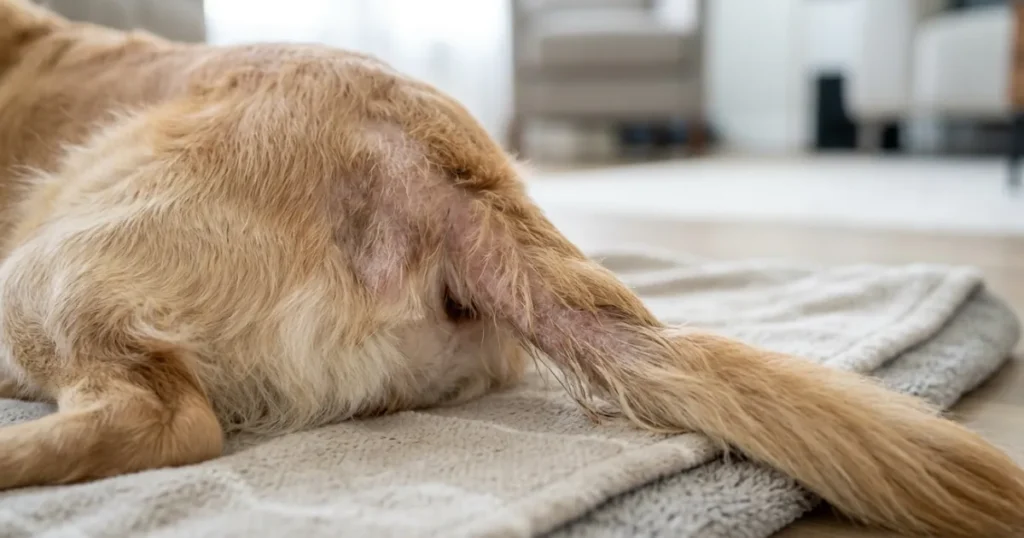
Most guides say to expect improvement “within a few weeks.” For Goldens with chronic skin changes, secondary pyoderma, or the classic “rat tail” pattern of alopecia seen in hypothyroid large-breed dogs, dermatological improvement takes 3-4 months at a minimum. Owners who expect a full coat recovery in 3 weeks call, worried that the medication isn’t working. Setting that expectation at the outset prevents those calls and prevents premature dose escalation.
In March 2025, a 6 years old spayed female golden presented with three months of progressive alopecia along the tail and flank and a 9-lb weight gain over 8 months. The owner had already tried two shampoo protocols from a groomer. Total T4 was low, and TSH was elevated. I started her at 0.30 mg BID, calculated on her estimated lean weight of 62 lbs (she weighed 71 lbs at presentation). At the 6-week recheck, T4 was in range, and TSH had normalized. Her coat began showing regrowth at week 10. Full recovery: 4.5 months. The owner said no one had told her it would take that long. I wish they had.
When to Call the Vet: Urgent vs. Monitor Table for Hypothyroidism Medication in Golden Retrievers.
| CALL VET TODAY (URGENT) | MONITOR AT HOME 24–48 HRS |
| Rapid heart rate or irregular heartbeat after starting levothyroxine | Mild increase in thirst in the first 2 weeks of treatment |
| Seizures or muscle tremors (signs of large overdose per PetMD/Thyro-Tabs prescribing info) | Mild restlessness or energy increase—often normal as metabolism normalizes |
| Vomiting or diarrhea beginning within 48 hours of a dose change | Slight decrease in appetite in week 1 — common adjustment effect |
| Signs of Addisonian crisis in any Golden on levothyroxine whose Addison’s disease is not yet stabilized | Coat shedding that temporarily increases in the first 4 weeks |
| No energy improvement at all after 4 weeks, combined with continued weight gain | Increased hunger in weeks 1–3 as metabolism restores |
| Suspected missed doses for 3+ days with return of severe lethargy | Single missed dose—give next scheduled dose normally; don’t double up |
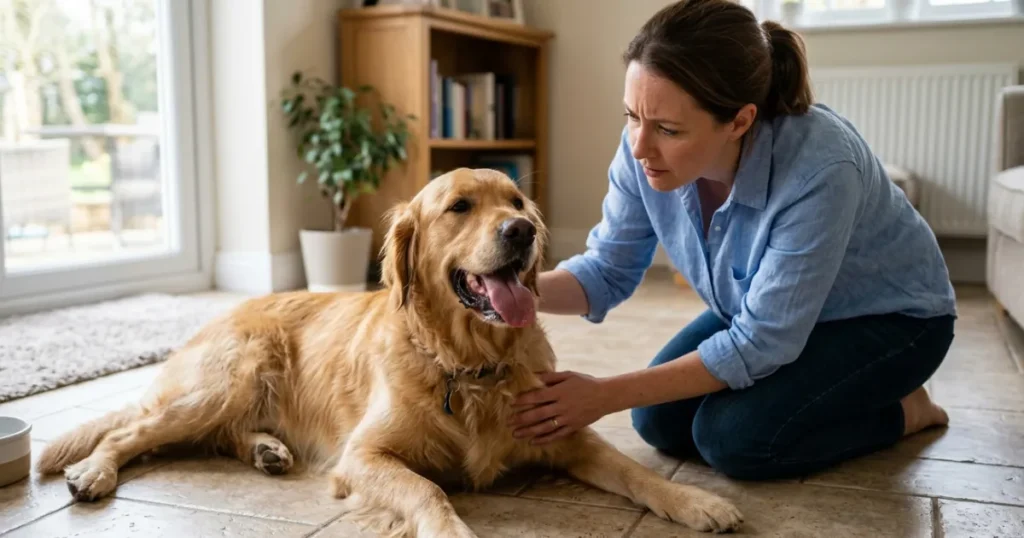
Expert Insight Callout.
The question I get most often from Golden owners after the first recheck is: ‘The T4 looks fine, but she’s still not herself.’ My first question back is always, “What time was that blood drawn relative to the morning pill?” In my practice, roughly one in three initial rechecks is timed incorrectly, drawn before the 4-hour post-pill window. The result looks fine on paper, but it understates peak T4. Re-drawing at the correct window has changed dose decisions more times than I can count.”
Medical Review
Non-urgent: This article addresses ongoing management of a diagnosed condition. If your Golden is newly showing lethargy, unexplained weight gain, or coat changes, schedule a veterinary appointment within 1-2 weeks. For signs of possible overdose, excessive panting, restlessness, or rapid heart rate after starting medication, call your vet the same day.
What medication treats hypothyroidism in dogs?
Levothyroxine sodium is the medication used for hypothyroidism in dogs. It’s the only FDA-approved oral thyroid hormone replacement for canine hypothyroidism, available under brand names Thyro-Tabs Canine and ThyroKare, by veterinary prescription only.
How does hypothyroidism medication in dogs work?
Levothyroxine replaces deficient thyroxine (T4). Peripheral tissues, primarily the liver and kidneys, convert this supplemental T4 into the active hormone T3, restoring metabolic function. Clinical improvement in energy and appetite typically begins within 2 weeks of starting the correct dose.
What is the correct levothyroxine dose for dogs?
The standard starting dose is 0.02 mg/kg twice daily, per AAHA guidelines. For a 65-lb Golden Retriever, that’s approximately 0.30 mg BID. In obese dogs, dosing uses estimated lean body weight, not actual weight, to avoid overdosing from day one.
What are the FDA-approved canine hypothyroidism medications?
Thyro-Tabs Canine and ThyroKare are the two FDA-approved levothyroxine products for dogs. Both require a veterinary prescription. Human-grade levothyroxine (Synthroid) uses a different formulation and is not recommended for dogs due to inconsistent bioavailability.
How often should I monitor my dog’s thyroid levels on medication?
Every 4-6 weeks initially until the dose is stable, then every 6-12 months lifelong. Blood must be drawn 4-6 hours after the morning dose to capture peak T4. Pre-dose draws produce falsely low results that can trigger unnecessary dose increases.
What are the side effects of hypothyroid medication in dogs?
At the correct dose, side effects are rare. Overdose causes thyrotoxicosis: increased thirst, urination, panting, restlessness, rapid heart rate, and weight loss. Large overdoses can cause agitation or seizures. Pruritus (itching) and mild hypersensitivity skin reactions are occasionally reported, per AKC veterinary sources.
Can a dog live a normal life on thyroid medication?
Yes. Most dogs achieve complete resolution of clinical signs with lifelong levothyroxine. Energy, weight, coat condition, and cognitive alertness all normalize once an effective dose is established. The medication requires daily administration and twice-yearly bloodwork, but the prognosis is excellent.
How long until thyroid medication works in dogs?
Energy and appetite improve within 2 weeks in most dogs. Coat regrowth begins around 6-10 weeks. Full resolution of dermatological signs, alopecia, skin infections, and coat texture takes 3-4 months. Owners who expect complete recovery in 3 weeks often assume the dose is wrong. It isn’t.
Can I give my dog levothyroxine with food?
You can, but absorption decreases with food, particularly high-fiber meals. AAHA recommends an empty stomach, ideally. More importantly, be consistent. If you give it with food, the monitoring blood draw must also be done after a fed-dose administration. Mixing fed and fasted administration between visits produces unreliable T4 readings.
What happens if a dog misses a thyroid medication dose?
Give the next scheduled dose at its normal time. Don’t double up. A single missed dose won’t cause a clinical crisis. Missed doses across multiple days can allow TSH to rise and symptoms to creep back; lethargy and appetite changes return first, usually within 3-5 days of consistent non-compliance.
Do Golden Retrievers develop hypothyroidism earlier than other breeds?
Yes. According to the University Federation for Animal Welfare, Golden Retrievers are diagnosed with lymphocytic thyroiditis at a younger age than most breeds. This is linked to the breed’s elevated TgAA prevalence; 69% of Goldens have elevated thyroglobulin autoantibody levels, per published breed-specific data, reflecting strong immune-mediated thyroid vulnerability.
What does the Golden Retriever Lifetime Study say about thyroid disease?
The Morris Animal Foundation’s Golden Retriever Lifetime Study is actively tracking thyroid disease incidence alongside cancer, joint disease, and other conditions in the breed. Published findings continue to reinforce that Goldens have higher rates of immune-mediated conditions, including lymphocytic thyroiditis, than most large-breed dogs of equivalent age.
How does hypothyroidism medication affect a Golden Retriever with heart disease?
Levothyroxine increases myocardial oxygen demand. In Goldens with dilated cardiomyopathy or confirmed cardiac disease, AAHA guidelines recommend starting at 25-50% of the standard dose and increasing gradually. A Golden with concurrent hypothyroidism and cardiac disease should have both conditions evaluated before levothyroxine is initiated at full dose.
Why does my Golden Retriever’s coat look worse before it improves on levothyroxine?
Increased shedding in the first 4 weeks is a normal part of coat turnover reactivation as metabolism normalizes. Follicles that had stalled in the telogen (resting) phase shed their existing hairs before new growth begins. It looks worse temporarily. If shedding is extreme or accompanied by skin redness, call your vet; secondary pyoderma may need separate treatment.
My Golden Retriever seems more anxious and is panting a lot after starting thyroid medication. What should I do?
Call your veterinarian today. Restlessness and panting following a dose change are signs of possible thyrotoxicosis, too much thyroid hormone. This requires a same-day blood draw to check T4 levels. Don’t administer the next dose until you’ve spoken to your vet.
Conclusion.
Levothyroxine sodium is the treatment for canine hypothyroidism in dogs; it is lifelong, well-tolerated, and effective when dosed correctly. For Golden Retrievers, that means calculating the starting dose on lean body weight, timing monitoring bloodwork 4-6 hours post-pill, and expecting coat recovery to take 3-4 months rather than weeks.
If your Golden has been diagnosed recently, bring this information to your next recheck and confirm when in the day the blood draw is scheduled. That single detail changes more treatment decisions than any other factor in long-term hypothyroidism in dogs medication management.
Have you started your Golden on thyroid medication? Tell us: how many weeks did it take before you noticed a real change in their energy, and was the coat the last thing to come back, or did something else improve more slowly? Real owner observations help other Golden families know what to expect.